AI泡沫

Search documents
AI的庞氏骗局?
傅里叶的猫· 2025-11-21 10:52
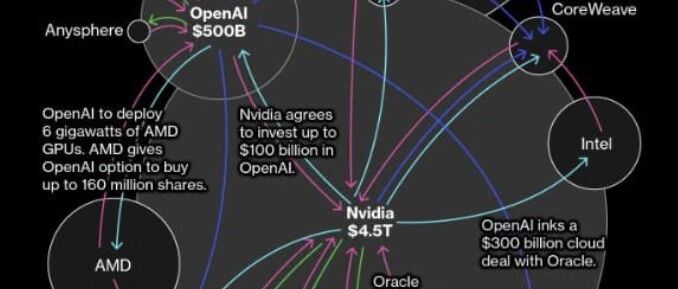
Core Insights - The article presents a bearish narrative on Nvidia, suggesting it exhibits signs of a Ponzi scheme due to alarming financial anomalies and unsustainable business practices [1][9]. Receivables Anomaly - Nvidia's accounts receivable surged by 89% to $33.4 billion, with Days Sales Outstanding (DSO) increasing from 46 to 53 days, indicating potential collection difficulties [2][3]. - The implication is that $10.4 billion may never be collected, a classic sign of financial distress [2]. Inventory Paradox - Inventory rose by 32% to $19.8 billion within three months, contradicting claims of high demand and sold-out capacity [2]. - The price of H100 rental dropped by 34% from $3.20 to $2.12 per hour, challenging the narrative of endless demand [2]. Cash Flow Signal - Nvidia's free cash flow conversion rate is only 75%, with a $4.8 billion gap between profits and actual cash flow, significantly lower than competitors like TSMC and AMD [3]. - This discrepancy suggests a façade of profitability while cash inflow remains weak [3]. Circular Financing Structure - The article details a complex flow of funds among Nvidia, Microsoft, OpenAI, and others, indicating a cycle where revenue is counted multiple times, creating an illusion of growth [3]. - CoreWeave alone owes Nvidia $5.9 billion, representing 18% of total receivables, contributing to a false sense of prosperity [3]. "Vibe Revenue" Admission - Executives from various AI companies reportedly acknowledge that current AI revenues are largely based on hype rather than actual product sales [6]. - OpenAI's projected revenue of $3.7 billion in 2025 against expenditures of $9.3 billion highlights a significant financial imbalance [6]. Historical Precedent - The article draws parallels between the current AI bubble and past financial frauds, such as the 2000 internet bubble and the Enron scandal, suggesting a similar trajectory for Nvidia [6]. Margin Compression Evidence - Despite Nvidia's reported gross margin of over 70%, the true margin is declining when accounting for one-time credits and increased competition [7]. - Future margins are expected to drop below 50%, undermining the company's valuation model [7]. Smart Money Exit - Notable investors, including Peter Thiel and SoftBank's Masayoshi Son, have recently sold significant Nvidia shares, indicating a lack of confidence in the stock [7]. - Major hedge funds have also established short positions following the earnings report [7]. Contagion Mechanism - The article warns that a decline in Nvidia's stock could trigger forced liquidations of Bitcoin collateralized loans, potentially leading to a significant drop in Bitcoin prices [7]. Regulatory Response - Anticipation of regulatory scrutiny from the SEC and Federal Reserve regarding circular financing and related transactions, which could result in mandatory restatements and penalties [8]. Conclusion - The article concludes that the current situation represents a significant financial bubble, with predictions of a market correction occurring between February and April 2026 [8].


黄仁勋:市场未充分认识到英伟达的优秀
财联社· 2025-11-21 10:50
Core Viewpoint - The article discusses the recent volatility in the stock market, particularly focusing on Nvidia's disappointing stock performance despite a strong earnings report, highlighting the challenges faced by the company in meeting market expectations [3][5]. Group 1: Nvidia's Market Performance - Nvidia's stock initially rose nearly 5% after its earnings report but ultimately closed down 3.15%, indicating a significant market reaction [5]. - The CEO of Nvidia, Jensen Huang, expressed frustration during an all-hands meeting, stating that the market's expectations for Nvidia are excessively high, creating a "no-win" situation for the company [5][8]. - Huang emphasized the immense pressure on Nvidia, suggesting that even a slightly disappointing earnings report could lead to catastrophic consequences for the market perception of AI [7][8]. Group 2: Impact on the AI Industry - Huang commented on the perception of an "AI bubble," indicating that a poor performance would serve as evidence of such a bubble, while a strong performance would be seen as fueling it [7]. - The article notes that Nvidia's significant influence on the global market makes it increasingly difficult to meet external expectations, which adds to the pressure on the company [8]. - The recent market fluctuations resulted in Nvidia losing $500 billion in market value within a week, a historical occurrence that underscores the company's substantial market presence [9].

黑色星期五,怎么看?
3 6 Ke· 2025-11-21 10:46
Core Insights - The U.S. stock market experienced a significant drop, influenced by Nvidia's strong earnings report and unexpected non-farm payroll data, raising concerns about an AI bubble and interest rate cuts [1][2][19] - Major indices, including the Nasdaq, saw substantial declines, with the Nasdaq dropping 4.7%, marking its largest single-day decline since April [2][19] - The market's reaction indicates a growing skepticism regarding the sustainability of AI demand and high valuations in the tech sector [6][17] Nvidia's Performance - Nvidia reported third-quarter revenue of $57 billion, a 62% year-over-year increase, and a net profit of $31.9 billion, up 65% year-over-year, exceeding market expectations [4][6] - The company's data center revenue reached $51.2 billion, reflecting a 66% year-over-year growth, and provided a strong fourth-quarter guidance [4][6] - Despite Nvidia's positive outlook, investor concerns about high valuations in the tech sector persist, with warnings from notable investors about the limitations of actual demand [6][17] Employment Data Impact - The U.S. non-farm payroll report showed an increase of 119,000 jobs in September, the strongest monthly gain since April, but the unemployment rate rose to 4.4%, the highest since 2021 [8][9][10] - The employment data has complicated the outlook for Federal Reserve interest rate cuts, with a 60.4% probability of maintaining rates in December and a 39.6% chance of a 25 basis point cut [10][17] - The mixed signals from the labor market have contributed to market volatility and uncertainty regarding future monetary policy [10][17] Market Dynamics - A tightening of liquidity and high valuations have led to increased selling pressure in the market, with significant outflows from long-term funds and a shift in hedge fund positions from net buying to net selling [14][15] - The trading volume of ETFs has surged to 41% of total market volume, indicating a shift towards passive and macro-driven funds, which has exacerbated downward momentum [15] - Goldman Sachs identified nine negative factors contributing to the recent sell-off, including concerns over Nvidia's peak performance and broader market liquidity issues [14][15] AI Market Concerns - The AI sector is facing scrutiny over its long-term profitability, with concerns that rising capital expenditures may not be sustainable [17][18] - The financing model within the AI ecosystem is becoming increasingly fragile, raising fears of a potential "Ponzi scheme" scenario if demand does not materialize [18] - Despite the presence of a bubble, individual companies may still hold investment value, as fundamentals can diverge from overall market sentiment [18][19]
英伟达内部会,黄仁勋坦言:太难了,做得好是AI泡沫,一点点不及预期,整个世界就会崩溃
华尔街见闻· 2025-11-21 10:42
全球市场陷入"AI泡沫"争论之际,即便是最成功的英伟达,也正面临着前所未有的审视压力。作为AI基础设施的核心供应商,英伟达的一举一动都被视为整个 行业健康状况的晴雨表。 据Business Insider周五报道,英伟达首席执行官黄仁勋在周四的内部会议上坦言, 尽管公司交出了"令人难以置信的"成绩单,但"市场并不领情"。 这位芯片巨头掌门人罕见地承认,英伟达如今面临一个无解困境:业绩出色会被指控助推AI泡沫,业绩不佳则被视为泡沫破裂的证据。 黄仁勋在会上表示, 市场对英伟达的预期已经高到令公司陷入某种"无赢局面"。 他直言: "如果我们交出糟糕的季报,哪怕只是差一点点,看起来有一点点不 稳,整个世界就会崩溃。" 黄仁勋在会上开玩笑提到 公司市值曾达5万亿美元的"美好旧时光"。 "历史上没人在几周内损失5000亿美元,"他说,"你得值很多钱才能在几周内损失5000亿 美元。" 这一市值波动反映出投资者对AI投资热潮的信心正在动摇,即便面对强劲的业绩数据,市场仍对持续性存在疑虑。 金融圈"明星"日历,投资快人一步 陷入"无赢困境" 据Business Insider获得的会议录音,黄仁勋在周四的内部会议上详细阐述 ...
左手倒右手,“6100亿美元的AI庞氏骗局崩盘”
Guan Cha Zhe Wang· 2025-11-21 10:22
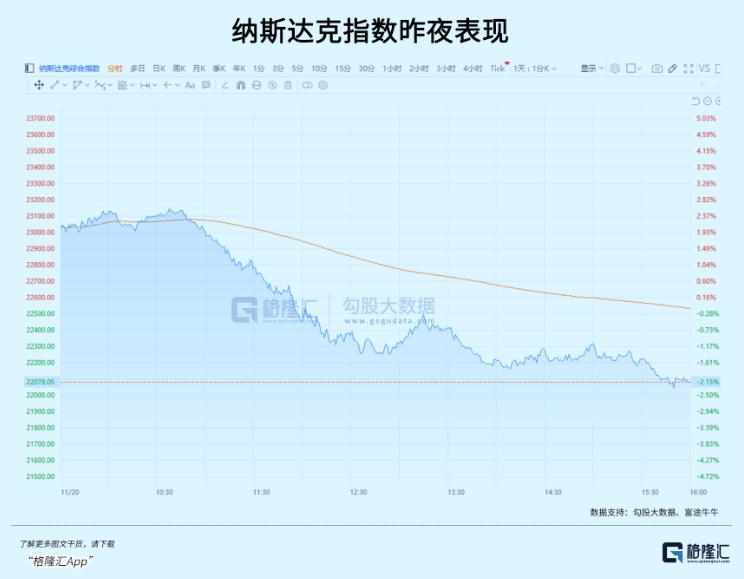
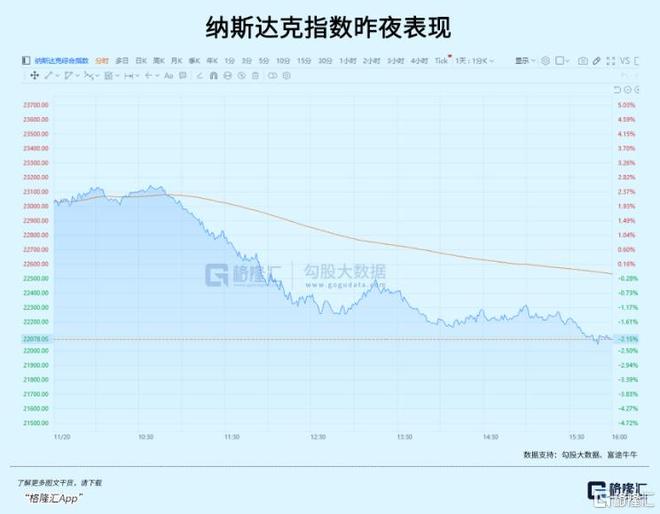
当地时间11月20日,AI芯片龙头美企英伟达发布了三季度财报,单季实现营收570.06亿美元,较去年同期增长62%;净利润319.1亿美元,同比增长65%,增 速创年内季度新高。 其中,备受瞩目的数据中心业务第三季度收入创下512亿美元的纪录,同比增长66%。 超出预期的增长表现、旺盛的需求,似乎看起来都让人感到"惊喜",但华尔街投资者们的回应却截然相反。昨天,财报发布后,英伟达美股一度上涨超过 5%,但随后持续走低,最终收跌3.15%,报180.64美元/股。受英伟达为首的科技股拖累,美股整体市场也同步走低,纳斯达克综合指数下跌了2.15%。 英伟达预计,四季度营收约为650亿美元,超出分析师预期的616.6亿美元。毛利率预计为74.8%,按照非公认会计准则计算为75%。该公司CEO黄仁勋还宣 称,在2025年和2026年获得了价值5000亿美元的人工智能芯片订单。 彭博社、华尔街日报等媒体均认为,这一行情主要受到针对AI投资的可持续性的担忧以及美联储是否会在12月降息的不确定性拖累。近几周以来,与各大 科技巨头CEO们"高歌猛进"的表态与动辄百亿美元的投资计划相反,投资者们对潜在的"AI泡沫"的忧虑却日益 ...

跌麻了,鬼扯的英伟达小作文
佩妮Penny的世界· 2025-11-21 10:14
Market Overview - Recent market volatility has been significant, with major declines in both U.S. stocks and cryptocurrencies, notably Bitcoin dropping from 120,000 to 85,000 in just over a month [1] - The A-share market has also experienced declines, with a notable drop from 4000 to 200 [1] Reasons for Market Decline - The market downturn can be analyzed through three main lenses: fundamentals, liquidity, and sentiment [5] - Discrepancies in the recently released non-farm payroll data have raised concerns about inflation, leading to a hawkish stance from the Federal Reserve and diminishing expectations for a rate cut in December [5] - The ongoing debate about an "AI bubble" has been fueled by Nvidia's recent earnings report, which has led to skepticism regarding the sustainability of AI-related growth [5][6] Nvidia's Financial Performance - Nvidia reported a significant revenue increase of 62%, with a projected future revenue of 350 billion over the next 14 months, supported by contracts with major clients like Saudi Arabia [7] - The company's cash flow for the third quarter was reported at 64 billion, with a net profit of 73 billion, indicating a cash flow conversion rate of 88%, which is considered healthy [6] - Despite strong financials, market reactions can be unpredictable, often moving contrary to positive earnings reports [9] AI Industry Outlook - Nvidia's CEO believes there is no bubble in the AI sector, citing ongoing paradigm shifts in the information industry that will drive infrastructure investments [12] - Reports suggest that AI-related stocks could contribute 70-80% of the S&P's gains by 2025, indicating a strong market sentiment towards AI despite concerns about overvaluation [12] Fund Strategy Adjustments - Many overseas funds have been adjusting their strategies since Q2, reducing exposure to tech growth stocks and reallocating to value sectors or broad market indices [13] - There is a trend of reallocating investments towards emerging markets, including Europe and Japan, as U.S. markets face volatility [13] Investor Sentiment - The recent market corrections have led to a sense of discomfort among investors, particularly those who may have celebrated earlier gains [15] - Maintaining a long-term investment perspective and confidence in holdings is emphasized as a strategy to navigate market fluctuations [15]

短期市场震荡 专家:沪指3850点附近或成重要支撑位
Sou Hu Cai Jing· 2025-11-21 10:14
Market Overview - A-shares experienced a significant decline with over 5000 stocks falling, leading to a drop in major indices: Shanghai Composite Index down 2.45% to 3834.89 points, Shenzhen Component Index down 3.41%, ChiNext Index down 4.02%, and Beixin 50 down 4.71% [1] - The total trading volume for A-shares was 1.98 trillion yuan, an increase from 1.72 trillion yuan the previous day [1] Weekly Performance - For the week, the Shanghai Composite Index fell 3.9%, Shenzhen Component Index dropped 5.13%, and ChiNext Index decreased by 6.15% [2] External Influences - The decline in A-shares was attributed to external shocks, particularly a significant drop in the US stock market, with the Nasdaq Index falling 2.15%, leading to a global sell-off of risk assets [2] - There is a noted shift of funds from high-valuation sectors to safer assets within the A-share market [2] Market Sentiment and Future Outlook - Analysts suggest that the market may continue to experience a downward trend in the short term, with the Shanghai Composite Index finding support around 3850 points [2] - There is a call for increased confidence in market valuations and a promotion of value investment principles [2] - Recommendations for investors include focusing on policy-driven sectors and well-adjusted growth stocks [2] Economic Indicators and Policy Considerations - Future market focus may shift towards the manufacturing PMI for November and the Federal Reserve's December meeting [2] - If the PMI remains weak, attention may turn to policy-driven defensive sectors; conversely, a drop in US core PCE inflation could raise expectations for Federal Reserve rate cuts [2] Global Market Conditions - The current global market is characterized by heightened risk aversion and tightening liquidity, influenced by various factors including the Epstein case, rising inflation concerns, and uncertain economic outlook [3] - Investors are advised to be cautious with dollar assets and to monitor policy signals leading up to the Federal Reserve's December meeting [3]
黑色星期五!怎么看?
Ge Long Hui· 2025-11-21 09:45
Core Insights - The U.S. stock market experienced a significant downturn, influenced by Nvidia's strong earnings report and unexpected non-farm payroll data, raising concerns about an AI bubble and interest rate cuts [1][2][4][6] Market Reaction - Major U.S. indices, including the Nasdaq, saw a sharp decline, with the Nasdaq dropping 4.7%, marking its largest intraday drop since April [2] - The VIX index, which measures expected stock market volatility, rose above 26 for the first time since April, indicating increased market anxiety [2] Nvidia's Performance - Nvidia reported third-quarter revenue of $57 billion, a 62% year-over-year increase, and a net profit of $31.9 billion, up 65% year-over-year, exceeding market expectations [4] - The company projected strong sales for its Blackwell and Rubin product lines, estimating $500 billion in overseas sales over the next six fiscal quarters [5] Employment Data Impact - The U.S. non-farm payrolls increased by 119,000 in September, the strongest monthly gain since April, while the unemployment rate rose to 4.4%, the highest since 2021 [6] - The employment data has led to a cooling of interest rate cut expectations, with a 60.4% probability that the Federal Reserve will maintain rates in December [6] Market Liquidity and Trading Dynamics - Market liquidity has decreased, with average liquidity in the S&P 500 trading dropping to $6 million, indicating a thin trading environment that can lead to significant price volatility [10] - The proportion of ETF trading volume surged to 41%, significantly above the year-to-date average of 28%, suggesting that passive and macro-driven funds are dominating market movements [10] AI Sector Concerns - There are growing doubts about the sustainability of AI demand and the high valuations of tech stocks, with concerns that the AI ecosystem may be experiencing a bubble [12][13] - The reliance on debt financing for capital expenditures among major tech companies raises questions about the long-term viability of AI investments [12][13] Overall Market Sentiment - The current market downturn reflects a concentrated release of negative sentiment, driven by the Federal Reserve's hawkish stance and pressures on tech stock valuations [14] - The potential for a significant adjustment in the market remains, but the likelihood of a deep correction similar to earlier this year is considered low [15]
黑色星期五!怎么看?
格隆汇APP· 2025-11-21 09:32
Core Viewpoint - The article discusses the recent volatility in the U.S. stock market, driven by concerns over AI bubbles and changing interest rate expectations, particularly following Nvidia's strong earnings report and the latest employment data [2][4][12]. Market Performance - Major U.S. stock indices, including the Nasdaq, experienced significant declines, with the Nasdaq dropping 4.7%, marking its largest intraday drop since April [4][12]. - In China, the three major stock indices also fell, with the Shanghai Composite Index down 2.45% and the ChiNext Index down 4.02% [3]. Nvidia's Earnings Report - Nvidia reported a third-quarter revenue of $57 billion, a 62% year-over-year increase, and a net profit of $31.9 billion, up 65% year-over-year, exceeding market expectations [6]. - Despite Nvidia's optimistic outlook, investor concerns about high valuations in tech stocks persisted, leading to market skepticism regarding the sustainability of AI demand [6][18]. Employment Data Impact - The U.S. non-farm payrolls increased by 119,000 in September, the strongest monthly gain since April, while the unemployment rate rose to 4.4%, the highest since 2021 [9][10]. - The employment report has complicated the outlook for Federal Reserve interest rate decisions, with a 60.4% probability of maintaining rates in December and a 39.6% chance of a 25 basis point cut [11]. Market Sentiment and Volatility - The article highlights a shift in market sentiment, with a focus on nine negative factors contributing to the recent sell-off, including concerns over Nvidia's "good news already priced in" and tightening liquidity [14][15]. - The average liquidity in the S&P 500 has decreased, indicating that small trades can lead to significant price fluctuations [15]. AI Market Dynamics - The article raises questions about the profitability of AI investments, noting that major tech companies are increasing capital expenditures while facing challenges in cash flow sustainability [19]. - The potential for an AI bubble is discussed, with concerns that the current financing models may lead to vulnerabilities in the market [19][24]. Future Outlook - The article suggests that while the immediate market outlook is uncertain, the long-term trend for A-shares remains positive, with expectations of a gradual upward movement around the 4000-point mark [27].

降息梦碎,今晚很关键!
Sou Hu Cai Jing· 2025-11-21 09:30
与此同时,部分美联储官员继续对市场的降息押注作出回应,多位美联储官员淡化12月降息的可能性。 其中,美联储理事丽莎·库克表示,金融体系仍面临一系列风险,包括"资产价格可能出现过度调整",暗示过早宽松并不稳妥。 另外,随着美联储理事迈克尔·巴尔也发出对于通胀担忧的重要信号,表示央行在考虑进一步降息时需保持谨慎。 隔夜,现货黄金在剧烈震荡中顽强收稳,收报4077.17美元,全天最高冲至4110.03美元,最低跌至4038.82美元,波动幅度超过70美元。今日欧市盘中,黄 金小幅下跌,目前在4055美元附近徘徊。 降息彻底悬了! 隔夜,美股三大指数上演"过山车式"行情,截至收盘,道琼斯指数跌0.84%,标普500指数跌1.56%,纳斯达克综合指数跌2.15%。 消息面上,在"迟到48天"之后,美国劳工统计局终于公布9月非农就业数据。美国9月非农就业人数增加11.9万人,市场预估为增加5.2万人,前值为增加 2.2万人。美国9月失业率为4.4%,预估为4.3%,前值为4.3%。 从数据来看,美国劳动力市场正面临一种"割裂"的情景,一方面就业人数超预期增长,另一方面,失业率意外升至四年新高。这份带有滞后数据的报告 (包 ...