即时零售

Search documents
黑猫投诉公布双11消费投诉报告:抖音投诉率最高 淘宝回复率最低
Sou Hu Cai Jing· 2025-11-25 05:39
Core Insights - The report by Heimao Complaints reveals the consumption and complaint situation during the longest Double Eleven shopping festival from October 9 to November 14, 2025 [1] Group 1: Consumption Trends - The Double Eleven promotional period set a record with a total of 13.938 billion express packages delivered nationwide from October 21 to November 1 [1] - There was a significant increase in "self-indulgent" consumption, with notable growth in categories such as interests, antiques, and trendy toys [1] - AI smart devices saw explosive growth, with sales of AI tablets and smartphones increasing by 200% and 150% respectively [1] - Instant retail participation surged, with Taobao Flash Sale integrating 400,000 brand stores, and the number of zero-order stores doubling year-on-year [1] Group 2: Complaint Trends - Apparel complaints topped the list with over 5,200 cases, followed by beauty and daily appliances with over 4,000 complaints each [1] - Due to the Sudan Red incident, complaints against domestic beauty brands rose from less than 40% to nearly 70% [1] - Complaints regarding smart home devices, such as robotic vacuum cleaners and floor washers, exceeded 530 cases, primarily related to faults and leaks [1] - Logistics complaints surpassed 70,000, with package damage accounting for nearly 21% of these complaints [1]
超盒算NB开放加盟;fudi入驻京东秒送;朴朴将开实体超市
Sou Hu Cai Jing· 2025-11-25 01:39
Group 1 - Hema has launched the "Co-creation and Symbiosis" plan to support 10 partners with annual sales exceeding 1 billion yuan and help 100 suppliers achieve threefold growth over the next three years [1] - The plan leverages Hema's nationwide supply chain network and AI decision-making platform to create products focused on health, convenience, and self-indulgence [1] - Hema currently operates nearly 500 fresh stores and 350 Super Hema stores, with an upgraded online platform for nationwide coverage [1] Group 2 - JD Seven Fresh's strawberry box cake has seen a 200% increase in sales within two weeks of launch, becoming the top seller in the baking category [3] - The cake features 16 direct-sourced strawberries and a reduced sugar content, appealing to health-conscious consumers [3] - JD Seven Fresh is shifting the baking industry focus from "traffic hits" to "quality longevity" by utilizing supply chain advantages and user insights [3] Group 3 - Super Hema NB has officially opened its franchise application channel, with the first batch of cities including Shanghai, Hangzhou, Jiaxing, and Huzhou [5] - The annual franchise fee is set at 50,000 yuan, excluding store renovation and equipment costs [5] - Franchisees are required to select locations in large residential communities or mature business districts, with store sizes ranging from 500 to 650 square meters [5] Group 4 - Fudi, a local membership-based retail brand, has partnered with JD for strategic cooperation, allowing its products to be available on JD's instant delivery platform [9] - Starting November 26, users can access Fudi's store on JD App for delivery within 30 minutes [9] - Fudi currently has over 200 million registered members and around 20 million paid members, with each store offering over 4,000 products [9] Group 5 - Luckin Coffee has surpassed 10,000 global stores, achieving its target ahead of schedule [10] - The brand has accelerated its expansion in first and second-tier cities, doubling its store count since 2024 [10] Group 6 - Taobao now hosts over 30,000 intangible cultural heritage brands, with nearly 90 million related products [11] - The sales of intangible cultural heritage products have exceeded 100 billion yuan for two consecutive years, with a stable double-digit growth rate [11] - Young consumers aged 18-24 have become the main force in intangible cultural heritage consumption, with their proportion increasing by 10% year-on-year [11] Group 7 - South Dairy has resumed its listing review on the Beijing Stock Exchange, facing a second round of inquiries regarding market position and R&D expenses [16] - The company's 2024 growth rate is expected to slow, with 2025's net profit increase relying on improved gross margins and reduced asset disposal losses [16] Group 8 - Walmart reported a record revenue of $179.5 billion for Q3 2026, with a 5.8% year-on-year increase [22] - The China market showed strong performance, with net sales reaching $6.1 billion (approximately 43.4 billion yuan), a 21.8% increase year-on-year [22] - E-commerce sales in China grew by over 30%, accounting for more than 50% of total sales [22]


九块九的鲜花让悦己消费成为日常
Sou Hu Cai Jing· 2025-11-24 21:05
Core Insights - The flower retail market in China is projected to reach nearly 220 billion yuan in 2024, with daily self-consumption accounting for over 40% of sales [1] - The shift from seasonal gifting to everyday purchases is driven by changing consumer attitudes and improved supply chain efficiencies [1][11] Group 1: Market Trends - The demand for affordable flower bouquets, such as the 9.9 yuan offerings, has increased significantly, with Meituan's flash purchase platform reporting a 15.7% year-on-year growth in flower transaction volume for 2024 [1][5] - In five-tier cities, flower transaction volume is expected to grow by 24.6% year-on-year, contributing over one-third of total sales [5] - The primary motivation for purchasing flowers has shifted, with 66% of consumers buying flowers to express emotions and 59% for home decoration, surpassing the 36% who buy for celebrations [5] Group 2: Consumer Behavior - The 25-35 age group accounts for 68% of online flower orders, with female users making up 74%, indicating a trend towards frequent, small-scale purchases [7] - Consumers are increasingly viewing flowers as a daily necessity rather than a luxury, with the average annual flower consumption in China at only about 10 stems, compared to 60 stems in countries with similar income levels [7] Group 3: Supply Chain Innovations - Supply chain upgrades have significantly reduced costs, allowing vendors to sell bouquets at lower prices while maintaining profitability; for instance, the cost of a bouquet is now controlled at under 5 yuan [8][9] - The OMO (Online-Merge-Offline) model has been effectively implemented, with examples like Yunnan's green fresh flower city warehouse reducing procurement costs by 25% and waste rates from 15% to below 5% [9] - The integration of e-commerce platforms has further accelerated market growth, with companies like Hema establishing efficient cold chain logistics to deliver fresh flowers within 24 hours [9][11]

电商“见顶”,零售变阵 | 《财经》封面
Sou Hu Cai Jing· 2025-11-24 12:05
Core Insights - The era of rapid growth driven by traffic dividends in the e-commerce sector has ended, transitioning to a phase where efficiency and consumer engagement are paramount [5][6][48] - The focus has shifted from sheer volume to understanding consumer emotions and experiences, marking a transition from a "goods society" to a "service society" [4][48] Group 1: E-commerce Growth Trends - The online retail growth rate for physical goods has significantly slowed, nearing zero growth, indicating a shift from high-speed expansion to stock competition [10][11] - The proportion of online retail sales of physical goods in total retail sales has peaked and is now declining, reflecting a maturing consumer market [13][11] - In contrast, express delivery volumes are experiencing rapid growth, highlighting a new normal characterized by fragmented consumption and high return rates [15][19] Group 2: Changing Competitive Landscape - The competition has shifted from long-distance e-commerce to instant retail, with major players like Alibaba, Meituan, and JD.com investing heavily in "30-minute delivery" models [4][26] - AI technology is being deeply integrated to enhance efficiency across the supply chain, marking the entry of e-commerce into a "computational power era" [4][40] - The new competitive logic emphasizes understanding consumer scenarios and needs rather than merely focusing on product distribution [40][46] Group 3: Consumer Behavior and Preferences - Consumers are increasingly engaging in high-frequency, low-value purchases, leading to a rise in order volumes despite lower individual transaction values [19][20] - The rise of the "emotional economy" indicates a shift towards service consumption, with emotional value and experiences becoming key drivers of consumer behavior [48][49] - The growth of non-physical consumption, such as emotional healing and digital services, is outpacing traditional physical goods sales [49][50] Group 4: Strategic Adjustments by Platforms - E-commerce platforms are evolving their strategies to integrate both online and offline services, focusing on creating seamless consumer experiences [40][46] - Companies are adopting a multi-platform approach, leveraging different channels for distinct roles, such as content-driven engagement and direct sales [24][37] - The competition is increasingly about defining user life scenarios and providing tailored solutions rather than just selling products [40][46] Group 5: Future Outlook - The future of e-commerce lies in the ability to adapt to changing consumer needs and preferences, moving towards a more mature and segmented consumption society [48][56] - Platforms must navigate the complexities of integrating services into their offerings while maintaining quality and consumer trust [46][56] - The emphasis on emotional value and personalized experiences will shape the next phase of growth in the retail landscape [48][50]

即时零售引爆“双十一”新战局,顺丰同城日均单量激增超50%
Quan Jing Wang· 2025-11-24 10:29
Core Insights - The 17th "Double Eleven" event concluded with instant retail emerging as the biggest surprise, showcasing significant growth in sales figures [1] - Comprehensive e-commerce platforms achieved sales of 1.619 trillion yuan, a year-on-year increase of 12.3%, while instant retail sales reached 67 billion yuan, soaring 138.4% year-on-year [1] Group 1: Instant Retail Growth - Instant retail has become a core growth avenue for platforms amid peak traffic benefits, with daily order volume for same-city delivery increasing over 50% compared to last year [1] - Food and beverage categories saw substantial growth, with beverage orders up over 160% and fast food orders increasing by 110% [1] - Major platforms are actively expanding their instant retail offerings, with Taobao Flash Sale collaborating with over 37,000 brands and 400,000 stores, and JD integrating instant retail into its core strategy [1] Group 2: Logistics and Delivery Innovations - SF Express Same City provides integrated supply chain solutions, partnering with major retailers like Sam's Club and Yonghui Supermarket to offer customized services [2] - To alleviate logistics pressure, platforms are promoting unmanned delivery, with SF Express deploying over 800 unmanned vehicles across more than 100 cities [2] - The "last mile" delivery strategy has significantly improved efficiency, with daily order volume during "Double Eleven" surpassing last year's peak by over 106% [2] Group 3: Market Transformation - Instant retail is fundamentally altering the competitive landscape of "Double Eleven," reflecting changes in consumer habits and testing commercial infrastructure [2] - The value of neutral third-party instant delivery platforms is increasingly recognized due to their comprehensive service capabilities [2]
传统经销商到了最危急的时刻
虎嗅APP· 2025-11-24 09:58
Core Viewpoint - The traditional distributors in China are facing a critical moment as their foundational business model is collapsing, not merely due to poor sales but because the retail environment is rapidly changing [4][6][7]. Group 1: Threefold Impact on Distributors - The first impact is the rise of snack discount stores, which are structurally replacing traditional stores, leading to a significant drop in sales for traditional retailers [9][12][13]. - The second impact is the competition from instant retail platforms like Meituan and Taobao, which are siphoning off orders directly from distributors through online ordering and fast delivery [16][19]. - The third impact involves a price system disruption caused by new retail formats, making it increasingly difficult for traditional retailers to sustain their operations [21][22][25]. Group 2: Survival Paths for Distributors - Path 1 involves optimizing existing business operations to stabilize cash flow, including reducing inventory and focusing on core profitable brands [28][30][32]. - Path 2 suggests transitioning from being a category distributor to a brand operator, leveraging professional capabilities to achieve higher margins [33][34]. - Path 3 advocates for a shift from B2B to an integrated supply and retail model, combining product offerings with retail capabilities to enhance bargaining power [35][36]. Group 3: Transformation Considerations - Transformation is not a guaranteed solution; missteps can lead to failure, emphasizing the need for careful planning and understanding of market dynamics before making changes [37][38]. - Companies are advised to take at least six months to explore different models and learn from both domestic and international cases before committing to a transformation strategy [39][40]. Group 4: Call to Action for Distributors - Distributors are urged to take immediate actions: optimize operations to preserve cash flow, identify suitable paths for transformation, and invest time in learning from real-world examples [46].
国泰海通:“双十一”即时零售亮眼 电商品类表现分化
智通财经网· 2025-11-24 08:40
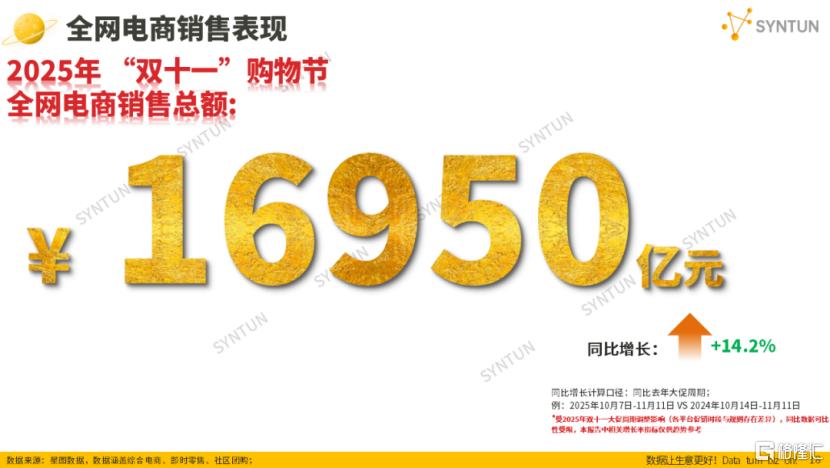
Overall Performance of "Double Eleven" - The overall e-commerce sales during the "Double Eleven" event showed stable growth, with a total online retail sales of 1.695 trillion yuan, representing a year-on-year increase of 14.2% [1] - The comprehensive e-commerce sales reached 1.619 trillion yuan, up 12.3% year-on-year, with Tmall, JD.com, and Douyin being the top three platforms [1] - Instant retail sales amounted to 67 billion yuan, marking a significant increase of 138.4% year-on-year, while community group buying sales fell by 35.3% [1] Category Performance - Categories such as clothing, cosmetics, and gold and silver jewelry performed well, with retail values increasing by 6.3%, 9.6%, and 37.6% respectively in October [3] - The sales of home appliances and audio-visual equipment saw a decline of 14.6%, while furniture sales increased by 9.6%, attributed to high base effects and fluctuations in the market [3] Discounts and Subsidies - The rules for the 2025 "Double Eleven" event have been simplified, with overall discounts remaining stable, and platforms like Tmall, JD.com, and Meituan increasing subsidies for instant retail, leading to substantial growth in this sector [4] Investment Insights - Strong gold prices have led jewelry companies to raise prices, with recommended stocks including Laopuhuang, Caibai, Chaohongji, Chow Tai Fook, and Luk Fook [5] - The changing market style favors new consumption with low valuations and high prosperity, with recommended stocks including Guming and benefiting stocks like Mixue Ice City [5] - Attention is drawn to supermarket adjustments, with recommended stocks including Bubugao, Huijia Times, Chongqing Department Store, Yonghui Supermarket, and Jiajia Yue [5] - The combination of consumption and technology remains a significant industry trend, with recommended stocks including Small Commodity City, Kante Optical, and Tianli International Holdings, along with benefiting stocks like Kevin Education [5]

港股消费热点解析
2025-11-24 01:46
Summary of Key Points from Conference Call Records Industry Overview - The conference call discusses the Hong Kong consumer sector, highlighting the rapid growth of instant retail, particularly in categories such as sports and outdoor, beauty, digital appliances, and pet products, which have outpaced the overall market growth. Traditional food and beverage categories are experiencing relatively weak growth [1][2]. Core Insights and Arguments - **Instant Retail Growth**: Instant retail has shown remarkable growth, with certain categories doubling their growth rates compared to the overall market. New consumption sectors are performing well both online and offline, with strong growth in new categories, demographics, and channels [1][2]. - **AI Technology Impact**: AI technology significantly enhances efficiency through precise marketing and consumer insights. Brands are encouraged to invest more in AI tools to capture consumer demand and predict product trends, thereby improving advertising conversion rates [1][4]. - **K-Shaped Market Recovery**: The market is experiencing a K-shaped recovery, where high-end products and cost-effective brands coexist. High-end products require value redefinition, while cost-effective brands leverage supply chain optimization to reduce prices [1][5][6]. - **Focus on Cash Flow and Shareholder Returns**: Essential consumer sectors emphasize certainty and shareholder returns, with a focus on companies with abundant free cash flow that can enhance shareholder returns through dividends or buybacks [1][7]. - **Potential in Health Supplements**: The health supplement industry is identified as a potential hidden champion due to the aging population and increasing health demands, with a strong growth outlook for anti-aging ingredients like ergothioneine [1][7]. Additional Important Insights - **Valuation of Consumer Sector**: The Hong Kong consumer sector is currently valued at historical lows, with the Hang Seng Consumer Index PE close to the 20th percentile over the past decade, indicating market pessimism [3][10]. - **Z Generation Consumer Behavior**: The Z generation is shifting from functional purchases to emotional and experiential ones, significantly impacting the essential consumer sector. This demographic is also price-sensitive, favoring high-cost-performance brands [3][15]. - **Risks in Essential Consumer Sector**: Despite its defensive nature, the essential consumer sector faces risks such as rising raw material costs and potential declines in consumer purchasing power during economic downturns [13][14]. - **Investment Strategy Recommendations**: Investors are advised to assess their risk profiles and consider funds that cover essential industries for stability, while more aggressive investors may explore high-volatility sectors like liquor [11]. This summary encapsulates the critical insights and trends discussed in the conference call, providing a comprehensive overview of the current state and future outlook of the Hong Kong consumer sector.
超八成的零售企业不赚钱,线下零售走到尽头了?
3 6 Ke· 2025-11-21 12:27
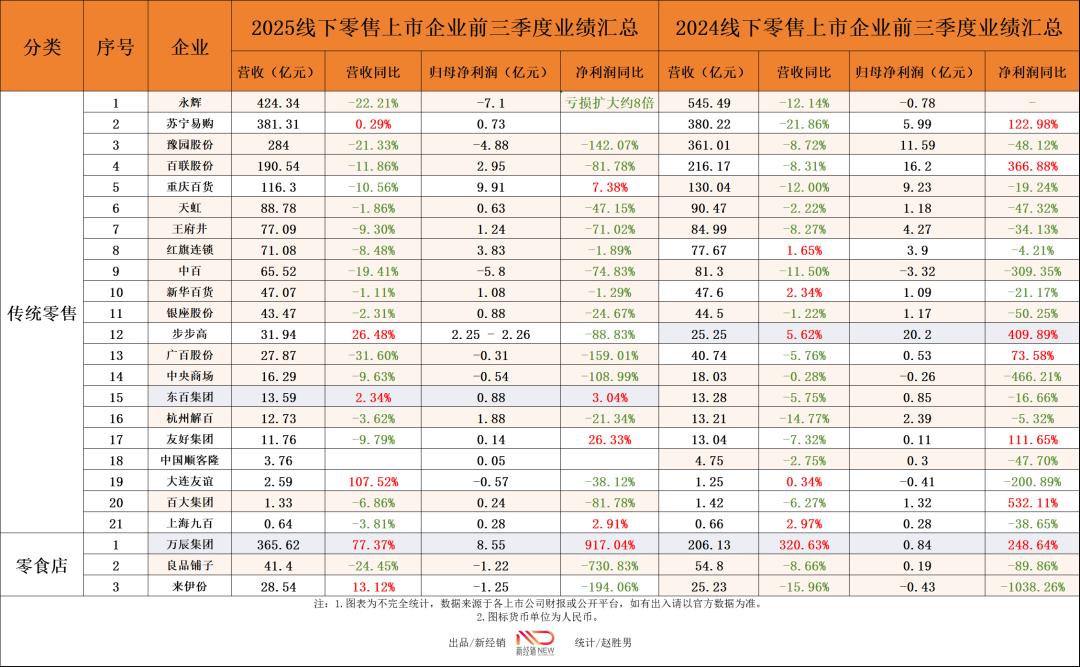
Core Insights - The offline retail industry is facing significant challenges, with many companies reporting declining revenues and profits, indicating a collective downturn in the sector [1][3] - Only 2 out of 24 listed retail companies achieved both revenue and profit growth in the first three quarters of 2025, highlighting the industry's struggles [3][10] Financial Performance Summary - Among the 24 listed retail companies, 18 experienced a year-on-year decline in revenue, and 19 saw a decrease in profits [3] - Notable companies with revenue and profit growth include: - 万辰集团: Revenue increased by 77.37% and net profit surged by 917.04% [10][11] - 东百集团: Revenue grew by 2.34% and net profit increased by 3.04% [10][13] Industry Trends - The shift towards online retail and new business models is evident, with the instant retail market projected to reach 1.4 trillion yuan by 2025, growing at a compound annual growth rate of 25% [6] - Instant retail sales during the 2025 "Double 11" shopping festival reached 67 billion yuan, a 138.4% increase year-on-year, outpacing traditional e-commerce growth [8] Business Model Innovations - New retail formats, such as membership stores and integrated online-offline experiences, are gaining traction, with companies like 山姆会员店 and 盒马 leading the way [9] - 万辰集团's success is attributed to its focus on the bulk snack market, which aligns with consumer demand for high value and convenience [11][12] Transformation Strategies - Retailers are exploring various transformation strategies, including: - Systematic adjustments to enhance user engagement and operational efficiency, exemplified by the "胖东来" model adopted by several companies [22] - Innovative shopping experiences that blend social, cultural, and entertainment elements to attract consumers [23] - Despite the challenges, successful transformation efforts in select stores indicate a potential path forward for the industry [24]

顺丰同城(09699.HK)“双十一”,揭示消费行为结构变迁与第三方即配价值
Ge Long Hui· 2025-11-21 07:00
Core Insights - This year's "Double Eleven" event saw significant growth in sales data, with a notable explosion in instant retail [1][3] - The comprehensive e-commerce platform sales reached 1.619 trillion yuan, a year-on-year increase of 12.3%, while instant retail sales reached 67 billion yuan, marking a substantial year-on-year growth of 138.4% [3] Group 1: Instant Retail Dynamics - The competition among platforms has shifted from food delivery to deep engagement in instant retail, with major players like Taobao Flash Sale, JD Instant Delivery, and Meituan Flash Sale expanding their services [5] - On the first day of Taobao Flash Sale, orders for coffee and convenience store items surged by 800% and 670% respectively, indicating a strong demand for instant retail [5] - By 2030, China's instant retail market is expected to exceed 3 trillion yuan, with a penetration rate rising from 6% to 15.7%, reflecting a compound annual growth rate of approximately 25% [5] Group 2: Third-Party Delivery Services - Third-party delivery platforms like SF Express are benefiting significantly from the rise of instant retail, with substantial order growth during the "Double Eleven" period [6][9] - SF Express's instant delivery service saw a year-on-year increase of over 160% in beverage orders and over 110% in fast food orders during the event [6] - The integration of third-party delivery services with various platforms allows for efficient fulfillment of cross-platform orders, reducing dependency on single platforms [9] Group 3: Market Trends and Future Outlook - The trend of "remote and near integration" in e-commerce is reshaping the fulfillment landscape, requiring enhanced supply chain capabilities [11] - SF Express's logistics services are well-positioned to meet the demands of the expanding market, particularly in lower-tier cities where internet user growth is accelerating [14] - The increasing demand for high-quality third-party logistics services in lower-tier markets is evident, with SF Express reporting a doubling of average daily orders in these areas [14] Group 4: Investment Perspective - The value of third-party delivery players like SF Express is supported by the growth potential in the instant retail sector and their competitive advantages [16] - The penetration rate of instant retail is still on the rise, with high-value categories and lower-tier markets showing significant growth potential [16] - SF Express's ability to provide comprehensive logistics services positions it well for long-term benefits from the expansion of the instant retail market [16]