
高端化

Search documents
华润啤酒(00291):高端化+降本增效,2025H1业绩超预期
ZHONGTAI SECURITIES· 2025-08-20 01:22
Investment Rating - The report maintains a "Buy" rating for the company, expecting a relative performance increase of over 15% compared to the benchmark index within the next 6 to 12 months [4][9]. Core Insights - The company achieved a revenue of 239.42 billion yuan in H1 2025, representing a year-on-year growth of 0.8%. The adjusted EBITDA was 83.36 billion yuan, up 10.7% year-on-year, while the net profit attributable to shareholders reached 57.89 billion yuan, marking a 23.0% increase [5]. - The high-end product strategy continues to yield significant results, with the beer business revenue growing by 2.6% year-on-year to 231.61 billion yuan in H1 2025. The company has seen strong sales growth in premium products, with Heineken sales increasing by over 20% and Snow beer by over 70% [6][5]. - The company is actively embracing new consumption trends, launching various specialty beers and expanding online sales channels, resulting in nearly 40% growth in online business and 50% in instant retail [6]. Financial Performance Summary - Revenue projections for 2025-2027 are adjusted to 410.65 billion yuan, 419.55 billion yuan, and 427.91 billion yuan respectively, with net profits expected to be 60.77 billion yuan, 58.74 billion yuan, and 62.78 billion yuan [6]. - The company’s gross margin improved by 2.0 percentage points to 48.9% in H1 2025, driven by the implementation of cost-saving strategies [6]. - The beer segment's EBITDA margin increased by 3.4 percentage points to 35.1%, reflecting enhanced operational efficiency [6]. Earnings Forecast - The earnings per share (EPS) for 2025-2027 are projected to be 1.87 yuan, 1.81 yuan, and 1.94 yuan respectively, with corresponding P/E ratios of 15.3, 14.3, and 13.3 [6][8].

解码制造业高质量发展之路
Jing Ji Ri Bao· 2025-08-20 00:10
Core Viewpoint - The manufacturing industry is emphasized as the foundation of national strength and economic development, with a focus on high-quality growth and strategic importance in the context of global changes and digital transformation [1][3]. Group 1: Manufacturing Industry Performance - In the first half of the year, the manufacturing value added grew by 7%, surpassing GDP growth by over 1 percentage point, indicating an increasing share of manufacturing in GDP [2]. - Manufacturing investment increased by 7.5%, significantly higher than the overall fixed asset investment growth of 2.8% [2]. - Exports of goods primarily from the manufacturing sector rose by 7.2%, showcasing manufacturing as a key driver of economic growth amid challenges in other sectors [2][3]. Group 2: Structural Trends in Manufacturing - High-end equipment manufacturing led growth with an increase of over 10%, outpacing overall manufacturing growth [2]. - High-tech manufacturing value added grew by 9.5%, exceeding the overall manufacturing growth rate by 2.5 percentage points, with significant increases in industrial robots and 3D printing equipment [2][3]. - The transformation of manufacturing is characterized by three trends: high-end, intelligent, and green development [3][4]. Group 3: Green Transformation - The production of new energy vehicles increased by over 10%, with rapid export growth in lithium batteries and wind power equipment [4][5]. - China's unique approach to green transformation integrates economic growth with environmental sustainability, avoiding the pitfalls of merely imposing costs [5][6]. Group 4: Challenges and Responses - The manufacturing sector faces challenges from external factors such as tariffs and technological restrictions, particularly affecting exports to the U.S. [6][7]. - Despite a decline in exports to the U.S., overall goods exports grew by 7.2%, driven by strong performance in emerging markets [7]. - The manufacturing sector's resilience is highlighted by its ability to adapt and maintain competitiveness through innovation and government support [7][8]. Group 5: Manufacturing Share and Reasonableness - The manufacturing share of GDP is projected to be around 24.9% in 2024, which is still significantly higher than the global average of approximately 15% [9][10]. - The decline in manufacturing share over the past decade reflects a natural evolution as economies develop, with a shift in demand from manufacturing to services as GDP per capita rises [9][10][11]. Group 6: Future Directions and Strategies - The future direction of manufacturing includes maintaining a reasonable share, enhancing technological capabilities, and focusing on high-value-added products [23][24]. - Key areas for development include traditional industries, emerging sectors like new energy vehicles and biopharmaceuticals, and future industries such as artificial intelligence [24][25]. - The integration of various industries through common-purpose technologies is essential for driving innovation and maintaining competitiveness in the global market [25].
7月份全省经济运行情况发布 继续保持稳中向好发展态势
He Nan Ri Bao· 2025-08-19 23:35
Economic Performance - The province's economy showed a steady and positive development trend in July, with industrial and investment growth accelerating, and key indicators consistently exceeding the national average [1][2]. Industrial Growth - The industrial added value above designated size increased by 8.8% year-on-year in July, accelerating by 0.6 and 2.4 percentage points compared to the previous month and the same period last year, respectively, and surpassing the national average by 3.1 percentage points [1]. - The power generation industry saw a significant increase, with industrial power generation volume rising by 27.3% year-on-year in July, accelerating by 31.5 percentage points from the previous month [1]. - The equipment manufacturing sector experienced rapid growth, with an added value increase of 12.5% in July, contributing 34.7% to the province's industrial growth [1]. Investment Trends - Fixed asset investment in the province grew by 5.6% year-on-year from January to July, surpassing the national growth rate of 4.0% [2]. - Private investment maintained strong growth, increasing by 8.5% year-on-year, contributing 90.9% to the overall investment growth in the province [2]. - Industrial investment continued to show double-digit growth, with a year-on-year increase of 23.4%, exceeding the national average by 14.4 percentage points [2]. Consumer Market - The total retail sales of social consumer goods reached 212.5 billion yuan in July, with a year-on-year growth of 4.8%, and a cumulative growth of 6.9% from January to July, outpacing the national average by 2.1 percentage points [3]. - The high-tech manufacturing industry and strategic emerging industries saw added value growth of 13.5% and 11.2% respectively in July, indicating a shift towards modernization [3]. Emerging Services - The province's emerging service industries, such as leasing and multi-modal transport, reported significant revenue growth, with increases of 38.1% and 34.2% respectively in the first half of the year [4]. - New consumption models are being actively developed, with a notable increase in the number of Hanfu stores in Luoyang, which grew to 1,360, a 14-fold increase from the end of 2022 [4].
华菱钢铁受益材料降价净利17亿 财务费用转负陆股通社保基金加仓
Chang Jiang Shang Bao· 2025-08-19 23:26
Core Viewpoint - Hualing Steel's operating performance has improved, with a significant increase in net profit despite a decline in revenue [1][2]. Financial Performance - In the first half of 2025, Hualing Steel achieved operating revenue of approximately 631 billion yuan, a year-on-year decrease of about 17% [1]. - The net profit attributable to shareholders exceeded 17 billion yuan, showing a year-on-year increase of over 30% [1][2]. - The company reported a negative financial expense of 16.1 million yuan for the first time in nearly 20 years, indicating improved financial health [1][7]. Market Conditions - The steel industry faced challenges due to geopolitical conflicts and economic policies, leading to a decline in global steel production and consumption [3]. - National crude steel production in the first half of 2025 was 515 million tons, down 3% year-on-year, while apparent consumption fell by 5.6% [3]. Strategic Initiatives - Hualing Steel is focusing on a transformation strategy emphasizing "high-end, green, intelligent, and service-oriented" development [1][4]. - The company has accelerated product iteration and optimization, with key product steel sales accounting for 68.5% of total sales, an increase of 3.9 percentage points year-on-year [1][6]. Research and Development - The company invested 2.842 billion yuan in R&D in the first half of 2025, continuing its commitment to innovation [1][6]. - Hualing Steel received 233 new patent authorizations, including 51 invention patents, and achieved a record number of metallurgical science and technology awards [6]. Cost Management - The company has implemented cost reduction measures, lowering procurement costs by approximately 250 million yuan in the first half of 2025 [7]. - As of June 30, 2025, the company's asset-liability ratio was 55.62%, a decrease of 0.40 percentage points from the beginning of the year [7]. Investor Sentiment - Capital markets have shown confidence in Hualing Steel, with significant increases in shareholdings from institutional investors [7].

通用技术昆明机床董事长王鹤:以自主创新竞逐世界一流机床企业
Zhong Guo Zheng Quan Bao· 2025-08-19 22:28
Core Viewpoint - The company is accelerating its overseas business expansion, with a significant increase in overseas sales contracts, reflecting the rise of China's "industrial mother machine" and its contribution to the global manufacturing transformation [1][7]. Group 1: Company Overview - Kunming Machine Tool, a key player in the machine tool industry, has transitioned from a long period of losses to profitability in 2023, marking a new development phase after its integration into the General Technology Group [2][3]. - The company has a product matrix primarily focused on precision boring and milling machines, which are crucial for high-end equipment manufacturing [2]. Group 2: Financial Performance - After joining the General Technology Group, Kunming Machine Tool ended a decade-long loss streak and achieved operational profitability in 2023 [2][3]. - The company has secured over 3 billion yuan in contract orders by focusing on key clients and addressing their processing challenges [7]. Group 3: Innovation and R&D - The company maintains a research and development investment ratio of around 5% of its revenue, with plans to invest over 400 million yuan in technological upgrades in 2024 [4][5]. - Self-research rate for key components has reached 70%, with a focus on overcoming technological barriers posed by foreign competitors [6]. Group 4: Market Expansion - Kunming Machine Tool is actively expanding into emerging markets and has achieved overseas sales contracts exceeding 100 million yuan for the first time in 2024, covering markets such as the USA, South Korea, and Australia [7][8]. - The company aims to leverage its geographical advantages to establish a foothold in Southeast Asia's machine tool market [8]. Group 5: Industry Challenges - The machine tool industry faces challenges such as low-end competition and a lack of high-end products, necessitating a push for market regulation and innovation [8]. - There is a pressing need for collaboration between industry and academia to address the talent crisis and foster technological innovation [8].
通用技术昆明机床董事长王鹤: 以自主创新竞逐世界一流机床企业
Zhong Guo Zheng Quan Bao· 2025-08-19 22:12
Core Viewpoint - The company is accelerating its overseas business expansion, achieving significant sales contracts in international markets, reflecting the rise of China's "industrial mother machine" and its contribution to global manufacturing transformation [1][6]. Group 1: Company Overview - Kunming Machine Tool, a key player in the machine tool industry, has transitioned from a period of losses to profitability, marking a new development phase after its integration into the General Technology Group [2][3]. - The company has a product matrix primarily focused on precision boring and milling machines, which are crucial for high-end equipment manufacturing [2]. Group 2: Financial Performance - In 2023, the company ended a decade-long loss streak and achieved operational profitability [2][3]. - The overseas sales contract amount exceeded 100 million yuan for the first time in 2024, indicating strong international market performance [6]. Group 3: Strategic Initiatives - The company has implemented a strategy of divesting non-core and less profitable businesses, focusing on its main operations in precision boring and milling machines [3]. - Organizational management reforms have been introduced, including dynamic performance assessments for leadership, enhancing the company's operational vitality [3]. Group 4: Innovation and R&D - The company maintains a research and development investment ratio of around 5% of revenue, with plans to invest over 400 million yuan in technological upgrades by 2024 [4][5]. - Self-research rate for key components has reached 70%, with a focus on overcoming technological barriers in high-end machine tools [5]. Group 5: Market Expansion - The company is actively exploring new growth points in traditional markets such as wind power, mold processing, and engineering machinery, securing over 300 million yuan in contract orders [6]. - Plans are in place to establish a stronghold for machine tool sales in Southeast Asia, aiming to rank among the top machine tool manufacturers globally by 2030 [7].
以自主创新竞逐世界一流机床企业
Zhong Guo Zheng Quan Bao· 2025-08-19 20:09
Core Viewpoint - The company is accelerating its overseas business expansion, achieving significant sales contracts in international markets, reflecting the rise of China's "industrial mother machine" and its contribution to global manufacturing transformation [1][2]. Group 1: Company Transformation - After being restructured into the General Technology Group in 2022, the company has entered a new development phase, ending a decade-long period of losses and achieving operational profitability in 2023 [2]. - The company has implemented a strategy of divesting non-core and less profitable businesses, focusing on its core precision boring and milling machine operations [2]. - The company has established a more dynamic incentive mechanism through market-oriented leadership selection and performance assessments, enhancing crisis awareness among the leadership team [2]. Group 2: Innovation and R&D - The company maintains a research and development investment ratio of around 5% of its revenue, with plans to invest over 400 million yuan in technological upgrades in 2024 [3]. - The technological transformation project aims to enhance production capacity and improve the manufacturing capabilities of high-end equipment by the end of 2026 [3]. - The company has achieved a self-research rate of 70% for key components, emphasizing the importance of independent innovation to overcome reliance on foreign technology [3][4]. Group 3: Market Expansion and Strategy - The company has secured over 300 million yuan in contract orders by focusing on key customers in traditional markets such as wind power, mold processing, and engineering machinery [5]. - The company is actively exploring emerging markets and has plans to leverage its geographical advantages to establish a foothold in Southeast Asia for machine tool sales [5]. - The company aims to rank among the second tier of global machine tool manufacturers by 2030 and the first tier by 2035, aspiring to become a world-class high-end machine tool equipment enterprise [5].
小米二季度营收再超千亿 汽车业务预计下半年盈利
Zheng Quan Shi Bao· 2025-08-19 18:48
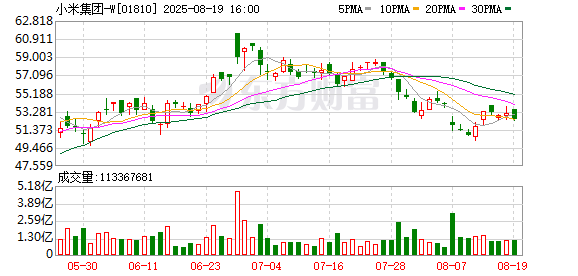
Core Insights - Xiaomi Group reported record-high financial results for Q2 2025, with revenue reaching 116 billion yuan, a year-on-year increase of 30.5%, marking the third consecutive quarter of exceeding 100 billion yuan [2] - Adjusted net profit for the quarter was 10.8 billion yuan, a significant year-on-year increase of 75.4%, continuing a trend of surpassing 10 billion yuan for two consecutive quarters [2] - Revenue from innovative businesses, including smart electric vehicles and AI, surpassed 20 billion yuan [2] Financial Performance - Xiaomi's automotive deliveries reached 81,302 units in Q2, with total deliveries exceeding 300,000 units as of July 10 [2] - The automotive business reported a reduced operating loss of 300 million yuan in Q2, with expectations of profitability in the second half of the year [2] - Revenue from smartphone and AIoT businesses was 94.7 billion yuan, a year-on-year increase of 14.8%, with smartphone revenue at 45.5 billion yuan [2][3] Market Position - Despite a challenging global smartphone market, Xiaomi achieved a market share of 16.8% in China, leading the domestic market with 11.5 million new device activations in Q2 [3] - Xiaomi's smartphone shipments have seen growth for eight consecutive quarters, ranking in the top five in 69 countries and regions [3] IoT and Consumer Products - Revenue from IoT and consumer products reached 38.7 billion yuan, with smart home appliances seeing a year-on-year revenue increase of 66.2% [2][3] - In Q2, Xiaomi's air conditioning product shipments exceeded 5.4 million units, marking a historical high with a growth rate of over 60% [3] - The company also reported significant growth in refrigerator and washing machine shipments, with increases of over 25% and 45%, respectively [3] High-End Market Strategy - Xiaomi's high-end smartphone sales accounted for 27.6% of total smartphone sales in mainland China, an increase of 5.5 percentage points year-on-year [4] - The company expanded its market share in the 4000-5000 yuan price segment to 24.7% and achieved a market share of 15.4% in the 5000-6000 yuan segment, a year-on-year increase of 6.5 percentage points [4] R&D Investment - R&D expenditure reached 7.8 billion yuan in Q2, a year-on-year increase of 41.2%, with an expected total investment of 30 billion yuan for the year [5] - Significant investments in foundational technologies are anticipated to drive breakthroughs in automotive, chip, and AI sectors [5]


小米高管解读Q2财报:肯定会增加AI和芯片投入 相信Q4手机毛利率会回升
Xin Lang Ke Ji· 2025-08-19 15:05
Core Insights - Xiaomi Group reported a total revenue of 116 billion yuan for Q2 2025, representing a year-on-year growth of 30.5%, and a net profit of 11.9 billion yuan, up 134.2% year-on-year [1] - Adjusted net profit, based on non-IFRS measures, reached 10.8 billion yuan, marking a 75.4% increase year-on-year [1] IoT Business Performance - Xiaomi's AIoT segment showed strong growth in both domestic and international markets, benefiting from the expansion of its new retail system [3][4] - The company has shifted its focus from rapid expansion to "scaled closure" in its overseas retail strategy, aiming to open 400 to 500 new stores by the end of the year, with a potential for over 1,000 stores in the following year [4] - The growth rate in the Chinese market is higher than in overseas markets, primarily due to the rapid development of the home appliance sector [3] Mobile Business Insights - The gross margin for the mobile business saw a quarter-on-quarter decline, attributed to rising component costs and a limited number of new product launches in Q2 [5][6] - The company anticipates a recovery in gross margin by Q4 2025, coinciding with a more significant release of new products [5] R&D Investments - Xiaomi's R&D expenditure increased by over 40% year-on-year in Q2, marking the fastest growth rate in recent years, with investments spread across core technologies such as chips, AI, and the Surge OS [7][8] - The company is committed to enhancing its technological capabilities, which are deemed essential for maintaining competitiveness in the market [7][8] AIoT Margins and Market Dynamics - The IoT business's gross margin showed a year-on-year increase but faced some pressure on a quarter-on-quarter basis, influenced by promotional activities like the "618 shopping festival" [6][9] - Despite competitive pressures in the home appliance market, Xiaomi remains on track to meet its annual targets for the IoT segment [7]
华润啤酒上半年净利增长23%:新零售合作出拉格爆品,白酒承诺给经销商兜底,将发力100-200元价位
Cai Jing Wang· 2025-08-19 13:36
Core Viewpoint - The high-end beer market still has significant growth potential, and the company will continue to prioritize high-end strategies while also exploring personalized and niche products [1][3][14] Financial Performance - In the first half of 2025, the company reported revenue of RMB 239.42 billion, a year-on-year increase of 0.8% [2] - The company's pre-tax profit and net profit attributable to shareholders were RMB 76.91 billion and RMB 57.89 billion, reflecting year-on-year growth of 20.8% and 23.0% respectively [2] - Beer business revenue reached RMB 231.61 billion, with a year-on-year increase of 2.6% [2] Market Position - The company has surpassed Budweiser APAC in revenue, which declined by 5.6% to USD 31.36 billion (approximately RMB 225.63 billion) in the same period [2] - High-end products such as Heineken, Old Snow, and Red Duke saw sales growth exceeding 20%, 70%, and 100% respectively in the first half of the year [3] New Retail Strategy - The company has experienced significant growth in online and instant retail, with overall transaction value increasing by 40% and 50% year-on-year [5] - Collaborations with major platforms like Alibaba, Meituan, JD.com, and Ele.me have been established to enhance consumer engagement and product development [5] Product Innovation - The company is focusing on flexible supply and personalized products, with new offerings such as 1L craft beers and various flavored lagers [6] - The introduction of local brands and products is seen as a way to meet consumer demand for personalization [7] Industry Trends - The beer industry is witnessing a shift towards high-end and personalized products, while the low-end segment faces challenges from both high-end and budget brands [6] - The company acknowledges the competitive landscape and the need for continuous innovation to maintain market relevance [6][14] Consumer Behavior - Changes in consumer purchasing behavior have been noted, with a shift towards online and instant retail channels, particularly among younger demographics [5][8] - The company is adapting to these changes by enhancing its product offerings and marketing strategies to cater to evolving consumer preferences [5][8]