中国经济

Search documents
首破140万亿元:中外专家解读中国经济年度答卷|全球财经连线
2 1 Shi Ji Jing Ji Bao Dao· 2026-01-19 15:08
南方财经 21世纪经济报道记者李依农杨雨莱 1月19日,2025年国民经济运行情况公布。初步核算,全年国内生产总值达140187.9亿元,同比增长 5.0%。在复杂的国际环境和多重不确定因素下,中国经济交出了一份向新向优的答卷。 中国首席经济学家论坛理事长连平在接受南方财经记者采访时表示,在内需偏弱、外部风险增加的情况 下,能保持5%左右的增速并不容易,足以体现中国经济的韧性。他指出,最值得关注的重点之一是结 构的变化——高技术产业和战略性新兴产业增速明显快于传统产业,正在为经济注入新动能,推动经济 向更高质量方向发展。 从国际视角看,渣打银行财富管理部全球首席投资总监布思哲在接受南方财经记者采访时指出,通胀已 经出现企稳回升的迹象,这对中国经济是一个"很重要的积极信号"。因为名义GDP的改善不仅能缓解债 务压力,也能增强投资和消费的动力,让经济更有"持续性"。 从数据层面看,2025年工业、服务业回升态势稳健,消费与外贸也保持韧性。连平认为,出口的结构在 优化,服务消费和新型消费增长较快,高技术产业的比重在提升,这些都在成为新的增长支撑。 展望2026年,连平认为,外部不确定性仍然存在,政策需要继续保持"稳 ...
2025年中国经济数据点评:中国经济的亮点和星光
ZHONGTAI SECURITIES· 2026-01-19 14:27
Economic Growth - In Q4 2025, China's GDP grew by 4.5% year-on-year, aligning with market expectations, achieving a full-year GDP growth of 5.0%[2] - The contribution rates of final consumption expenditure, gross capital formation, and net exports to GDP changed from 44.5%, 25.2%, and 30.3% in 2024 to 52.0%, 15.3%, and 32.7% in 2025, respectively[2] Consumption and Investment - Final consumption expenditure's contribution to economic growth exceeded 50% due to the "trade-in" policy, with retail sales growth rising from 3.5% in 2024 to 3.7% in 2025[2] - Fixed asset investment decreased by 3.8% year-on-year in 2025, which indirectly boosted the contribution of final consumption to economic growth[2] Industrial Performance - Industrial value-added growth in December 2025 rose to 5.2% from 4.8% in November, while the service production index increased from 4.2% to 5.0%[2] - High-tech industry value-added growth reached 11.0% in December 2025, marking the highest level for the year, with an annual growth of 9.4% compared to 8.9% in 2024[2] Capacity Utilization and Real Estate - China's industrial capacity utilization rate increased from 74.6% in Q3 2025 to 74.9% in Q4 2025, but was down 1.3 percentage points year-on-year, the largest decline since Q2 2023[2] - Real estate indicators showed a narrowing decline, with property sales area and value improving from -17.0% and -24.6% in November to -15.5% and -23.5% in December 2025[3] Policy Outlook - The report suggests that structural highlights in the economy are emerging, but the "strong supply, weak demand" situation persists, necessitating continued policy support[3] - The central bank's structural interest rate cuts and expanded lending in January 2026 indicate a clear intention for a more accommodative credit policy to stimulate economic growth[3]
2025年中国经济“年报”出炉:顶压前行 向新向优
Yang Shi Wang· 2026-01-19 14:09
Core Insights - In 2025, China's economy demonstrated stability and resilience, with a GDP of 140,187.9 billion yuan, reflecting a growth rate of 5.0% compared to the previous year [1] - The contribution of China's economy to global growth is expected to remain around 30%, highlighting its role as a key driver in the world economy [1] - The "Four Stabilities" policy was introduced to stabilize employment, enterprises, markets, and expectations amid external challenges [2] Economic Growth - China's GDP growth was steady throughout the year, with quarterly growth rates of 5.4%, 5.2%, 4.8%, and 4.5% respectively [1] - The average annual growth rate during the "14th Five-Year Plan" period was 5.4%, with an economic increment exceeding 36 trillion yuan [1] Foreign Trade - In 2025, China's total goods import and export reached 45.47 trillion yuan, a historical high with a year-on-year growth of 3.8% [1] - High-tech product exports increased by 13.2%, with significant growth in sectors like robotics [1] - Exports to countries involved in the Belt and Road Initiative grew by 11.2%, indicating a diversified market strategy [1] Consumption Trends - The total retail sales of consumer goods surpassed 50 trillion yuan, with a year-on-year growth of 3.7% [2] - The contribution of final consumption expenditure to economic growth was 52.0% [2] - Digital consumption accounted for nearly half of residents' total consumption expenditure, with online retail sales growing by 8.6% [3] Manufacturing and Innovation - The manufacturing sector showed robust growth, with the value added in high-tech manufacturing increasing by 9.4% [4] - The production of new energy vehicles accounted for over 50% of domestic new car sales, with an average of 45,000 new energy vehicles produced daily [4] - The application of artificial intelligence and digital technologies is driving significant improvements in productivity and efficiency across various industries [5] Investment and Future Outlook - China's innovation index has entered the global top ten, with rapid growth in new industries such as artificial intelligence and commercial aerospace [6] - Effective investment in areas like computing power and data centers is expected to transform the growth dynamics of the Chinese economy in the coming years [6] - The overall economic landscape remains stable, with a focus on high-quality development and resilience in the face of external uncertainties [6]
中国经济“稳进新韧”
第一财经· 2026-01-19 13:57
Core Viewpoint - In 2025, China's GDP reached 140 trillion yuan, achieving a growth rate of 5%, meeting the initial target set at the beginning of the year, and maintaining stability in economic performance amidst various challenges [2][3]. Economic Growth and Structure - The GDP growth for 2025 was consistent across quarters: Q1 at 5.4%, Q2 at 5.2%, Q3 at 4.8%, and Q4 at 4.5% [4]. - The contribution rates to economic growth from final consumption expenditure, capital formation, and net exports were 52.0%, 15.3%, and 32.7% respectively for the year [5][6]. Consumer Behavior and Retail - The total retail sales of consumer goods surpassed 50 trillion yuan, growing by 3.7% year-on-year, with service retail sales increasing by 5.5%, indicating a shift towards service consumption [5][6]. - Service consumption accounted for 46.1% of per capita consumption expenditure, reflecting a growing trend towards diverse and quality consumption preferences [6][7]. Industrial Performance - Industrial production value reached 41.7 trillion yuan, growing by 5.8%, with manufacturing value added at 34.7 trillion yuan, increasing by 6.1% [8][9]. - The high-tech manufacturing sector showed significant growth, with increases of 9.4% in high-tech manufacturing and 9.2% in equipment manufacturing, indicating a shift towards advanced industrial capabilities [8][9]. Future Outlook - Despite challenges in 2026, the economic foundation remains strong, with expectations for continued growth driven by domestic demand and policy support [5][10]. - The focus for 2026 will be on stabilizing key industries, expanding effective demand, and fostering innovation to enhance industrial growth [10].


四连跳!
Jin Rong Shi Bao· 2026-01-19 13:07
经济发展的韧性,在稳基固本中不断筑牢。韧性是穿越周期的底气,中国经济以坚实基础抵御风浪,以 深化改革激活活力。粮食产量稳站高位,制造业规模连续领跑全球,网络基础设施覆盖广泛,坚实的产 业底盘为抗风险提供硬支撑;改革开放持续深化,全国统一大市场加快建设,民营经济活力充分释放, 外资准入门槛不断降低,制度红利持续释放;民生保障有力有效,居民收入与经济增长同步,就业形势 总体稳定,恩格尔系数稳步下降,民生底气凝聚发展合力。在开放合作中,外贸结构持续优化,民营企 业成为外贸增长主力,对"一带一路"国家贸易占比稳步提升,中国经济既是全球增长的动力源,也是国 际合作的大市场,韧性在内外联动中愈发强劲。 全年国内生产总值约140万亿元,按不变价格计算,比上年增长5.0%;全年全国城镇调查失业率平均值 为5.2%;货物贸易再创新高,外汇储备余额超过3.3万亿美元……1月19日,国家统计局公布了国民经济 运行成绩单。 没有一蹴而就的跨越,只有久久为功的积淀。中国经济五年"四连跳",是传统产业转型升级的坚守,是 新兴产业加速崛起的奋进,是改革开放持续深化的红利,更是14亿人携手前行、共促发展的磅礴合力。 站在开局的新起点,中国经 ...
2025年中国经济复盘:5%的成绩与发力方向
Yuekai Securities· 2026-01-19 11:45
Economic Performance - In 2025, China's GDP growth reached 5%, with the total economic volume surpassing 140 trillion yuan for the first time[1] - Exports grew by 5.5%, supported by diversification into ASEAN and African markets, offsetting declines in exports to the US[2] - The Shanghai Composite Index rose by 18.4%, with the ChiNext Index and STAR 50 Index increasing by 49.6% and 35.9% respectively[3] Economic Challenges - Real estate investment fell by 17.2%, a larger decline than the previous year's 10.6%[4] - Retail sales growth for the year was 3.7%, lower than the 5% growth in the first half of 2025[5] - The GDP deflator was negative at -1%, indicating nominal GDP growth of only 4% compared to a real growth of 5%[6] Policy Outlook - In 2026, proactive fiscal policies and monetary easing are expected to support economic growth, aiming for a strong start in Q1[7] - The government plans to allocate 625 billion yuan for consumer goods replacement programs and 2.95 trillion yuan for infrastructure projects[8] - Emphasis on increasing residents' income and investing in human capital as key strategies to boost domestic demand[9]
四个关键词读懂2025年中国经济“年报”
Xin Hua Wang· 2026-01-19 10:56
Economic Overview - In 2025, China's GDP reached 140,187.9 billion yuan, marking a 5.0% increase from the previous year [1][5][38] - The average urban survey unemployment rate was 5.2%, indicating overall employment stability [5][9] - China's foreign exchange reserves exceeded 3.3 trillion USD, with trade hitting new highs [5][9] Stability - The year 2025 showcased a stable economic environment despite various risks and challenges [9][36] - The growth of high-tech manufacturing added to the stability, with its value-added output accounting for 17.1% of total industrial output [14][20] Progress - The focus on high-quality development and the transition to new growth drivers were emphasized, with significant contributions from final consumption, which accounted for over 50% of economic growth [12][14] - The total import and export volume increased by 3.8% compared to the previous year [14] Innovation - Research and development expenditure intensity reached 2.8%, surpassing the OECD average for the first time [22][25] - China's innovation index entered the global top ten, reflecting advancements in artificial intelligence, quantum technology, and other cutting-edge fields [25][30] Resilience - China's economy demonstrated resilience amid global economic disruptions, achieving both quantitative and qualitative improvements [32][36] - The contribution of China's economy to global growth is projected to be around 30%, with high-tech product exports increasing by 13.2% [34][38]
解读2025中国经济数据:5%增长下的亮点与挑战
Xin Lang Cai Jing· 2026-01-19 10:45
Economic Overview - In 2025, China's GDP reached 140.19 trillion yuan, growing by 5.0% year-on-year, with a quarterly trend of 5.4%, 5.2%, 4.8%, and 4.5% [3][23] - The industrial added value increased by 5.9%, while the total retail sales of consumer goods reached 50.12 trillion yuan, growing by 3.7% [3][23] - Fixed asset investment (excluding rural households) declined by 3.8%, primarily due to the real estate sector's downturn [3][23] Trade Performance - The total import and export volume reached 45.47 trillion yuan, an increase of 3.8%, with exports at 26.99 trillion yuan (up 6.1%) and imports at 18.48 trillion yuan (up 0.5%) [3][23] - High-tech product exports grew by 13.2%, indicating a shift towards higher value-added goods [26][27] Employment and Income - The urban surveyed unemployment rate averaged 5.2%, up by 0.1 percentage points from the previous year [4][24] - The per capita disposable income for residents was 43,377 yuan, nominally increasing by 5.0% [4][24] Investment Trends - Fixed asset investment saw a notable decline, with real estate investment dropping by 17.2% [15][34] - Manufacturing investment grew by only 0.6%, a significant slowdown from the previous year's 9.2% [35][36] - Private investment decreased by 6.4%, indicating a lack of confidence among private enterprises [36] Consumer Behavior - Consumer spending showed signs of weakness, with retail sales growth declining throughout the year, particularly in the latter half [31][32] - Service consumption, however, grew by 5.5%, outpacing goods retail sales, reflecting a shift towards service-oriented spending [31][32] Future Outlook - The 2026 economic policy will focus on proactive fiscal measures and moderate monetary policies to stimulate demand and optimize supply [37][38] - Experts predict a GDP growth target of around 5% for 2026, supported by improved real estate conditions and increased project initiations [37][38] - Potential risks include ongoing challenges in the real estate market and local government debt issues [38][39]
新华鲜报丨140万亿元!中国经济再上新台阶
Xin Hua Wang· 2026-01-19 10:32
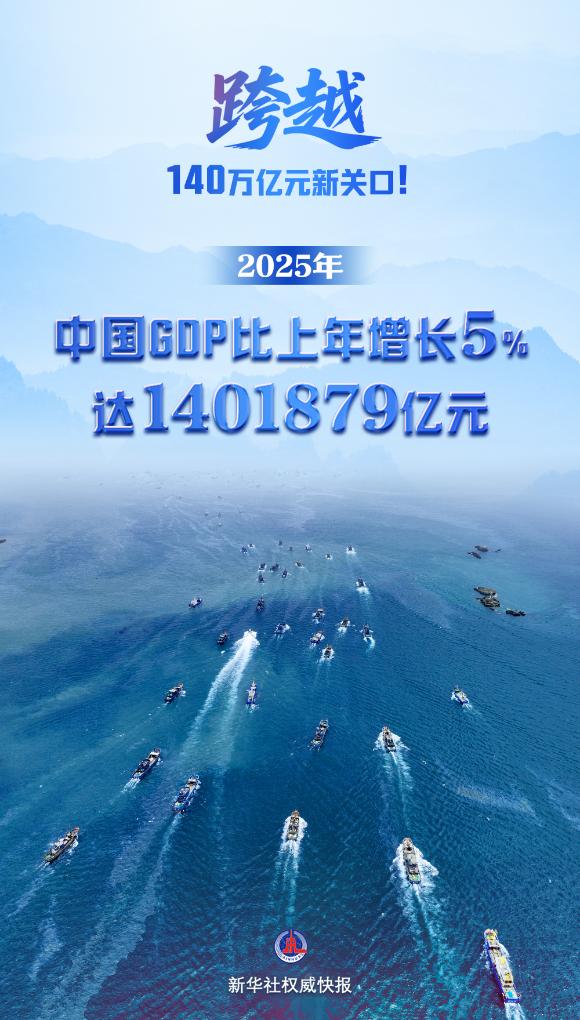
Core Viewpoint - China's GDP is projected to exceed 140 trillion yuan by 2025, with a growth rate of 5% compared to the previous year, marking a significant milestone in the country's economic development [1][4]. Economic Growth - The National Bureau of Statistics reported that during the "14th Five-Year Plan" period, China's economy achieved a "four consecutive jumps" in total economic output, reaching milestones of 110 trillion, 120 trillion, 130 trillion, and now 140 trillion yuan [6]. - China's contribution to global economic growth is expected to be around 30%, making it a stable and reliable engine for global economic growth [6]. Economic Resilience - China's agricultural output has stabilized at 1.4 trillion jin for two consecutive years, and the manufacturing value added has remained the highest in the world for 16 years [7]. - The service sector's contribution to GDP has increased to 57.7%, supported by the world's largest and most comprehensive network infrastructure, which enhances the country's ability to withstand risks [7]. Innovation and Technology - China has entered the top ten in global innovation index rankings, with R&D expenditure intensity reaching 2.8%, surpassing the OECD average for the first time [8]. - Significant advancements in technology and innovation are evident, with notable achievements in various sectors, including the successful launch of the "Nine Days" drone and the entry of the first electromagnetic aircraft carrier [8]. Consumer Market Dynamics - The total retail sales of consumer goods have surpassed 50 trillion yuan, reflecting a 3.7% increase from the previous year, with new retail models like unmanned stores and warehouse membership stores experiencing double-digit growth [9]. - The per capita disposable income of residents has increased by 5.0%, and the urbanization rate has reached 67.89%, indicating positive progress in social welfare and public services [9].
陈文玲:2025年中国经济不容易、不平凡、不一般
Sou Hu Cai Jing· 2026-01-19 10:11
Core Insights - China's economy achieved a GDP of 14,018.79 billion yuan in 2025, reflecting a 5.0% growth compared to the previous year, indicating overall stability and meeting expected targets [3][4] - The economy faced significant pressures, including intense global competition, reshaping international dynamics, the impact of trade wars, and both longstanding and emerging domestic challenges [3] - Structural changes in the economy were noted, with traditional industries accelerating their transformation and strategic emerging industries optimizing, leading to the emergence of leading enterprises in sectors like quantum computing, industrial robotics, artificial intelligence, and large models [3] Economic Policies - More proactive fiscal policies and moderately loose monetary policies played a crucial role in maintaining market vitality and momentum [4] - Legislative measures such as the introduction of the Private Economy Promotion Law and revisions to the negative list for market access provided institutional guarantees for market activation [4] Trade and Openness - Significant progress was made in import and export trade and foreign openness, with an emphasis on expanding the "open door" policy, positioning China as a major leader in an increasingly open world [4]