
信用债

Search documents
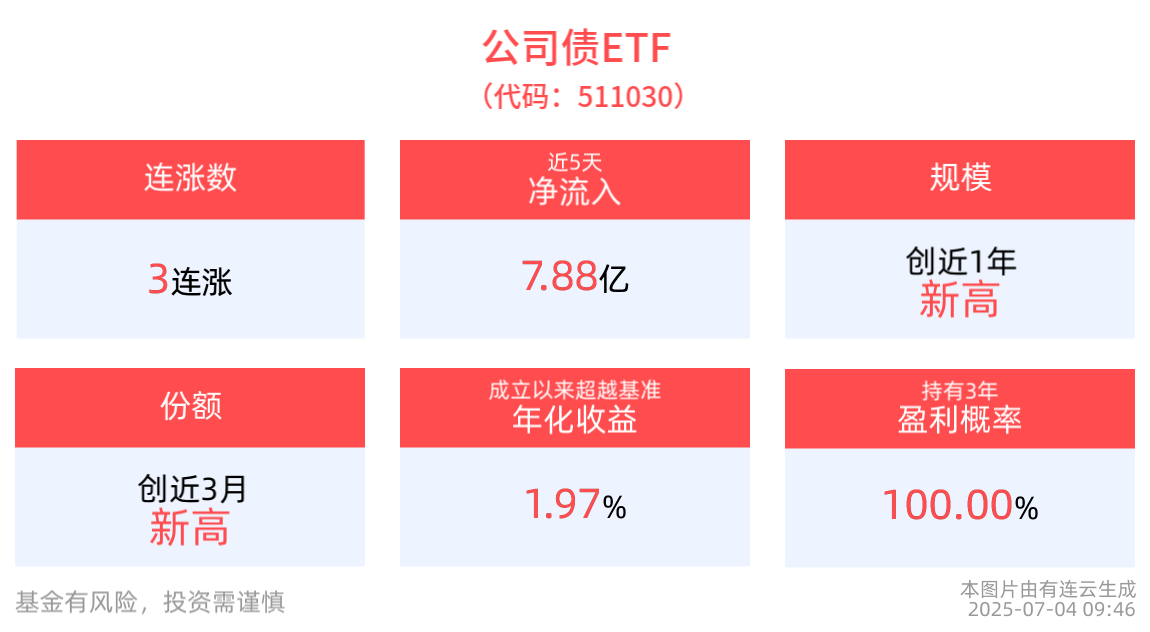
公司债ETF(511030)冲击3连涨!规模超200亿,兼具中登质押库资格和上交所融资融券标的
Sou Hu Cai Jing· 2025-07-04 02:06
Group 1 - The company bond ETF (511030) has seen a 0.03% increase, marking three consecutive days of gains, with the latest price at 106.19 yuan. Over the past year, the ETF has accumulated a rise of 2.18% [1] - The trading volume for the company bond ETF was 0.48% with a transaction value of 1.05 billion yuan. The average daily trading volume over the past month was 22.76 billion yuan [1] - The latest scale of the company bond ETF reached 21.876 billion yuan, setting a new record since its inception [1] Group 2 - Institutions indicate that social financing (社融) may see a year-on-year increase in June, with expected new loans around 2 trillion yuan and a social financing increment of 3.8 trillion yuan, reflecting a growth rate of 8.8% [4] - The secondary market for government bonds showed varied trading activities, with large banks buying 10.1 billion yuan, while city commercial banks sold 33.1 billion yuan. Overall, bond funds have accumulated a net purchase of approximately 170 billion yuan in bonds with a maturity of 20 years or more since the beginning of the year [4] - The company bond ETF (511030) is the only credit bond ETF in the market with a scale exceeding 20 billion yuan, qualifying for both the China Securities Depository and Clearing Corporation's pledge library and the Shanghai Stock Exchange's margin trading [4][7]

信用债ETF博时(159396)最新份额创近3月新高,机构:2025年信用债整体仍偏乐观
Sou Hu Cai Jing· 2025-07-03 05:52
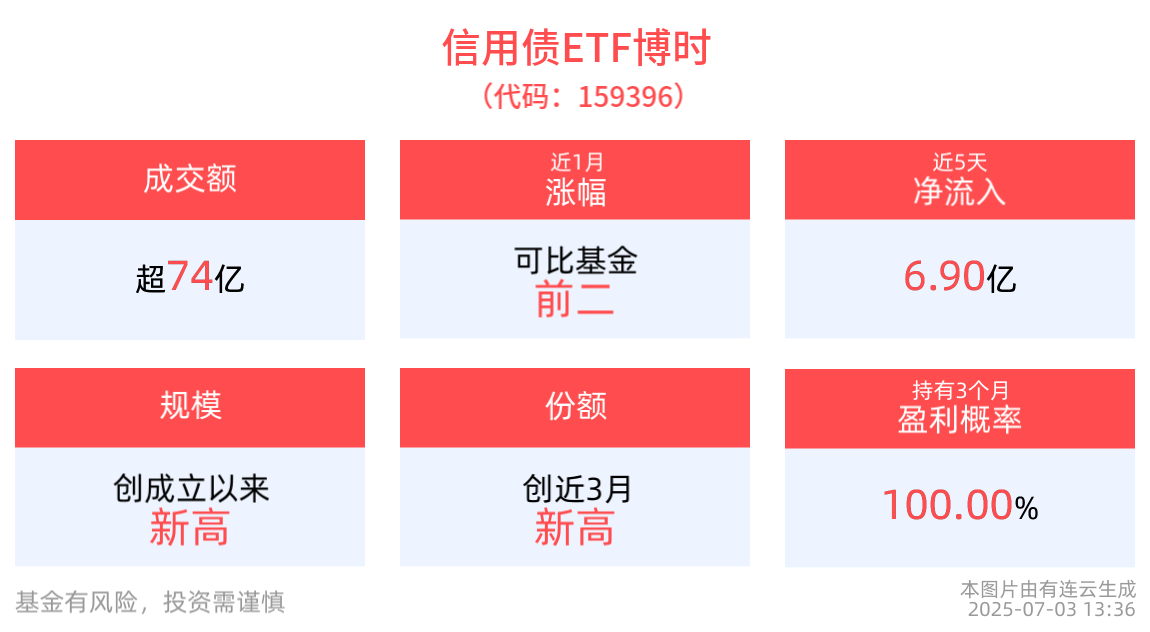
Core Viewpoint - The credit bond ETF Boshi (159396) shows positive performance and liquidity, with a recommendation for investors to focus on specific bond durations and types for potential gains [3][4]. Group 1: Performance Metrics - As of July 3, 2025, the credit bond ETF Boshi increased by 0.06%, with a latest price of 101.24 yuan [3]. - Over the past three months, the ETF has accumulated a rise of 1.16%, ranking 2nd out of 4 comparable funds [3]. - The ETF's latest scale reached 12.316 billion yuan, marking a new high since its inception, and it ranks 2nd among comparable funds [4]. - The ETF's share count reached 12.2 million, also a new high in the last three months, maintaining the 2nd position among comparable funds [4]. Group 2: Liquidity and Trading Activity - The ETF recorded a turnover rate of 60.27% during trading, with a transaction volume of 7.429 billion yuan, indicating active market participation [3]. - The average daily transaction volume over the past month was 4.678 billion yuan, ranking 1st among comparable funds [3]. Group 3: Fund Inflows and Returns - The ETF experienced a net inflow of 22.251 million yuan recently, with a total of 690 million yuan net inflow over the past five trading days, averaging 138 million yuan per day [4]. - Since its inception, the ETF has had a maximum consecutive monthly gain of 4 months, with a profit percentage of 80% and a profit probability of 73.12% [4]. - The ETF's Sharpe ratio for the past month was 1.06, placing it in the top 2 out of 4 comparable funds, indicating higher returns for the same level of risk [4]. Group 4: Risk and Fee Structure - The maximum drawdown since inception for the ETF was 0.89%, with a relative benchmark drawdown of 0.10% [4]. - The management fee for the ETF is 0.15%, and the custody fee is 0.05%, which are the lowest among comparable funds [4]. - The tracking error for the ETF year-to-date is 0.009%, indicating high tracking precision compared to similar funds [4]. Group 5: Market Context - The People's Bank of China reported liquidity injections in June, including a net injection of 535.9 billion yuan through short-term reverse repos [3]. - Industry experts remain optimistic about the overall credit bond market in 2025, suggesting a focus on 3-5 year bonds with higher valuations and liquidity for tactical trading [3].
收益、规模双丰收!盘一盘上半年优势ETF,你买对了吗?
Sou Hu Cai Jing· 2025-06-26 08:12
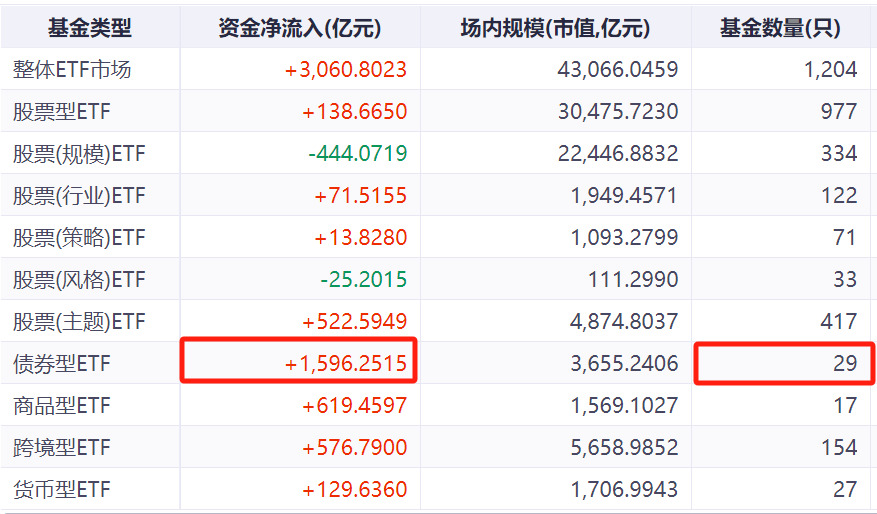
Core Insights - The overall ETF market has seen significant growth in both share and asset scale in the first half of 2025, with a total non-monetary ETF share of 4.3 trillion yuan, an increase of over 500 billion yuan since the beginning of the year [2][4]. Group 1: Bond ETFs - Bond ETFs emerged as the top-selling category in the first half of the year, with 29 funds contributing nearly 160 billion yuan in sales [2][3]. - The total net inflow for bond ETFs reached approximately 159.6 billion yuan, with the Hai Fu Tong Zhong Zheng Short-term Bond ETF (511360) leading with an inflow of nearly 19 billion yuan [4][5]. - The surge in bond ETF popularity is attributed to increased demand for stable returns amid an asset shortage, with investors favoring medium-term, high-rated credit bonds [5]. Group 2: Commodity ETFs - Commodity ETFs achieved a return of 20.48%, primarily driven by gold ETFs, which significantly outperformed other commodities [6][7]. - The largest gold ETF, Hua An Gold ETF (518880), saw inflows exceeding 20 billion yuan, more than double that of the second-largest [9]. - The rise in gold prices is linked to heightened market uncertainty and increased demand for safe-haven assets due to global geopolitical tensions [10]. Group 3: Cross-Border ETFs - Cross-border ETFs experienced an 18% increase, largely due to strong performance in Hong Kong stocks, particularly in the pharmaceutical, dividend, and technology sectors [11][12]. - The top-performing cross-border ETF, Fu Guo Zhong Zheng Hong Kong Stock Connect Internet ETF (159792), recorded a net inflow of nearly 19 billion yuan [12]. - The Hong Kong stock market's daily trading volume has reached a historical high, contributing to the strong performance of cross-border ETFs [13]. Group 4: Stock ETFs - Core broad-based stock ETFs, particularly the CSI 300 ETFs, have shown robust inflows, with the top two ETFs each exceeding 20 billion yuan in net inflows [14][15]. - The overall trend indicates a stable performance in the stock ETF market, supported by government interventions and a strong demand for core assets [16].
多只金融科技ETF大涨逾7%丨ETF晚报
2 1 Shi Ji Jing Ji Bao Dao· 2025-06-25 10:44
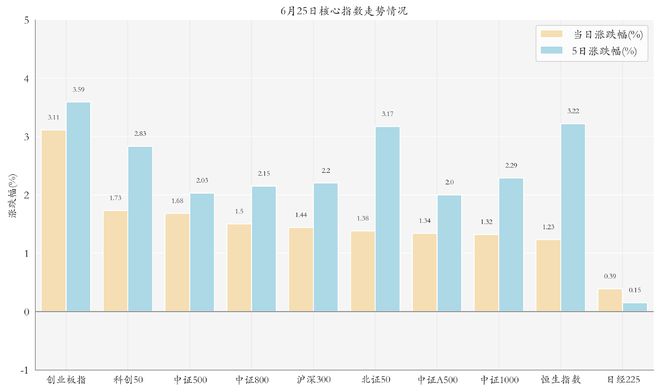
ETF Industry News - Major indices collectively rose, with several fintech ETFs experiencing significant gains, including Huaxia Fintech ETF (516100.SH) up 7.60%, and others also showing strong performance [1][11] - Stock ETFs have seen net inflows for eight consecutive trading days, with a total net inflow of 503 million yuan on June 24, driven by the resurgence of major stocks [2] - Credit bond ETFs have experienced explosive growth since 2025, with total market size surpassing 204.68 billion yuan, accounting for 57% of the entire bond ETF market, indicating a strong demand for stable income assets [3] Market Overview - On June 25, the three major indices rose, with the Shanghai Composite Index up 1.04% to 3455.97 points, Shenzhen Component Index up 1.72% to 10393.72 points, and the ChiNext Index up 3.11% to 2128.39 points [4] - In terms of sector performance, non-bank financials, defense, and computer sectors led the gains, while coal, oil, and transportation sectors lagged behind [6] ETF Market Performance - The overall performance of ETFs showed that industry-specific ETFs had the highest average increase of 1.72%, while currency ETFs had the lowest average change of -0.01% [9] - The top-performing ETFs included fintech ETFs, with Huaxia Fintech ETF (516100.SH) leading at 7.60% increase, followed closely by other fintech ETFs [12][11] - The trading volume for stock ETFs was led by the CSI 300 ETF (510300.SH) with a transaction amount of 6.841 billion yuan, followed by the Securities ETF (512880.SH) and the Sci-Tech 50 ETF (588000.SH) [14]
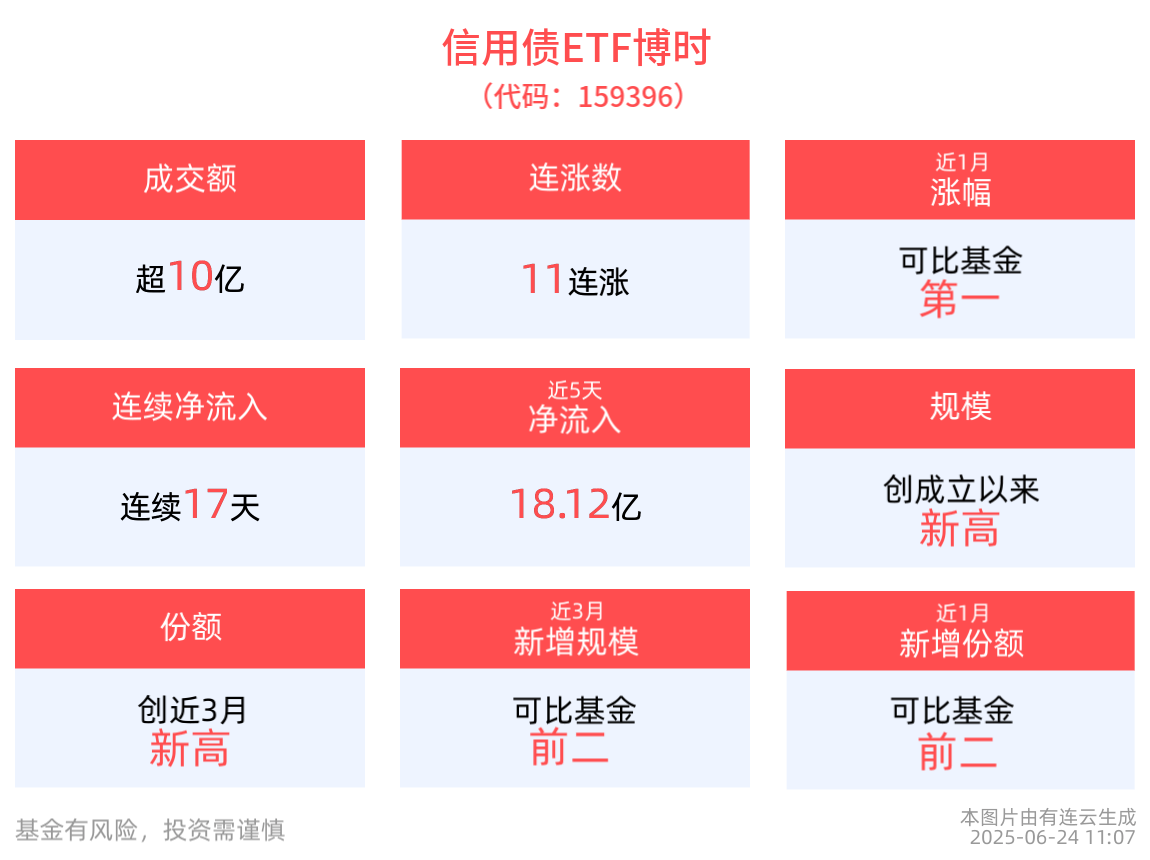
机构:信用债短期内发生调整的可能性较低,信用债ETF博时(159396)盘中飘红,成交额超10亿元
Sou Hu Cai Jing· 2025-06-24 03:22
Core Viewpoint - The credit bond ETF from Bosera has shown strong performance with significant inflows and trading volume, indicating a favorable market environment for credit bonds [3][4] Group 1: Performance Metrics - As of June 24, 2025, the Bosera credit bond ETF has increased by 0.03%, marking its 11th consecutive rise, with the latest price at 101.16 yuan [3] - The ETF has achieved a record high in scale, reaching 11.398 billion yuan, ranking 2nd among comparable funds [3] - The ETF's share count has reached 11.3 million, also a 3-month high, ranking 2nd among comparable funds [3] Group 2: Trading Activity - The ETF has seen a trading turnover of 9.28% during the day, with total transactions amounting to 1.059 billion yuan [3] - Over the past week, the ETF has averaged daily transactions of 5.633 billion yuan, leading among comparable funds [3] - The ETF has experienced continuous net inflows over the past 17 days, with a peak single-day inflow of 737 million yuan, totaling 3.793 billion yuan in net inflows [3] Group 3: Risk and Return Analysis - Since its inception, the ETF has recorded a maximum drawdown of 0.89%, with a recovery period of 26 days [4] - The ETF has a Sharpe ratio of 1.40 for the past month, ranking in the top 50% among comparable funds, indicating higher returns for the same level of risk [4] - The management fee is 0.15% and the custody fee is 0.05%, the lowest among comparable funds [4] Group 4: Investment Strategy - The ETF closely tracks the Shenzhen benchmark market-making credit bond index, reflecting the operational characteristics of the credit bond market in Shenzhen [4] - The company suggests focusing on medium to long-term credit bonds with maturities of 3-5 years while advising to control positions to mitigate interest rate fluctuations [3]
利率周报:债市或需重视下沉策略-20250623
Hua Yuan Zheng Quan· 2025-06-23 13:46
Group 1: Macroeconomic Overview - Shanghai will implement eight financial opening measures to enhance cross-border trade and investment facilitation [12] - In May 2025, the total retail sales of consumer goods reached 4.1 trillion yuan, a year-on-year increase of 6.4%, with a month-on-month acceleration of 1.3 percentage points [12] - From January to May, national fixed asset investment (excluding rural households) was 19.2 trillion yuan, a year-on-year increase of 3.7%, with a slowdown of 0.3 percentage points compared to the previous four months [12] Group 2: Consumer and Production Trends - The passenger car market continues to show high growth, with average daily retail and wholesale numbers increasing by 22.7% and 38.0% year-on-year, respectively [17][19] - The film market saw a decline in box office revenue, with a year-on-year decrease of 9.5% as of June 20 [19] - The construction chain shows insufficient recovery momentum, with the total transaction area of commercial housing in 30 cities down by 4.4% year-on-year, although the number of transactions increased by 12.8% [18][61] Group 3: Commodity Prices - Agricultural product prices are under pressure, with the average wholesale price of pork down by 17.8% year-on-year, while the average price of six key fruits increased by 7.0% [77][79] - Industrial products generally declined, with the average price of thermal coal down by 29.9% year-on-year, and the average price of rebar down by 13.1% [85][87] Group 4: Bond Market and Institutional Behavior - As of June 20, the yields on 1-year, 5-year, 10-year, and 30-year government bonds were 1.36%, 1.50%, 1.64%, and 1.84%, respectively, showing a decline compared to June 13 [100] - The average duration of long-term bond funds has risen to approximately 5.0 years, reflecting a shift in institutional strategies towards long-duration investments [110][115] - The average duration of credit bond funds remains stable at around 2.3 years, indicating a focus on structural opportunities as credit spreads compress [111][115]
车企缩短账期,供应链现金流改善
HTSC· 2025-06-23 11:39
Report Summary 1. Industry Investment Rating There is no industry investment rating provided in the report. 2. Core Viewpoints - The commitment of 17 key automakers to shorten the payment period to suppliers within 60 days is a positive response to the "Regulations on Ensuring Payment for Small and Medium - sized Enterprises", which helps to alleviate market concerns about automakers' repayment ability and promotes the healthy development of the industry [2][10][11]. - For automakers, the shortened payment period has limited impact on cash - flow as they have sufficient bank credit. For component manufacturers, it can improve capital turnover, increase cash on hand, and potentially reduce impairment losses and improve profitability [2][13][15]. - The bond market shows that under the central bank's support, the mid - to long - term credit bonds remain strong. The issuance sentiment of credit bonds is warming up, and the secondary trading of short - duration bonds is active with a slight increase in long - duration trading [3][52][62]. 3. Summary by Directory 3.1 Credit Hotspot: Automakers Shortening Payment Periods - 17 key automakers, including BYD, Geely, FAW, etc., promised to unify the supplier payment period within 60 days. SAIC and BAIC additionally promised not to use commercial acceptance bills, while FAW and Jianghuai promised to streamline approval processes [10]. - As of June 22, 2025, there are 8 automaker bond - issuing entities with a cumulative outstanding bond scale of 66.9 billion yuan, and 4 component bond - issuing entities with a cumulative outstanding bond scale of 4 billion yuan [11]. - For automakers, although the shortened payment period may have a short - term impact on operating cash - flow, the cash - flow pressure is limited due to their good credit and sufficient unused bank credit. For example, if the accounts payable and notes turnover rate is adjusted to 6, the capital gap of most automakers is about 50 billion yuan, and Geely Holding Group's gap exceeds 100 billion yuan [13][15]. - For component manufacturers, the shortened payment period can improve capital turnover and cash on hand. On average, component companies may receive 3.5 billion yuan in additional monetary funds, which can enhance operational flexibility and risk - resistance ability [15]. - In terms of bond - issuing entity spreads, the industry spread of industrial bonds consists of liquidity premium and credit risk premium. In the short term, the commitment benefits component manufacturers more, and some high - spread entities may see a narrowing of spreads. Automakers' spreads are mainly affected by liquidity premium [20]. 3.2 Market Review - From June 6 to June 13, 2025, the monetary policy expectations at the Lujiazui Forum were not met, but the central bank maintained a loose tax - period capital environment. The mid - to long - term credit bonds remained strong, with yields of 7 - 10Y varieties mostly falling by more than 4BP. Some spreads increased slightly due to the strong performance of interest - rate bonds [3][27]. - The yields of Tier 2 and perpetual bonds also generally declined, with 5 - 10Y yields falling by about 4BP. The median spreads of public bonds in various industries showed mixed trends, and the median spreads of urban investment bonds in most provinces declined, with Inner Mongolia's spread dropping by more than 4BP [3][27]. 3.3 Primary Issuance - From June 16 to June 20, 2025, corporate credit bonds issued a total of 334.7 billion yuan, a slight 4% decrease from the previous period; financial credit bonds issued a total of 173 billion yuan, a 61% increase from the previous period. The net financing of corporate credit bonds was 28.7 billion yuan, with urban investment bonds having a net repayment of 26.5 billion yuan and industrial bonds having a net financing of 59.6 billion yuan [4][52]. - The issuance of credit bonds continued to recover after holiday factors and annual report updates. The average issuance rates of medium - short - term notes and corporate bonds showed a downward trend [4][52]. 3.4 Secondary Trading - Active trading entities are mainly medium - to high - grade, medium - short - term, and central and state - owned enterprises. Urban investment bond trading is mainly concentrated in high - grade platforms in economically strong provinces and core platforms in high - spread areas of large economic provinces. Real - estate bond trading is mainly AAA - rated with a maturity of 1 - 3 years, and private enterprise bond trading is also mainly AAA - rated with medium - short maturities [5][62]. - The proportion of trading volume of urban investment bonds with a maturity of over 5 years increased slightly from 0% to 2% compared to the previous week [5][62].




平安债券ETF三剑客集体上涨,公司债ETF(511030)最新规模突破200亿元,国债ETF5至10年(511020)冲击7连涨
Sou Hu Cai Jing· 2025-06-23 02:21
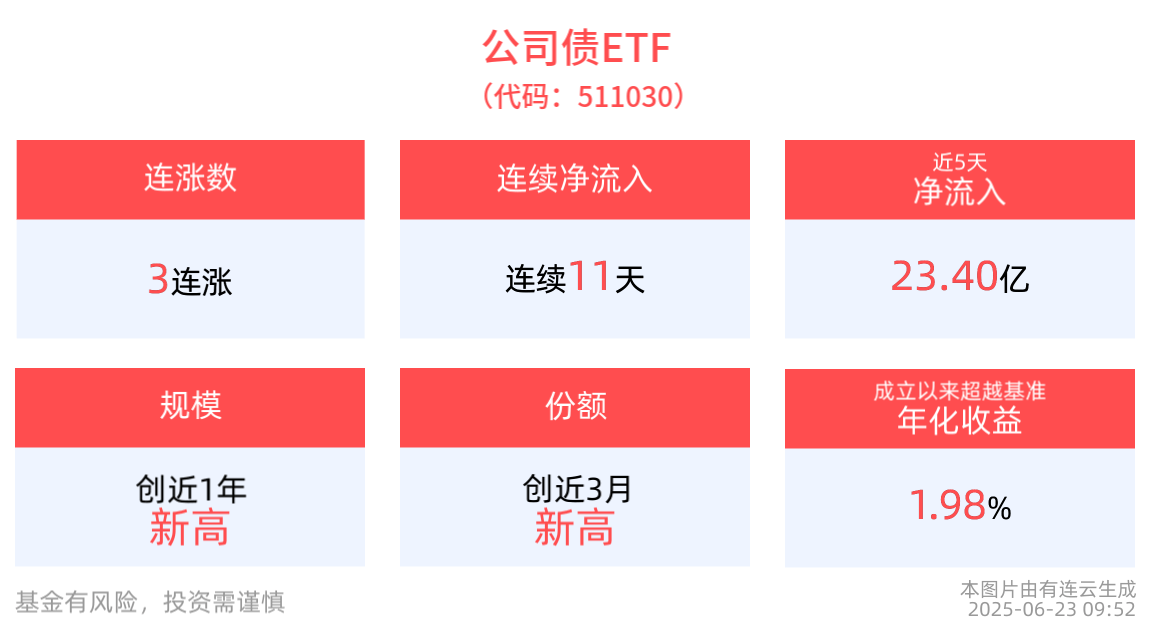
Group 1: Company Bond ETF Performance - The Company Bond ETF (511030) has increased by 0.01%, marking its third consecutive rise, with the latest price at 106.06 yuan [1] - Over the past year, the Company Bond ETF has accumulated a total increase of 2.18% [1] - The latest scale of the Company Bond ETF reached 20.774 billion yuan, a new high in nearly one year [1] - The Company Bond ETF has seen continuous net inflows for 11 days, with a maximum single-day net inflow of 1.538 billion yuan, totaling 5.212 billion yuan in net inflows, averaging 474 million yuan per day [1] Group 2: National Debt ETF Performance - The National Debt ETF for 5 to 10 years (511020) has risen by 0.02%, achieving its seventh consecutive increase, with the latest price at 117.65 yuan [4] - The latest scale of the National Debt ETF for 5 to 10 years is 1.433 billion yuan [4] Group 3: National Development Bond ETF Performance - The National Development Bond ETF (159651) has increased by 0.01%, marking its fifth consecutive rise, with the latest price at 106.22 yuan [6] - The latest scale of the National Development Bond ETF is 1.029 billion yuan [7] Group 4: Market Insights and Future Outlook - Recent strong performance in credit bonds is attributed to several factors, including stable funding rates maintained by the central bank through various operations [7] - The rapid growth of bank wealth management products in April and May has led to significant buying pressure in the market [7] - The insurance sector has seen a rebound in premium income growth, contributing to increased buying power in the market [7] - The market is currently at a critical point, with enthusiasm for long positions in 20-year and 50-year national bonds [8] - Technical indicators suggest a potential for a pullback after an initial rise, with a focus on maintaining liquidity as yields and spreads compress [8] - The "Three Musketeers" of bond ETFs from Ping An Fund include the Company Bond ETF, National Development Bond ETF, and National Debt ETF for 5 to 10 years, covering various durations to help investors navigate the bond market cycle [8]
渤海证券研究所晨会纪要(2025.06.18)-20250618
BOHAI SECURITIES· 2025-06-18 01:38
Macro and Strategy Research - The economic data for May 2025 shows that the industrial added value increased by 5.8% year-on-year, which is lower than the expected 6.0% and the previous value of 6.1% [3] - The retail sales of consumer goods increased by 6.4% year-on-year, surpassing the expected 4.9% and the previous value of 5.1% [3] - Fixed asset investment accumulated a year-on-year growth of 3.7%, below the expected 4.1% and the previous value of 4.0% [3] - The decline in industrial added value is attributed to fewer working days and a lag in production due to tariff adjustments, particularly affecting labor-intensive industries like textiles [3] - The service sector's production index grew by 6.2%, indicating a slight improvement from April [3] Consumption Growth Challenges - The significant rise in retail sales is driven by holiday consumption and promotional activities, reaching a new high in nearly a year [4] - Automotive sales increased by 11.2% year-on-year, but overall sales revenue growth is limited due to pricing factors [4] - Future consumption may struggle to maintain current levels due to policy adjustments and potential overconsumption [4] Investment Needs Policy Support - Fixed asset investment growth has declined for two consecutive months, with manufacturing investment decreasing by 0.4 percentage points to 7.8% year-on-year [4] - Ten out of twelve sub-sectors in manufacturing saw a slowdown in investment growth, particularly in transportation equipment and non-ferrous metal smelting [4] - Infrastructure investment growth decreased to 9.3%, with local debt pressures limiting project funding [5] - Real estate investment saw a significant decline, with sales in major cities dropping and funding sources for real estate companies decreasing by 10.5% year-on-year [5] Fixed Income Research - The overall issuance rates for credit bonds have mostly decreased, with a range of -7 basis points to 6 basis points [7] - The net financing amount for credit bonds has decreased, with corporate bonds and short-term financing bonds seeing an increase in net financing [7] - The secondary market for credit bonds has seen a significant increase in transaction volume, with most varieties experiencing growth [7] - The credit spreads for medium and short-term notes, corporate bonds, and urban investment bonds have generally narrowed [7] Industry Research - The metal industry is experiencing traditional seasonal characteristics, with demand expected to decline as summer approaches [15] - Steel prices are expected to remain weak due to increasing inventory pressures [15] - Copper prices are supported by tight supply and low inventory, but lack upward momentum in the short term [15] - Gold prices are bolstered by international trade tensions and geopolitical factors, with a need to monitor macroeconomic data and interest rate expectations [15] - The lithium market faces oversupply issues, leading to expected price weakness [15]





2025年5月金融数据点评:信贷需求偏弱,但社融增速平稳
Hua Yuan Zheng Quan· 2025-06-15 09:22
Group 1: Report Investment Rating - No industry investment rating is provided in the report. Group 2: Core Viewpoints - The credit demand is weak, but the growth rate of social financing is stable. The new loans in May 2025 decreased year-on-year, reflecting weak credit demand and the impact of implicit debt replacement. The growth rate of M2 was stable month-on-month, and the growth rate of M1 rebounded. The social financing in May increased year-on-year, and the growth rate of social financing was stable. It is expected that the new loans in 2025 will increase slightly year-on-year, the net financing of government bonds will expand significantly year-on-year, the social financing will increase significantly year-on-year, and the growth rate of social financing may rise first and then fall, with an estimated year-end growth rate of about 8.3%. Interest rate bonds may experience narrow fluctuations in stages, and 5Y credit bonds with a yield of more than 2% are favored [1][2]. Group 3: Summary by Relevant Catalog Credit Demand Analysis - In May 2025, the new loans decreased year-on-year, reflecting weak credit demand and the impact of implicit debt replacement. The new individual loans were +540 million, including -208 million in short-term individual loans and +746 million in medium - and long - term individual loans, with a slight year-on-year increase. The new short - term corporate loans were +1.1 billion, the new medium - and long - term corporate loans were +3.3 billion, and the bill financing was +746 million. Due to low capacity utilization in manufacturing, weak real estate investment, and limited infrastructure investment space, credit demand may be weak in the long term [2]. M1 and M2 Analysis - Since January 2025, the central bank has adopted a new M1 caliber, which further includes personal current deposits and customer reserves of non - bank payment institutions on the basis of the previous M1. As of the end of May 2025, the balance of the new - caliber M1 reached 108.9 trillion yuan. In May, the growth rate of the new - caliber M1 was 2.3%, a month - on - month increase of 0.8 percentage points, and the growth rate of M2 was 7.9%, a month - on - month decrease of 0.1 percentage points. The growth rates of both the new and old M1 calibers have significantly rebounded since Q4 2024, reflecting an improvement in economic activity [2]. Social Financing Analysis - In May 2025, the social financing increment was 2.29 trillion yuan, a significant year - on - year increase of 0.22 trillion yuan, mainly from the net financing of government bonds and corporate bonds. The increment of RMB loans to the real economy was 59.6 billion yuan, a year - on - year decrease of 22.37 billion yuan; the undiscounted bank acceptance bills were - 11.62 billion yuan; the net financing of corporate bonds was +14.96 billion yuan; the net financing of government bonds was 1.46 trillion yuan, a year - on - year increase of 23.67 billion yuan. The growth rate of social financing at the end of May was 8.7%, the same as at the end of the previous month and 0.7 percentage points higher than at the beginning of the year [2]. Bond Investment Suggestion - Interest rate bonds may experience narrow fluctuations in stages, and 5Y credit bonds with a yield of more than 2% are favored. The reduction of long - term time deposit interest rates of major banks in May 2025 is beneficial to credit bonds. The reduction of deposit interest rates is expected to promote the growth of wealth management scale, and the wealth management scale may increase significantly in July, further compressing credit spreads. In 2025, bond market investment needs to be cautious, and attention should be paid to stock and convertible bond investment opportunities and Hong Kong - listed bank stocks [2].