
工程师红利

Search documents
全球第一!“深圳-香港-广州”创新集群首次登顶
Xin Hua She· 2025-09-01 14:40
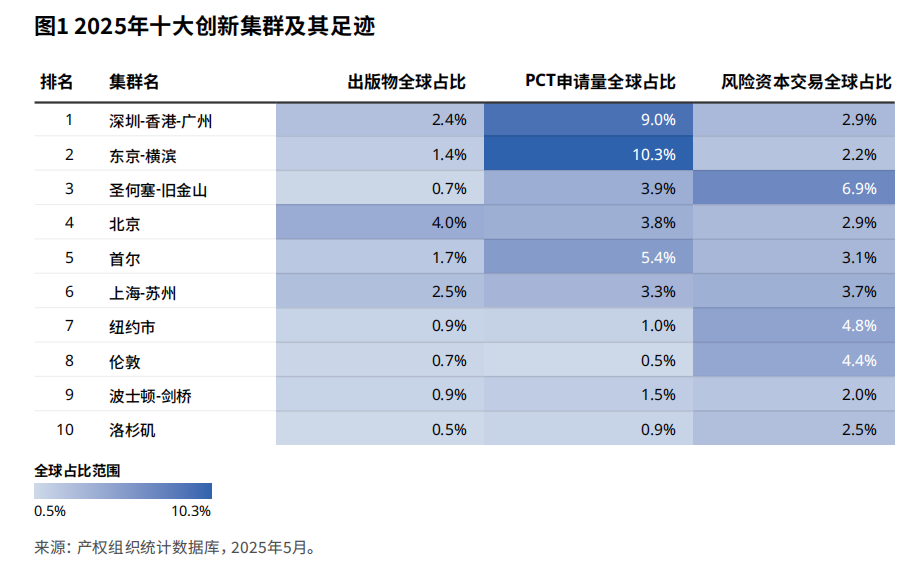
科技部副部长陈家昌致辞说,香港拥有顶尖的科研机构、国际化的人才队伍和完善的知识产权体系,是 全球创新网络的关键枢纽。中国中央政府全力支持香港特别行政区加快建设国际创新科技中心,参与粤 港澳大湾区、河套深港科技创新合作区建设,与内地珠联璧合、双向赋能。 在今年的排名中,"东京-横滨"集群和美国"圣何塞-旧金山"集群分列第二和第三。此前,"深圳-香港-广 州"创新集群曾连续五年位居全球第二位。 新华财经香港/深圳9月1日电(记者曹霁阳、陈宇轩、胡林果)世界知识产权组织1日在香港发布 《2025年全球创新指数》百强创新集群,"深圳-香港-广州"创新集群首次排名全球第一。 该排名通过三项核心指标,即《专利合作条约》(PCT)提交的国际专利申请量、科学论文发表量,以 及今年新增的风险资本交易量,来识别世界级创新活动在当地的集中程度。 国家知识产权局副局长张志成在发布活动上致辞表示,"深圳-香港-广州"创新集群在全球百强创新集群 中连续多年位居前列,彰显了中国的创新活力。世界知识产权组织此次选择在中国香港特区发布世界百 强创新集群排名,充分体现了粤港澳大湾区创新集群在全球的代表性,也证明了中国在科技创新方面的 迅速发展进 ...
“深圳—香港—广州” 跃居全球创新集群首位
2 1 Shi Ji Jing Ji Bao Dao· 2025-09-01 09:00
Core Viewpoint - The "Shenzhen-Hong Kong-Guangzhou" innovation cluster has surpassed the "Tokyo-Yokohama" cluster to become the top global innovation cluster according to the Global Innovation Index (GII) released by the World Intellectual Property Organization (WIPO) [1] Group 1: Innovation Cluster Rankings - The GII cluster ranking was established in 2017 and is based on three core indicators: international patent applications via the Patent Cooperation Treaty (PCT), scientific publications, and the newly added venture capital (VC) transaction volume [1] - The "Shenzhen-Hong Kong-Guangzhou" cluster has ranked second globally for five consecutive years before this year, when the inclusion of VC transactions reshaped the rankings [1] - In 2025, the "Shenzhen-Hong Kong-Guangzhou" cluster is projected to account for 2.9% of global VC transactions, compared to 2.2% for the "Tokyo-Yokohama" cluster [1] Group 2: Performance Metrics - The "Shenzhen-Hong Kong-Guangzhou" cluster holds a global share of 9.0% in PCT applications, ranking second, with Huawei being the top applicant [2][4] - The cluster also has a global share of 2.4% in scientific publications, totaling 194,000 papers, with Sun Yat-sen University being the leading institution [4] - Shenzhen has maintained the highest PCT international patent application volume in China for 21 consecutive years, with 16,300 applications projected for 2024 [4] Group 3: Human Capital and Innovation Ecosystem - The region has successfully transitioned its development engine to focus on high-quality human capital, referred to as the "engineer dividend," to effectively address the "Lewis Turning Point" [4] - The accumulation of large-scale, high-quality human capital, combined with an effective corporate innovation ecosystem, is expected to unleash greater innovation momentum and economic value [4] - Hong Kong's innovation and technology development has seen significant progress, with Huawei's research team in Hong Kong growing to over 700 members [5]

从“链”与“炼”看“工程师红利”
Ren Min Wang· 2025-08-25 08:40
Core Insights - The total number of engineers in China increased from approximately 5.2 million in 2000 to about 17.7 million in 2020, indicating a significant "engineer dividend" [1] Group 1: Formation of Engineer Dividend - The "chain" aspect refers to the establishment of 32 National Excellent Engineer Colleges, the introduction of interdisciplinary subjects, and the promotion of "new engineering" education, which connects the education chain with the talent chain [1] - The "refinement" aspect highlights the practical training in major engineering projects like the "Jiang Hai" project, where engineers gain hands-on experience and tackle technical challenges in emerging strategic industries [1] Group 2: Future Outlook - There remains a notable gap in high-level engineers in China, emphasizing the need to cultivate a robust environment for engineer development [1] - Accelerating the construction of a large-scale team of excellent engineers will provide stronger support for nurturing new productive forces and promoting high-quality development [1]
从“链”与“炼”看“工程师红利”(快评)
Ren Min Ri Bao· 2025-08-24 22:01
Core Insights - The total number of engineers in China increased from approximately 5.2 million in 2000 to about 17.7 million in 2020, indicating a significant growth in the engineering workforce [1] Group 1: Talent Development - The formation of a large "engineer dividend" is attributed to the integration of education and talent chains, exemplified by the establishment of 32 National Excellent Engineer Colleges and the promotion of "new engineering" education [1] - Collaboration between schools and enterprises for order-based training emphasizes the connection between industry and innovation chains, facilitating talent cultivation [1] Group 2: Practical Experience - Major engineering projects, such as the "Jiang Hai" project, provide real-world training opportunities that enhance engineers' skills through hands-on experience [1] - The rich practical scenarios in emerging industries serve as a classroom for engineers, fostering their growth and development [1] Group 3: Future Outlook - Despite the growth in the engineering workforce, there remains a significant gap in high-level engineers, highlighting the need for continued investment in talent development [1] - Strengthening the foundation for engineers' growth and accelerating the construction of a large-scale team of excellent engineers will support the cultivation of new productive forces and promote high-quality development [1]
林园:坚守“嘴巴”赛道 老龄化将催生医药需求十倍扩容,我们提前市场15年布局
Xin Lang Ji Jin· 2025-08-21 07:19
Group 1 - The core viewpoint is that leading consumer companies in China have the ability to withstand economic cycles, with A-share consumer leaders still having relatively low valuations compared to their foreign counterparts [1] - The focus remains on "mouth-related" consumption themes, particularly in basic consumer goods like food and beverages, as well as essential products in the pharmaceutical sector [1] - These industries share a common characteristic of controllable inventory, allowing companies to adjust supply flexibly based on actual market demand [1] Group 2 - In the pharmaceutical sector, two main directions are highlighted: innovative drugs and traditional Chinese medicine (TCM) [2] - The innovative drug market in China is expected to grow significantly due to the "engineer dividend," with domestic companies having room for growth compared to global giants [2] - TCM is also experiencing innovation, with traditional formulas being re-evaluated for new uses, particularly as the aging population increases demand for these products [2] Group 3 - The market for chronic disease medications is projected to grow tenfold in the next twenty years, especially among the elderly population [2] - The core logic for optimism in the pharmaceutical sector is the aging population, which is associated with a rise in diseases like cardiovascular issues and kidney problems [2] - The current stage of the industry is seen as just the beginning, with significant potential for companies to emerge as global leaders in market capitalization [3]
市场新高下的投资抉择:林园直言医药板块“还没真正开始” 核心逻辑仍是老龄化与“嘴巴”
Xin Lang Ji Jin· 2025-08-21 07:16
Group 1 - The current market sentiment is optimistic, with the Shanghai Composite Index approaching 3800 points, leading investors to question the sustainability of the rally and investment strategies [1] - Leading consumer companies in A-shares are well-positioned to navigate economic cycles, with valuations still relatively low compared to similar companies abroad [1] - The focus on "mouth-related" consumption sectors, particularly food and beverage, as well as essential medical products, is emphasized due to their controllable inventory levels [1] Group 2 - In the pharmaceutical sector, two main directions are highlighted: innovative drugs and traditional Chinese medicine (TCM) [2] - The innovative drug market in China is expected to grow significantly, supported by a strong talent pool and relatively low costs, with current valuations remaining attractive [2] - TCM is experiencing innovation and revaluation, particularly as the aging population increases demand for these products, which are effective for symptom relief [2] Group 3 - The pharmaceutical industry is still in its early stages, with market awareness not fully developed, suggesting potential for significant future growth [3] - Companies in this sector may emerge as global leaders in market capitalization, with the current investment opportunity representing a chance to get ahead of market recognition by approximately 15 years [3] - The potential for growth in this industry is substantial, driven by an increasing consumer base and the aging population [3]
中国汽车全球化系列报告(6):汽车出海:量化测算工程师红利对企业盈利的贡献
Shenwan Hongyuan Securities· 2025-08-21 03:39
Investment Rating - The report maintains a positive outlook on companies with global capabilities, including BYD, Geely, Great Wall, SAIC, and Changan, as well as companies like Li Auto, Xpeng, and NIO that have strong product definition capabilities in smart electric vehicles [4][5][6]. Core Insights - Since 2020, China's automobile export volume has rapidly increased, reaching 6.41 million units in 2024, making it the world's largest exporter, with a year-on-year growth of 22.7%. In the first half of 2025, exports continued to grow by 10.4%, totaling 3.08 million units [5][10][13]. - Chinese automakers are accelerating overseas localization to avoid tariffs and reduce costs, with brands like BYD, Changan, and Geely establishing factories abroad and localizing operations [5][15]. - Chinese automakers benefit from high research and investment efficiency, leading to significant cost advantages. In 2024, the average R&D amortization per vehicle for Chinese companies was 7,660 yuan, significantly lower than foreign companies [3][35]. Summary by Sections 1. Export Growth and Globalization - The export of complete vehicles has seen rapid growth, with a monthly export volume increasing from 70,000 units in early 2020 to 550,000 units by May 2025, a nearly sevenfold increase. In 2024, exports surpassed Japan, marking a significant milestone [10][13]. - Major markets for Chinese automobile exports include Russia (1.158 million units), Mexico (445,000 units), and emerging markets like the UAE and Brazil, which saw over 100% growth [13][15]. 2. Profitability Analysis - The report highlights that Chinese automakers achieve significant excess profits due to their R&D and investment efficiency. For instance, the net profit per vehicle for Chinese companies is 11,217 yuan, compared to 4,349 yuan for foreign companies [3][5]. - The report anticipates that by 2030, overseas sales of Chinese automobiles could exceed 10 million units, with local production becoming the mainstream approach [3][5]. 3. R&D and Investment Efficiency - Chinese automakers have a shorter new model development cycle of about 18 months, which is half that of foreign companies. This efficiency allows for quicker market responses and reduced R&D costs [35][43]. - The average depreciation and amortization per vehicle for Chinese companies in 2024 was 8,901 yuan, significantly lower than that of foreign brands, which often exceed 14,000 yuan [47][50]. 4. Localization and Supply Chain Trends - The trend towards localization is driven by the need to mitigate tariff impacts and optimize supply chains. Chinese parts manufacturers are increasingly establishing production facilities in key regions like Mexico and Southeast Asia [24][27]. - The report emphasizes that local production can eliminate high import tariffs, making it a more sustainable profit engine compared to exporting [30][32].




中国汽车全球化系列报告(6):汽车出海:量化测算工程师红利对企业盈利的贡献
Shenwan Hongyuan Securities· 2025-08-21 02:12
Investment Rating - The report maintains a positive outlook on Chinese automotive companies with global capabilities, including BYD, Geely, Great Wall, SAIC, and Changan, as well as companies like Li Auto, Xpeng, and NIO that have strong product definition capabilities in smart electric vehicles [4][3]. Core Insights - Since 2020, China's automotive export volume has rapidly increased, reaching 6.41 million units in 2024, making it the world's largest exporter, with a year-on-year growth of 22.7%. In the first half of 2025, exports continued to grow by 10.4%, totaling 3.08 million units [3][5]. - Chinese automotive companies are accelerating overseas localization to avoid tariffs and reduce costs, with brands like BYD, Changan, and Geely establishing factories abroad [3][20]. - Chinese companies benefit from high research and investment efficiency, leading to significant cost advantages. In 2024, the average R&D amortization per vehicle for Chinese companies was 7,660 yuan, significantly lower than foreign companies [3][39]. - The report predicts that from 2021 to 2030, the export market will evolve in three phases, with southern markets (Middle East, ASEAN) becoming the core growth area, expected to account for 65.7% by 2027 [3][4]. Summary by Sections 1. Domestic Exports & Overseas Factories - The automotive export volume has seen a significant increase, with monthly exports reaching 550,000 units by May 2025, a nearly sevenfold increase since early 2020 [14]. - In 2024, Russia was the largest market for Chinese automotive exports, with 1.158 million units, followed by Mexico with 445,000 units [17][3]. - Chinese brands are rapidly increasing their global presence, with BYD leading the growth in the first half of 2025, exporting 472,000 units, a 128% increase [17][3]. 2. Profitability Analysis of Overseas Expansion - The report highlights that the profitability of Chinese automotive companies is driven by localization, which allows them to avoid high import tariffs and reduce logistics costs [30][33]. - Local production in Europe can increase profit margins significantly compared to exporting, with examples showing profit margins improving by over 7 percentage points [33][30]. 3. Excess Returns Analysis for Chinese Automotive Companies - Chinese automotive companies are achieving excess returns due to their R&D and investment efficiencies, with net profits per vehicle significantly higher than foreign competitors [3][39]. - The report suggests that if overseas operations replicate domestic management models, excess returns could reach 26,000 yuan per vehicle under optimistic assumptions [3][39]. 4. Key Conclusions and Investment Recommendations - The report recommends investing in companies with strong global capabilities and those excelling in smart electric vehicle product definitions, such as BYD, Geely, Great Wall, SAIC, Changan, Li Auto, Xpeng, and NIO [4][3].

华尔街“大空头”突然转向!大手笔买入阿里京东看涨期权,虎牙年内暴涨24倍
Sou Hu Cai Jing· 2025-08-18 23:11
Group 1 - Michael Burry's investment strategy has dramatically shifted, indicating a fundamental reversal in Wall Street's attitude towards Chinese assets [2] - Burry's Scion Asset Management sold all put options on Chinese stocks like Alibaba and JD.com, while actively buying call options, contrasting sharply with his previous strategy [2] - The strong rebound of Chinese stocks in recent months has significantly influenced Burry's investment decisions, leading to a complete turnaround from a bearish to a bullish stance [2][4] Group 2 - The resurgence of Chinese stocks has been remarkable, with companies like Huya seeing a price increase of over 2400%, and major players like Alibaba and JD.com also showing substantial gains of 46.47% and 31.70% respectively [4] - International capital is reassessing the resilience of the Chinese economy, with Goldman Sachs reporting a peak interest in Chinese assets among global investors [5] - Several foreign institutions are expressing positive views on Chinese assets, citing advantages such as a complete modern industrial system and breakthroughs in technology sectors like AI and semiconductors [7] Group 3 - Burry's shift reflects a broader recognition of China's economic potential and resilience, suggesting a more open and dynamic Chinese market that will attract more international capital [9] - Analysts highlight that liquidity and long-term policy expectations are key drivers of the recent A-share market rally, with rising market risk appetite enhancing profit opportunities [7] - Investors are advised to maintain holdings in the current favorable valuation environment while being cautious about blindly chasing market trends [7]



惠理投资盛今:中国资产具备多重核心竞争优势
Shang Hai Zheng Quan Bao· 2025-08-17 13:36
Core Viewpoint - The Hong Kong stock market has shown strong performance this year, driven by multiple core competitive advantages of Chinese assets, which are expected to enhance their attractiveness to international capital [1][2]. Group 1: Factors Driving Hong Kong Stock Market Strength - Three main factors are identified as driving the strength of the Hong Kong stock market: the "hard technology" wave, the rise of the "new economy," and the weakening of the US dollar [2]. - The "hard technology" revolution is expected to bring profound changes to production and lifestyle, with leading Chinese internet companies poised to capitalize on AI applications [2]. - The "new economy" has become a pillar of the Hong Kong stock market, with its market capitalization share increasing from 27% at the end of 2015 to an expected 51% by the end of 2024 [2]. - The weakening US dollar has led to a reallocation of funds, with a slowdown in foreign capital outflow from the Hong Kong market, making it an attractive option for global capital seeking undervalued assets [2]. Group 2: Core Competitive Advantages of Chinese Assets - Chinese assets possess three core competitive advantages: a complete modern industrial system, increased R&D investment leading to brand premium, and significant long-term investments in core technology fields [3]. - The manufacturing sector in China has achieved low-cost, high-efficiency capabilities through vertical integration and scale advantages [3]. - Chinese companies are increasingly recognized for their global competitiveness in areas such as AI, semiconductors, new energy, and aerospace [3]. Group 3: Investment Opportunities in A-Share Market - The A-share market presents four key investment opportunities: stable cash returns in sectors like telecommunications, finance, and utilities; potential in the internet sector and consumer sub-industries due to policy support and AI commercialization; growth in the biopharmaceutical industry driven by improved policies and global competitiveness; and a stabilization in the real estate sector along with improved prospects for chemicals and raw materials [3].