
系统性风险

Search documents
沪胶,偏弱运行
Bao Cheng Qi Huo· 2025-10-10 07:07
Report Industry Investment Rating - Not provided Core Viewpoints of the Report - After the National Day holiday, the domestic Shanghai rubber futures 2601 contract showed a rebound after over - decline, but the futures price was under the reverse suppression of the 5 - day moving average, and the short - and medium - term moving averages showed an obvious short - selling trend. It is expected that the Shanghai rubber will continue to run weakly in the future. The bullish expectations at the industrial level are difficult to resist the bearish sentiment in the macro - environment, and the Shanghai rubber 2601 contract is expected to maintain a volatile and weak trend [2][9] Summary by Relevant Catalogs Impact of US Government Shutdown - Due to the failure of the US Senate to pass a new temporary appropriation bill on October 6, the US government shutdown continued. The 35 - day shutdown from late 2018 to early 2019 caused a loss of $3 billion to GDP. It is estimated that each week of the current shutdown will reduce the economic growth rate by about 0.15 percentage points, and may reduce it by 0.2 percentage points when the impact on private institutions is included. The shutdown has a major impact on the economy and demand, and drags down the price trend of commodities, which also has a negative impact on Shanghai rubber futures [2] Supply and Demand in the Rubber Market - **Supply**: Currently, both domestic and foreign natural rubber producing areas are in the peak tapping season, especially the Southeast Asian main producing areas. The supply pressure is steadily increasing. In August, the total rubber production of ANRPC member countries was 1.0787 million tons, a month - on - month increase of 10,500 tons. From January to August, the total rubber production reached 6.8536 million tons, a year - on - year increase of 65,000 tons, or 0.96%. Thailand, the world's largest rubber producer, had a total rubber production of 2.8158 million tons in the first 8 months of this year, a year - on - year increase of 81,900 tons, or 3.00%. Its total export volume from January to August was 2.7569 million tons, a year - on - year increase of 200,600 tons, or 7.85% [4][6] - **Demand**: Affected by the slowdown of the world economic growth due to the global tariff war, the rubber consumption market has cooled down. In August, the total consumption of ANRPC member countries was 899,900 tons, a month - on - month decrease of 17,100 tons, and a year - on - year decrease of 44,200 tons, or 4.68%. From January to August, the total consumption was 7.1751 million tons, a significant year - on - year decrease of 267,600 tons, or 3.60%. Overall, the rubber market shows a pattern of strong supply and weak demand [8] Impact of Typhoon "Maideme" - Typhoon "Maideme" landed and hit the northern part of Hainan Province and the southwestern part of Guangdong Province in China, which are important rubber - planting areas. It may bring a production reduction expectation, which in turn supports the stabilization of the Shanghai rubber futures price. However, the bullish expectation at the industrial level is difficult to resist the bearish sentiment in the macro - environment [8][9]
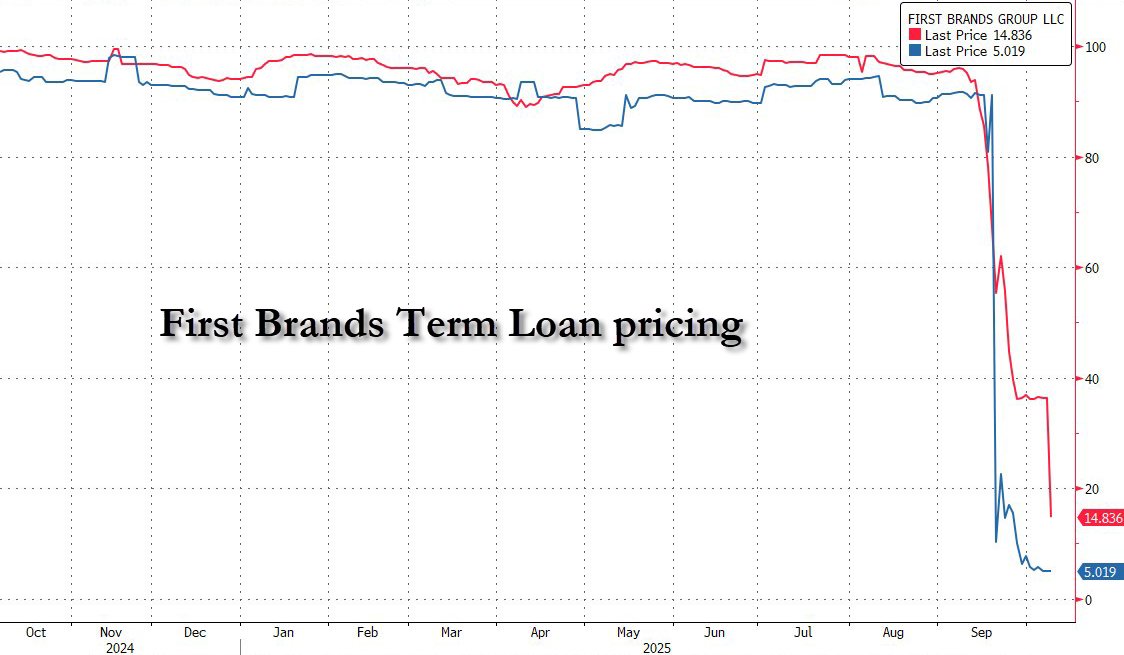
一场“小型次贷危机”?美国“暴雷”企业First Brands债权人称“23亿美元凭空消失”
Hua Er Jie Jian Wen· 2025-10-09 07:31
Core Insights - First Brands, an automotive parts supplier, has filed for bankruptcy, raising concerns on Wall Street about potential systemic risks in the credit market due to the disappearance of up to $2.3 billion in assets [1][3][5] - The company left behind $5.8 billion in leveraged loan debt and total liabilities may approach $12 billion, with loan prices plummeting to one-third of their value shortly before the bankruptcy [1][6] Group 1: Bankruptcy Details - First Brands filed for Chapter 11 bankruptcy protection on September 28, leaving behind $5.8 billion in leveraged loan debt [5] - The company’s advisors admitted in court that they could not trace $1.9 billion in assets that were supposed to serve as collateral for creditors, with only $12 million remaining in bank accounts [1][4] Group 2: Creditor Concerns - Raistone, one of the largest creditors, claims that $2.3 billion in assets are "untraceable" and is demanding an independent investigator to examine the circumstances surrounding the bankruptcy [3][4] - Raistone is also linked to $631 million in investments exposed to First Brands' invoices and claims to be owed at least $172 million [3] Group 3: Market Reactions - Morgan Stanley characterized the bankruptcy as an "isolated incident," maintaining a constructive outlook on the overall credit market [6] - Conversely, investor Jim Chanos warned that this could be the "first thunder" of a crisis in the private credit market, drawing parallels to the Enron scandal [6] - Despite the turmoil, the broader credit market remains calm, but Bank of America strategists suggest defensive measures due to widening spreads between high-yield and investment-grade bonds [6]

燃料油维持偏弱运行
Bao Cheng Qi Huo· 2025-10-09 05:57
投资咨询业务资格:证监许可【2011】1778 号 运筹帷幄 决胜千里 燃料油维持偏弱运行 宝城期货 陈栋 国庆长假期间,海外市场发生一系列重大事件。美国联邦政府陷入停摆危机,OPEC+产油国继续扩大 11 月产能规模。在负面情绪不断发酵下,全球能源市场偏空氛围进一步增强,从而导致国际原油期货价格 遭遇重挫。其中,WTI 与布伦特原油双双跌至近五个月以来的低位。这一系列外部利空冲击不仅重塑了原 油市场的交易逻辑,而且也会迫使节后国内燃料油期货维持低开弱势运行的走势。 美国政府停摆 系统性风险出现 由于美国国会参议院在 10 月 3 日未能通过新的临时拨款法案,民主党和共和党的提案均再度遭到否 决,联邦政府"停摆"继续。据美国国会预算办公室估计,美国联邦政府在 2018 年底至 2019 年初为期 35 天的"停摆"给该国 GDP 造成 30 亿美元的损失。如若此次美国政府每"停摆"一周,经济增速将下降约 0.15 个百分点,如果算上私营机构受到的影响,经济增速可能下降 0.2 个百分点。不难看出,停摆对原油 等能源商品呈现偏负面影响。尽管地缘政治和 OPEC+的产量决策是油价的主要驱动因素,但政府停摆增加 了 ...
原油周报:避险情绪升温,原油偏弱运行-20251009
Bao Cheng Qi Huo· 2025-10-09 03:17
Report Industry Investment Rating - No relevant content provided. Core Viewpoints of the Report - Due to the US federal government shutdown during the National Day holiday, international crude oil futures prices declined under pressure. The WTI crude oil futures price dropped from a pre - holiday high of $66.42/barrel to a low of $60.40/barrel, a cumulative decline of 9.06%. The Brent crude oil futures price fell from a pre - holiday high of $70.76/barrel to a low of $64/barrel, a cumulative decline of 9.55%. The domestic crude oil futures 2511 contract is expected to face a risk of a gap - down opening after the holiday. With the support of geopolitical premium weaker than systematic risks, the domestic crude oil futures may maintain a weak and volatile trend on the first trading day after the holiday [5]. Summary by Directory 1 Market Review 1.1 Spot prices rose slightly and basis discounts widened slightly - As of the week ending September 30, 2025, the spot price of crude oil produced in the Shengli Oilfield area was $64.63/barrel, equivalent to RMB 459.2/barrel, a week - on - week increase of $4.7/barrel. The domestic crude oil futures main contract 2511 closed at RMB 479.7/barrel, a week - on - week increase of RMB 6.6/barrel. The basis was RMB 20.5/barrel [9]. 1.2 Systematic risks occurred and international crude oil futures declined - Affected by the US federal government shutdown, during the National Day holiday, international crude oil futures prices declined under pressure. The WTI crude oil futures price dropped from a pre - holiday high of $66.42/barrel to a low of $60.40/barrel, a cumulative decline of 9.06%. The Brent crude oil futures price fell from a pre - holiday high of $70.76/barrel to a low of $64/barrel, a cumulative decline of 9.55%. The domestic crude oil futures 2511 contract dropped from a rebound high of RMB 499.2/barrel to below RMB 480/barrel, a cumulative decline of 3.90%. It is expected that the domestic crude oil futures 2511 contract may face a risk of a gap - down opening after the holiday [5][12][13]. 2 Crude Oil Supply - Demand Surplus Escalated and the Production Increase Rhythm Accelerated 2.1 OPEC+ accelerated capacity release and the expectation of supply surplus increased - In August 2025, OPEC+ member countries decided to increase production. From April to August 2025, OPEC+ shifted from a production - cut cycle to a production - increase cycle, with a cumulative production increase of 191.9 barrels/day. In August 2025, OPEC member countries' crude oil production was 2794.8 barrels/day, a significant month - on - month increase of 47.8 barrels/day and a significant year - on - year increase of 129.6 barrels/day [20][21][22]. 2.2 Non - OPEC oil - producing countries' production capacity remained at a high level - As of the week ending October 3, 2025, the number of active oil drilling rigs in the US was 422, a week - on - week decrease of 2 and a year - on - year decrease of 57. As of the week ending September 26, 2025, the US crude oil daily production was 1350.5 barrels, a week - on - week increase of 0.4 barrels/day and a year - on - year increase of 30.5 barrels/day [36]. 2.3 The peak season of crude oil demand in the Northern Hemisphere was coming to an end - Entering October, the peak season of gasoline consumption in the US ended, and the demand factor weakened. Different energy institutions had different forecasts for the crude oil market. EIA and IEA were pessimistic about the future oil price, while OPEC was relatively optimistic [41][42][43]. 2.4 US crude oil inventories increased slightly and refinery operating rates decreased slightly - As of the week ending September 26, 2025, US commercial crude oil inventories reached 416.5 million barrels, a week - on - week increase of 1.792 million barrels. The refinery operating rate was 91.4%, a week - on - week decrease of 1.60 percentage points [44]. 2.5 China's crude oil imports increased slightly in August 2025 - In August 2025, China's industrial crude oil production was 18.26 million tons, a year - on - year increase of 2.4%. The crude oil processing volume was 63.46 million tons, a year - on - year increase of 7.6%. The crude oil import volume was 49.492 million tons, a month - on - month increase of 2.288 million tons and a year - on - year increase of 0.392 million tons [48]. 3 The Middle East Situation Showed Signs of Easing but Risks Still Existed - During the National Day holiday, eight foreign ministers called for an end to the Gaza war, but Israel said it was a change in the combat situation rather than a cease - fire. The easing of the Middle East situation weakened the support for the crude oil market, and the "war premium" subsided [57][58][59]. 4 Net Long Positions in the International Crude Oil Market Changed Differently Week - on - Week - As of September 23, 2025, the average non - commercial net long position of WTI crude oil was 102,958 contracts, a week - on - week increase of 4,249 contracts. As of September 30, 2025, the average net long position of Brent crude oil futures funds was 202,480 contracts, a week - on - week decrease of 9,903 contracts [62][64]. 5 Conclusion - Affected by the US federal government shutdown and OPEC+ production increase, international crude oil futures prices declined. With the support of geopolitical premium weaker than systematic risks, the domestic crude oil futures may maintain a weak and volatile trend on the first trading day after the holiday [70].
甲醇周报:偏空因素主导,甲醇震荡回落-20251009
Bao Cheng Qi Huo· 2025-10-09 03:16
x30003 姓名:陈栋 宝城期货投资咨询部 从业资格证号:F0251793 投资咨询证号:Z0001617 电话:0571-87006873 邮箱:chendong@bcqhgs.com 报告日期:2025 年 10 月 9 日 作者声明 本人具有中国期货业协会授 予的期货从业资格证书,期货 投资咨询资格证书,本人承诺 以勤勉的职业态度,独立、客 观地出具本报告。本报告清晰 准确地反映了本人的研究观 点。本人不会因本报告中的具 体推荐意见或观点而直接或 间接接收到任何形式的报酬。 甲醇 | 周报 2025 年 10 月 9 日 甲醇周报 专业研究·创造价值 偏空因素主导 甲醇震荡回落 核心观点 甲醇:节前两个交易日,受困于国内外甲醇供应压力增大,而 下游烯烃需求偏弱影响,叠加港口库存居高不下。甲醇期货基本面乏 力导致其主力 2601 合约呈现震荡回落的走势,期价自 2367 元/吨一线 跌落至 2328 元/吨,累计跌幅达 1.15%。1-5 月差维持在贴水 34 元/ 吨。 甲醇-MA 国庆长假期间,美国联邦政府意外停摆,系统性风险发生,导致 全球金融市场避险情绪大幅升温,黄金期货走强,其他大宗商品普遍 ...
宝城期货原油早报-20251009
Bao Cheng Qi Huo· 2025-10-09 02:27
Report Summary 1. Report Industry Investment Rating No investment rating information is provided in the report. 2. Report's Core View - The crude oil 2511 contract is expected to run weakly, with short - term weak oscillation, medium - term oscillation, and an intraday decline [1][5]. 3. Summary According to Related Contents a. Price Movement and View Classification - For price movement calculation, for varieties with night trading, the night - trading closing price is the starting price; for those without, the previous day's closing price is used. The daily daytime closing price is the end price to calculate the rise - fall range [2]. - A decline greater than 1% is considered a fall, a decline of 0 - 1% is weak oscillation, a rise of 0 - 1% is strong oscillation, and a rise greater than 1% is an increase. Strong/weak oscillation only applies to intraday views, not short - and medium - term views [3][4]. b. Crude Oil Market Analysis - Core logic: During the National Day holiday, the unexpected shutdown of the US federal government led to a significant increase in global financial market risk - aversion sentiment. Gold futures strengthened, and other commodities were generally under pressure. Eight OPEC+ oil - producing countries decided to increase production by 137,000 barrels per day in November, increasing the supply pressure in the oil market. Although eight foreign ministers called for an end to the Gaza war, Israel's combat state remains unchanged. The US WTI and Brent crude oil futures prices dropped by about 1% during the holiday. With geopolitical premium support weaker than systematic risks, the domestic crude oil 2511 contract is expected to show a weakly oscillating trend on the first trading day after the holiday [5].
宝城期货橡胶早报-20251009
Bao Cheng Qi Huo· 2025-10-09 02:09
Report Industry Investment Rating No relevant content provided. Core View of the Report - Both Shanghai rubber (RU) and synthetic rubber (BR) are expected to run weakly, with short - term and intraday views of being oscillatory and weak, and mid - term views of decline [1][5][6] Summary by Related Catalogs Shanghai Rubber (RU) - **Price Trend**: Short - term oscillatory and weak, mid - term decline, intraday oscillatory and weak, overall expected to run weakly [1][5] - **Core Logic**: During the National Day holiday, the unexpected shutdown of the US federal government led to a significant increase in risk - aversion sentiment in the global financial market. Commodities were generally under pressure, and the main contract of Japanese rubber futures had a cumulative maximum decline of 3.83%. Typhoon "Maidoum" might cause yield reduction in natural rubber planting areas. Before the holiday, the 2601 contract of domestic Shanghai rubber futures showed a weak downward trend, so it is expected to maintain an oscillatory and weak trend on the first trading day after the holiday [5] Synthetic Rubber (BR) - **Price Trend**: Short - term oscillatory and weak, mid - term decline, intraday oscillatory and weak, overall expected to run weakly [1][6] - **Core Logic**: During the National Day holiday, the US federal government shutdown increased global risk - aversion sentiment. Commodity prices were under pressure. The prices of US WTI crude oil and Brent crude oil futures had a cumulative decline of about 1%. Due to weak cost support and a weak supply - demand structure, and the 2511 contract of synthetic rubber futures showed a weak downward trend before the holiday, it is expected to maintain an oscillatory and weak trend on the first trading day after the holiday [6]
宝城期货甲醇早报-20251009
Bao Cheng Qi Huo· 2025-10-09 02:09
Report Summary 1. Report Industry Investment Rating - No specific investment rating for the industry is provided in the given content. 2. Report's Core View - The domestic methanol futures 2601 contract is expected to maintain a weak and volatile trend. The short - term view is weakly volatile, the medium - term view is a decline, and the overall reference view is weak operation [1][5]. 3. Summary by Related Content 3.1 Price Performance and View - The methanol 2601 contract shows short - term weakness, medium - term decline, and intraday weakness, with a core logic of being dominated by bearish factors and weak and volatile [1]. 3.2 Core Logic - During the National Day holiday, the unexpected shutdown of the US federal government led to a systemic risk, increasing global financial market risk - aversion sentiment. Gold futures strengthened, while other commodities were generally under pressure. Domestically, methanol's high operating rate and weekly output, along with increasing external import pressure and high post - holiday port inventory, contribute to the bearish outlook. Although downstream demand is gradually improving, the olefin market profit is poor, and the weak demand situation remains to be improved [5]. Calculation Rules - For commodities with night trading, the starting price is the night - trading closing price; for those without, it's the previous day's closing price. The ending price is the day - trading closing price. A decline greater than 1% is considered a fall, 0 - 1% is weakly volatile, a rise of 0 - 1% is strongly volatile, and a rise greater than 1% is an increase. Strongly/weakly volatile only applies to intraday views [2][3][4].
“崩盘专家”黑天鹅基金:美股将大幅上涨,随后是1929式崩盘
Hua Er Jie Jian Wen· 2025-09-24 01:29
Core Viewpoint - Mark Spitznagel, manager of Universa Investments, predicts a significant rise in the U.S. stock market, potentially reaching 8000 points on the S&P 500, which represents about a 20% increase from current levels, driven by factors such as Federal Reserve interest rate cuts [1] - However, Spitznagel warns that this rise may precede a severe market crash, potentially the worst since 1929, due to accumulated systemic risks from prolonged government interventions in the market [1][4] Market Conditions - Spitznagel compares the current market environment to the late 1920s, suggesting that significant price increases often signal market tops [3] - Historical data indicates that the S&P 500 index has averaged a 26% annualized return in the 12 months leading up to bear markets since 1980, with the final 12 months before the 1929 crash showing returns more than double this average [3] - Institutional investors' stock exposure has reached its highest level since November 2007, just before the financial crisis, while U.S. households' stock allocation has surpassed levels seen during the tech bubble [3] Systemic Risks - Spitznagel likens the current market to a "powder keg" due to the accumulation of risks from continuous market interventions by central banks and governments, which have inflated market valuations to near historical highs [4] - He argues that these interventions, while temporarily mitigating losses, have led to an accumulation of risks that could result in a catastrophic market event [4] Investment Strategy - Spitznagel's fund employs a unique tail risk hedging strategy, which focuses on buying protection during optimistic market conditions rather than timing the market [2][4] - Despite his warnings, Spitznagel advises individual investors to maintain a long-term investment approach, as the greatest risk often comes from their own behavior rather than the market itself [5]
“崩盘专家”黑天鹅基金:美股将大幅上涨,随后是“1929式崩盘”
Hua Er Jie Jian Wen· 2025-09-24 00:50
Core Viewpoint - Mark Spitznagel, manager of Universa Investments, predicts a significant rise in the U.S. stock market, potentially reaching 8000 points on the S&P 500, but warns of an impending severe market correction akin to the 1929 crash [1][3] Group 1: Market Predictions - Spitznagel foresees a short-term increase in the S&P 500 by approximately 20% due to favorable conditions such as potential interest rate cuts by the Federal Reserve [1] - He compares the current market environment to the late 1920s, suggesting that the accumulation of systemic risks could lead to a catastrophic market event [3][4] Group 2: Historical Context and Indicators - Historical data indicates that significant market gains often precede downturns, with the S&P 500 averaging a 26% annual return in the year before bear markets since 1980 [3] - Current indicators show that institutional investors' stock exposure is at its highest since November 2007, and household stock allocation has surpassed levels seen during the tech bubble [3][4] Group 3: Systemic Risks and Market Interventions - Spitznagel attributes the potential market collapse to prolonged government and central bank interventions, which have inflated market valuations to near historical highs [4] - He uses the analogy of extinguishing small forest fires to illustrate how these interventions have allowed systemic risks to accumulate, leading to a potentially devastating market event [3][4] Group 4: Investment Strategy and Advice - Despite his warnings, Spitznagel does not advocate for market timing among individual investors, emphasizing the importance of long-term holding strategies [4] - Universa Investments employs a unique tail risk hedging strategy that protects traditional investors during market upswings, allowing them to participate without excessive risk [2][4]