线上线下融合

Search documents
北京多家商业项目冲刺开业:发力年末消费
Bei Jing Ri Bao Ke Hu Duan· 2025-12-21 16:36
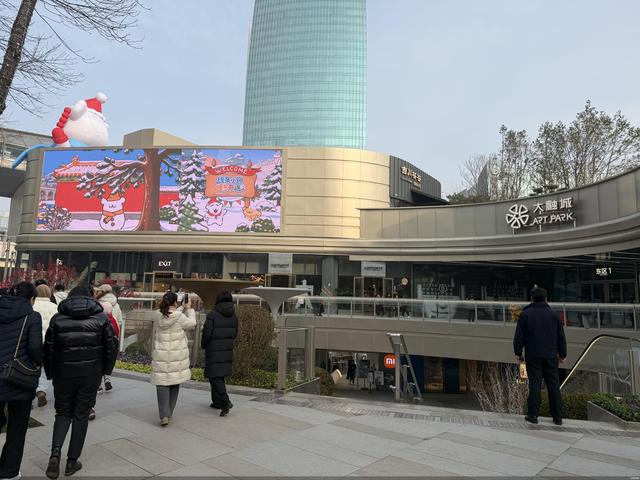
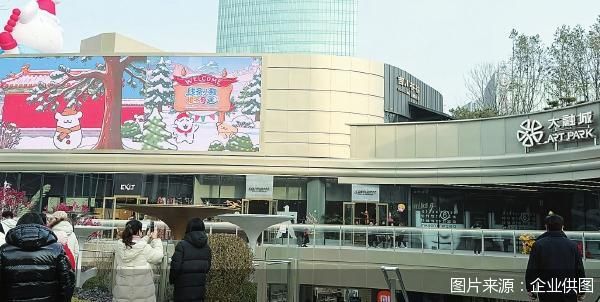
Core Insights - Beijing's commercial market is experiencing a wave of new openings by the end of 2025, with projects like Zhongguancun Daluocheng East District officially opening, enhancing the supply of brand goods in the area [1][3] - The new projects aim to capitalize on the upcoming peak consumption seasons during the New Year and Spring Festival, with multiple commercial projects launching to attract consumer attention [3][4] - The openings reflect a response to the trend of consumption upgrades, aiming to activate potential demand with higher quality offerings [5] Group 1: Project Openings - Zhongguancun Daluocheng East District has opened with over 60 first stores, including COACH concept store and gaga flagship store, enhancing the area's commercial offerings [3][6] - Other projects like Lianhua Hui and Wanli in Tongzhou District are set to open by the end of the year, with Wanli already in trial operation and focusing on cultural, sports, and family entertainment [3][4] - Lianhua Hui is transforming from a hypermarket to a "neighborhood lifestyle space," introducing tech retail brands like Huawei and Xiaomi, along with various dining options [3][7] Group 2: Market Positioning - The new projects have distinct positioning, with Zhongguancun Daluocheng focusing on high-end consumption and filling gaps in brand offerings in Haidian District [6][7] - Wanli aims to leverage its proximity to Universal Beijing Resort to attract tourists and convert them into overnight and experiential consumers [6][7] - Lianhua Hui's transformation caters to community needs, maintaining its supermarket while expanding dining and entertainment options [7] Group 3: Consumer Engagement Strategies - New commercial projects are encouraged to create engaging experiences through events and unique offerings to maintain consumer interest and ensure sustainable operations [8][9] - Operators should adapt tenant mixes based on market changes and consumer feedback, continuously innovating marketing activities to attract diverse customer groups [8][9] - The integration of online and offline shopping experiences is crucial, with a focus on creating themed spaces for younger consumers and utilizing data analytics for targeted marketing [9]

北京多家商业项目年末冲刺开业
Bei Jing Shang Bao· 2025-12-21 15:55
Core Viewpoint - The Beijing commercial market is experiencing a wave of openings by the end of 2025, with new projects enhancing consumer offerings and responding to market demand, particularly in the context of the upcoming holiday shopping season [1][4]. Group 1: New Openings and Market Dynamics - The Zhongguancun Daluocheng East District has officially opened, complementing the West District, and features over 60 first stores, including brands like COACH and gaga [3][5]. - The upcoming openings in Tongzhou District, such as Lianhua Hui and Wanli, aim to capitalize on the year-end consumption peak, with Wanli set to officially open on December 26 [3][4]. - The new commercial projects are strategically timed to attract consumers during the New Year and Spring Festival, which are critical periods for achieving annual sales targets [4][6]. Group 2: Differentiated Positioning - Despite their proximity in opening dates, the new projects in Tongzhou and Zhongguancun have distinct market positions, targeting different consumer segments [5][6]. - Zhongguancun Daluocheng East District aims to fill gaps in brand offerings in a tech-rich area, while Wanli focuses on leveraging tourist traffic from nearby Universal Studios [5][6]. - Lianhua Hui's transformation into a "neighborhood lifestyle space" retains its supermarket roots while expanding into dining and entertainment, catering to community needs [5][6]. Group 3: Supply and Consumer Engagement - The concentration of new commercial openings enriches market supply, prompting businesses to innovate in order to maintain consumer interest and ensure sustainable operations [7][8]. - Key strategies for new projects include event-driven marketing, creating unique attractions, and continuously refreshing tenant mixes based on sales data and consumer feedback [7][8]. - The integration of online and offline shopping experiences is increasingly important, with projects encouraged to utilize data analytics for targeted marketing and enhanced consumer experiences [8].
德百集团张月娟谈商业新生态:从购物场所到城市会客厅
Sou Hu Cai Jing· 2025-12-19 09:11
Core Viewpoint - Traditional retail enterprises are facing a profound transformation in consumer behavior, shifting from mere purchasing to seeking emotional value, cultural identity, and immersive experiences, prompting a redefinition of the marketplace's role [1]. Group 1: Consumer Behavior Changes - Consumers are no longer satisfied with just shopping; they seek social connections, emotional links, and cultural resonance in retail spaces [4]. - The real challenge for offline retail is not a decrease in foot traffic, but a fundamental change in consumer behavior, where consumers "vote with their feet" towards places that offer unique experiences and emotional value [4]. Group 2: Business Strategy and Transformation - 德百集团 is transforming its commercial spaces from "transaction venues" to "city living rooms" and "cultural experience sites," which is both a strategy to address challenges and a key to seizing new opportunities [4]. - The company has launched the "德州589街区," which leverages historical context to enhance commercial space, achieving significant results in foot traffic and consumption levels since its opening [4]. Group 3: Market Positioning and Future Directions - 德百集团 aims to serve a diverse customer base while maintaining a clear core positioning as a "quality consumption leader" and "provider of a better life" [5]. - The company is pursuing a diversified strategy guided by the principles of "development, consolidation, breakthrough, and combination," which includes upgrading traditional retail, enhancing online-offline integration, and expanding into health and cultural tourism sectors [5]. - These initiatives reflect the company's commitment to social responsibility, integrating local cultural heritage and regional economic development into its business model [5].

万宁究竟做错了什么?
3 6 Ke· 2025-12-18 07:54
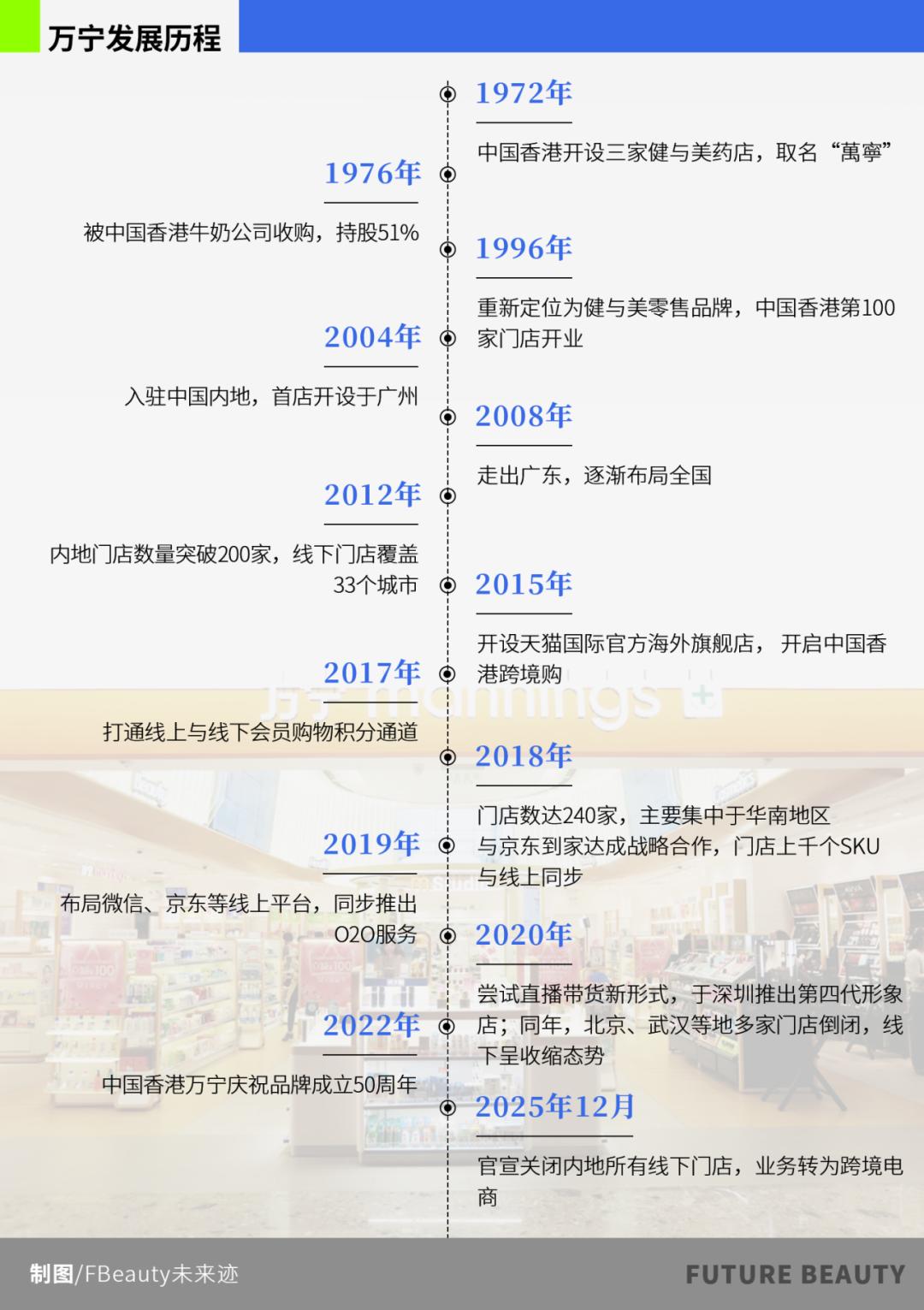
Core Insights - Mannings has officially announced its exit from the mainland China market, with all offline stores set to close by January 15, 2026, and online sales ceasing by December 26, 2025, transitioning to cross-border e-commerce thereafter [2][4][10] Company Overview - Mannings, a well-known retail brand in beauty and health, has been in the mainland market since 2004, reaching a peak of over 240 stores by 2018, primarily concentrated in Southern China [4][12] - The brand's decline is attributed to a series of strategic missteps, including frequent changes in leadership and failure to resonate with the local market [6][10] Market Context - The beauty retail sector has undergone significant restructuring, with competitors like Sephora and Watsons adapting through digital transformation and unique product offerings, while Mannings struggled to keep pace [2][15] - The overall sales in the cosmetics specialty store channel saw a total of 1,030 billion yuan in the first three quarters, with a year-on-year decline of 2.8% and 46,900 stores shutting down [3][15] Strategic Failures - Mannings faced challenges in its operational strategy, including a lack of effective execution in its membership program and slow product selection, which hindered its competitiveness [7][10] - The brand's attempt to replicate its Hong Kong success in mainland China did not materialize, leading to a loss of its core "pharmaceutical cosmetics" identity [10][12] Consumer Perception - Social media feedback indicates that consumers found Mannings' offerings to be less appealing compared to competitors, with comments highlighting a lack of unique advantages and product diversity [11][12] - The brand's failure to establish a strong emotional connection with consumers contributed to its decline, as it could not differentiate itself in a crowded market [15][20] Industry Implications - Mannings' exit serves as a cautionary tale for traditional retail models facing the pressures of e-commerce and changing consumer preferences, emphasizing the need for agility and innovation in the retail space [15][24] - The shift in consumer expectations towards personalized experiences and emotional connections highlights the evolving landscape of beauty retail, where brands must adapt to survive [20][24]
四川移动:数智力量让服务更透明更温暖更安全
Si Chuan Ri Bao· 2025-12-15 22:10
Core Viewpoint - Sichuan Mobile is transforming its service model from passive response to proactive protection, focusing on transparency, safety, and care for special groups, thereby enhancing customer experience and satisfaction [4][9]. Group 1: Service Transparency and Safety - Sichuan Mobile has implemented a "service account" system that provides customers with clear details on fees and consumption, ensuring they have control over their expenses [5]. - The company has launched a "harassment and fraud prevention" service that has protected over 41 million customers by effectively blocking unwanted calls [6]. - Advanced technology is utilized to enhance security, including AI monitoring systems during major examinations to ensure fairness and integrity [6]. Group 2: Online and Offline Service Integration - Sichuan Mobile is promoting a seamless integration of online and offline services, allowing customers to access services proactively rather than having to seek them out [7]. - The "video customer service" feature enables remote assistance for troubleshooting, making complex processes simpler for users [7]. - The "online appointment" feature in the mobile app allows users to reserve service times and check queue statuses, significantly improving convenience [8]. Group 3: Special Group Care - The company has established a "special group response mechanism" to assist elderly and rural customers, providing services such as door-to-door SIM card replacement and fraud prevention education [9]. - Sichuan Mobile has initiated programs to protect vulnerable populations, including the installation of fire alarms for elderly individuals and distributing safety wristbands for children [10][11]. - The company is committed to bridging the digital divide for the elderly by offering tailored services and support, ensuring they can enjoy a secure and connected life [10]. Group 4: Community Engagement and Social Responsibility - Sichuan Mobile has engaged in community initiatives, such as providing technology education to rural schools, thereby fostering a sense of security and opportunity for children [11]. - The company emphasizes the importance of safety for both the elderly and children, creating a multi-layered protective network through community collaboration [10][11]. - Sichuan Mobile aims to enhance the overall sense of security and well-being for all customers, regardless of age or location, through its comprehensive service offerings [11].

广博股份(002103) - 002103广博股份投资者关系管理信息20251215
2025-12-15 08:26
Group 1: Company Overview and Activities - Guangbo Group Co., Ltd. held an investor activity on December 15, 2025, at their company location, attended by representatives from Huayuan Securities, Xibu Lide, and Ningyin Wealth Management [2]. - The company launched its brand experience store, "潮玩先锋," in Shanghai on November 28, 2025, featuring various interactive areas and products, marking a significant upgrade in brand experience and operational depth [3]. Group 2: Marketing Strategies - The company organized a "Christmas-themed pop-up event" starting December 12, 2025, at Shanghai Jing'an Joy City, showcasing new products from popular IPs such as "Persona," "Hunter x Hunter," and others [4]. - Guangbo's marketing strategy includes leveraging social media platforms like Xiaohongshu to continuously release product information and brand activities, creating an integrated online and offline marketing matrix [4]. Group 3: Product Development and Future Plans - The company is developing an "IP Fun Food" series in collaboration with the popular IP "Detective Conan," which has received positive market feedback due to its innovative combination of food and collectibles [5]. - Future plans involve focusing on Gen Z consumer demands, optimizing the food supply chain, and enhancing product design and interactive features to create immersive consumption experiences [6]. - In 2025, Guangbo is prioritizing the development of new categories, including cards, plush toys, and food products, with successful launches of collectible cards based on the "Zhu Xian" IP [6].

直播电商变局,东方甄选要从“线上山姆”变成“线下盒马”?
Xin Lang Cai Jing· 2025-12-15 05:59
文 | C2CC新传媒 日前,《北京商报》报道的一则招聘信息引发行业关注。东方甄选正在为北京首家旗舰店招聘店长,优先锁定"餐饮+零售"复合业态管理人才。虽然该信 息目前已经更新为"旗舰店门店储备店长"招聘,但俞敏洪的东方甄选"全国线下百家门店"构想正式迈出了实质性的一步。 俞敏洪对东方甄选线下门店布局的构思由来已久。早在去年7月,俞敏洪就明确表示,希望依托新东方全国800个地面教学点,探索线上线下相结合的模 式,开设会员店、旗舰店等等。 近期,东方甄选前CEO孙东旭离职,公司也进行了工商变更,其经营范围新增了餐饮管理、餐饮服务及外卖递送服务等业务。 根据此前透露的信息,东方甄选首家旗舰店位于北京中关村,面积约400平方米,门店将融合生鲜、零食、日用百货等类目,同时,还有简餐与咖啡饮品 区。从业务组合上,东方甄选线下店融合了山姆会员店、盒马鲜生等会员制超市业态,小象超市、京东便利店等即时零售业态,以及便利蜂、罗森、7- ELEVEn等便利店业态。 俞敏洪意图是将东方甄选线下店打造成为一个更具沉浸式体验的消费空间,而非传统的零售门店。 2025年上半年,抖音平台直播带货GMV同比下降41%。冰冷的数据,撕开了直播 ...

彩虹集团:公司将持续优化线上线下融合策略
Zheng Quan Ri Bao Zhi Sheng· 2025-12-11 08:45
Core Viewpoint - The company is focusing on "technology empowerment, resource integration, and efficiency upgrade" to enhance input-output efficiency in response to rising online traffic costs [1] Group 1: Technology and Operations - The company is strengthening its technical platform capabilities by applying artificial intelligence for content generation and material optimization, as well as using smart algorithms for precise marketing, which automates core business operations and improves advertising accuracy and conversion rates [1] - The company is leveraging its qualifications as a "comprehensive agent of the giant engine" and "KA service provider for Tencent advertising" to deepen collaborations with leading platforms such as ByteDance, Tencent Advertising, and Xiaohongshu, effectively integrating quality resources to consolidate traffic acquisition capabilities [1] Group 2: Business Structure and Strategy - The company is expanding into emerging businesses such as media platform operations and live broadcast agency services to extend service boundaries and enhance the value of single clients, optimizing its business structure to counteract traffic cost pressures [1] - The company is implementing a strategy of "deepening and optimizing in parallel, traditional and emerging collaboration" for its offline distribution network, focusing on refined operations of existing distributors through empowerment training and digital tool support to enhance their comprehensive service capabilities [1] Group 3: Marketing and Channel Development - The company is dynamically optimizing its structure in line with consumer trends and channel changes, with a focus on expanding into emerging channels like instant retail and deepening cooperation with key clients to enrich offline touchpoints, thereby enhancing coverage breadth and depth [1] - The company emphasizes "deep integration of online and offline" as its core strategy, aiming to build a collaborative and efficient marketing network system [1] - The company will continue to optimize its online and offline integration strategy, driven by technology to enhance efficiency and strengthen channel resilience, promoting high-quality development of its marketing system [1]

东方甄选线下开店:直播巨头的零售突围与未知挑战
Xin Lang Cai Jing· 2025-12-11 02:21
Core Insights - The company is transitioning from an online-focused strategy to a physical retail model, driven by the saturation of online growth and internal challenges [2][9] - The company's gross merchandise value (GMV) from all sales channels dropped from 14.3 billion to 8.7 billion yuan in the 2025 fiscal year, with a significant decline in orders from Douyin [2][9] - The new flagship store in Beijing will feature a hybrid model combining retail and dining, aiming to enhance customer experience and brand recognition [3][10] Sales Performance - The company's GMV decreased from 143 billion yuan to 87 billion yuan year-on-year [2][9] - Orders from Douyin fell from 180 million to 91.6 million [2][9] - The company has launched 732 self-operated products, a 50% increase year-on-year, with self-operated products now accounting for 43.8% of GMV [2][9] Strategic Shift - The shift to physical stores is seen as a response to intense competition in online streaming and a need for new growth avenues [2][9] - The flagship store will not only sell groceries and daily necessities but also include a dining area, reflecting a new retail model [3][10] - The company aims to leverage its existing educational centers to create a membership system that converts foot traffic into loyal customers [11] Membership and Customer Engagement - As of the end of the 2025 fiscal year, the company had 264,300 paid members, a 33% increase [11] - The membership fee is set at 199 yuan, with a refund policy that aligns with consumer behavior in China [11] - The company has organized member events to enhance customer loyalty, including dinner gatherings [11] Competitive Landscape - The company faces significant competition from established players like Fudi, Hema, and Sam's Club in the physical retail space [12] - The shift to offline retail requires a different skill set, as consumer behavior in physical stores is more rational compared to impulsive online purchases [12] - Other live-streaming companies are also entering the offline market, indicating a broader industry trend [13] Industry Context - The company's move to physical retail aligns with a larger trend of integrating digital and physical commerce [14] - Instant retail GMV is growing at 19.5%, outpacing the overall online retail growth rate [14] - The rise of store broadcasting on platforms like Douyin is reshaping the retail landscape, with a significant increase in brand participation [14]
砍掉两员「深耕线上」大将,自然堂「重投线下」为哪般?
3 6 Ke· 2025-12-08 03:31
在冲刺IPO的关键时期,国货美妆品牌自然堂却传出核心高管变动的消息。 据"美妆商业评论圆周率"报道,长期执掌电商业务的负责人吴梦与原市场部总经理谭彦已相继离职。尽管公司官方尚未就此事发布正式公告,但两位女将 在公司冲刺IPO的关键时期离去,无疑引发了市场对其战略方向与内部调整的密切关注。 据了解,吴梦是陪伴自然堂线上业务崛起的关键人物,在集团任职超过十年,曾先后担任电子商务事业部总经理、营销副总裁、零售总裁等要职。在其主 导下,自然堂电商业务从无到有,至2017年已跻身全网美妆销售额前列,线上渠道一度贡献公司约30%的收入。 而谭彦则是一位兼具传统品牌管理与互联网营销经验的资深人士,她不仅拥有宝洁市场部的扎实功底,还曾担任天猫母婴市场部负责人,被视为连接经典 营销与数字新潮的桥梁。 值得注意的是,两位高管的核心履历均深度聚焦于线上渠道的开拓与运营。这与自然堂在招股书中阐述的募资用途形成了微妙对照——公司计划将资金用 于升级线下零售网点、推广线下自营旗舰店等。 《节点美妆》认为,在线上增长显现疲态、竞争格局生变的当下,自然堂两位"线上女将"的离开,似乎不只是一种人事更迭,更或是自然堂为战略重心向 线下倾斜而进行 ...