
财政政策

Search documents
日本大选临近叠加财政担忧 日元持续承压
Jin Tou Wang· 2026-02-06 02:44
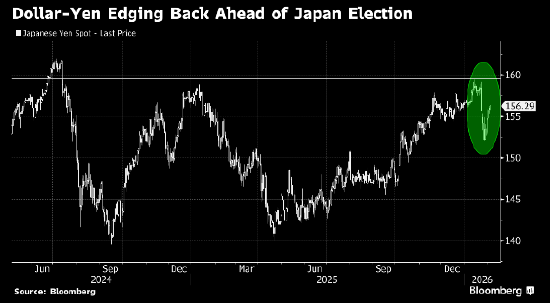
Core Viewpoint - The USD/JPY exchange rate is experiencing a slight pullback while remaining strong, driven by political uncertainty in Japan, fiscal policy expectations, and the divergence in monetary policies between the US and Japan, with upcoming elections amplifying short-term volatility [1][2]. Group 1: Market Dynamics - As of February 6, 2026, the USD/JPY exchange rate is reported at 156.5800, down 0.4900 (0.2866% decline) from the previous trading day, with a daily high of 157.0600 and a low of 156.5000, indicating a high-level minor correction [1]. - The upcoming Japanese House of Representatives election on February 8 is raising market concerns regarding the election outcome and subsequent fiscal policies, particularly the ruling Liberal Democratic Party's expansionary fiscal policies which may exacerbate debt burdens and suppress the yen [1][2]. - Despite a rise in Japan's service sector PMI to 53.7 in January, the yen remains under pressure due to ongoing fiscal and political risks, with inflation momentum cooling further, leading to reduced expectations for short-term interest rate hikes by the Bank of Japan [1][2]. Group 2: USD Strength and Technical Analysis - The USD is supported by policy expectations, with the dollar index at 97.774 (up 0.13%) as of February 5, providing support for the USD/JPY pair [2]. - Technically, the USD/JPY has broken through the 156.50 resistance level and is in a strong consolidation phase, with MACD indicating bullish momentum but with diminishing strength, and the relative strength index nearing high levels, suggesting limited upward space [2]. - The 157 level is identified as a critical resistance point; if sustained, it could open further upward movement, while failure to hold may lead to a retracement to 156.50 [2]. Group 3: Future Outlook - The outcome of the upcoming election is seen as a key short-term factor, with expectations that a significant victory for the ruling party could push the exchange rate towards 160, while a less favorable outcome could see it drop to 151 [2]. - The short-term outlook for USD/JPY remains focused on high-level fluctuations, influenced by the Japanese election results, the divergence in monetary policies between Japan and the US, and the shifting expectations for Fed rate cuts [2].
灵活高效护航流动性充裕
Jing Ji Ri Bao· 2026-02-05 22:13
Core Viewpoint - The People's Bank of China (PBOC) is taking measures to ensure liquidity in the banking system ahead of the Spring Festival, including a 800 billion yuan reverse repurchase operation to maintain a stable financial environment [1][2]. Group 1: Liquidity Management - The PBOC will conduct a 800 billion yuan reverse repurchase operation with a term of 3 months, resulting in a net injection of 1000 billion yuan after accounting for 700 billion yuan in maturing reverse repos [1]. - The central bank's actions are aimed at supporting major projects and maintaining economic recovery momentum, despite seasonal cash withdrawal demands and credit expansion [1][2]. - In January, the PBOC injected liquidity through various tools, including a net injection of 700 billion yuan via medium-term lending facilities (MLF) and 1678 billion yuan through 7-day reverse repos [2]. Group 2: Policy Coordination - The collaboration between monetary and fiscal policies has been effective in stabilizing market liquidity, with significant government bond issuance supporting economic growth targets [4]. - The issuance of government bonds in 2025 was accelerated, with a total of 16 trillion yuan issued, reflecting the coordinated efforts of monetary and fiscal policies [4][5]. - The PBOC's liquidity support has facilitated smoother government bond issuance, enhancing market expectations and stability [4][5]. Group 3: Future Outlook - Experts anticipate continued use of various liquidity management tools, including reverse repos and MLF, to address cash flow pressures in February [3]. - The PBOC is expected to maintain a flexible approach to liquidity injection, balancing short-term and long-term financial needs while supporting economic stability [6][7]. - The ongoing enhancement of the monetary policy framework aims to optimize liquidity management and ensure effective financial support for the real economy [6][7].
去年广义财政支出首次突破40万亿,今年支出如何扩大
Di Yi Cai Jing Zi Xun· 2026-02-05 15:37
2026.02.05 根据财政部数据,2025年广义财政(全国一般公共预算和全国政府性基金预算)支出约为40.03万亿 元,同比增长3.7%;广义财政收入约为27.38万亿元,同比下降约2.9%;广义财政支出超过收入约12.65 万亿元,同比增长21.3%。 粤开证券首席经济学家罗志恒告诉第一财经,去年面对收入端多重压力,财政政策通过提高赤字率与扩 大债务规模,实施超常规逆周期调节,保持必要支出强度,有力发挥了宏观政策的支撑作用,推动全年 经济平稳运行。 去年底全国财政工作会议提出,今年继续实施更加积极的财政政策,包括扩大财政支出盘子,确保必要 支出力度等,以推动今年经济实现质的有效提升和量的合理增长。 罗志恒认为,2026年财政政策预计在现有基础上进一步加力提效,通过提升赤字规模、优化支出结构、 创新政策工具等,以更强的政策力度推动经济稳中向好并切实改善民生。 财政支出为何能保持力度 去年广义财政支出规模创新高,支出增速与名义经济增速相近,折射了财政支出有力。 财政部数据显示,2025年全国一般公共预算支出约28.74万亿元,同比增长1%。全国政府性基金支出约 11.29万亿元,同比增长11.3%。 本文字 ...


中国思考-加税不太可能
2026-02-05 02:22
Summary of Key Points from the Conference Call Industry Overview - The discussion primarily revolves around the **telecommunications industry** in China, particularly focusing on the implications of a potential increase in the value-added tax (VAT) for this sector and its broader economic impact [1][10]. Core Insights and Arguments - **Tax Increase Concerns**: There are market concerns regarding a potential broad increase in VAT, which could affect various service industries. However, it is believed that the decision-makers are unlikely to implement such a broad tax increase as it would hinder efforts to combat deflation and does not align with macroeconomic consistency evaluations [1][10]. - **Targeted Tax Adjustment**: The recent VAT adjustment for the telecommunications sector, where the rate for traditional value-added services was raised from 6% to 9%, is viewed as a targeted structural adjustment rather than a precursor to widespread tax hikes [10]. - **Economic Policy Outlook**: The fiscal policy for 2026 is expected to remain similar to that of the previous year, with a focus on maintaining stability in fiscal deficits and spending ratios. If economic growth slows, there may be an additional fiscal stimulus of 0.5% of GDP introduced mid-year [13]. - **Impact on Consumer Confidence**: A broad increase in VAT would counteract efforts made over the past year to rebuild confidence in the private sector, making such a move unlikely [13]. Additional Important Content - **Sector-Specific Taxation Risks**: While a broad tax increase is deemed unlikely, certain sectors may face stricter tax enforcement and a tightening of preferential policies, although these changes are expected to be gradual and administrative rather than resulting in an overall increase in statutory tax rates [10]. - **Macroeconomic Implications**: Raising VAT in a weak demand environment could suppress consumption and investment, exacerbating deflationary pressures. Academic research indicates that using tax increases to support fiscal spending often diminishes the effectiveness of such policies [10]. - **Policy Communication**: The decision-makers are likely to ensure clarity and predictability in policy communication to avoid undermining confidence in the private sector [13]. This summary encapsulates the key points discussed in the conference call, highlighting the telecommunications industry's current challenges and the anticipated fiscal policy direction in China.
2026年全球信用风险八大展望报告-联合资信
Sou Hu Cai Jing· 2026-02-04 16:59
Global Economic Landscape - The global economic growth rate is projected to be around 3.0% in 2026, with the US stabilizing at approximately 2%, while the EU and Japan are expected to grow at 1.4% and 0.5% respectively [2][36] - Emerging economies like China, India, and the UAE are maintaining mid-to-high-speed growth, becoming significant engines of global economic development [2][43] Fiscal Policies - Expansionary fiscal policies are becoming mainstream, with developed and emerging economies maintaining high fiscal deficit rates of around 5.0% and 6.0% respectively, leading to rising government debt levels [2][36] - The sustainability of government debt is increasingly being challenged, particularly in the US and Japan [2][36] Supply Chain Restructuring - The trend of localization and regionalization is reshaping global supply chains, with the US controlling high-end segments, China becoming an indispensable "central node," and ASEAN and Latin America attracting investments due to their geographical advantages [2][36] Commodity Prices - Commodity price trends are diverging, with gold prices expected to rise above $6,000 per ounce driven by geopolitical risks and Fed rate cut expectations, while international crude oil prices may further decline to around $57 per barrel [2][36] Technological and ESG Developments - The AI sector continues to innovate, with multi-agent systems and humanoid robots gaining attention, although investment bubble risks exist [2][36] - ESG development is progressing with significant disparities, as Europe leads, China advances steadily, and the US lags behind, moving towards sustainable development [2][36] Geopolitical Risks - Geopolitical conflicts are identified as the largest risk in 2026, with the US executing Monroe Doctrine in the Western Hemisphere and increasing tensions in regions like Latin America and the Arctic [7][15] - The ongoing Russia-Ukraine conflict is likely to continue as a war of attrition, while the Middle East faces heightened risks due to the spillover effects of the Israel-Palestine conflict [15][20] Central Bank Policies - There are significant differences in global central bank monetary policies, with the Fed expected to adopt a more accommodative stance, potentially cutting rates 2-3 times in 2026 [24][27] - The European Central Bank is likely to maintain a "middle strategy," keeping rates around 2% to balance inflation and growth [28][30] - The Bank of Japan is expected to continue raising rates to around 1%, facing challenges from policy contradictions and currency pressures [34][36]

部署2026年信贷工作!央行:强化消费领域金融支持
Sou Hu Cai Jing· 2026-02-04 09:53
Core Viewpoint - The People's Bank of China emphasizes the need for targeted and coordinated efforts in the credit market for 2026, focusing on enhancing financial services for major strategies, key areas, and weak links in the economy [2][4]. Group 1: Financial Development Strategies - The meeting outlines the importance of developing the "Five Major Financial Articles," which include technology finance, green finance, inclusive finance, pension finance, and digital finance, while strengthening financial support in the consumption sector [4][6]. - There is a shift in focus from enhancing the adaptability of financial products to implementing structural monetary policy tools and coordinating with fiscal policy, indicating a clearer direction for macroeconomic support [4][6]. Group 2: Key Areas of Focus - The 2026 credit support will prioritize expanding domestic demand, technology innovation, and support for small and micro enterprises, with a particular emphasis on reinforcing financial support in the consumption sector [6]. - The meeting highlights the need for financial institutions to adhere to market-oriented and legal principles in their services, particularly in addressing the debt risk of financing platforms and supporting local governments in market-oriented transformations [6].

分析:日元下跌势头可能没什么障碍
Xin Lang Cai Jing· 2026-02-04 09:43
Core Viewpoint - The USD/JPY exchange rate has risen above 156 yen per dollar as Japan's elections approach, recovering from previous lows, with the yen being the worst-performing currency in the G10 this year. The downward trend may continue after the election risk event passes [1][3]. Group 1 - The weakening of the yen is partly due to ambiguous comments from Prime Minister Fumio Kishida regarding the benefits of a weak currency [1][3]. - Concerns have arisen among investors regarding the potential dovish stance of Kevin Warsh, nominated as the next Federal Reserve Chairman [1][3]. Group 2 - Market expectations suggest that Kishida's ruling Liberal Democratic Party will secure a significant majority in the elections, likely leading to more aggressive fiscal policies that could increase inflation and further pressure the yen [5]. - In the options market, the volume of USD/JPY call options with a nominal amount of $100 million or more exceeded that of put options, indicating increased demand for dollar bullish options [5]. - With the Bank of Japan not in a hurry to accelerate interest rate hikes, the most likely direction for USD/JPY is towards 160 yen [5].
2026年贵金属相对价值前景展望
Qi Huo Ri Bao· 2026-02-04 03:48
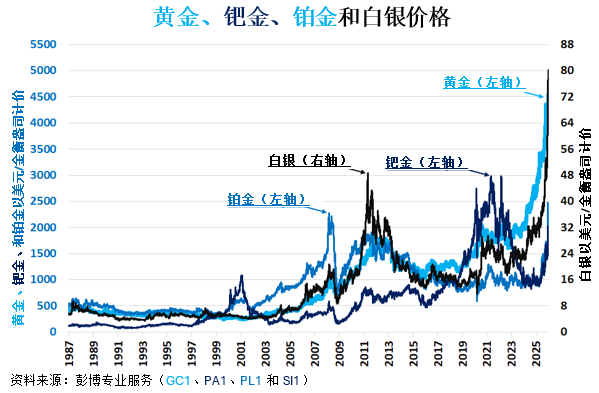
贵金属价格在2025年末的大幅上涨趋势延续至2026年初,黄金价格已突破每盎司4500美元,白银价格突 破每盎司80美元,铂金更是达到2007年以来的首次纪录高位。钯金价格同样出现大幅反弹,但距离纪录 高位仍有相当距离。 图1:贵金属价格飞涨幅度几无先例 从价格回报来看,金属自2024年底至今的表现远超其他资产类别。截至1月6日,黄金上涨65%,钯金上 涨95%,铂金上涨150%,白银涨幅高达170%。其中黄金表现相对偏弱,可能与其涨幅在2000年至2024年 底间就已遥遥领先于其他金属有关。在2020年代的前五年里,黄金上涨73%,白银上涨63%,而铂金和 钯金则分别下跌8%和52%。在一定程度上,白银、铂金和钯金近期的强势表现,或反映了其在长期落后 于黄金之后的奋起直追。 那么,投资者应如何看待这些贵金属之间的相对价值?整个贵金属板块的前景又将如何? 贵金属相对价值分析:白银与黄金 如今,要再坚持"白银相对黄金价格偏低"的观点,恐怕难有说服力。金银比(即一盎司黄金可兑换的白 银盎司数)已降至2013年以来的最低水平。 图2:最近几个月白银相对黄金显著走强 白银的部分涨幅,或反映了其相较于黄金的高β属性。白 ...
信用利差周报2025年第44期:LPR连续六个月持平,外币主权债券接力发行-20260204
Zhong Cheng Xin Guo Ji· 2026-02-04 02:39
Report Industry Investment Rating No relevant content provided. Core Views - The LPR has remained unchanged for six consecutive months, and monetary policy still has a certain degree of determination. The central bank may maintain reasonable and sufficient liquidity through structural tools or timely reserve requirement ratio cuts. In the bond market, with the interweaving of long and short factors, the wait-and-see sentiment will continue in the short term, and it is more likely to be volatile [2][10][12]. - The Ministry of Finance successfully issued 4 billion euro sovereign bonds in Luxembourg, indicating that China's bond market opening continues to advance. This not only releases a positive signal of China's financial market opening but also has multiple meanings such as constructing diversified foreign currency financing channels and promoting cross - border docking of financial infrastructure [3][14][16]. - In October, the cumulative year - on - year data of real estate investment and sales further weakened, and the real estate market continued to operate at the bottom, with the confidence of real estate enterprises to be restored [4][18]. - The central bank provided liquidity support last week, and the overall capital price showed a downward trend. The issuance scale of the primary credit bond market increased significantly, and the issuance cost mostly declined. In the secondary market, the trading activity continued to decline, and the credit bond yields fluctuated [5][6][35]. Summary by Directory Market Hotspots - **LPR Remains Unchanged for Six Consecutive Months**: The 1 - year LPR is 3.00%, and the 5 - year and above LPR is 3.50%, both remaining unchanged for 6 months. The reasons include the narrowing of the net interest margin of commercial banks, the current low - level interest rate, and the emphasis on "cross - cycle adjustment" in monetary policy. The central bank may use structural tools or reserve requirement ratio cuts to maintain liquidity. The bond market is expected to fluctuate [2][10][12]. - **Foreign - Currency Sovereign Bonds Issued Continuously**: On November 18, the Ministry of Finance issued 4 billion euro sovereign bonds in Luxembourg. The total subscription amount was 100.1 billion euros, 25 times the issuance amount. It is innovative in product types, with diversified investor structures. It has multiple meanings such as reducing exchange - rate risks, providing pricing references, and promoting cross - border docking of financial infrastructure [3][14][16]. Macroeconomic Data - In October, the real estate development climate index was 92.43, a decrease of 0.34 from the previous value. National real estate development investment decreased by 14.7% year - on - year, the housing construction area of real estate development enterprises decreased by 9.4% year - on - year, and the sales area of newly built commercial housing decreased by 6.8% year - on - year, with the decline narrowing compared with the same period last year [4][18]. Money Market - The central bank conducted 5 periods of 7 - day reverse repurchase operations totaling 167.6 billion yuan and 1 period of 6 - month outright reverse repurchase of 80 billion yuan last week. After deducting the maturity amount, the net investment in the open market was 123.4 billion yuan. Except for DR014 and DR1M, most term pledged repurchase rates decreased by 1 - 5bp. The 3 - month Shibor slightly decreased, and the 1 - year Shibor remained unchanged [21]. Primary Market of Credit Bonds - The issuance scale of credit bonds last week was 356.661 billion yuan, an increase of 105.252 billion yuan from the previous value. Except for the private placement corporate bonds, the issuance scale of other bond types increased. The infrastructure investment and financing industry had a net inflow of financing, while the industrial bond financing situation varied. The average issuance cost of credit bonds mostly declined, especially for medium - and high - grade bonds [6][24][25]. Secondary Market of Credit Bonds - The secondary - market spot trading volume of bonds last week was 822.4458 billion yuan, a decrease of 44.3106 billion yuan from the previous period. The average daily spot trading volume decreased to 164.4892 billion yuan. The bond market yields fluctuated. The yields of interest - rate bonds and credit bonds showed different trends, and most of the rating spreads expanded [35]. Appendix - **Credit Risk Events in the Bond Market**: There were events such as bond extensions and defaults of some real estate and media companies, including the interest extension of "H1 Greenview 01" and "H1 Greenview 02" and the principal and interest default of "17 Huawen Media MTN001H" [44]. - **Regulatory and Market Innovation Dynamics**: There were updates to the list of special institutional investors for private placement debt financing instruments, and policies such as including savings bonds (electronic) in the scope of personal pension products [45]. - **Monthly Net Financing of Main Credit Bond Types**: The net financing of different types of credit bonds showed different trends from January 2024 to October 2025 [46].
2026年02月04日申万期货品种策略日报-国债-20260204
Shen Yin Wan Guo Qi Huo· 2026-02-04 02:08
| | | | | 申银万国期货研究所 唐广华(从业资格号:F3010997;交易咨询号:Z0011162) tanggh@sywgqh.com.cn 021-50586292 | | | | | | | --- | --- | --- | --- | --- | --- | --- | --- | --- | --- | | | | TS2603 | TS2606 | TF2603 | TF2606 | T2603 | T2606 | TL2603 | TL2606 | | | 昨日收盘价 | 102.414 | 102.444 | 105.905 | 105.930 | 108.260 | 108.250 | 111.96 | 112.1 | | | 前日收盘价 | 102.390 | 102.408 | 105.860 | 105.895 | 108.250 | 108.210 | 112.06 | 112.2 | | | 涨跌 | 0.024 | 0.036 | 0.045 | 0.035 | 0.010 | 0.040 | -0.100 | -0.100 | | | 涨跌幅 | 0.02% | 0. ...