
反内卷

Search documents
有色金属行业周报:有色板块集体走强,聚焦美联储领导层更迭后续影响-20260115
Western Securities· 2026-01-15 11:17
Investment Rating - The report maintains a positive outlook on the non-ferrous metals sector, highlighting opportunities driven by macroeconomic conditions and supply constraints [8][9]. Core Insights - The non-ferrous metals sector has shown significant strength, outperforming the Shanghai Composite Index by 4.74 percentage points, with a weekly increase of 8.56% [11]. - Key price movements include copper prices rising to $12,998.00 per ton, an increase of 4.31% week-on-week, and aluminum prices reaching $3,136.00 per ton, up 3.81% [22][25]. - The report emphasizes the importance of macroeconomic indicators, such as the U.S. non-farm payrolls and unemployment rate, which influence market expectations for Federal Reserve interest rate decisions [16][17]. Summary by Sections Market Review - The non-ferrous metals sector significantly outperformed the Shanghai Composite Index, with notable increases in various sub-sectors, including precious metals and industrial metals [11]. - The report details specific stock performances, with top gainers including Tianli Composite (+35.97%) and Yunnan Zhenye (+22.58%) [11]. Key Focus Areas & Price Changes - U.S. non-farm employment increased by 50,000 in December, with an unemployment rate of 4.4%, slightly below expectations, impacting market sentiment [16]. - Domestic CPI rose by 0.8% year-on-year in December, the highest in nearly two years, while PPI's decline narrowed to 1.9% [17]. - The Kamoa-Kakula copper smelter successfully produced its first batch of anode copper, with expected production of 380,000 to 420,000 tons of copper concentrate in 2026 [19]. - Baogang Co. set the price for rare earth concentrates at 26,834 yuan per ton for Q1 2026, with adjustments based on REO content [20]. Metal Prices & Inventory Changes - Industrial metals showed price increases, with copper and aluminum prices rising significantly, while inventories displayed mixed trends across different exchanges [22][24]. - Precious metals, particularly gold and silver, saw price increases driven by geopolitical factors and expectations of monetary easing by the Federal Reserve [37][38]. - Energy metals, including lithium and cobalt, continued to see price increases, with lithium prices reaching 143,200 yuan per ton, up 18.68% [42]. Strategic Metals & Investment Opportunities - The report highlights the ongoing price increases in tungsten and the potential for investment opportunities in this sector, driven by supply constraints and policy support [46][58]. - The strategic metals sector is expected to benefit from easing export restrictions and improved market conditions, with a focus on cobalt, antimony, and tungsten [58][59].
汽车产业竞争力源自硬实力
Ren Min Ri Bao· 2026-01-15 09:10
Core Viewpoint - The continuous advancement of electrification technology, accelerated application of cutting-edge technologies, and the implementation of anti-involution measures have led to sustained growth in China's automotive production and sales, reflecting the strong resilience and dynamic momentum of the economy under pressure [7]. Group 1: Automotive Production and Sales Growth - China's automotive production and sales have maintained a scale of over 30 million units for three consecutive years, ranking first globally for 17 years [7]. - In 2025, the production and sales of new energy vehicles (NEVs) are expected to reach 16.626 million and 16.49 million units, respectively, representing year-on-year growth of 29% and 28.2% [9]. - NEVs accounted for 47.9% of total new car sales in 2025, indicating a significant shift towards electric vehicles [9]. Group 2: Technological Advancements in Electrification - By 2025, the average range of pure electric passenger vehicles in China is projected to approach 500 kilometers, with fast-charging technology allowing for 80% charge in 15 minutes [8]. - The introduction of solid-state batteries is moving towards mass production by 2027, and a unique "super electric hybrid technology" is being widely adopted [9]. - Exports of NEVs are expected to reach 2.615 million units in 2025, doubling year-on-year, with passenger vehicle exports at 2.532 million units and commercial vehicle exports at 83,000 units [9]. Group 3: Advancements in Intelligent Driving - R&D investment in intelligent driving technology has reached 10 billion yuan, with Huawei's ADS 5 transitioning from technical validation to mass production adaptation [10]. - Over 60% of new passenger vehicles sold in China are equipped with L2-level assisted driving features, and the first L3-level conditional autonomous driving vehicles have received approval [10]. - The automotive industry is becoming a key carrier for the commercialization of advanced technologies such as semiconductors and artificial intelligence [10]. Group 4: Industry Transformation and Anti-Involution Measures - Anti-involution measures have been implemented to address issues like price wars and unfair competition, leading to a 4.4% profit growth in the automotive industry from January to October 2025 [11]. - The industry is shifting from resource-dependent, low-cost competition to a focus on technological innovation and value upgrading, with flagship models gaining market recognition [11]. - High-end domestic brands such as AITO, Li Auto, and Zeekr have seen sales growth exceeding 40% year-on-year in 2025 [11].


化工板块领涨两市!锂电利好频出,化工ETF上探2.42%
Xin Lang Cai Jing· 2026-01-15 06:53
Group 1 - The chemical sector is leading the market with a significant increase, as evidenced by the chemical ETF (516020) rising by 0.99% [1] - Among the constituent stocks, rubber additives and phosphorus chemicals are showing strong performance, with Tongcheng New Materials hitting the daily limit and Hongda shares increasing by over 5% [1] - The overall trend indicates a positive outlook for the chemical industry, with expectations of a rebound in profitability and valuation in 2026 [3] Group 2 - Major lithium battery manufacturers are initiating large-scale equipment bidding, with reports of hundreds of GWh orders received, indicating a robust demand in the market [2] - It is projected that the new lithium battery production capacity will exceed 1 TWh by 2026, marking a historical high for new orders among equipment manufacturers [2] - The chemical ETF (516020) tracks the CSI sub-industry index, covering key themes such as AI computing power and new energy, with nearly 50% of its holdings in large-cap leading stocks [3]


国投瑞银策略报告 | 一季度:多类资产向好,人工智能热潮能否持续对市场表现极为关键
Hua Xia Shi Bao· 2026-01-15 06:48
Market Overview - In 2025, most assets performed positively, with global stock indices, industrial and precious metals, and US Treasuries entering a bull market, despite some pressures from trade disputes in April [1][2] - The weak performance of the US dollar, domestic bonds, energy, and agricultural products was noted, with domestic bonds underperforming expectations due to various factors including economic data volatility [2] Economic Factors - The bull market was supported by several fundamental factors: the decline of the "American exceptionalism" narrative, ongoing de-dollarization, a soft landing for the global economy, and continued investment in technology sectors like AI [2] - The interplay of these factors suggests that without strong capital expenditure in technology and TACO transactions, achieving a soft landing would be challenging [2] 2026 Market Outlook - For 2026, a moderate economic slowdown is expected, with developed economies like the US and Europe maintaining stable growth [3] - AI-related investments in the US are anticipated to continue supporting economic growth, potentially mitigating recession risks [3] - Fiscal policies in major economies are expected to be expansionary, providing additional support to economic growth [3] Asset Allocation - US Treasury yields are expected to have limited room for decline in 2026, with a neutral scenario predicting a slight decrease in yields [7] - The outlook for US equities remains cautiously optimistic, with a strategy of buying on dips being recommended due to ongoing AI developments and supportive monetary policies [7] - Gold is viewed positively due to long-term trends like de-dollarization and central bank purchases, despite recent price fluctuations [8] - Industrial metals like copper are also favored due to limited supply and demand from new economic sectors [8] Domestic Market Insights - In China, inflation trends will be crucial for the performance of stocks and bonds in 2026, with expectations of gradual recovery in corporate earnings and return on equity (ROE) [6] - The A-share market is expected to see a bullish trend, driven by improving corporate fundamentals and increasing demand for equity investments from residents [6][12] - Key sectors to watch include midstream manufacturing benefiting from PPI improvements and stable growth companies with potential for valuation recovery [22][24] Bond Market Outlook - The bond market is expected to face challenges in becoming a bull market, with limited upside potential for yields [9] - The overall economic environment suggests that while nominal growth may improve, the risks to the bond market remain skewed to the downside [9][36] - The strategy for bond investments should focus on maintaining liquidity and considering short-duration assets to navigate potential volatility [36]
ETF盘中资讯|化工板块领涨两市!锂电利好频出,化工ETF(516020)上探2.42%
Sou Hu Cai Jing· 2026-01-15 06:45
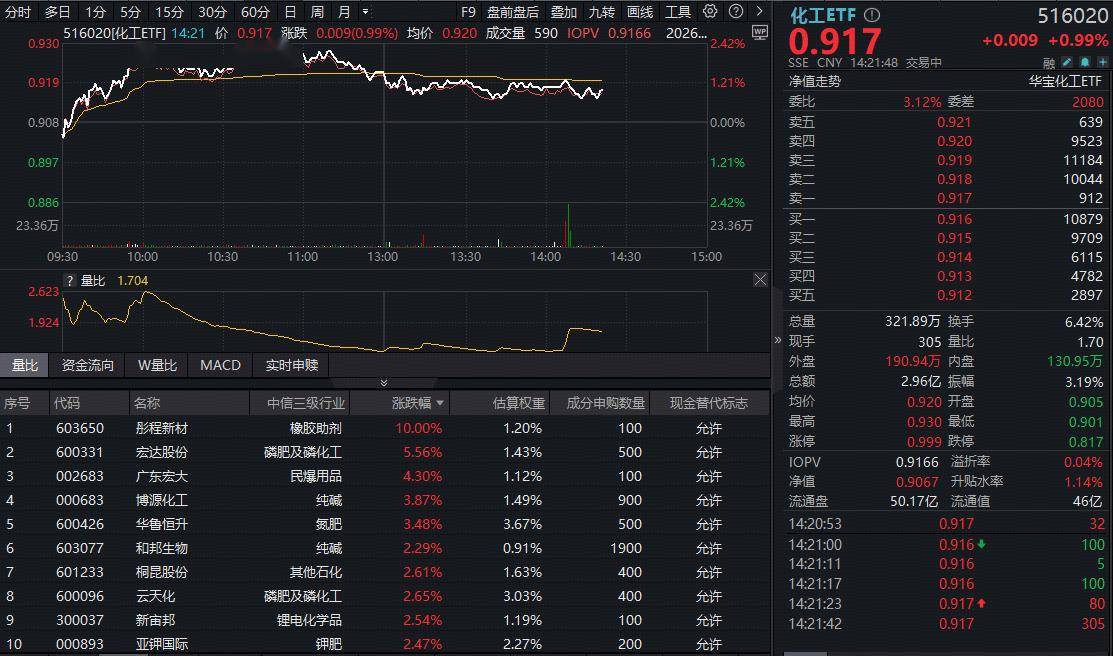
Group 1 - The chemical sector is leading the market gains, with the basic chemical sector showing the highest increase among 30 CITIC primary industries, reflecting a 0.99% rise in the chemical ETF (516020) [1] - Key stocks in the sector include rubber additives and phosphorus chemicals, with notable performances from Tongcheng New Materials, which hit the daily limit, and Hongda Co., which rose over 5% [1][2] - The overall market sentiment indicates a strong rebound in the chemical sector, driven by significant orders from leading lithium battery manufacturers, with expectations of substantial growth in lithium battery production capacity by 2026 [2][3] Group 2 - Industry analysts predict that the chemical industry's profitability is likely to recover in 2026 after experiencing a downturn in 2025, with a new phase of supply-demand rebalancing beginning [3] - The chemical ETF (516020) tracks the CSI segmented chemical industry theme index, with nearly 50% of its holdings concentrated in large-cap leading stocks, providing investors with opportunities to capitalize on the sector's rebound [3] - The ETF includes exposure to various themes such as AI computing, anti-involution policies, and new energy, which are expected to drive growth in the chemical sector [3]

化工板块领涨两市!锂电利好频出,化工ETF(516020)上探2.42%
Xin Lang Cai Jing· 2026-01-15 06:38
Group 1 - The chemical sector is leading the market with the basic chemical sector showing the highest increase among 30 CITIC primary industries, with the chemical ETF (516020) rising by 0.99% [1][5][12] - Key stocks in the sector include rubber additives and phosphate chemicals, with notable gains from Tongcheng New Materials hitting the daily limit, and Hongda Co., Ltd. increasing by over 5% [1][6][12] - The chemical ETF (516020) tracks the CSI sub-industry theme index, with nearly 50% of its holdings concentrated in large-cap leading stocks such as Wanhua Chemical and Salt Lake Industry, while the other 50% covers leading stocks in phosphate, fluorine, and nitrogen sectors [3][9] Group 2 - Major lithium battery manufacturers are starting large-scale equipment bidding, with some equipment manufacturers reporting hundreds of GWh in orders, and the market expects further orders of similar scale [8][9] - It is estimated that new lithium battery production capacity will exceed 1 TWh by 2026, with most lithium equipment manufacturers expected to achieve record high new orders in 2026 [8][9] - The chemical industry is at a new starting point of supply-demand rebalancing, with policies aimed at "anti-involution" and "stabilizing growth" expected to help the economy recover and confirm the bottom of corporate profits [8][9]

中国经济透视 _2026年宏观主题和可能存在的变数_ 宇
2026-01-15 06:33
Summary of Key Points from the Conference Call Industry Overview - The conference call discusses the macroeconomic outlook for China in 2026, focusing on GDP growth, export trends, real estate market dynamics, and policy support measures. Core Insights and Arguments 1. **GDP Growth Forecast**: The expected GDP growth rate for China in 2026 is projected to be around 4.5%, a slowdown from approximately 5% in 2025, primarily due to a significant reduction in net exports' contribution to growth [2][6][25]. 2. **Export Trends**: Export growth is anticipated to slow down in 2026, influenced by global economic conditions, previous tariff impacts, and a high base effect. The forecasted export growth rate is between 2.5% and 3% [7][4][6]. 3. **Real Estate Market**: The real estate sector is expected to continue its downward trend, with a projected decline in sales, new construction, and investment by 5-10% in 2026. However, the extent of the decline may be less severe than in 2025 [8][12][26]. 4. **Consumer Spending**: Consumer growth is expected to remain moderate but slow down due to high base effects from previous subsidies. The total amount for trade-in subsidies is estimated at approximately 250 billion yuan, a 17% decrease from 2025 [12][16]. 5. **Investment Recovery**: Fixed asset investment is projected to recover moderately in 2026, particularly in infrastructure and manufacturing, following a significant decline in 2025 [13][17]. 6. **Policy Support**: The government is expected to maintain a balanced and moderate policy support approach, with a potential increase in the fiscal deficit by 0.5-1% of GDP and a reduction in policy interest rates by 20 basis points [3][25][32]. 7. **Inflation Trends**: CPI is expected to slightly rebound to 0.4% in 2026, while PPI is projected to see a narrowing of its decline [16][22]. 8. **Currency Outlook**: The Chinese yuan is expected to appreciate against a basket of currencies while remaining stable against the US dollar, with a projected exchange rate fluctuation around 7.0 to 6.9 by the end of 2026 [20][22]. Additional Important Insights 1. **Structural Reforms**: The government is focusing on structural reforms, including promoting innovation and reducing "involution" in the economy, which may enhance overall economic growth [26][27]. 2. **Uncertainties and Risks**: Potential risks include the unpredictability of the real estate market, the impact of US-China trade relations, and the possibility of a bubble in artificial intelligence investments [4][38]. 3. **Long-term Economic Strategy**: The new five-year plan emphasizes innovation and aims to increase the contribution of "new economy" sectors to GDP, which is expected to grow faster than traditional sectors [26][27]. This summary encapsulates the key points discussed in the conference call, providing a comprehensive overview of the anticipated economic landscape for China in 2026.
“反内卷”助力盈利修复,石化ETF(159731)迎布局新机遇
Mei Ri Jing Ji Xin Wen· 2026-01-15 06:31
Core Viewpoint - The petrochemical industry is experiencing a positive trend, with significant inflows into related ETFs and a favorable outlook for earnings growth in the A-share market through 2026 [1] Group 1: Market Performance - The China Securities Petrochemical Industry Index is currently experiencing high volatility, with a rise of approximately 1.15% [1] - Notable stocks such as Tongcheng New Materials have reached the daily limit, while Guangdong Hongda, Hualu Hengsheng, and Tongkun Co. have also seen gains [1] - The Petrochemical ETF (159731) has recorded net inflows in 8 out of the last 10 trading days, totaling 133 million yuan [1] - The latest share count for the Petrochemical ETF has reached 399 million, with a total scale of 379 million yuan, both hitting record highs since inception [1] Group 2: Earnings Outlook - According to Zhongyin Securities, the cumulative profit growth rate for non-financial A-shares is expected to be between 2.4% and 5.5% in 2025, indicating a continued trend of profit recovery [1] - The overall profit recovery trend is likely to persist into 2026, supported by technological industry trends and the further implementation of "anti-involution" policies [1] - Despite the current high valuation of A-share indices, they have not yet entered a phase of excessive bubble similar to 2007 and 2015, suggesting ample room for index growth in 2026 [1] Group 3: Industry Composition - The top three sectors within the China Securities Petrochemical Industry Index are refining and trading (27.28%), chemical products (22.81%), and agricultural chemical products (20.3%) [1] - The "anti-involution" policy is identified as a core theme for the petrochemical industry, with expectations for continued improvement in industry supply-demand dynamics and profitability [1]
ETF盘中资讯|吸金额断层居首!化工板块继续猛攻,磷化工、锂电多点开花,化工ETF(516020)全天强势
Sou Hu Cai Jing· 2026-01-15 06:16
Group 1 - The chemical sector continues to show strength, with the Chemical ETF (516020) experiencing a price increase of 0.77% as of the report time [1] - Key stocks in the sector include Tongcheng New Materials, which hit the daily limit, and Hongda Co., which rose over 4%, along with Guangdong Hongda and Boyuan Chemical, both up over 3% [1] - The chemical sector has seen a net inflow of over 13.4 billion CNY from main funds in a single day, leading all 30 sectors in net inflow [1][3] Group 2 - The Chemical ETF (516020) has attracted significant investment, with a net subscription of over 310 million CNY in the last five trading days and over 630 million CNY in the last ten days [3] - Since the beginning of 2025, the Chemical ETF has outperformed major indices, with a cumulative increase of 46.38% compared to 23.1% for the Shanghai Composite Index and 20.51% for the CSI 300 Index [3][4] - The chemical sector's performance has been notably better than the overall market, reflecting a strong investment opportunity [5] Group 3 - The Chemical ETF (516020) tracks the CSI Sub-Industry Chemical Theme Index, with nearly 50% of its holdings in large-cap leading stocks like Wanhua Chemical and Salt Lake Co., while the other 50% focuses on leading stocks in sub-sectors such as phosphate and nitrogen fertilizers [5] - The sector is expected to benefit from policies aimed at economic recovery and growth, with a high probability of confirming corporate profit bottoms in 2026-2027 [5]

吸金额断层居首!化工板块继续猛攻,磷化工、锂电多点开花,化工ETF(516020)全天强势
Xin Lang Cai Jing· 2026-01-15 06:00
Group 1 - The chemical sector continues to show strength, with the Chemical ETF (516020) experiencing a price increase of 0.77% as of the latest update [1][9] - Key stocks in the sector include Tongcheng New Materials, which hit the daily limit, and Hongda Co., which rose over 4%, along with Guangdong Hongda and Boyuan Chemical, both up over 3% [1][9] - The Chemical ETF has seen significant net inflows, with over 3.1 billion yuan in net subscriptions in the last five trading days and a total of over 6.3 billion yuan in the last ten days [2][11] Group 2 - The Chemical ETF's underlying index has shown a cumulative increase of 46.38% since the beginning of 2025, outperforming major indices such as the Shanghai Composite Index (23.1%) and the CSI 300 Index (20.51%) [2][12] - The basic chemical sector has received a net inflow of over 134 billion yuan in a single day, leading among 30 sectors tracked by CITIC [4][11] - Historical performance of the detailed chemical index shows fluctuations, with a notable increase of 41.09% in 2025, following declines in previous years [5][12] Group 3 - The Chemical ETF (516020) tracks the CSI Sub-Industry Chemical Theme Index, with nearly 50% of its holdings in large-cap leading stocks, including Wanhua Chemical and Salt Lake Co., allowing investors to capitalize on strong market trends [6][14] - The ETF also includes exposure to various sub-sectors such as phosphate fertilizers, fluorine chemicals, and nitrogen fertilizers, providing a comprehensive investment opportunity in the chemical sector [6][14] - Investors can also access the chemical sector through the Chemical ETF linked funds (Class A 012537/Class C 012538) [6][14]


