AI泡沫

Search documents
全球基金经理为企业“过度投资”敲响警钟,AI泡沫正在破裂?
Di Yi Cai Jing· 2025-11-19 09:26
Group 1: Market Sentiment and Investment Trends - The Nasdaq index has declined nearly 6% since November, reflecting a cautious sentiment among global fund managers, with 20% expressing concerns over "over-investment" in companies, the highest since August 2005 [1][2] - 45% of surveyed investors identified the "AI bubble" as the top tail risk for the economy and markets, up from 33% the previous month, indicating growing apprehension about AI-related stocks [2] - Fund managers' cash holdings have dropped to a low of 3.7%, historically seen as a "sell signal" for global equities, with past occurrences leading to market declines within one to three months [2] Group 2: AI Sector Analysis - Concerns regarding the sustainability of large-scale investments in AI are rising, with skepticism about the sector's network effects and economies of scale compared to traditional tech sectors [3][4] - The potential warning sign for an AI bubble burst could be when a company announces a significant AI project requiring substantial investment, yet its stock price declines [4] - Despite concerns, 53% of fund managers believe AI is genuinely enhancing productivity, with 43% viewing productivity gains from AI as the largest bullish catalyst by 2026 [4] Group 3: Financial Health and Risk Assessment - The financing for AI data center construction surged in September and October, with companies like Meta and Oracle issuing $75 billion in bonds and loans, exceeding the past decade's average by twofold [7][8] - While some tech giants show high debt levels, their financial health remains manageable, as exemplified by Meta's $37 billion debt against $60 billion in cash and equivalents [8] - The assessment of market bubbles should consider the rate of asset price changes, with current growth patterns indicating a bubble but not yet at an extreme level [7][8]

热门科技类ETF四季度表现承压,调整何时结束?
Guo Ji Jin Rong Bao· 2025-11-19 07:47
Core Viewpoint - The technology sector is experiencing a significant adjustment, with a shift towards value stocks, leading to a debate on whether the market style has switched [1][4]. Market Performance - As of November 18, multiple robotics-themed ETFs have dropped over 14% in the fourth quarter, while previously strong sectors like AI are also seeing declines [2][4]. - The three major indices of the Sci-Tech Innovation Board have experienced varying degrees of decline, with the Sci-Tech 50 Index down 9.19%, the Sci-Tech 100 Index down 8.16%, and the Sci-Tech 200 Index down 6.5% [2][3]. - Despite the recent downturn, the Sci-Tech 50 Index has risen over 37% year-to-date, with the Sci-Tech 100 and 200 indices showing gains exceeding 45% [2]. Factors Influencing Adjustments - The recent adjustments in the technology sector are attributed to three main factors: significant gains in tech stocks since Q2 leading to profit-taking, capital flowing into defensive sectors, and the impact of declining US tech stocks [3][4]. - The current market environment has seen a shift towards traditional value stocks, with sectors like coal, energy, and rare metals leading the market, with the largest ETF in this category rising over 11% [4]. Investment Strategies - Investment professionals suggest a cautious approach to technology ETFs, recommending a gradual accumulation strategy during this adjustment phase [1][6]. - The technology sector is still viewed as a long-term investment focus, supported by policy and industry fundamentals, despite short-term volatility [6]. Future Outlook - Analysts believe that the technology sector may stabilize around Q2 of the following year, contingent on significant policy stimuli or breakthroughs in technology [6]. - The current valuation of the Sci-Tech 50 Index is around 152 times PE (TTM), while the Sci-Tech 100 and 200 indices are above 200 times, indicating a potential caution among investors due to high valuations [4][5].
谷歌发布新智能模型!CEO警告AI泡沫风险
新华网财经· 2025-11-19 07:12
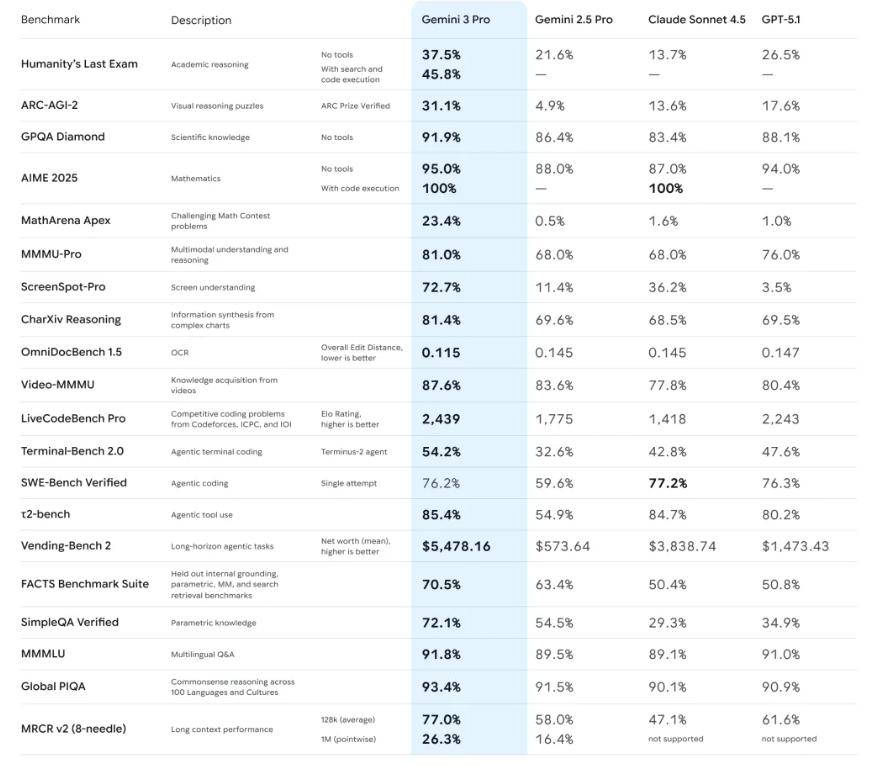
Core Viewpoint - Google has launched its most advanced model, Gemini 3, which integrates powerful features to help users realize their creative ideas easily, boasting PhD-level reasoning capabilities and excelling in various tests [1][4]. Group 1: Model Capabilities - Gemini 3 demonstrates advanced multimodal reasoning, visual and spatial understanding, and exceptional multilingual performance, supporting a context window of up to 1 million tokens for efficient learning [4]. - The model can assist users in various tasks, such as interpreting and translating handwritten recipes into a shareable cookbook and analyzing competition videos to create training plans [4]. - In programming, Gemini 3 has achieved high scores in benchmark tests like WebDev Arena and Terminal-Bench 2.0, showcasing its coding capabilities [4]. Group 2: Long-term Planning and Performance - Gemini 3 Pro ranks first in the Vending-Bench 2 test, which evaluates long-term planning capabilities through simulated management of a vending machine business, maintaining consistent tool usage and decision-making over a year [5]. - The model is designed to handle complex workflows, improving daily task management such as booking local services or organizing inboxes [6]. Group 3: User Engagement and AI Infrastructure - Google reports that its AI Overviews have 2 billion monthly users, with the Gemini App surpassing 650 million monthly active users, and over 70% of cloud customers utilizing the company's AI services [6]. - The company is expanding its advanced chip infrastructure, including GPUs from NVIDIA and its own TPUs, which are critical for powering all Google products and creating a competitive advantage [8][9]. Group 4: Market Position and Concerns - Analysts believe Google's AI stack creates a strong competitive moat, with significant capital expenditure potential due to its comprehensive approach from chip development to application [9]. - Despite being a major beneficiary of the AI wave, the CEO expressed concerns about a potential AI bubble, acknowledging irrational elements in the current investment climate [9].



摧毁AI牛市的“罪魁祸首”:“最弱一环”甲骨文
美股IPO· 2025-11-19 07:09
Core Viewpoint - Investors are no longer merely buying into the AI narrative but are critically examining the financial costs incurred by companies to support this narrative, particularly those that are heavily borrowing to fund expansion [1][7]. Group 1: Market Sentiment and Trends - The U.S. stock market indices have experienced declines, with the S&P 500 falling for four consecutive trading days amid concerns over an AI bubble [2]. - A recent survey indicates that 45% of fund managers view the "AI bubble" as the primary tail risk in the market, with growing worries about excessive spending on AI-related projects [4]. - The "OpenAI halo" effect, which previously boosted stock prices, is rapidly fading, as evidenced by Oracle's stock price decline following its announcement of a $300 billion deal with OpenAI [6][13]. Group 2: Oracle's Financial Situation - Oracle's ambitious growth plans are undermined by a fragile financial structure, with a projected capital expenditure of $35 billion for the current fiscal year and an expected annual expenditure of $80 billion by 2029 [9][10]. - The company's net debt has reached 2.5 times its EBITDA, having more than doubled since 2021, and is expected to double again by 2030 [10]. - Market predictions suggest that Oracle will continue to experience negative cash flow over the next five years [11]. Group 3: Risk Assessment - The cost of hedging against Oracle's debt default risk has risen to a three-year high, reflecting increasing market concerns about its credit risk [12]. - The inability of partnerships with AI leaders to boost stock prices raises questions about the sustainability of significant capital commitments in the AI sector [16][17].

伯恩斯坦:AI泡沫的“核心争议”,GPU真的能“用”6年吗?
美股IPO· 2025-11-19 07:09
Core Viewpoint - The debate surrounding the economic lifespan of GPUs is central to understanding the profitability of tech giants and the potential AI valuation bubble, with Bernstein supporting a 6-year depreciation period while critics like Michael Burry argue for a shorter lifespan of 2-3 years, suggesting accounting manipulation to inflate profits [3][14]. Group 1: GPU Depreciation and Economic Viability - Bernstein analysts argue that a 6-year depreciation period for GPUs is economically reasonable, as the cash costs of operating older GPUs are significantly lower than market rental prices, making it feasible to extend their usage [4][6]. - The report indicates that even 5-year-old NVIDIA A100 chips can still yield "comfortable profits," and only GPUs from the 7-year-old Volta architecture approach the cash cost breakeven point [4][6]. - The demand for computing power remains strong, supporting the value of older GPUs, as leading AI labs are willing to pay for any available computing resources, regardless of the model's age [9][10]. Group 2: Accounting Practices and Market Concerns - Michael Burry warns that tech giants are artificially inflating short-term profits by extending the useful life of assets, with predictions that this accounting practice could lead to an inflated profit of $176 billion for major tech companies from 2026 to 2028 [14]. - Burry specifically highlights that companies like Meta, Alphabet, Microsoft, Oracle, and Amazon are extending their depreciation periods to 6 years, despite the typical product cycle for AI chips being only 2-3 years [14]. - Amazon has recently shortened the expected lifespan of some servers and network equipment from 6 years to 5 years, reflecting differing views within the industry on hardware iteration speed [13].
谷歌扔出“王炸”Gemini 3,引爆华尔街新权力格局
Sou Hu Cai Jing· 2025-11-19 06:37
Core Insights - Google launched its latest AI model, Gemini 3, which has generated significant public interest and is considered to outperform competitors like OpenAI's GPT-5.1 in various benchmarks [1][2][6] - Despite the excitement, initial expectations for Gemini 3 were tempered, allowing for a more favorable reception compared to previous AI model launches [1][6] Performance Metrics - Gemini 3 Pro achieved a score of 37.5% in the "Humanity's Last Exam," surpassing GPT-5.1's score of 26.5% and the previous Gemini 2.5 Pro's score of 21.6% [2][3] - In various benchmarks, Gemini 3 Pro outperformed competitors in areas such as visual reasoning, scientific knowledge, and mathematics, with scores like 95.0% in mathematics without tools [3] Application and User Engagement - Gemini 3 supports numerous AI products and services, including Google's own tools and popular platforms like Figma [4][6] - Monthly active users for Gemini applications have doubled to over 650 million, while ChatGPT has around 800 million weekly active users [6] Market Impact and Investment Trends - Following the launch of Gemini 3, Alphabet's stock price saw significant interest, with major investors like Berkshire Hathaway increasing their holdings [7][8] - Despite the overall positive sentiment, Alphabet's stock did not see a substantial increase on the launch day, indicating market caution amid broader concerns about an AI bubble [11]

刚刚,A股突变!
天天基金网· 2025-11-19 05:20
Market Overview - On November 19, the A-share market exhibited a volatile "roller coaster" trend, with the Shanghai Composite Index down 0.04% and the Shenzhen Component Index down 0.32%, while the ChiNext Index rose by 0.12% [3][4] - The total market turnover was 1.12 trillion yuan, showing a slight decrease compared to the previous day, with nearly 4600 stocks declining [4] Sector Performance - The oil and petrochemical, banking, insurance, and defense sectors showed positive performance, while real estate, media, building materials, and retail sectors struggled [4][19] - The motorcycle sector led with a 5.38% increase, followed by oil and gas at 2.54% and consumer goods at 2.25% [5] Stock Movements - In the Hong Kong market, major indices turned negative, with the Hang Seng Index down 0.45% and the Hang Seng Tech Index down 0.98%. Xiaomi Group led the decline, falling over 4% [6][7] - The media sector in A-shares saw significant declines, particularly in AIGC concept stocks, with Tianxiaxiu hitting the daily limit down [9][10] High-Profile Stocks - Among the top 10 market capitalization stocks, only Kweichow Moutai experienced a slight decline, while others, including Agricultural Bank of China and Industrial and Commercial Bank of China, saw gains [20] - The "Big Three" oil companies collectively performed well, with China Petroleum rising over 4% and China National Offshore Oil Corporation up over 2% [24][25] Concept Stocks - The Hainan Free Trade Port concept stocks experienced a collective pullback, with Hainan Ruize down over 9% and Hainan Airport down over 6% [11][12] - Solar glass concept stocks also faced declines, with Hainan Development dropping nearly 9% [13] Conclusion - The market showed clear signs of divergence, with large-cap stocks outperforming small-cap stocks, indicating a potential shift in investor sentiment [19][20]







Gemini 3打服奥特曼马斯克,谷歌CEO却在担心AI泡沫
Sou Hu Cai Jing· 2025-11-19 05:19
Core Viewpoint - Google CEO Sundar Pichai has expressed concerns about the potential "AI bubble," highlighting irrational factors in the current trillion-dollar AI investment frenzy, suggesting that a bubble burst could affect all companies involved [1][10][11] Group 1: AI Investment Trends - Major tech companies are significantly increasing their investments in AI, with Meta projecting capital expenditures between $70 billion and $72 billion for 2025, up from previous estimates [3][5] - Microsoft reported a total capital expenditure of $34.9 billion as of September 30, exceeding analyst expectations and previous quarter figures [5] - Alphabet, Google's parent company, raised its revenue forecast for the year from $85 billion to between $91 billion and $93 billion, nearly double its projected capital expenditures for 2024 [5] Group 2: Company Valuations and Financial Performance - Nvidia has become the first company to surpass a market valuation of $5 trillion, reflecting the immense value attributed to AI-related businesses [5] - OpenAI's valuation surged to $500 billion following a secondary share sale, a 67% increase from its previous valuation of $300 billion, despite reporting a quarterly loss of $11.5 billion [6][9] - The financial impact of OpenAI's losses has affected its net profit and earnings per share, reducing them by $3.1 billion and $0.41 respectively [7][8] Group 3: Industry Perspectives on AI - Pichai compared the current AI situation to the 2000 internet bubble, indicating that no company would be immune to potential fallout [10] - He acknowledged the excitement surrounding AI but emphasized the need for a balanced perspective, recognizing both rational and irrational elements in the industry's current state [11] - Pichai cautioned against blindly trusting AI-generated information, advocating for the use of additional tools, such as Google Search, to verify information [13][14]

海外策略:美股AI泡沫是否存在?进行到哪儿了?
Changjiang Securities· 2025-11-19 05:16
丨证券研究报告丨 市场策略丨专题报告 [Table_Title] 海外策略:美股 AI 泡沫是否存在?进行到哪儿 了? 报告要点 [Table_Summary] 从估值、流动性和资本开支三个角度来看,美股 AI 当前并没有明显的出现泡沫的迹象。从估值 来看,当前纳斯达克指数当前估值难言较低,但相比于 2000 年科网泡沫时期仍有差距。从流 动性角度看,12 月美联储降息的预期正逐步减弱,市场流动性过度充裕的可能性不大。分析资 本开支数据,美国企业层面的扩张行为与科网泡沫时期有所不同,当前的扩张行为仍较为有序。 市场仍然未到需要担忧 AI 泡沫是否会破裂的阶段,即使最终会形成泡沫,当前也只是在形成泡 沫的早期演进期。 分析师及联系人 [Table_Author] 戴清 SAC:S0490524010002 SFC:BTR264 请阅读最后评级说明和重要声明 %% %% %% %% research.95579.com 1 [Table_Title 海外策略:美股2] AI 泡沫是否存在?进行到哪儿 了? [Table_Summary2] 市场焦点 1:美股 AI 泡沫是否存在?进行到哪儿了? 导读:近期随着对于 ...
A股,突变!
中国基金报· 2025-11-19 05:14
【导读】A股市场震荡走低,近4600股下跌;金融、石油板块护盘,房地产、传媒不振;高 位股大跳水 中国基金报记者 晨曦 刚刚,跳水了! 11月19日上午,A股市场走出"过山车"行情,午前震荡走低。截至午间收盘,上证指数跌 0.04%,深证成指跌0.32%,创业板指涨0.12%;上证50指数、沪深300指数飘红。 全市场半日成交额为1.12万亿元,较上日同期略有缩量;全市场近4600只个股下跌。 | | | | | N FOR HOUSE LE LE LE LE LE LEASE LE LEASE LE LEASE LE LEASE LE LEASE LE LEASE LE LEASE LE LEASE LE LEASE LEAST LE LEASE | | | | --- | --- | --- | --- | --- | --- | --- | | 金额 | | | | 1.12万亿 | | | | 成交流 | | | | 791.647 | | | | 开盘 | | | | 6282.91 (-0.08%) | | | | 152 1 | | | | 6306.81 ( 0.30%) | | | | RE ...