电动化

Search documents
均胜电子递表赴港上市 募资加码智能汽车研发与全球化布局
Quan Jing Wang· 2025-08-12 09:53
Core Viewpoint - Junsheng Electronics is planning an IPO in Hong Kong to accelerate investments in smart automotive technology, manufacturing capabilities, and global market expansion in response to the trends of electrification, connectivity, and intelligence in the automotive industry [1][3]. Group 1: Company Overview - Junsheng Electronics, headquartered in Ningbo, Zhejiang, is a leading domestic and internationally recognized supplier of smart automotive components, covering automotive safety and electronics [2]. - The company ranks as the second largest smart cockpit domain controller supplier in China and the fourth globally, based on projected 2024 revenue, and holds the second position in passive safety products both in China and globally [2]. - The automotive safety business has been the core revenue source for Junsheng Electronics, accounting for approximately 69% of total revenue from 2022 to 2024, with a slight decrease to 62.6% in the first four months of 2025 [2]. Group 2: Financial Performance - From 2022 to 2024, Junsheng Electronics reported steady revenue growth, with figures of 49.793 billion RMB, 55.728 billion RMB, and 55.864 billion RMB, while net profit increased significantly from 233 million RMB to 1.24 billion RMB and 1.326 billion RMB [4]. - In the first four months of 2025, the company achieved a revenue of 19.707 billion RMB and a net profit of 491 million RMB [4]. - Research and development (R&D) expenditures from 2022 to 2024 were 3.034 billion RMB, 3.648 billion RMB, and 3.686 billion RMB, representing 6% to 7% of revenue, with R&D investment of 1.574 billion RMB in the first four months of 2025 [4]. Group 3: IPO Fund Utilization - The IPO proceeds will be allocated to several key areas: (1) R&D and industrialization of smart automotive technologies, including domain controllers and advanced driver-assistance systems (ADAS); (2) manufacturing capacity expansion through upgrading production lines and introducing smart manufacturing technologies; (3) overseas market expansion in Europe, North America, and emerging markets; (4) mergers and acquisitions to strengthen technological capabilities and product lines; (5) supplementing working capital for daily operations and optimizing capital structure [4][5].

开源证券:欧洲车企延续电动化发展态势 新车型有望带动本地电车市场放量
Zhi Tong Cai Jing· 2025-08-12 08:31
Group 1 - The core viewpoint is that European automakers are continuing to show significant growth in electric vehicle (EV) sales in the first half of 2025, with major brands like Volkswagen, Renault, and BMW leading the charge [1] - Volkswagen Group's BEV deliveries in Europe increased by 89% year-on-year, while Renault's BEV sales rose by 57%, and BMW's new energy vehicle sales grew by 35% [1] - Stellantis saw a substantial improvement in sales, with some brands like Citroën achieving a 185% year-on-year increase in pure electric sales, while Mercedes-Benz's new energy vehicle sales remained flat [1] Group 2 - European automakers are set to continue launching new electric vehicle models in 2025-2026, which is expected to solidify and extend the trend of electrification [2] - Renault plans to release multiple electric models, including the Alpine A390 and Renault 4, while Stellantis will introduce several models based on new platforms [2] - Volkswagen, BMW, and Mercedes-Benz are also preparing to showcase or begin production of their next-generation electric vehicles, with significant product launches planned for 2025 and 2026 [2]
老豪华如何进化为新豪华
Zhong Guo Qi Che Bao Wang· 2025-08-12 06:33
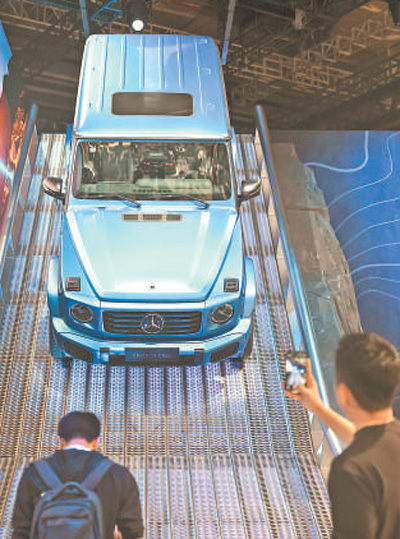
Core Insights - Traditional luxury brands like BBA (Benz, BMW, Audi) are facing strong competition from new luxury brands represented by companies like Wenjie and Li Auto in the Chinese market [2][3] - Significant price reductions have been observed for multiple Benz models, with discounts reaching up to 50%, leading to the closure of several dealerships in cities like Tangshan, Dongying, and Luoyang [2] - Mercedes-Benz's net profit after tax dropped by 55.8% year-on-year in the first half of the year, with total sales in China declining by 14% to 293,200 units [2] - Audi and BMW also reported declines in sales, with Audi's sales down 10.2% and BMW's net profit decreasing by over 29% [2] Market Dynamics - The definition of luxury is evolving as the automotive industry accelerates towards electrification and intelligence, with younger consumers prioritizing technology and practicality over brand prestige [2][3] - Mercedes-Benz is adjusting its electrification strategy to allow for a coexistence of fuel and electric vehicles, catering to different market conditions, particularly in China [3][10] - The acceptance of intelligent technology varies globally, with Chinese consumers showing the highest willingness to adopt smart features, while North American and European consumers express concerns about privacy and data security [3][9] Technological Focus - Mercedes-Benz identifies five key future technology anchors: electronic and electrical architecture, powertrains, autonomous driving, smart cockpits, and data security [8][9] - The company emphasizes the importance of self-research in electronic architecture and powertrains to maintain competitive advantage, while opting for collaboration in areas like data security and chip development [10][12] - The strategy includes a focus on user-centered technology that enhances safety, comfort, and convenience, avoiding mere technological accumulation [6][7] Localization and Global Strategy - The unique dynamics of the Chinese market are seen as a testing ground for innovation, with Mercedes-Benz aiming to adapt its product development processes to align with local market demands [13][14] - The company plans to leverage its experiences in China to enhance its global operations, potentially developing next-generation platforms locally [13] - The shift from traditional luxury to new luxury is characterized by a blend of brand heritage with modern consumer needs, with China acting as a catalyst for this transformation [14]


外资车企携新车、前沿技术亮相上海车展 坚定信心深耕中国市场
Xin Hua Wang· 2025-08-12 05:57
Group 1 - The Shanghai International Automobile Industry Exhibition showcases nearly 1,000 domestic and foreign enterprises from 26 countries, featuring over 100 new vehicles and cutting-edge technologies [2] - Multinational automotive companies like BMW, Audi, and Continental are demonstrating their commitment to the Chinese market through localized products and significant investment plans [2][3] - The exhibition serves as a platform for global automakers to present advancements in smart and electric vehicles, with companies like Continental and Aptiv unveiling localized solutions tailored for China's complex driving conditions [2][3] Group 2 - China has maintained its position as the world's largest automobile production and sales country for 16 consecutive years, with new energy vehicles accounting for over 40% of total new car sales [3] - The rapid development of new energy and smart connected vehicles, along with a complete industrial chain and a wealth of technological talent, attracts foreign enterprises to engage in collaborative innovation [3] - The active participation of foreign companies in the Shanghai Auto Show reflects China's strong appeal to the global automotive industry and will further promote the integration of China's automotive sector with the global market [3][4] Group 3 - Foreign companies are restructuring their relationship with the Chinese market through deep localization, moving beyond mere technology transfer to collaborative innovation with local partners [4] - This "mutual engagement" is expected to elevate China's automotive industry to the high end of the global value chain while opening new growth avenues for multinational enterprises [4] - The scale and innovative dynamism of the Chinese market will determine the competitiveness of global automakers over the next decade [4]

车企进入加速分化期
Xin Hua Wang· 2025-08-12 05:55
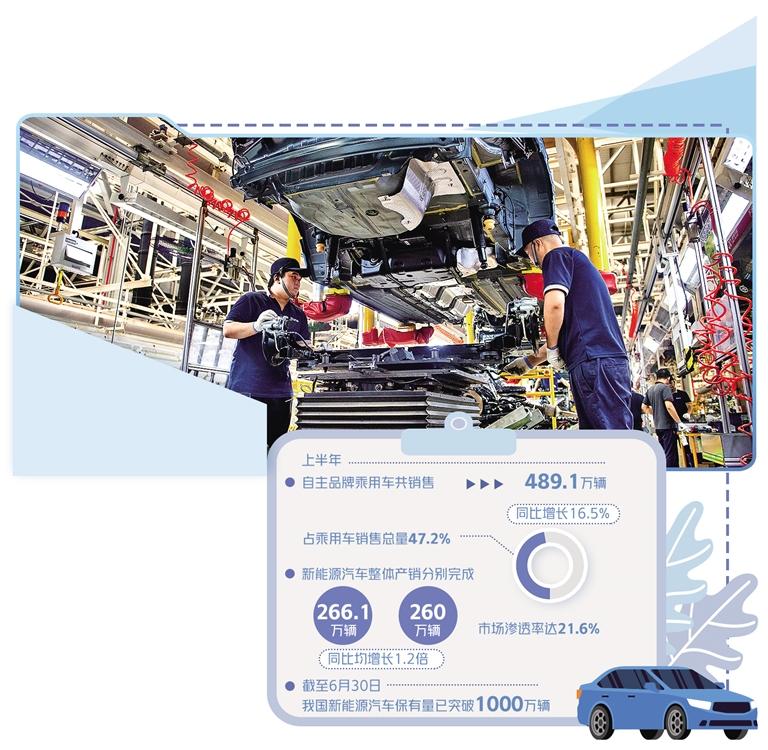
Core Insights - The Chinese automotive market has shown a "V" shaped recovery in the first half of the year, with total vehicle sales reaching 12.057 million units, a year-on-year decline of 6.6%, but the decline has narrowed compared to earlier months [2] - The top ten automotive companies accounted for 85.8% of total sales, indicating significant market concentration [2] - The performance of automotive companies has varied significantly, with a clear divide between those adapting to the trends of electrification and smart technology and those lagging behind [2][6] Industry Performance - In the first half of the year, domestic brands sold 4.891 million passenger vehicles, a year-on-year increase of 16.5%, capturing 47.2% of the market share, up 5.3 percentage points from the previous year [4] - Leading companies like Great Wall Motors, Changan Automobile, and BYD reported substantial profit increases, with BYD's expected profit growth ranging from 138.59% to 206.76% [4] - The overall production and sales of new energy vehicles (NEVs) exceeded expectations, reaching 2.661 million and 2.6 million units respectively, with a market penetration rate of 21.6% [5] Market Dynamics - The market is experiencing a significant divide, with traditional fuel vehicle sales declining, as evidenced by a 12% year-on-year drop in June sales [6] - Several weaker automotive companies are facing financial difficulties, with some entering bankruptcy proceedings, highlighting the competitive pressures in the market [6][7] - The number of new energy vehicle-related companies has surged, with approximately 552,000 registered, and 118,000 new registrations in the first half of the year, reflecting a growth rate of 46.5% [5] Future Outlook - The automotive industry is expected to recover in the second half of the year, supported by policies such as reduced vehicle purchase taxes and local incentives to stimulate consumption [9][10] - Major companies like BYD are optimistic about achieving sales targets, with projections of reaching 1.5 million units for the year, and potentially up to 2 million units under favorable conditions [10] - Overall, the automotive market is projected to reach 27 million units in sales for the year, with a 3% year-on-year growth, and NEV sales expected to grow by over 56% [10]

广汽本田高层人事调整 合资车企加速战略转型
Zhong Guo Zhi Liang Xin Wen Wang· 2025-08-12 04:26
Core Viewpoint - The automotive industry is undergoing a deep transformation, prompting joint venture companies to actively seek role redefinition and development momentum conversion [1][2] Group 1: Company Developments - GAC Honda has appointed Gao Hongxiang as the new executive vice president, aiming to drive transformation in areas such as new energy, intelligence, and innovative marketing [1] - The leadership change is seen as a critical step for GAC Honda to accelerate its strategic transformation and enhance future competitiveness, signaling a positive embrace of new trends [1] - GAC Group is implementing comprehensive reforms across organizational structure, processes, and personnel to empower its joint ventures [1] Group 2: Industry Trends - Joint venture companies are restructuring strategies and innovating organizations to seize development opportunities amid intensifying competition in electrification and intelligence [2] - The new leadership is expected to inject fresh momentum into GAC Honda, helping it reshape its core competitiveness in the new energy and intelligence wave [2] - The personnel changes reflect the joint venture sector's proactive response to significant industry changes and its pursuit of new growth paths [2]

春风动力: 春风动力2025年半年度报告
Zheng Quan Zhi Xing· 2025-08-11 16:19
Core Viewpoint - Zhejiang Chunfeng Power Co., Ltd. reported significant growth in revenue and profit for the first half of 2025, driven by strong performance in its all-terrain vehicle (ATV) and motorcycle segments, alongside a rapid expansion in its electric two-wheeler business [2][19]. Company Overview and Financial Indicators - The company achieved a revenue of approximately 9.86 billion RMB, a 30.90% increase compared to the same period last year [2]. - Total profit reached approximately 1.24 billion RMB, reflecting a 53.30% year-on-year growth [2]. - Net profit attributable to shareholders was about 1.00 billion RMB, up 41.35% from the previous year [2]. - The company's total assets increased to approximately 16.74 billion RMB, a 12.38% rise from the end of the previous year [2]. Business Operations Main Business - The company focuses on the power sports industry, aiming to become a world-class brand by offering products in the ATV, motorcycle, and electric two-wheeler segments [3][4]. - The ATV segment includes vehicles designed for off-road use, with a displacement range of 400CC to 1000CC, catering to various applications such as outdoor work and recreational activities [3][4]. Marketing and Sales Strategy - The company employs a global marketing strategy, with over 7,000 retail terminals worldwide, and a strong presence in North America, Europe, and Asia [3][4]. - The sales model combines direct sales, dealer networks, and online platforms to enhance market reach and customer engagement [3][4]. Industry Overview ATV Market - The global ATV market is projected to grow from 15 billion USD in 2023 to 29.5 billion USD by 2033, with a compound annual growth rate (CAGR) of 7% [6][7]. - North America remains the largest market, accounting for 83.85% of global sales, driven by high outdoor recreational demand [6][7]. Motorcycle Market - The motorcycle market in China is experiencing significant growth, with production and sales exceeding 10 million units in the first half of 2025, marking an 11.83% increase year-on-year [10][11]. - The demand for mid to large displacement motorcycles is rising, reflecting a shift towards recreational and lifestyle-oriented usage [10][11]. Electric Two-Wheeler Market - The electric two-wheeler segment is rapidly expanding, with sales expected to reach 52 million units in 2025, driven by increasing consumer demand for eco-friendly transportation options [11][14]. - The company’s electric brand, Jike, is positioned to capture market share through innovative product offerings and strategic channel expansion [18][23].

春风动力(603129.SH):上半年净利润10.02亿元 同比增长41.35%
Ge Long Hui A P P· 2025-08-11 12:18
Core Insights - The company, Spring Power (603129.SH), reported a strong performance in the first half of 2025, focusing on globalization, electrification, and intelligence as strategic directions [1] Financial Performance - Total operating revenue reached 9.855 billion, representing a year-on-year increase of 30.90% [1] - Net profit attributable to the parent company was 1.002 billion, showing a year-on-year growth of 41.35% [1] - The net profit after deducting non-recurring items was 0.951 billion, up by 38.38% year-on-year [1] - The net cash flow from operating activities was 2.4 billion, reflecting a significant increase of 60.84% compared to the previous year [1] Strategic Initiatives - The company is advancing product innovation, market expansion, and industrial upgrades through capacity expansion, technological iteration, market development, and governance optimization [1]
吉利汽车(0175.HK):总销量同环比持续增长 Q3强势新车周期开启
Ge Long Hui· 2025-08-08 11:46
Core Viewpoint - Geely Automobile reported strong sales growth in July 2025, with a total of 238,000 vehicles sold, representing a year-on-year increase of 57.7% and a month-on-month increase of 0.7% [1] Sales Performance - July sales reached 238,000 units, with a cumulative total of 1.647 million units sold from January to July 2025, marking a year-on-year increase of 48.8% [1] - New energy vehicle sales in July exceeded 130,000 units, showing a year-on-year growth of 120.4% and accounting for 54.7% of total sales, an increase of 15.6 percentage points year-on-year [1] Model Breakdown - Sales by brand in July included 194,000 units for Geely, 27,000 units for Lynk & Co, and 17,000 units for Zeekr, with year-on-year increases of 70.0%, 27.9%, and 8.4% respectively [1] - The Galaxy model sold 95,000 units in July, reflecting a significant year-on-year increase of 237.2% [1] Export Performance - In July, Geely exported 35,000 vehicles, which is a year-on-year increase of 6.0% but a month-on-month decrease of 11.8% [1] Product Strategy - Geely plans to launch 10 new energy models in 2025, including 5 new models and several updated versions under the Geely brand [2] - The company is focusing on smart technology integration, with new models expected to feature advanced driving assistance systems [2] Platform and Profitability - The GEA architecture is expected to support a new product cycle, enhancing the transition to new energy vehicles and improving profitability [3] - The company anticipates a net profit of 16.1 billion yuan for 2025, with a price-to-earnings ratio of 10X [3]

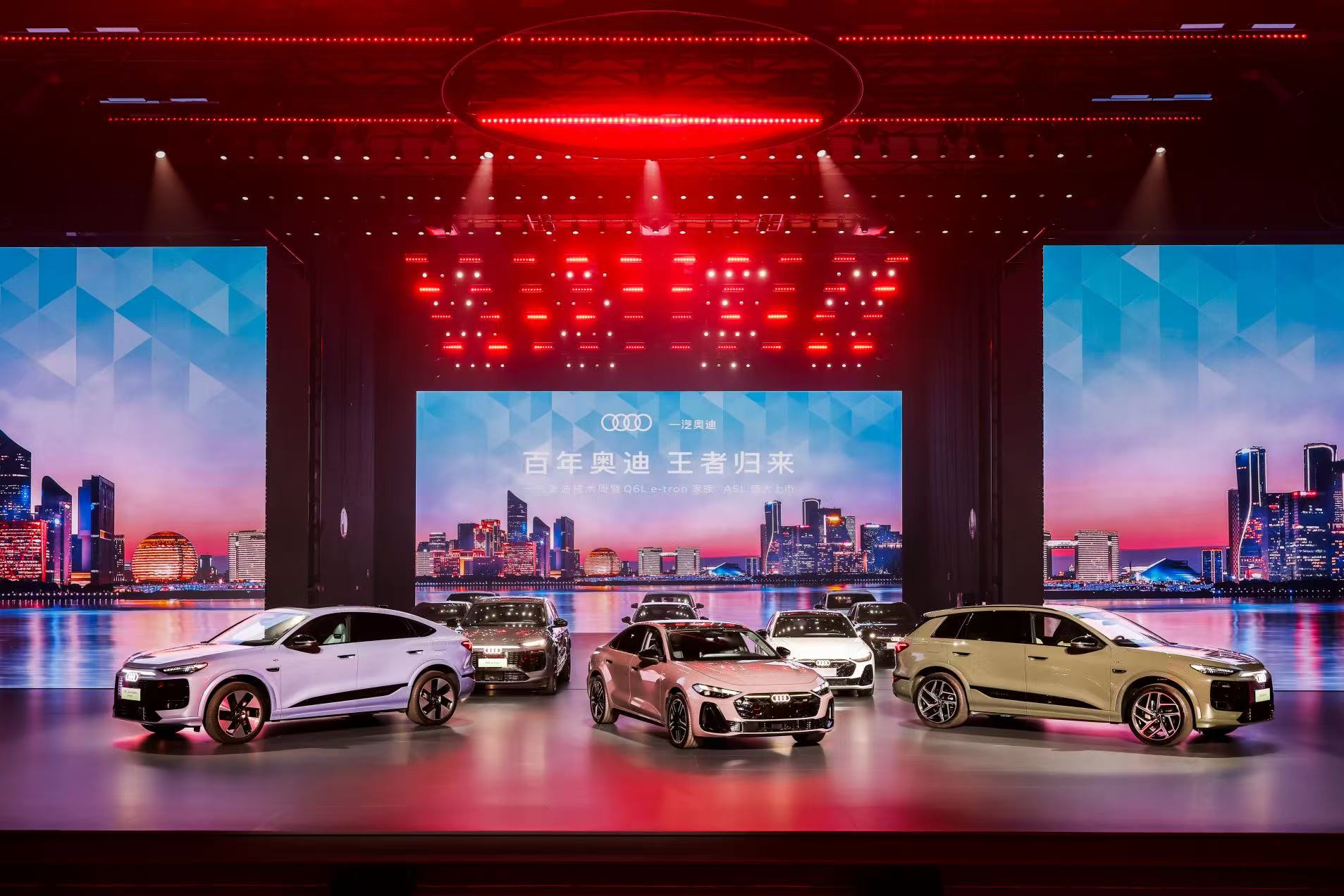
一汽奥迪Q6L e-tron家族与A5L联袂上市
Qi Lu Wan Bao· 2025-08-08 01:47
Core Viewpoint - The event marked the launch of the Q6L e-tron family and A5L, showcasing FAW Audi's advancements in smart and electric vehicle technology, in collaboration with leading tech partners like Huawei and CATL [1][4][9]. Group 1: Event Highlights - The event featured an immersive digital technology exhibition, presenting the achievements of Audi's PPE luxury electric platform and PPC luxury fuel intelligent platform [1]. - A stunning light show involving 46 buildings was created, enhancing the brand's connection with users and showcasing its modern image [3]. Group 2: Strategic Developments - FAW Audi's technology week represents a culmination of 37 years of collaboration between FAW and Audi, highlighting milestones in introducing luxury vehicles to the Chinese market [4]. - The company is committed to a dual strategy of "oil and electricity coexistence," focusing on high-quality development in the Chinese automotive industry [5][15]. Group 3: Product Launches - The Q6L e-tron family, priced between 348,800 to 398,800 yuan, is the first product based on the PPE platform, featuring a 107 kWh CATL battery and an 800V high-voltage platform [9]. - The A5L, as the first model on the PPC platform, is priced between 239,800 to 289,800 yuan, incorporating advanced technologies and a new design philosophy [11]. Group 4: Market Commitment - Audi's strategy emphasizes "In China, for China," with a significant product layout aimed at meeting local consumer demands [6]. - FAW Audi aims to achieve a cumulative sales milestone of 10 million vehicles, reinforcing its leadership position in the luxury car market in China [15].