
美元指数

Search documents
金元期货:美债美元联手施压 贵金属偏弱运行
Jin Tou Wang· 2025-11-05 01:36
Macro News - The U.S. Treasury yields have rebounded significantly, with the 10-year Treasury yield returning to 4.11%, primarily due to high corporate bond issuance and uncertainty surrounding monetary policy following hawkish comments from Powell last week [1] - The dollar index has shown a notable rebound, approaching the critical level of 100, influenced by expectations of the Federal Reserve's monetary policy and the weakening of non-U.S. currencies [1] - The Federal Reserve's mixed signals create uncertainty in the market, with various officials expressing differing views on the potential for a rate cut in December, indicating that while risks to employment and inflation are rising, a rate cut is not guaranteed [1] Economic Data - The U.S. ISM Manufacturing PMI for October is reported at 48.7, marking the eighth consecutive month of contraction, falling short of the expected 49.5 and down from the previous value of 49.1 [2] - New orders have declined for the second consecutive month, and the production index remains weak, with the price payment index hitting a new low for the year [2] - The ongoing government shutdown continues to pose risks, with the latest vote failing to pass, which may enhance market uncertainty and increase safe-haven demand for precious metals [2] Institutional Views - Precious metals are currently in a volatile trend, facing pressure from the significant rebound in the dollar index and U.S. Treasury yields, leading to a weaker performance [2] - Previous short-term corrections have lowered volatility, and recent optimistic expectations have not materialized, suggesting a higher likelihood of renewed risks in the future [2] - Despite the challenges, there are indications that precious metals may have support for recovery in the medium to long term, although fluctuations in U.S. Treasury yields and the dollar index need to be monitored closely [2]
张尧浠:美政府停摆创纪录、金价仍有再走低风险
Sou Hu Cai Jing· 2025-11-05 01:08
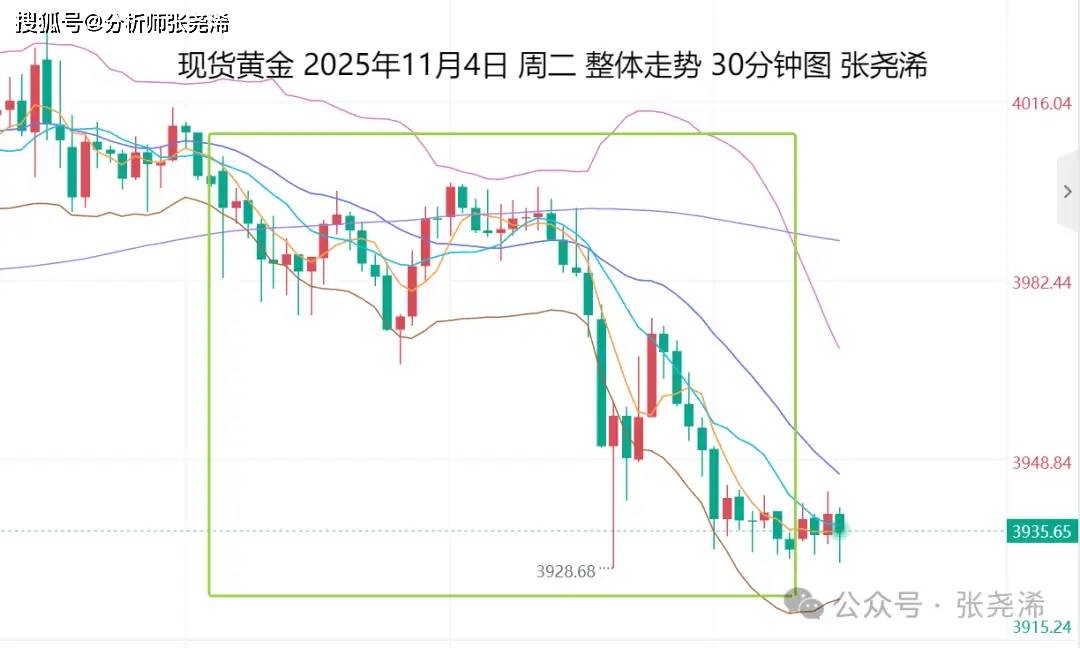
Core Viewpoint - The article discusses the recent decline in international gold prices, influenced by factors such as the U.S. government's record shutdown and the Federal Reserve's internal disagreements regarding interest rate cuts, which have led to a stronger U.S. dollar and increased pressure on gold prices [1][3][4]. Market Performance - On November 4, gold opened at $4001.88 per ounce, reached a high of $4005.56, but ultimately closed at $3931.87, down $70.01 or 1.75% [1]. - The price fluctuation for the day was $76.79, indicating significant volatility [1]. Economic Indicators - The article highlights the importance of upcoming economic data, including the U.S. ADP employment figures and ISM non-manufacturing PMI, which are expected to be better than previous values and may negatively impact gold prices [3][4]. - The 10-year U.S. Treasury yield closed at 4.090%, contributing to the downward pressure on gold [3]. Technical Analysis - Short-term outlook suggests that gold bears have the upper hand, with potential further declines below $3900 unless there is a surprising positive employment report [4]. - Monthly and weekly charts indicate that gold prices may face selling pressure, with potential targets at $3800 or even $3700 if bearish trends continue [8][10]. Future Outlook - Despite short-term challenges, the long-term outlook for gold remains bullish, with expectations of reaching new highs around $5000 due to ongoing economic uncertainties and potential future Fed rate cuts [6]. - Factors such as the ongoing government shutdown, persistent inflation, and global central bank gold purchases are expected to support gold prices in the long run [6][8]. Support and Resistance Levels - Key support levels for gold are identified at $3900 and $3850, while resistance levels are at $3970 and $4000 [12]. - For silver, support is noted at $46.10 and $45.50, with resistance at $47.70 and $48.00 [12].

4日美元指数重返100关口上方 国际金价跌超1%
Sou Hu Cai Jing· 2025-11-05 00:39
Core Viewpoint - The unclear outlook for Federal Reserve interest rate cuts and tight liquidity in financial markets have driven the US dollar index to rebound, reaching a new high since May 20 of this year [1] Group 1: Currency Market - The US dollar index closed above the 100 mark on Tuesday, marking a significant increase [1] - A stronger dollar has put pressure on gold prices, leading to a decline in international gold prices [1] Group 2: Commodity Market - As of the close, the December gold futures price on the New York Commodity Exchange settled at $3960.5 per ounce, reflecting a drop of 1.33% [1]
民生宏观:美元指数再破100 但升值周期未至
Xin Lang Cai Jing· 2025-11-04 22:50
来源:格隆汇APP 格隆汇11月5日|民生宏观研报称,我们倾向于本轮美元指数的突破相对7月会更"成功"——反弹的点位 可能会更高(101至103),持续的时间会更长,至少需要美国政府开门后,连续偏弱的经济硬数据来修 正市场的预期。但我们不认为美元的升值周期要来了,当前美元更多的只是反弹:短期内,市场已经开 始定价12月不降息(预期概率已经超过30%),这使得后续政策预期调整有较大的空间。此外,年底前 白宫将公布美联储主席人选,从热门的人选来看,政策区别只是在于"宽松"还是"极度宽松",预计对于 美元都不是好消息。 ...
民生证券:美元百点关口再闯关 本轮突破或将更具持续性
智通财经网· 2025-11-04 22:49
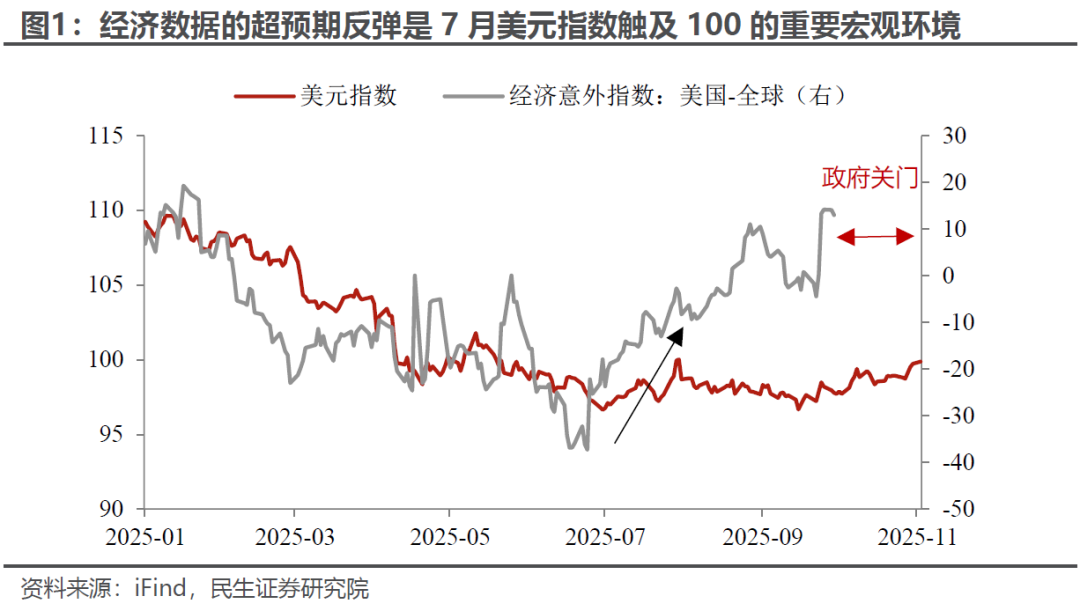
Core Viewpoint - The report from Minsheng Securities indicates that the US dollar index is attempting to break above 100 for the second time this year, with expectations that this attempt may be more successful than the previous one in July, potentially reaching levels between 101 and 103 and lasting longer [1][14]. Group 1: Market Conditions - The current market environment is characterized by a lack of economic data, leading to a state of "autopilot" where concerns about hawkish comments from Powell exist without sufficient data to counter them [8]. - The previous attempt in July was influenced by strong economic data, which shifted market expectations from a "recession" to a "recovery" mode, while the current situation lacks such supportive data [5]. Group 2: External Influences - The driving forces behind the dollar's movements differ between the two attempts; in July, the British pound was the weakest among G7 currencies due to ongoing economic weakness, while currently, the Japanese yen is leading the decline due to its own political and economic challenges [9][12]. - The trade agreements between the US and Japan, which impose tariffs on Japanese goods while providing favorable terms to South Korea, have positioned Japan at a disadvantage compared to its regional counterparts [13]. Group 3: Future Expectations - Despite the current rebound in the dollar, Minsheng Securities does not foresee a long-term appreciation cycle for the dollar, viewing the current situation as a temporary rebound rather than a sustained increase [14]. - The market is beginning to price in a likelihood of no interest rate cuts in December, with expectations exceeding 30%, indicating potential adjustments in future policy expectations [14]. - The ongoing debt issues in the US and the potential for accelerated rate cuts by the Federal Reserve suggest that the dollar's long-term outlook remains uncertain, with significant implications for risk assets [18].
美元指数涨0.34%报100.21,非美货币多数下跌
Mei Ri Jing Ji Xin Wen· 2025-11-04 22:22
Core Viewpoint - The US dollar index increased by 0.34% to 100.21, while most non-US currencies experienced declines, indicating a strengthening of the dollar against other currencies [1]. Currency Movements - The euro fell by 0.32% against the dollar, trading at 1.1482 [1]. - The British pound decreased by 0.91%, with a rate of 1.3021 against the dollar [1]. - The Australian dollar dropped by 0.75%, reaching 0.6489 against the dollar [1]. - The Japanese yen declined by 0.35%, trading at 153.6740 against the dollar [1]. - The Canadian dollar appreciated by 0.32%, with a rate of 1.4103 against the dollar [1]. - The Swiss franc increased by 0.31%, trading at 0.8106 against the dollar [1].
ICE美元指数涨0.38%
Mei Ri Jing Ji Xin Wen· 2025-11-04 21:43
Group 1 - The ICE Dollar Index increased by 0.38%, reaching a daily high of 100.255 points during the New York trading session on November 4 [1] - At 15:42 Beijing time, the index slightly declined to 99.743 points before continuing to rise [1]
美联储“鹰鸽乱舞” 美元指数重回100关口
Sou Hu Cai Jing· 2025-11-04 16:04
本报记者 韩昱 11月4日,美元指数盘中重回100关口,为今年8月份以来首次。拉长时间看,自9月中旬以来,美元指数 呈现出震荡回升的趋势,从96水平逐步拉升突破97、98、99整数关口,期间(9月15日至11月4日记者发 稿时)涨幅约为2.41%。 陕西巨丰投资资讯有限责任公司高级投资顾问丁臻宇在接受《证券日报》记者采访时表示,美元指数短 期或维持震荡偏强态势,但上行空间有限。一方面,美联储将于12月1日起结束缩表,宣告量化紧缩告 一段落,对美元流动性形成支撑;另一方面,美联储内部对降息路径存在分歧,政策决策的谨慎性可能 延缓美元走弱节奏。 从美元指数来看,明明认为,短期来看,美元指数走势主要取决于市场对于美联储降息路径的预期变动 和市场的风险情绪变动。若核心经济数据披露后美国经济表现低于预期,或推动美元指数走弱。 在今年连续两次降息后,除鲍威尔外,美联储官员近日也密集发声释放货币政策信号,但"鹰派""鸽 派"信号均有体现,内部对降息路径的分歧愈发明显。 "2026年美元指数大概率进入下行通道,长期承压趋势明确。"丁臻宇认为,核心逻辑在于市场对美国利 率的"重新定价",美联储进入降息通道将对美元形成持续压力。 ...
美元指数破百后,黄金又崩了:现货黄金失守3990美元!接下来还会跌吗?
Sou Hu Cai Jing· 2025-11-04 12:12
Core Viewpoint - The recent sharp decline in gold prices, breaking the critical support level of $3990, follows three months of continuous increases, raising concerns about the future trajectory of gold prices [1]. Group 1: Market Dynamics - Gold was a leading asset this year, reaching historical highs in March, with a 47% surge in global investment demand in Q3, and Chinese investors purchasing 74 tons of gold, a 19% increase year-on-year [3]. - On November 3, gold prices dropped over 1% during U.S. trading hours, struggling to maintain the $4000 mark, and fell below $3990 on November 4, a significant level previously viewed as a "bullish lifeline" by many institutions [3][5]. Group 2: Factors Behind the Decline - The primary pressure on gold prices comes from the strengthening U.S. dollar, which surpassed the 100 mark on November 4 for the first time since August, as Federal Reserve officials expressed opposition to a rate cut in December, boosting confidence in the dollar [5]. - The yield on 10-year U.S. Treasury bonds has surged to 4.11%, offering higher returns without the volatility associated with gold, prompting large investors to withdraw from the gold market [6][7]. - A decrease in risk aversion due to easing geopolitical tensions in the Middle East has diminished gold's appeal as a safe-haven asset, compounded by the lack of timely economic data releases due to the U.S. government shutdown, leading to increased gold sell-offs [8][9]. Group 3: Future Outlook - In the short term, gold prices are likely to experience "volatile downward movement" due to the strong dollar and reduced likelihood of a December rate cut, with a potential drop to $3900 [11]. - However, the long-term outlook remains positive for gold, suggesting a "value return" despite the current "pressure test," depending on whether investors are focused on short-term trading or long-term positioning [11][13].
美元第二次尝试破100,有何不同?
Minsheng Securities· 2025-11-04 11:51
Group 1: Dollar Index Analysis - The dollar index attempted to break 100 for the second time, with the first attempt occurring at the end of July 2025, followed by a significant drop due to disappointing non-farm payroll data on August 1[3] - The current macroeconomic environment differs significantly from July, with a lack of economic data and a hawkish stance from Powell leading to a "self-driving" market[4] - In July, the British pound experienced the largest decline among G7 currencies due to ongoing economic weakness in the UK, while this time the Japanese yen is leading the decline following Japan's monetary easing policies[4] Group 2: Future Outlook - The current attempt to break 100 is expected to be more successful than in July, with potential for higher rebound points and longer duration[5] - However, the dollar is not entering a long-term appreciation cycle; it is merely experiencing a rebound[5] - Short-term market expectations are pricing in a greater than 30% probability of no interest rate cuts in December, indicating significant room for policy expectation adjustments[5] - The upcoming announcement of the Federal Reserve chair by the White House is anticipated to negatively impact the dollar[5] - Long-term, the Fed is still in a rate-cutting cycle, and ongoing U.S. debt issues alongside European fiscal measures remain critical concerns[5] - The dollar's rebound may assist in stabilizing gold and silver prices and help equity markets adjust to high valuations[5] - Risks include significant changes in U.S. trade policies and unexpected tariff expansions that could lead to a global economic slowdown[5]