
人工智能

Search documents
紫金矿业净利首破500亿大关
第一财经· 2026-03-23 06:22
2026.03. 23 本文字数:2383,阅读时长大约4分钟 作者 | 第一财经 魏中原 近日,紫金矿业(601899.SH)发布2025年年报,凭借黄金、白银等主营产品价格与产量同步增 长,公司全年净利首次突破500亿元大关。 年报显示,紫金矿业2025年实现营业收入3490.8亿元,同比增长近15%;实现归母净利润518亿 元,同比增长61.55%。亮眼业绩的背后,是金、银、铜等主要金属在2025年"全面牛市"中的量价齐 升效应。公司拟每10股派发现金红利3.8元(含税),加上已实施的58.5亿元中期分红,全年现金分 红总额将达159.5亿元,分红规模创下上市以来新高。 然而,就在年报发布前夕,黄金市场却遭遇剧烈震荡,美联储鹰派信号叠加美以伊冲突持续,令金银 价格一夜之间跌回年初水平。大宗商品周期历来波动剧烈,也是矿产企业面临的现实考验。2026年 是紫金矿业在创始人陈景河交棒后的第一个完整财年,新一届管理层将面临不同以往的挑战。 不只如此,"紫金系"资本版图正在加快成型。报告期内,紫金矿业成功控股A股上市矿业公司藏格矿 业(000408.SZ),系公司历史最大单笔投资,并成功分拆紫金黄金国际(0225 ...


为什么可靠的数据是深度研究的基础?
Refinitiv路孚特· 2026-03-23 06:03
Core Viewpoint - LSEG's Deep Research aims to provide structured, reliable research capabilities tailored for market participants, enhancing the quality and trustworthiness of financial research [1][2]. Group 1: Deep Research Development - Deep Research is rapidly evolving, leveraging OpenAI's GPT-5.2 to enable structured queries and real-time research guidance within LSEG's Workspace [1]. - The tool integrates verified data sources and controlled access, ensuring transparency in data usage, which is crucial for producing actionable insights [2]. Group 2: Benefits for Analysts and Portfolio Managers - Analysts and portfolio managers can generate rigorous research reports more efficiently, combining narrative analysis with relevant data and peer comparisons, all based on authorized data [2]. - The reports produced can be directly utilized in investment committees and client discussions, enhancing the credibility of the insights [2]. Group 3: Advantages for Investment Bankers - For investment bankers, Deep Research provides in-depth and trustworthy research that identifies emerging trends and supports new business opportunities [4]. - It aids in refining valuation recommendations and structuring better deals, ultimately creating value for corporate clients and mitigating transaction risks [4]. Group 4: Market Interpretation for Trading and Risk Teams - The tool significantly improves the efficiency of market interpretation, especially during rapid market fluctuations, by providing traceable and verifiable explanations [4]. - Deep Research consolidates market background information and authorized news signals into comprehensive reports, helping teams distinguish between market noise and actual drivers [4]. Group 5: Macro and Multi-Asset Decision Making - For macro research and multi-asset decision teams, Deep Research enables the transformation of geopolitical and macroeconomic events into testable scenario analyses [5]. - It establishes a systematic framework to analyze inter-asset linkages, enhancing decision-making confidence through transparent analytical logic [5]. Group 6: Future Vision of LSEG - LSEG aims to achieve "LSEG Everywhere," integrating its services into clients' workflows while prioritizing access management and governance [5]. - The value of Deep Research is expected to increase exponentially as it operates within a controlled data environment rather than relying on scattered information from the open web [5][6].

全球市场再次开启无差别抛售模式
第一财经· 2026-03-23 05:47
2026.03. 23 本文字数:2425,阅读时长大约4分钟 作者 | 第一 财经 后歆桐 周一(23日)亚太交易时段,随着中东局势进一步压制投资者情绪,从亚太主要股指到加密货币再 到黄金,再次进入"跌跌不休"模式。布伦特原油期货继续下跌,至111.97美元/桶。WTI原油期货下 跌0.6%,至97.64美元/桶。两者价差超过14美元/桶,这是多年来两者准价格之间最大的价差。 Strategas Research首席市场策略师维罗内(Chris Verrone)表示,不断扩大的价差可能预示 着"此次石油危机已达顶峰"。他还补充,布伦特原油期货价格高企可能会促使交易员将这场冲突持续 时间延长纳入考量。 富达全球宏观总监蒂默(Jurrien Timmer)在社交平台发帖称:"这一切到底意味着什么?为什么风险 资产下跌、美元受追捧,而债券收益率和比特币价格却在上涨?问题太多了。" 日韩股市跌超5% Asymmetric Advisors日本股票策略师阿瓦达斯(Amir Anvarzadeh)在报告中写道,无论接下来 发生什么,短期通胀前景已经非常明朗。美国总统特朗普向伊朗发出48小时最后通牒,要求其重新 开放霍尔 ...

数据来了:用户使用滴滴AI叫车,最关心的问题是什么
Zhong Guo Qi Che Bao Wang· 2026-03-23 05:29
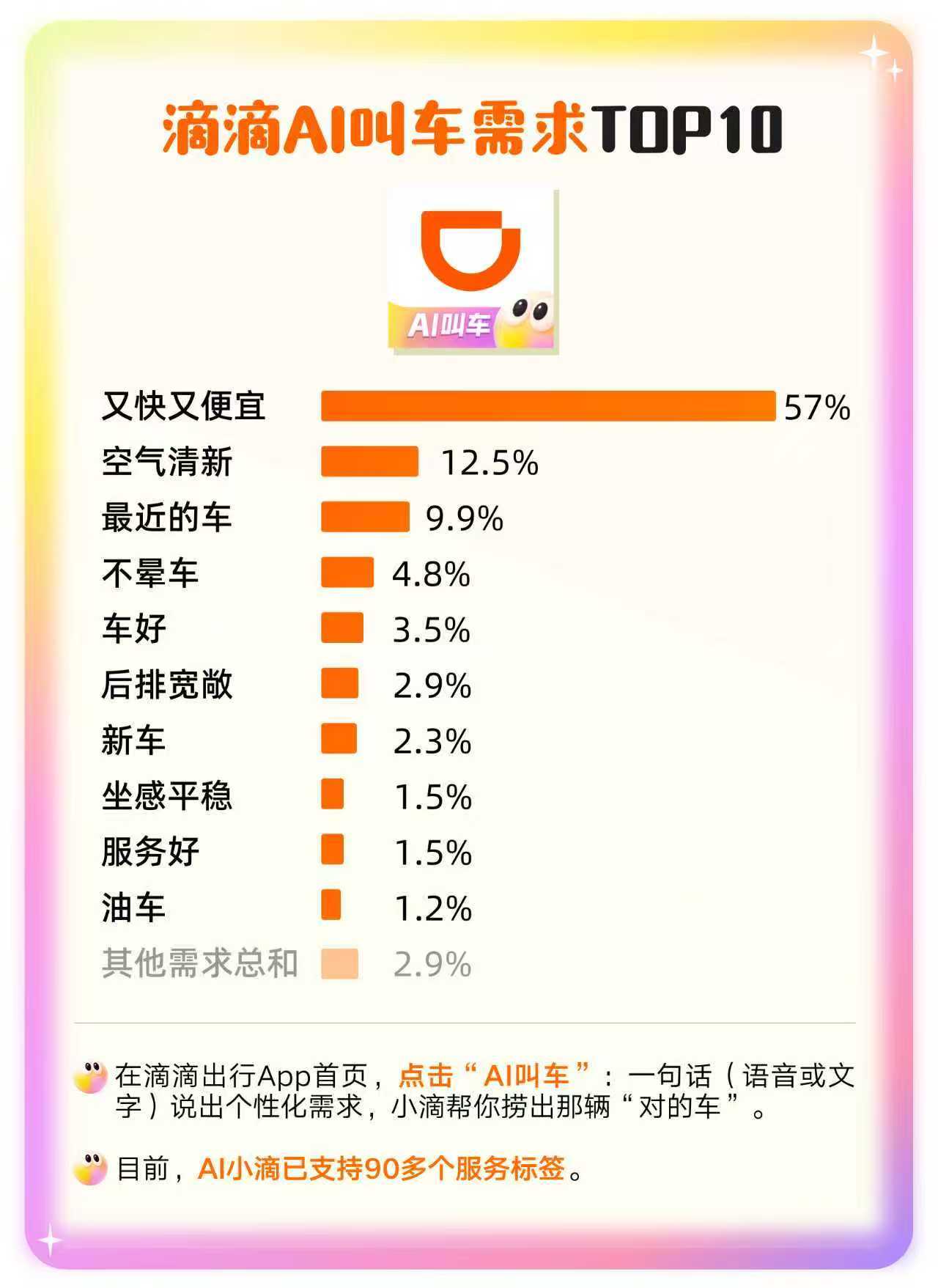
Group 1 - The core idea of the article is that Didi's AI travel assistant, Xiao Di, has quickly gained popularity among users, transforming the ride-hailing experience from simply "hailing a car" to "hailing the right car" [1] - Didi's operational data shows that in personalized ride requests, the top three preferences are "fast and cheap" (57%), "fresh air" (12.5%), and "nearest car" (9.9%), indicating users' focus on efficiency, price, and comfort [1] - Xiao Di currently supports over 90 service tags, reflecting the diverse preferences of users, especially in important scenarios like family pickups, group travel, and business trips [1] Group 2 - Features such as searching nearby locations, booking rides, combined travel, and order inquiries are being frequently used, highlighting the platform's role as a vital connection to surrounding life services [4] - The most searched destinations include "subway station," "coffee shop," and "charging station," indicating users' real-life needs that extend beyond mere transportation [4] - The data on "scheduled rides" shows a growing demand for planned and predictable travel, with users frequently booking rides for specific times and days [4] Group 3 - The data reflects the potential of AI in innovating consumer scenarios, as users seek a travel assistant that understands their needs and integrates information to aid decision-making [6] - Didi's leading supply network and service advantages can be enhanced through AI to better meet users' personalized and diverse demands [6] - AI Xiao Di not only activates long-tail user demands but also connects with the local community, emphasizing a human-centered approach to technological innovation [6]

贝塔创新科技观察:以算力为核心的新型基础设施体系正在形成
Jiang Nan Shi Bao· 2026-03-23 05:25
Core Insights - The article emphasizes the growing importance of computing infrastructure as a foundation for industrial upgrades, driven by advancements in artificial intelligence (AI) and the digital economy [1][2][3] Industry Trends - The global AI computing industry is transitioning from infrastructure construction to systematic development, reshaping the competitive landscape of the AI industry since 2022 [1][2] - The rapid expansion of the digital economy has transformed computing power from a mere technical resource into a critical production factor, prompting countries to enhance digital infrastructure [2][4] - In China, national projects like "East Data West Computing" are optimizing the layout of computing resources, pushing the transition from traditional data centers to intelligent computing centers focused on AI applications [2][4] Company Strategy - The company has been systematically advancing research and planning for intelligent computing infrastructure, focusing on AI server platforms, high-performance GPU nodes, and regional intelligent computing center architectures [3][5] - The company proposes a development strategy that combines platform capability construction with node resource layout, advocating for a collaborative computing network that includes central, regional, and edge nodes [3][5] - As of 2023, the demand for high-performance computing resources has surged due to the rapid growth of generative AI technologies and large model training needs [3][4] Future Outlook - The company anticipates a structural change in global computing demand by 2024, with a dual focus on centralized high-performance resources for model training and localized infrastructure for enterprise AI applications [5][6] - The future of AI infrastructure is expected to exhibit a networked characteristic, with multi-node, collaborative computing networks becoming essential [6][7] - The competitive logic of the AI industry is shifting from resource competition to system competition, where the ability to build stable, efficient, and scalable computing systems will determine long-term advantages [7][8]
AI算力行业周报:英伟达GTC 2026正式开幕,OFC 2026见证“互连爆发”
Huaxin Securities· 2026-03-23 05:24
Investment Rating - The report maintains a recommendation for investment in the AI computing sector, particularly focusing on companies like NVIDIA and others involved in AI infrastructure [2]. Core Insights - NVIDIA has transitioned from a chip supplier to a full-stack AI infrastructure platform, with expectations that demand for its AI chips will reach at least $1 trillion by 2027, doubling previous forecasts [3]. - The OFC 2026 event highlighted the emergence of new multi-source protocol organizations to address interconnect needs for large-scale AI data centers, with significant participation from over 60 companies [4]. - The report emphasizes the importance of AI software and ecosystem development, particularly with the introduction of the NemoClaw software stack for secure AI operations [3]. Weekly Market Analysis - The communication sector saw a weekly increase of 2.10%, while the electronics sector experienced a decline of 2.84% from March 16 to March 20 [11]. - The AI computing sector showed varied performance, with communication network devices rising by 7.38%, while other power equipment saw a decline of 6.76% [17]. - The report indicates that the electronic sector had a net outflow of 20.4 billion yuan, while the communication sector had a net inflow of 20.55 billion yuan during the same period [22]. Company Focus and Earnings Forecast - Key companies highlighted include: - **Shannon Semiconductor (300475.SZ)**: Current stock price at 157.15, with an EPS forecast of 2.36 for 2026 and a "Buy" rating [5]. - **Guokai Micro (300672.SZ)**: Current stock price at 195.1, with an EPS forecast of 2.24 for 2026 and a "Buy" rating [5]. - **Luxshare Precision (002475.SZ)**: Current stock price at 48.22, with an EPS forecast of 3.00 for 2026, currently unrated [5]. - **Worley (002130.SZ)**: Current stock price at 24.61, with an EPS forecast of 1.39 for 2026, currently unrated [5]. Industry Dynamics - The report notes that the PCB industry is experiencing a shift towards high-frequency and high-speed boards due to the demands of 5G and AI technologies, with China becoming the largest PCB production base globally [27]. - The report highlights that the PCB industry is expected to recover from a downturn starting in 2024, with significant growth anticipated in 2025 [29]. - The demand for AI-related PCB is expected to rise sharply, driven by the increasing needs of AI computing [29].

每日市场观察-20260323
Caida Securities· 2026-03-23 05:13
Market Overview - On March 20, the market indices closed lower with a trading volume of 2.29 trillion, an increase of approximately 160 billion from the previous trading day[1] - The Shanghai Composite Index fell by 1.24%, while the Shenzhen Component decreased by 0.25%, and the ChiNext Index rose by 1.3%[4] Industry Performance - Most industries experienced declines, particularly in computer, military, media, chemical, and oil sectors, while only a few, such as power equipment and communication, showed gains[1] - The market sentiment remains unstable, with significant fluctuations observed in various sectors, despite some temporary rebounds[1] Monetary Policy - The People's Bank of China emphasized maintaining stability in financial markets, including stocks, bonds, and foreign exchange, indicating a potential liquidity support mechanism for non-bank financial institutions[1] Fund Flows - On March 20, net outflow from the Shanghai Stock Exchange was 14.153 billion, while the Shenzhen Stock Exchange saw a net inflow of 12.275 billion[5] - The top three sectors for capital inflow were photovoltaic equipment, batteries, and communication devices, while IT services, software development, and communication services saw the most outflows[5] Economic Indicators - The March Loan Prime Rate (LPR) remained unchanged, with the 5-year LPR at 3.5% and the 1-year LPR at 3%[8] Employment Initiatives - The Ministry of Human Resources and Social Security and the Ministry of Finance announced measures to enhance youth employment, particularly focusing on private enterprises and advanced manufacturing sectors[9]
滴滴公布AI打车数据,网约车进入个性化需求时代
Guan Cha Zhe Wang· 2026-03-23 05:04
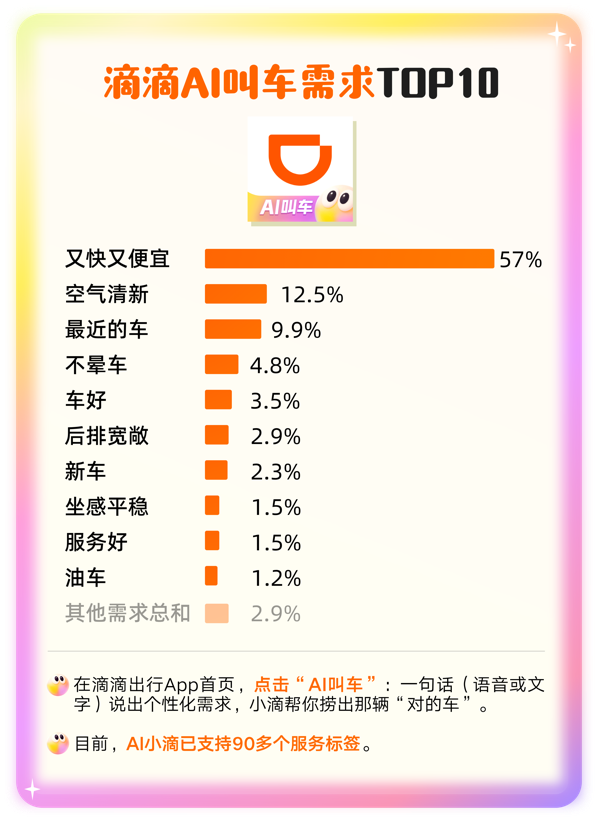
Core Insights - The launch of Didi's AI travel assistant, Xiao Di, has significantly enhanced user experience by evolving the service from simply hailing a ride to matching users with the right vehicle based on personalized preferences [1] Group 1: User Preferences and Behavior - Users prioritize efficiency and cost, with preferences for "fast and cheap" (57%), "fresh air" (12.5%), and "nearest car" (9.9%) being the top three factors in personalized ride requests [1] - The assistant supports over 90 service tags, indicating a strong user interest in comfort and specific vehicle attributes, especially in important scenarios like family transport and business travel [1] Group 2: Functional Usage Trends - Features such as searching nearby locations, booking rides, and order inquiries are frequently utilized, reflecting users' real-life needs beyond mere transportation [3] - High-frequency search destinations include "subway stations," "coffee shops," and "charging stations," showcasing the platform's role as a connector to local services [3] Group 3: Planning and Decision-Making - Users exhibit a growing demand for planned and predictable travel, with common booking times including "8 AM tomorrow" and recurring schedules like "Monday to Friday at 8 AM" [4] - The "combination travel" feature is popular, with users seeking efficient routes that minimize transfers and walking [4] - Users are leveraging AI for personal expense management, asking questions about past spending and ride types, indicating a shift towards using the assistant for informed decision-making [4] Group 4: Industry Perspective - Industry experts recognize the potential of AI in creating innovative consumer experiences, emphasizing the need for a travel assistant that comprehends user needs and integrates information [6] - Didi's strong supply network and service advantages position it well to meet diverse user demands through AI, enhancing user engagement and satisfaction [6]
用户使用滴滴AI叫车,最关心的问题是什么
Xin Lang Cai Jing· 2026-03-23 04:48
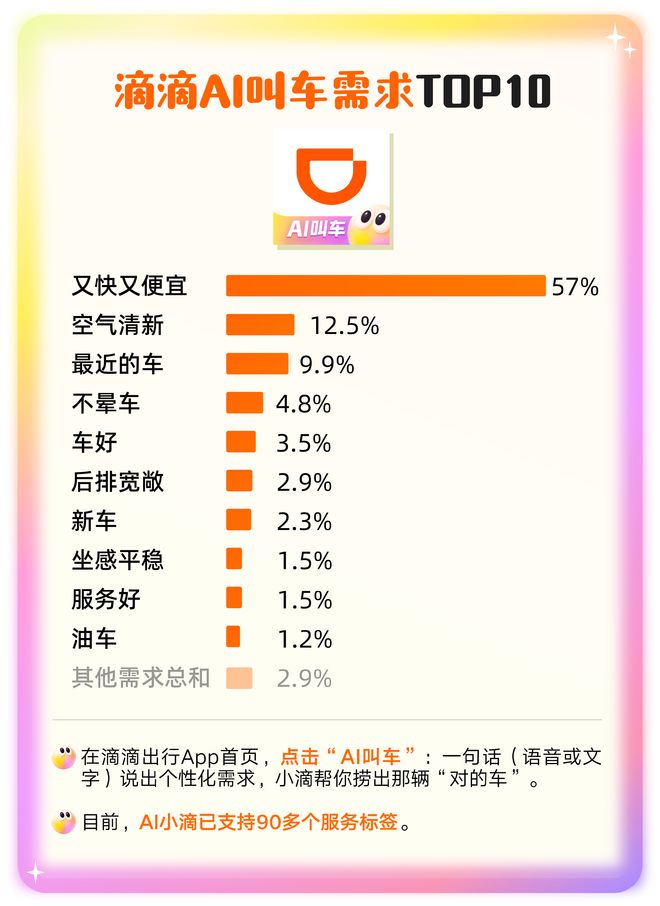
Core Insights - Didi's AI travel assistant, Xiao Di, has quickly gained popularity among users, evolving from "hailing a car" to "hailing the right car" [1][7] - The top three personalized ride requests are "fast and cheap" (57%), "fresh air" (12.5%), and "nearest car" (9.9%), indicating users' preferences for efficiency, cost, and comfort [1][7] - Xiao Di currently supports over 90 service tags, reflecting diverse user needs in various travel scenarios, especially for family, group, and business trips [1][7] User Behavior and Features - Users frequently utilize features such as searching nearby locations, booking rides, combining travel options, and order inquiries, showcasing a strong connection to daily life [3][9] - Popular search destinations include "subway stations," "coffee shops," and "charging stations," indicating a blend of commuting and leisure needs [3][9] - The data shows an increasing demand for planned and predictable travel, with users often scheduling rides for specific times or recurring weekly trips [3][9] AI's Role in Travel - The data highlights the potential of AI in creating innovative consumer experiences, as users seek a travel assistant that understands their needs and aids in decision-making [6][12] - Didi's extensive supply network and service advantages enable it to better meet personalized and diverse user demands through AI [6][12] - AI Xiao Di not only activates long-tail user needs but also connects users to nearby services, emphasizing a human-centered approach to technological innovation [6][12]
ETF跟踪研究:ETF市场周度更新-20260323
Yin He Zheng Quan· 2026-03-23 04:44
ETF Market Overview - As of March 23, 2026, the total number of ETFs in the market reached 2,310, with a total scale of 1,234.5 billion yuan and a weekly trading volume of 123.4 billion yuan. The number of newly added funds this week was 13 [1][3]. - Equity funds dominate the market, with thematic equity funds accounting for 30.6% of the total number, and their scale reaching 1,234.5 billion yuan, representing 60.1% of the total scale. Bond ETFs had the highest weekly trading volume, accounting for 25.3% [1][4]. Fund Inflow and Outflow - The inflow of funds last week was primarily concentrated in broad-based indices and bond ETFs, with the top inflow being the Short-term Bond ETF from Hai Fu Tong, which saw an inflow of 1.2 billion yuan. The latest scale of this fund is 12.3 billion yuan [5][6]. - In contrast, resource and chemical ETFs experienced significant outflows, with the chemical ETF seeing an outflow of 1.2 billion yuan, and the non-ferrous metal ETF experiencing an outflow of 1.1 billion yuan [7][8]. Industry Sector Fund Flow - Only the financial real estate and pharmaceutical sectors saw a slight net inflow of funds, with the financial real estate sector receiving 1.2 billion yuan and the pharmaceutical sector 0.3 billion yuan. Other sectors, including consumption and technology, experienced net outflows [13][14]. New ETF Listings - Last week, a total of 13 new ETFs were listed, all of which were equity funds covering various sectors, themes, and cross-border categories. The largest new listing was the Agricultural and Fishery ETF from Invesco, with a scale of 1.2 billion yuan [16][17]. Core Broad-based Index and ETF Performance - The performance of core broad-based indices showed significant divergence, with the ChiNext index rising against the trend, achieving a weekly return of 3.5%. In contrast, the CSI 300 index saw the largest weekly decline of 2.3% [18][19].