
全球化

Search documents
《财富》专访复星医药董事长陈玉卿:出发与归来
财富FORTUNE· 2025-09-22 13:09
Core Viewpoint - The article emphasizes the journey and vision of Fosun Pharma under the leadership of Chairman Chen Yuqing, focusing on innovation, global expansion, and the integration of AI in drug development and operations [3][10][20]. Group 1: Company Background and Leadership - Chen Yuqing transitioned from academia to the corporate world 26 years ago, eventually becoming the Chairman of Fosun Pharma in April 2025 [1][3]. - Under his leadership, Fosun Pharma has grown into a nearly 100 billion yuan global innovative pharmaceutical company, with a strong emphasis on corporate culture that fosters innovation and talent development [3][4]. Group 2: Innovation and Product Development - Fosun Pharma has consistently prioritized innovation, launching 12 innovative drugs since 2019, including the first CAR-T product in China and the first PD-1 monoclonal antibody approved for small cell lung cancer [4][6]. - The company’s innovative drug revenue exceeded 4.3 billion yuan in the first half of 2025, accounting for 31% of its pharmaceutical business revenue, with a year-on-year growth of 14.26% [8][10]. Group 3: Globalization Strategy - Fosun Pharma's globalization strategy focuses on building local capabilities rather than merely exporting products, with over 1,000 personnel in its overseas commercialization team and a marketing network covering over 110 countries [10][12]. - The company has established regional distribution centers in emerging markets and has supplied over 420 million doses of anti-malarial products globally, significantly impacting public health [13][20]. Group 4: AI Integration in Operations - Fosun Pharma is actively integrating AI into its operations, utilizing the PharmAID decision-making platform to enhance drug development efficiency, reducing target validation time by over 60% [14][15]. - The company emphasizes that while AI is a powerful tool for enhancing efficiency, it cannot replace the intrinsic value of human expertise and understanding of patient needs [16][17]. Group 5: Future Vision and Commitment - The company aims to become a global "Big Pharma" over the next decade, focusing on innovation, deep internationalization, and comprehensive AI adoption as its core strategies [19][20]. - Fosun Pharma's mission remains to ensure every family enjoys health, reflecting its commitment to addressing clinical needs through continuous innovation [20].


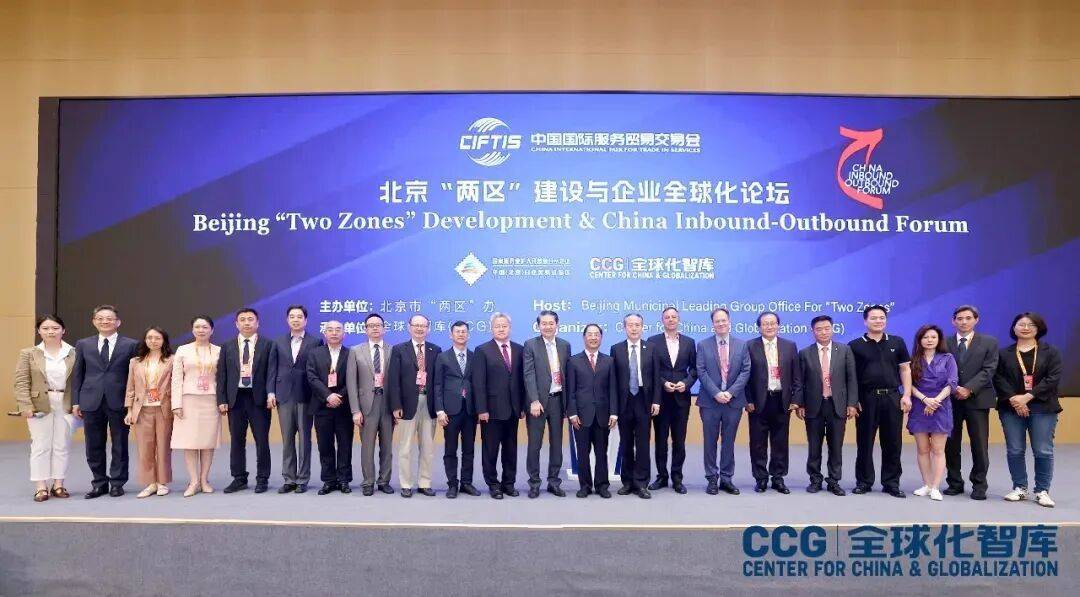
高端对话| CCG服贸会中国企业全球化论坛
Sou Hu Cai Jing· 2025-09-22 05:04
Core Viewpoint - The forum focused on the new trends in global trade and the innovative paradigms of China's service trade system, emphasizing the importance of globalization and service trade development strategies. Group 1: Globalization and Service Trade Trends - The export of Chinese goods, particularly electric vehicles, is expected to create significant demand for additional services, leading to a vast service market [3] - The global economic landscape is evolving, with service trade showing three notable trends: digital intelligence, greening and sustainability, and regional collaborative development [7] - Companies must understand local conditions and manage relationships with local stakeholders effectively during overseas investments [5] Group 2: Strategic Recommendations - Emphasizing digitalization as a driving force for economic and service trade development [7] - The need for a comprehensive regulatory framework to retain high-end services and talent in Beijing's "Two Zones" [9] - Chinese enterprises should optimize their global layout and deepen cooperation with Belt and Road countries, leveraging emerging industry advantages [13] Group 3: Compliance and Trust - As globalization becomes more complex, companies face multi-layered regulations and compliance requirements, leading to a deeper integration of products and services [14] - Trust is fundamental for the healthy operation of trade and economy, necessitating face-to-face dialogue and communication [14]
持续成功的企业,都在死磕“组织能力”
3 6 Ke· 2025-09-22 01:50
Core Insights - The article emphasizes that while achieving business success is relatively easy, sustaining it is significantly more challenging due to the rapid development of AI and global market uncertainties [1][3] - Unique organizational capabilities, which are difficult to replicate, are essential for long-term success, as they enable companies to effectively implement strategies and adapt to changing environments [1][4] Organizational Capability - Yang Guoan's formula for sustained success is: Business Success = Strategic Direction × Organizational Capability, highlighting that execution relies heavily on organizational strength [3][4] - Organizational capability is defined by three pillars: employee skills, employee mindset, and governance methods, all of which must align for effective strategy execution [4][6] Globalization and AI Impact - The article discusses the challenges of globalization, outlining three stages for companies going global: "going out," "going in," and "going up," each requiring enhanced organizational capabilities [6][7] - AI is reshaping industries and necessitating a shift in organizational structures and talent development to integrate technology into business processes effectively [7][8] Company Identity and Values - Companies must define their identity and values beyond just business models and efficiency, focusing on core competencies and strategic partnerships to avoid resource dilution [10][11] - The article suggests that true industry leaders prioritize long-term value creation over short-term gains, balancing tangible and intangible values [11][12]

数据解放生产力——琰究摩托车数据系列(2025年8月)【民生汽车 崔琰团队】
汽车琰究· 2025-09-21 11:47
Core Viewpoint - The motorcycle industry is experiencing significant growth, particularly in the sales of larger displacement motorcycles, with a notable increase in year-on-year sales figures for August 2025 [2][4]. August Data Observation - For motorcycles with displacement over 250cc, August sales reached 84,000 units, representing a year-on-year increase of 23.6% but a month-on-month decrease of 4.4%. Cumulative sales from January to August totaled 675,000 units, up 36.0% year-on-year [2]. - In the 250ml to 400ml displacement category, August sales were 47,000 units, up 28.5% year-on-year and 6.5% month-on-month, with cumulative sales of 356,000 units from January to August, reflecting a 36.5% year-on-year increase [3]. - For the 400ml to 500ml category, August sales were 17,000 units, down 28.5% year-on-year and 27.9% month-on-month, with cumulative sales of 170,000 units, showing a slight year-on-year increase of 0.9% [4]. - In the 500ml to 800ml category, August sales reached 19,000 units, a significant year-on-year increase of 231.4% and a month-on-month increase of 0.8%, with cumulative sales of 131,000 units, up 130.2% year-on-year [4]. - For motorcycles over 800cc, August sales were 1,000 units, down 39.4% year-on-year and 16.6% month-on-month, with cumulative sales of 17,000 units, up 77.6% year-on-year [4]. Company Performance - Chuanfeng Power sold 15,000 units in August, a year-on-year increase of 14.4%, with a market share of 17.4%, down 3.5 percentage points month-on-month. The cumulative market share from January to August was 21.0%, an increase of 1.2 percentage points compared to the full year of 2024 [5]. - Longxin General sold 14,000 units in August, a year-on-year increase of 29.0%, with a market share of 16.9%, up 1.0 percentage points month-on-month. The cumulative market share from January to August was 14.2%, unchanged from the full year of 2024 [5]. - Qianjiang Motorcycle sold 9,000 units in August, a year-on-year decrease of 18.5%, with a market share of 10.2%, down 1.3 percentage points month-on-month. The cumulative market share from January to August was 13.1%, down 3.7 percentage points compared to the full year of 2024 [5]. Industry Outlook - The industry is advised to focus on key companies such as Geely Automobile, Xiaopeng Motors, Li Auto, BYD, Xiaomi Group, Chuanfeng Power, and others as potential investment opportunities [6][10][12].





周观点 | 特斯拉机器人迎重磅催化 看好T链核心主线【民生汽车 崔琰团队】
汽车琰究· 2025-09-21 11:47
Core Viewpoints - The automotive sector is experiencing a mixed performance with a notable increase in new energy vehicle sales, while traditional passenger car sales show a decline year-on-year [2][43] - The market is expected to benefit from new vehicle launches and government policies aimed at stimulating demand, particularly in the context of trade tensions and competition [4][39] Weekly Data - In the second week of September 2025, passenger car sales reached 458,000 units, down 4.7% year-on-year but up 24.7% month-on-month; new energy vehicle sales were 271,000 units, up 6.2% year-on-year and 22.8% month-on-month; new energy penetration rate was 59.3%, down 0.9 percentage points [2][43] - The automotive sector in A-shares rose by 3.1% from September 15 to 19, outperforming the market, with sub-sectors like auto parts and services showing significant gains [3][38] Investment Recommendations - Focus on quality domestic brands that are accelerating in smart technology and globalization, recommending companies such as Geely, Xpeng, Li Auto, BYD, and Xiaomi [4][16] - In the auto parts sector, recommend companies involved in smart driving and intelligent cockpits, as well as those in the new energy vehicle supply chain [7][18] New Model Launches - Recent launches include the Xiangjie S9T and the Galaxy M9, both achieving significant pre-order numbers shortly after their release, indicating strong market interest [6][14] - Upcoming models from various manufacturers are expected to further boost sales and market presence, particularly in the high-end segment [14][16] Robotics and Automation - Tesla's upcoming Optimus V3 robot is anticipated to be a major catalyst for the robotics sector, with production targets set to reach hundreds of units by the end of 2025 [5][19] - The domestic robot manufacturers are accelerating their IPO processes, which could serve as a new catalyst for market sentiment [5][20] Liquid Cooling Technology - The global liquid cooling market is projected to grow at a CAGR of 27.6% from 2024 to 2030, driven by the increasing demand for high-performance computing [22][24] - Liquid cooling technology is becoming essential for data centers, especially with the rise of AI applications requiring high power density [22][24] Motorcycle Market - The motorcycle market is seeing a surge in demand for mid to large displacement models, with significant year-on-year growth in sales [25][27] - Recommended companies in this sector include Chunfeng Power and Longxin General, which are positioned to benefit from this trend [25][27] Heavy Truck Market - The heavy truck market is expected to recover due to expanded government subsidies for replacing older vehicles, with sales showing a year-on-year increase [28][29] - Companies like China National Heavy Duty Truck and Weichai Power are recommended for their strong market positions [30][31] Tire Industry - The tire industry is experiencing a positive outlook with strong demand and ongoing globalization efforts among leading manufacturers [31][33] - Recommended companies include Sailun Tire and Senlong, which are well-positioned to capitalize on these trends [31][33]

十大机构看后市:牛市中高位震荡后A 股多继续上涨,坚持科技,高低切的时机尚未到来
Sou Hu Cai Jing· 2025-09-21 09:12
Group 1 - The overall market performance shows mixed results with the Shanghai Composite Index down by 1.3%, while the Shenzhen Component and ChiNext Index increased by 1.14% and 2.34% respectively [1] - Citic Securities emphasizes the importance of the globalization of leading Chinese manufacturing companies, suggesting that this will enhance pricing power and profit margins, leading to market capitalization growth beyond domestic economic fundamentals [1] - The financing trends around the National Day holiday indicate a pattern of "pre-holiday contraction and post-holiday explosion," with historical data suggesting a high probability of A/H shares rising after preventive rate cuts by the Federal Reserve [1][2] Group 2 - Huajin Securities notes that historically, after high-level fluctuations in a bull market, A-shares tend to continue rising, with current policies and external events remaining positive [2] - Dongwu Securities identifies potential market directions for the fourth quarter, suggesting a structural shift may occur, with cyclical sectors and low-position technology branches being key areas to watch [3] - China Galaxy Securities recommends focusing on sectors benefiting from policy and industry support, such as AI, lithium batteries, and consumer services, especially with the upcoming holidays boosting travel-related stocks [4] Group 3 - Western Securities reports a contraction in A-share valuations, with the coal industry leading gains due to rising coal prices driven by winter supply concerns [5] - The market is expected to experience a period of consolidation, with support levels identified at previous lows, and recommendations to maintain current positions until adjustments are complete [7] - Kaisheng Securities highlights the ongoing dominance of technology sectors, driven by relative profitability and global semiconductor cycles, with AI emerging as a significant demand driver [8] Group 4 - Debon Securities indicates that the current market is at the beginning of a new dollar interest rate cut cycle, with a slow bull market expected to continue, particularly in sectors like AI and solid-state batteries [9] - Xiangcai Securities suggests that the A-share market is likely to operate in a "slow bull" manner, influenced by ongoing policies and the "14th Five-Year Plan," with a focus on technology, green initiatives, and consumer services [10]




朱啸虎:搬离中国,假装不是中国AI创业公司,是没有用的
Hu Xiu· 2025-09-20 14:15
Group 1 - The discussion highlights the impact of DeepSeek and Manus on the AI industry, emphasizing the importance of open-source models in China and their potential to rival closed-source models in the US [3][4][5] - The conversation indicates that the open-source model trend is gaining momentum, with Chinese models already surpassing US models in download numbers on platforms like Hugging Face [4][5] - The competitive landscape is shifting towards "China's open-source vs. America's closed-source," with the establishment of an open-source ecosystem being beneficial for China's long-term AI development [6][7] Group 2 - Manus is presented as a case study for Go-to-Market strategies, illustrating that while Chinese entrepreneurs have strong product capabilities, they often lack effective market entry strategies [10][11] - Speed is identified as a critical barrier for AI application companies, with the need to achieve rapid growth to outpace competitors [11][12] - Token consumption is discussed as a significant cost indicator, with Chinese companies focusing on this metric due to lower willingness to pay among domestic users [12][13][14] Group 3 - The AI coding sector is characterized as a game dominated by large companies, with high token costs making it challenging for startups to compete effectively [15][16] - The conversation suggests that AI coding is not a viable area for startups due to the lack of customer loyalty among programmers and the high costs associated with token consumption [16][18] - Investment in vertical applications rather than general-purpose agents is preferred, as the latter may be developed by model manufacturers themselves [20] Group 4 - The discussion on robotics emphasizes investment in practical, value-creating robots rather than aesthetically pleasing ones, with examples of successful projects like a boat-cleaning robot [21][22] - The importance of combining functionality with sales capabilities in robotic applications is highlighted, as this can lead to a more favorable ROI [22][23] Group 5 - The conversation stresses the need for AI hardware companies to focus on simplicity and mass production rather than complex features, as successful hardware must be deliverable at scale [28][29] - The potential for new hardware innovations in the AI era is questioned, with a belief that significant breakthroughs may still be years away [30][31] Group 6 - The dialogue addresses the challenges of globalization for Chinese companies, noting that successful market entry in the US requires a deep understanding of local dynamics and compliance [36][37] - The importance of having a local sales team for B2B applications in the US is emphasized, as relationships play a crucial role in sales success [38][39] Group 7 - The conversation highlights the risks associated with high valuations, which can limit a company's flexibility and increase pressure for performance [42][43] - The discussion suggests that IPOs for Chinese companies may increasingly occur in Hong Kong rather than the US, as liquidity issues persist in the market [46][48] Group 8 - The need for startups to operate outside the influence of large companies is emphasized, with a call for rapid growth and innovation in the AI sector [49][53] - The potential for AI startups to achieve significant scale quickly is acknowledged, but the conversation warns that the speed of evolution in the AI space may outpace traditional exit strategies [52][53]

Z Event|ICCV 2025免费夏威夷之行报名中!招募Researcher&AI创业者
Z Potentials· 2025-09-20 02:17
Group 1 - The article discusses the recruitment of new interns, indicating a focus on attracting creative talent from the post-00s generation [4] - It highlights the importance of resonating with Z Potentials, emphasizing the sharing of stories and ideas within the community [10] - The article mentions various professionals with expertise in AI, smart hardware, and globalization, suggesting a strong emphasis on cutting-edge technology and innovation [10][11] Group 2 - The event "KAUAI MEETUP" is scheduled for October 23-26, 2025, in Kauai, Hawaii, indicating a future gathering focused on networking and collaboration [1] - The article promotes engagement with Z Potentials through various channels, including product discussions, events, and research [10] - It encourages professionals in the tech field to connect and share insights, fostering a collaborative environment [10]

拒绝全球化只会被时代抛弃
Jing Ji Ri Bao· 2025-09-19 22:18
Core Viewpoint - The author Charles Mann argues that globalization is an inevitable historical result driven by multiple factors, and that economic decoupling and trade disruptions cannot reverse the established reality of globalization [1]. Group 1: Historical Context of Globalization - The rise of the Ottoman Empire in the mid-15th century disrupted traditional trade routes between Europe and Asia, prompting Europeans to seek new maritime trade routes, leading to Columbus's accidental discovery of the Americas [2]. - The moment Europeans set foot in the Americas marked the beginning of globalization, with immediate effects such as the exchange of species, notably the introduction of crops like potatoes and tobacco to Europe, which significantly altered local diets and social customs [3]. Group 2: Impact on China and Global Trade - China was also influenced by globalization, with crops like sweet potatoes, corn, and chili peppers spreading from coastal regions to inland areas, becoming staples in local diets [4]. - The demand for luxury goods such as porcelain, silk, and tea from China led to an influx of silver, which became a crucial currency in the late Ming Dynasty, although a subsequent silver shortage was exacerbated by global events [4]. Group 3: Modern Globalization Dynamics - Globalization has evolved from its tumultuous beginnings to a more peaceful phase characterized by multinational trade, cultural exchange, and international cooperation on key issues like climate change, leading to a "homogeneous world" where humanity forms a community of shared destiny [5]. - Despite recent setbacks in economic globalization due to rising unilateralism and protectionism, the overall trend since the turn of the millennium has been a steady increase in global wealth, benefiting many countries and regions [5]. Group 4: Socioeconomic Implications - The prosperity and stability of the world cannot be built on the foundation of increasing inequality; those who reject globalization risk being left behind [6].
调研速递|德尔玛接受投资者调研,透露多品牌发展等精彩要点
Xin Lang Cai Jing· 2025-09-19 10:57
Core Viewpoint - Guangdong Delmar Technology Co., Ltd. held an online investor reception event on September 19, 2025, focusing on its strategic direction and business development plans [1][2]. Group 1: Development Strategy - The company adheres to a "multi-brand, multi-category, globalization" core strategy, focusing on the "Delmar" and "Philips" dual-brand drive, and aims to expand in home environment, water health, and personal health categories [3]. - Future efforts will enhance product innovation capabilities, supply chain efficiency, and global channel layout, promoting products towards green, energy-saving, and intelligent directions [3]. Group 2: Brand Building - The "Delmar" brand is well-regarded among young consumers for its high cost-performance and design, while "Philips" occupies a high-end market position in water health [3]. - The company plans to enhance brand vitality through social media promotion and e-commerce platform operations, with future investments in R&D innovation and experiential marketing to strengthen brand image [3]. Group 3: Stock Price and Market Value Management - In response to the stock price being 40% below the issue price, the company noted that the secondary market price is influenced by various factors and will focus on product innovation, market expansion, manufacturing capability enhancement, and operational efficiency for market value management [3]. - Any share repurchase plans will be disclosed in a timely manner [3]. Group 4: Capacity Construction - The company continues to invest in its own capacity construction, with the smart manufacturing base having been put into operation in 2024, and any future production base developments will be disclosed promptly [3]. Group 5: Product Innovation - In the first half of 2025, R&D investment increased by 5.35% year-on-year, focusing on home environment, water health, and personal health categories, based on consumer insights and an optimized supply chain [3]. Group 6: Business Expansion - The company will continue to focus on its core home appliance business and will consider entering emerging fields based on industry development, company strategy, and operational goals [3].