地缘政治紧张

Search documents
秦氏金升:7.22伦敦金回调做多,黄金行情分析与操作建议
Sou Hu Cai Jing· 2025-07-22 03:27
Core Viewpoint - Gold prices have shown volatility, with recent fluctuations influenced by geopolitical tensions, economic uncertainties, and central bank gold purchases, while the market anticipates potential interest rate cuts from the Federal Reserve [3][4]. Price Movement Analysis - As of July 22, gold is trading around $3,388 per ounce, having experienced a rebound after stabilizing at $3,345, breaking through the key resistance level of $3,376, and reaching a high of $3,400 [1][3]. - The breakout of the $3,376 resistance has turned it into a significant support level, indicating that the bullish trend remains intact despite recent fluctuations [1][3]. Technical Analysis - On the daily chart, gold has established support at the $3,376 level, with short-term resistance focused in the $3,400 to $3,420 range, where $3,420 aligns with historical high points [4][6]. - The 4-hour chart indicates strong support near the Bollinger Band midline at $3,380, and while the MACD shows signs of a potential pullback, there is no clear bearish signal yet, suggesting that bullish momentum is still building [4]. Trading Strategy - The recommended trading strategy includes entering long positions around $3,380, with protective stops set at $3,374, targeting the previous high of $3,402 [7]. - For aggressive traders, entering long positions at the current price of $3,388 is suggested, with plans to add to positions upon a pullback to $3,380 [7]. - Short positions are advised to be considered only after gold reaches the $3,420 resistance level [8].


秦氏金升:7.20伦敦金下周涨跌预测,黄金行情分析与操作建议
Sou Hu Cai Jing· 2025-07-20 09:46
Core Viewpoint - The gold market is experiencing significant volatility influenced by geopolitical tensions, economic uncertainties, and central bank gold purchases, while also facing pressure from fluctuating dollar indices and changing market risk preferences [3][5]. Market Analysis - On July 18, spot gold closed at $3350.05, showing a slight decline of 0.25% after a strong rebound from a low of $3309.82, indicating intensified market competition between bulls and bears [1]. - The recent strong U.S. retail sales (+0.6%) and unemployment claims (221,000) contributed to the initial drop in gold prices, but subsequent market reactions led to a recovery [1][3]. - The gold price is currently forming a tight technical triangle between $3320 and $3377, with critical support at $3320 and resistance at $3377, which could lead to further movements towards $3390 and potentially $3400 or $3428 if broken [3][5]. Technical Indicators - The Bollinger Bands are narrowing, indicating a potential for price movement, with gold trading above the middle band, suggesting a rebound from oversold conditions [5]. - The MACD indicator shows a potential bullish crossover, while the RSI indicates strong bullish momentum, reinforcing the likelihood of upward movement [5]. - Short-term trading strategies suggest buying on dips around $3340 with a protective stop at $3330, targeting $3365, while medium-term strategies remain bullish as long as prices hold above $3300 [7].

不只经济衰退,崩溃还将改变一代人
海豚投研· 2025-07-12 08:20
Core Viewpoint - The article discusses a significant generational economic shift characterized by debt accumulation, social division, geopolitical tensions, and the potential collapse of the monetary system, suggesting that this is not just another economic recession but a transformative crisis that could reshape society [3]. Debt Cycle and Unsustainable Growth - Low debt costs, often due to low interest rates, lead borrowers to become complacent, resulting in increased leverage that becomes unsustainable as interest rates rise [5]. - The feedback loop created by debt-driven spending and growth can lead to asset price inflation, creating a false sense of security that ultimately results in a painful deleveraging process when debt repayment becomes burdensome [5][6]. - Central banks typically lower interest rates to stimulate borrowing and consumption, but this tool loses effectiveness when rates approach zero, leading to reliance on quantitative easing, which can distort price discovery and exacerbate inequality [6][7]. Internal Fractures: Social and Political Divisions - Historical patterns show that social disintegration often follows a buildup of tensions among various societal groups, leading to political dysfunction and economic inequality [9]. - Trust in institutions and leaders is crucial for societal cohesion; when this trust erodes, it can lead to a breakdown of the social contract and increased polarization [10][11]. - The rise of populism and extreme political rhetoric can hinder effective governance, making it difficult to address pressing issues like debt and education [10][11]. Geopolitical Deconstruction and Cold War 2.0 - The article highlights a strategic decoupling in global relations, particularly between the West and China, leading to a fragmented world order where nations prioritize security over efficiency in supply chains [13][14]. - Competition for technological supremacy and control over critical resources is intensifying, with countries increasingly seeking to reduce dependence on adversaries [14][15]. - The erosion of trust in the global financial system, particularly regarding the U.S. dollar, is prompting nations to explore alternative currencies and payment systems [17][18]. Currency Order Cracks - The current monetary system, heavily reliant on the U.S. dollar, is facing challenges due to persistent fiscal deficits and rising debt levels, leading to a loss of confidence in its stability [18][19]. - Countries are increasingly seeking to diversify away from dollar dependence, engaging in bilateral trade agreements and exploring digital currencies [20][21]. - The transition away from a dollar-centric system may not lead to immediate collapse but indicates a shift towards increased volatility and uncertainty in global finance [21]. Next Phase: Pain or Restructuring - The article emphasizes the importance of recognizing risks and opportunities in a volatile environment, advocating for a balanced approach to resource allocation [22][24]. - Diversification across asset classes, countries, and economic conditions is crucial for managing risk and seizing opportunities during periods of upheaval [24][25]. - Successful navigation of these challenges requires a thoughtful, adaptable strategy that prepares for multiple outcomes rather than relying on a single perspective [25][26].

印度汽车经销商协会联盟(FADA):6月份乘用车零售销量同比增长4.84%,对短期前景持谨慎乐观的态度,考虑到稀土短缺、地缘政治紧张局势及美国关税溢出影响,需保持警惕。
news flash· 2025-07-07 03:33
Core Insights - The Federation of Automobile Dealers Associations (FADA) reported a year-on-year increase of 4.84% in passenger vehicle retail sales for June [1] - The organization maintains a cautiously optimistic outlook for the short-term market despite challenges [1] Industry Summary - Passenger vehicle retail sales in June experienced a growth of 4.84% compared to the same month last year [1] - FADA emphasizes the need for vigilance due to factors such as rare earth shortages, geopolitical tensions, and the spillover effects of U.S. tariffs [1]
牛弹琴:加拿大又出坏招加拿大打压中企心理扭曲动作变形
Bei Jing Ri Bao Ke Hu Duan· 2025-06-29 02:22
Group 1 - Canada has ordered Hikvision to cease operations in the country, citing "national security" concerns, which reflects a broader geopolitical tension and bias against Chinese companies [1] - The Canadian Minister of Industry, François-Philippe Champagne, stated that the decision was made after a multi-step review by Canadian security and intelligence agencies [1] - Hikvision's spokesperson expressed strong opposition to the decision, arguing that it lacks factual basis, procedural fairness, and transparency, and is influenced by the company's country of origin rather than its technology standards [1] Group 2 - The Chinese Embassy in Canada condemned the move, asserting that it undermines the legitimate rights of Chinese enterprises and disrupts normal economic and trade cooperation between China and Canada [1] - The situation highlights ongoing challenges in China-Canada relations, indicating that despite changes in leadership, Canada continues to struggle with a fair approach towards Chinese companies [1]
黄金大顶将至?花旗拉响警报:年底恐开启20%下跌周期!
华尔街见闻· 2025-06-17 11:01
Group 1: Gold Market Outlook - The core view is that gold prices are expected to decline below $3000 per ounce in the coming quarters, marking the end of the current record rally [1][2] - Citigroup analysts predict that gold prices will peak between $3100 and $3500 per ounce in Q3 of this year, before gradually falling to a range of $2500 to $2700 per ounce by the second half of 2026, representing a decline of approximately 20-25% from current forward prices [2] - The report outlines three scenarios for gold price movements: a base case (60% probability) where prices remain above $3000 per ounce for the next quarter before declining, a bullish case (20% probability) where geopolitical tensions and inflation risks push prices to new highs, and a bearish case (20% probability) where resolution of tariff issues leads to a sharp price drop [4] Group 2: Factors Influencing Gold Prices - Short-term, gold is expected to maintain high prices in Q3 due to strong investment demand [5] - The rise in gold prices is primarily driven by concerns over tariffs, Federal Reserve policies, and geopolitical risks, rather than central bank purchases; resilient jewelry consumption also supports prices [6] - Global gold expenditure as a percentage of GDP has reached 0.5%, the highest level in the past fifty years, indicating strong investor preference for gold as a safe-haven asset [7] Group 3: Future Economic Conditions - In Q4, global growth confidence may improve slightly, particularly with the implementation of U.S. stimulus budgets, which could reduce safe-haven sentiment; a potential shift towards more moderate trade policies under Trump may also decrease market uncertainty [9] - Expectations of a shift from tightening to a neutral stance by the Federal Reserve could further diminish gold's appeal as a non-yielding asset [9] - Historical data over the past 55 years shows that when investment demand declines, gold prices tend to fall, as price adjustments lead to reduced jewelry consumption and encourage inventory holders to sell [10] Group 4: Industrial Metals Outlook - In contrast to gold, Citigroup maintains a structurally bullish outlook on industrial metals despite short-term pressures from tariffs and weak demand [11] - The aluminum market is particularly favored, with the report highlighting aluminum as a "future-facing" metal, constrained on the supply side by energy intensity and driven on the demand side by strong growth in AI data centers, humanoid robots, and decarbonization processes [12][13] - Citigroup forecasts a supply shortage in aluminum over the next five years at current price levels, necessitating prices to rise above $3000 per ton to incentivize sufficient supply growth [14]

金信期货日刊-20250616
Jin Xin Qi Huo· 2025-06-16 02:35
Report Summary 1. Report Industry Investment Rating No relevant content provided. 2. Core View of the Report - Crude oil futures prices rose significantly on June 12 and 13, 2025, with the WTI July crude oil futures up 4.88% on the 12th, closing at $68.15 per barrel, and domestic crude oil futures hitting the daily limit on the 13th. Geopolitical tensions, supply - demand imbalances, and positive progress in Sino - US economic and trade negotiations contributed to the price increase. The subsequent rise in crude oil prices may push up inflation and increase downstream enterprise costs [3]. - For stock index futures, next week's market is expected to continue to fluctuate at a high level [6]. - Gold is still bullish, and it's only a matter of time to reach a new high. A low - buying strategy is more prudent [10][11]. - Iron ore is a strong variety in the black series, but it has been rising weakly recently and should be viewed as a volatile market [14][15]. - Glass should be viewed with a short - term volatile mindset, waiting for the effect of real - estate stimulus or major policy announcements [17][18]. - Urea prices are in a weak adjustment. When reaching the previous support area, short - position holders should be wary of a strong rebound from the long side [21]. 3. Summary by Related Catalogs Crude Oil Futures - On June 12 and 13, 2025, crude oil futures prices rose significantly. Geopolitical tensions, such as the uncertainty of the US - Iran nuclear negotiation and threats of conflict, led to concerns about supply disruptions. From the supply - demand perspective, the peak travel season in the US and the peak power - consumption season in the Middle East increased demand, while the US commercial crude oil inventory decreased by 3.6 million barrels last week. Positive progress in Sino - US economic and trade negotiations also boosted prices. The price increase may push up inflation and increase downstream costs [3]. Stock Index Futures - After Israel attacked Iran, the three major A - share indexes opened lower and closed with a mid -阴线, with a slight rebound at the end. Next week, the market is expected to continue to fluctuate at a high level [6][7]. Gold - Due to Israel's surprise attack on Iran, geopolitical risks increased. The overseas gold market is approaching a new high, and Shanghai gold, although relatively weak, is also rising. Gold is still bullish, and reaching a new high is just a matter of time. A low - buying strategy is more prudent [10][11]. Iron Ore - At the end of the quarter, mines are still ramping up shipments, and iron - water production is seasonally weak, increasing the over - valuation risk of iron ore. However, the continuous decline in port inventory supports the market. It is a strong variety in the black series, but has been rising weakly recently and should be viewed as a volatile market [14][15]. Glass - There has been no significant cold - repair situation due to losses on the supply side, factory inventories are still high, and downstream deep - processing orders have weak restocking motivation. The market should be viewed with a short - term volatile mindset, waiting for the effect of real - estate stimulus or major policy announcements [17][18]. Urea - The domestic daily urea production is about 205,600 tons, with an operating rate of about 87.23%. Agricultural demand progress is slow, and downstream players are less involved. Urea prices are in a weak adjustment. When reaching the previous support area, short - position holders should be wary of a strong rebound from the long side [21].
Why Lockheed Martin Rallied on a Bad Day for the Markets on Friday
The Motley Fool· 2025-06-13 21:02
Group 1 - Lockheed Martin's shares increased by 3.5% despite a 1.1% decline in the S&P 500, driven by geopolitical tensions following Israel's strike on Iran, which raised the possibility of increased defense spending [1] - The U.S. Defense Department may reduce its orders for Lockheed's F-35s from 48 to 24 planes in fiscal 2026, potentially impacting about 5% of Lockheed's revenue [2] - The escalation of conflict could lead to a reversal or reduction of the anticipated F-35 order cuts, as Israel is a significant buyer of Lockheed's defense equipment [3][4] Group 2 - Defense stocks, including Lockheed Martin, have faced pressure this year due to skepticism around defense spending and government efficiency efforts, but they can provide stability during geopolitical tensions [6][7] - In times of rising geopolitical tensions, defense, oil, and gold stocks can act as a hedge, offering a form of insurance for diversified portfolios, while Lockheed also provides dividends [8]


金信期货日刊-20250613
Jin Xin Qi Huo· 2025-06-12 23:33
Report Summary Report Industry Investment Rating No relevant information provided. Core Viewpoints - On June 12, 2025, crude oil futures rose significantly, with the WTI July crude oil futures up 4.88% to $68.15 per barrel. The rise was due to geopolitical tensions, increased demand, and positive progress in Sino-US economic and trade negotiations. The price increase may push up inflation and raise downstream costs, and continuous attention should be paid to geopolitical situations, OPEC+ policies, and global economic trends [3]. - A-share market: After opening lower in the morning, the three major A-share indexes quickly rebounded and then fluctuated sideways, closing flat. With limited news except for the Sino-US economic and trade consultation mechanism meeting, the market is expected to continue to fluctuate at a high level [6][7]. - Gold: Currently in a volatile pattern that is difficult to change in the short term, but still bullish in the long term. It is advisable to buy on dips rather than chase the rise [10][11]. - Iron ore: There is a risk of overvaluation due to weak demand, but the continuous decline in port inventories supports the market. It is still a strong variety in the black series. Technically, the support below is effective, but it has been rising weakly recently, so it should be viewed as a volatile market [14][15]. - Glass: The supply side has not seen significant losses and cold repairs, factory inventories are still high, and downstream demand has not increased significantly. It is necessary to wait for the effects of real estate stimulus or major policy announcements. Technically, it declined slightly today, and a short - term volatile view is adopted [17][18]. - Urea: The domestic daily urea output is about 205,600 tons, with an operating rate of about 87.23%. Agricultural demand progress is slow, and the price continues to adjust weakly. When it reaches the previous support area, short - position profits are realized, and a strong rebound from the long side should be watched out for [21]. Summary by Related Catalogs Crude Oil Futures - On June 12, 2025, WTI 7 - month crude oil futures rose 4.88% to $68.15 per barrel [3]. - Reasons for the rise: geopolitical tensions (uncertainty in US - Iran nuclear negotiations), increased demand (US summer travel peak and Middle - East summer electricity - consumption peak), and positive progress in Sino - US economic and trade negotiations [3]. - Impact: may push up inflation and increase downstream costs, and continuous attention is needed on geopolitical situations, OPEC+ policies, and global economic trends [3]. A - share Market - The three major A - share indexes opened lower, rebounded quickly, and then fluctuated sideways, closing flat [7]. - With limited news except for the Sino - US economic and trade consultation mechanism meeting, the market is expected to continue high - level fluctuations [6]. Gold - Currently in a volatile pattern, difficult to change in the short term, but bullish in the long term [11]. - Operation strategy: buy on dips rather than chase the rise [10]. Iron Ore - There is a risk of overvaluation due to weak demand, but port inventory decline supports the market [14][15]. - Technically, the support below is effective, but the recent rise is weak, so it is a volatile market [14]. Glass - Supply side: no significant losses and cold repairs, high factory inventories [18]. - Demand side: downstream demand has not increased significantly, waiting for real estate stimulus or major policy announcements [17][18]. - Technically, it declined slightly today, and a short - term volatile view is adopted [17]. Urea - Supply: domestic daily output is about 205,600 tons, with an operating rate of about 87.23% [21]. - Demand: agricultural demand progress is slow, and downstream follow - up is limited, so the price continues to adjust weakly [21]. - Strategy: when it reaches the previous support area, short - position profits are realized, and a strong rebound from the long side should be watched out for [21].
A股全线重挫:三大指数齐跌,超4000股飘绿
Sou Hu Cai Jing· 2025-06-10 10:00
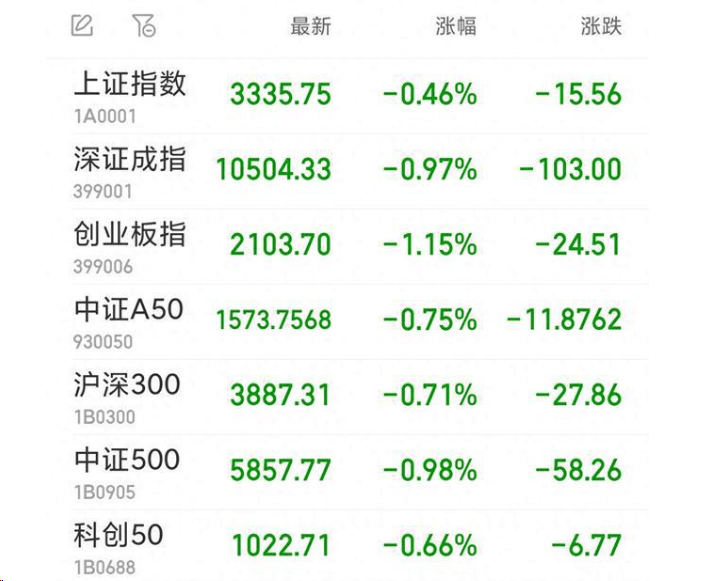
Market Overview - The A-share market experienced a significant adjustment, with all three major indices declining collectively. The Shanghai Composite Index fell by 0.46% to 3335.75 points, the Shenzhen Component Index decreased by 0.97% to 10504.33 points, and the ChiNext Index dropped by 1.15% to 2103.70 points. Over 4000 stocks declined, with less than 500 stocks rising, indicating a pessimistic market sentiment [1][2]. Reasons for Decline - External factors impacting the market include changes in the Federal Reserve's policy expectations, which have cooled interest rate cut anticipations, leading to pressure on global risk assets and foreign capital outflow from A-shares. Additionally, geopolitical tensions have heightened risk aversion, prompting some funds to withdraw from the stock market [3]. - Internal economic data has shown weakness, with recent PMI, consumption, and industrial value-added data falling short of expectations, raising concerns about the strength of economic recovery. Certain sectors, such as real estate and consumer electronics, have reported declining performance, negatively affecting related sectors [3]. - There is pressure on the funding side, with northbound capital experiencing a net outflow exceeding a specified amount, and margin trading balances declining, indicating reduced activity of leveraged funds [3]. Sector Performance - Leading sectors that faced declines include: - New Energy: Major stocks like CATL and LONGi Green Energy fell due to rumors of industry overcapacity. - Consumer Electronics: Stocks within the Apple supply chain collectively retreated. - Brokerage: The brokerage sector faced pressure due to low market trading activity [5]. - Defensive sectors, such as agriculture and pharmaceuticals, remained relatively stable, while high-dividend assets like banks and public utilities attracted risk-averse funds [5]. Investment Strategies - Companies suggest that the market may continue to experience fluctuations in the short term, advising investors to focus on policy catalysts and firms with strong earnings certainty. It is recommended to control positions to avoid blind bottom-fishing and to wait for market stabilization signals [4][5]. - Attention should be given to policy developments, such as increased growth stabilization measures or favorable capital market reforms, and to prioritize defensive sectors like consumer goods and pharmaceuticals that are undervalued [5].