贬值交易

Search documents
贵金属开启全面牛市 背后是新逻辑在驱动
Jin Tou Wang· 2025-10-15 08:13
Group 1 - Precious metals continue to rise, with gold surpassing $4,185 per ounce, marking a significant increase of over 50% this year [1][2] - Silver also reached new highs, with prices briefly exceeding $53.54 before experiencing a short-term pullback, indicating strong market performance [1][2] - Analysts suggest that the current gold price surge may indicate a different kind of crisis, driven by unsustainable global government debt levels and potential currency devaluation or inflation [2] Group 2 - The market is witnessing a unique bull market in gold, driven by strong physical demand rather than typical crisis indicators [2] - The decline in the value of the US dollar is attributed to excessive government borrowing and a significant fiscal deficit of $2 trillion, which undermines the dollar's purchasing power [2] - The tight liquidity in the silver market remains a focal point, with physical inventory reductions leading to higher spot prices compared to futures prices [2][3] Group 3 - Technically, gold prices are in an upward channel, with potential to reach $4,300 if they break above $4,250 [4] - The gold-to-silver ratio has decreased from 86:1 at the beginning of the year to approximately 78:1, indicating stronger performance of silver in the current precious metals cycle [4] - The simultaneous rise in gold and silver prices reflects global market concerns about economic outlook and expectations of continued monetary easing [4]
黄金一直涨?历史上三次都以暴跌收场
阿尔法工场研究院· 2025-10-15 00:07
Core Viewpoint - The article discusses the surge in gold prices driven by fears of financial collapse, with global investors, both professional and retail, rushing to purchase gold, pushing its price to historical highs, potentially entering a bubble phase [2][4][8]. Group 1: Market Dynamics - Gold prices have increased over 50% this year, reaching a record of $4,000 per ounce, with expectations for 2023 to be the best year since 1979 [4][20]. - The recent gold buying frenzy in Japan has seen retail investors actively purchasing gold bars and coins, leading to a significant increase in demand [6][29]. - Central banks, particularly in developing countries, have been major buyers of gold, diversifying their foreign exchange reserves and reducing reliance on the US dollar [6][7]. Group 2: Investor Behavior - A record $26 billion flowed into gold ETFs in the third quarter, indicating a shift in investor sentiment towards gold as a safe haven asset [7][20]. - The phenomenon of "gold-plated FOMO" (fear of missing out) has emerged, with investors rushing to buy gold to avoid missing price momentum, potentially leading to increased market volatility [7][20]. - Traditional methods of valuing gold, such as its relationship with real interest rates, have become less reliable, complicating investment decisions [21][30]. Group 3: Economic Context - The article highlights concerns over rising debt levels and inflation, with investors viewing gold as a hedge against these risks, particularly in the context of US economic policies [10][18]. - The ongoing tensions in US-China trade relations have further fueled gold's appeal as a safe asset [20][30]. - The article notes that gold's supply is relatively inelastic, with production expected to remain stable over the next three years, which could support higher prices [23][24]. Group 4: Historical Comparisons - Historical patterns indicate that rapid increases in gold prices can lead to significant corrections, as seen in the late 1970s and 2011 [14][17]. - The current market sentiment reflects a shift towards gold as a protective asset amid fears of economic instability, reminiscent of past financial crises [8][10].


昨夜,中国金龙大涨
Shang Hai Zheng Quan Bao· 2025-10-14 00:55
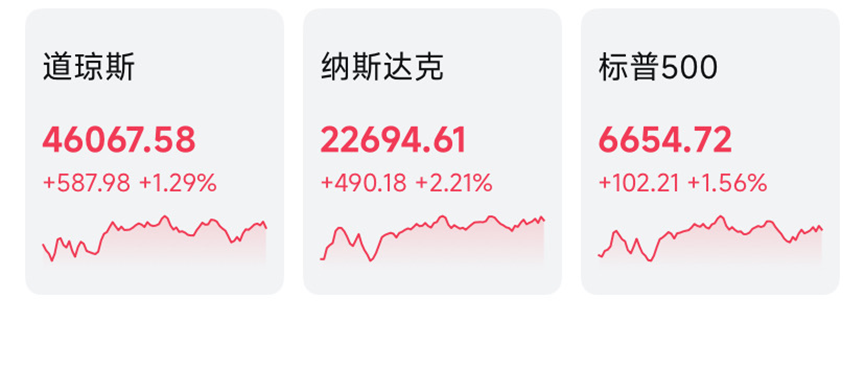
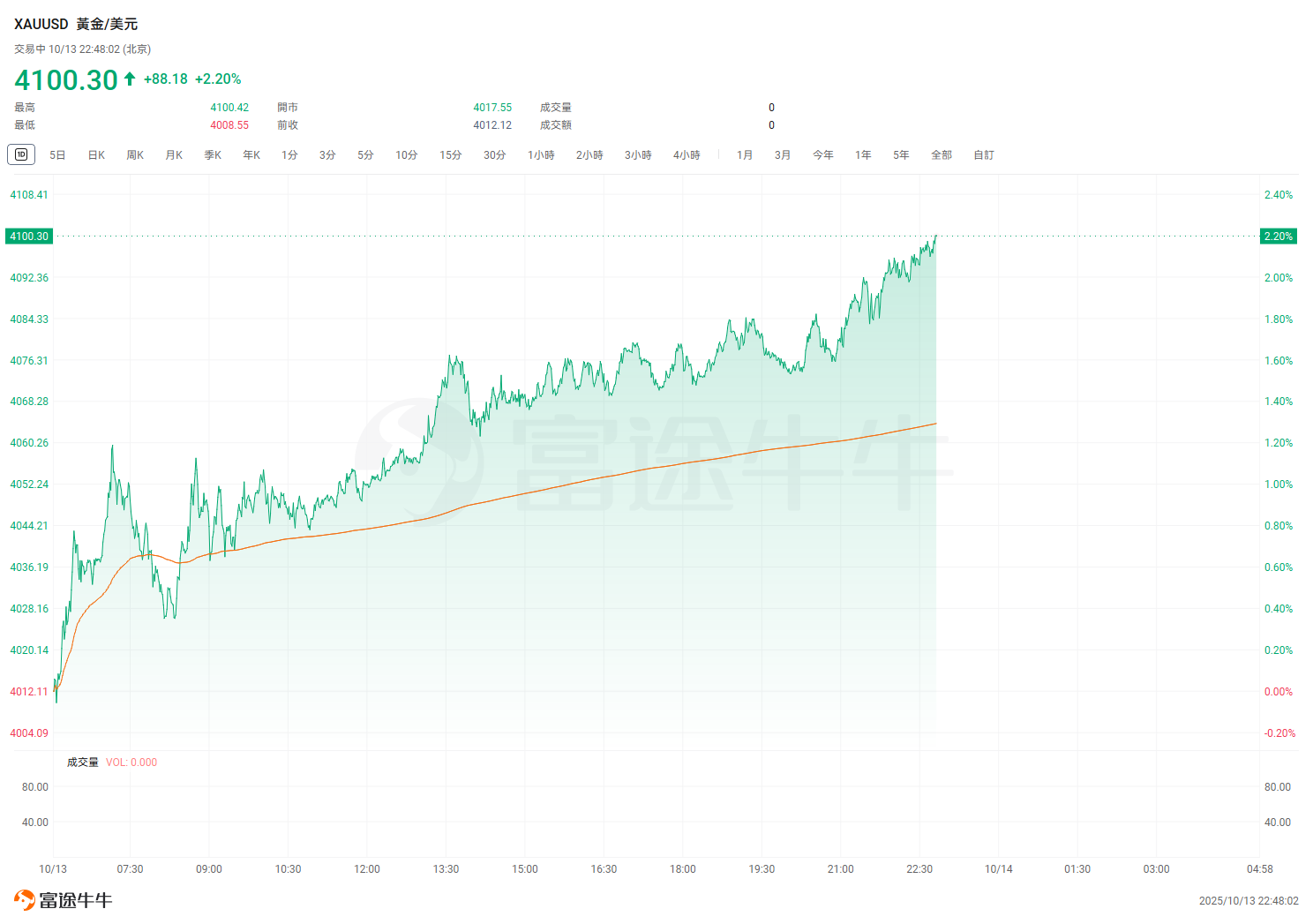
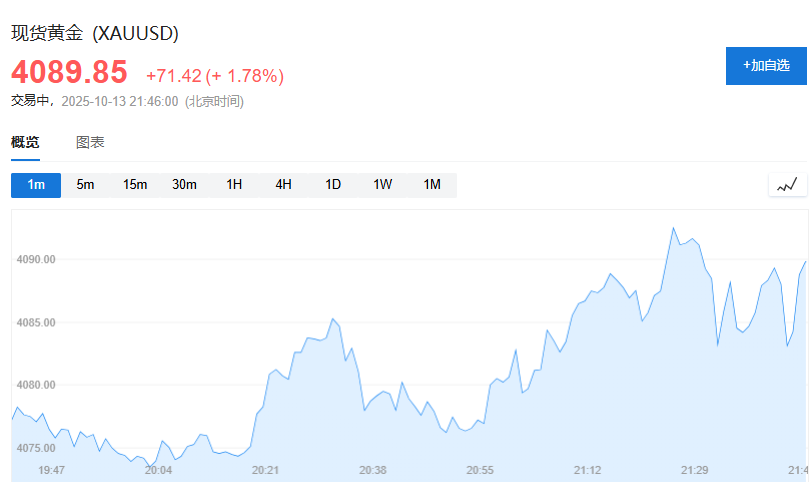
Market Overview - The U.S. stock market experienced a significant rebound on October 13, driven by improved market risk appetite and ongoing AI capital expenditure trends, with the Dow Jones and S&P 500 indices rising over 1% and the Nasdaq increasing by more than 2% [1][3] - The Nasdaq China Golden Dragon Index surged by 3.21%, indicating a notable recovery in sentiment towards Chinese assets [1][5] AI Sector Developments - OpenAI announced a strategic partnership with Broadcom to co-develop a custom AI accelerator, leading to a nearly 10% increase in Broadcom's stock price, closing at $356.7 [10][11] - The collaboration aims to create a 10-gigawatt custom AI accelerator, with deployment expected to begin in the second half of 2026 and completion by the end of 2029 [10][11] - This partnership highlights the importance of custom accelerators in optimizing AI infrastructure, as emphasized by OpenAI's CEO Sam Altman [11] Precious Metals Performance - Gold prices reached a new high, surpassing $4100 per ounce, with a year-to-date increase of over 57% [12][13] - Silver prices also hit a record high, breaking the $52 per ounce mark, with an annual increase of approximately 80% [12][13] - Bank of America raised its gold price target to $5000 per ounce and silver to $65 per ounce by 2026, citing ongoing investment demand and structural supply shortages as key drivers [14]

美银唱多金银:上调2026年黄金目标价至5000美元,白银至65美元
美股IPO· 2025-10-13 16:03
Group 1: Core Views - The U.S. Bank predicts that gold prices will rise to $5,000 per ounce by 2026 due to factors such as expanding fiscal deficits and rising debt levels [1][5][6] - Silver is expected to experience a structural supply shortage for the fifth consecutive year, with prices projected to reach $65 per ounce despite a potential 11% decline in physical demand by 2026 [1][8] Group 2: Market Dynamics - The imbalance between supply and demand is becoming a key driver for rising precious metal prices, with policy uncertainty increasing safe-haven demand for gold [5][6] - The current gold price has increased by 55% this year, surpassing $4,000 per ounce for the first time on October 8 [7] - The silver market is facing extreme supply shortages, with London silver inventories having decreased by one-third since 2021, leading to a market dysfunction [9] Group 3: Price Projections - The average price forecast for gold in 2026 has been raised to $4,400 per ounce, with a peak target of $5,000 [6][7] - The average price expectation for silver is set at $56.25 per ounce, driven by ongoing supply shortages [8]

黄金、白银再创历史新高!美银唱多:上调2026年黄金目标价至5000美元,白银至65美元
Hua Er Jie Jian Wen· 2025-10-13 15:08
Core Viewpoint - The outlook for precious metals, particularly gold and silver, is optimistic due to structural supply shortages and increasing investment demand, with Bank of America projecting gold prices to reach $5,000 per ounce and silver prices to $65 per ounce by 2026 [1][7]. Group 1: Gold Market - Bank of America has raised its 2026 gold price target to $5,000 per ounce, indicating a potential increase of approximately 22% from current levels [1]. - The bank attributes this bullish outlook to the expansion of fiscal deficits, rising debt, and a non-traditional policy framework from the White House, which is expected to sustain demand for gold as a safe-haven asset [7]. - Year-to-date, gold prices have surged by 55%, recently surpassing the $4,000 mark for the first time on October 8 [7]. Group 2: Silver Market - The silver market is facing a significant structural supply shortage, with expectations of a fifth consecutive year of supply deficits, despite a projected 11% decline in physical demand by 2026 [1][8]. - Bank of America forecasts silver prices to rise to $65 per ounce, with an average price expectation of $56.25 per ounce [7]. - The London silver market is experiencing liquidity issues, with a notable decline in inventories since 2021, which has led to a rare backwardation in the silver futures market [8].
美银唱多金银:上调2026年黄金目标价至5000美元,白银至65美元
Hua Er Jie Jian Wen· 2025-10-13 13:52
Group 1: Market Outlook - Bank of America has raised its 2026 gold price target to $5,000 per ounce, indicating a potential upside of approximately 22% from current levels, while silver is set at $65 per ounce, suggesting a 25% increase [1][4] - The bank maintains a bullish stance on the precious metals market, driven by sustained investment demand and structural supply shortages [1][4] Group 2: Gold Market Analysis - The average gold price forecast for 2026 has been increased to $4,400 per ounce, with a peak target of $5,000, influenced by factors such as rising fiscal deficits and expectations of interest rate cuts in a 3% inflation environment [5] - Gold has risen 55% year-to-date, surpassing the $4,000 mark for the first time on October 8, 2023 [5] - To push gold prices to $6,000, a 28% increase in purchasing volume is required from investors [5] Group 3: Silver Market Analysis - The silver market is experiencing extreme supply-demand imbalances, with a projected 11% decline in physical demand by 2026, yet ongoing supply shortages are expected to drive prices up to $65 per ounce, with an average price forecast of $56.25 [6] - The London silver market is facing significant disruptions, with analysts noting that it is "effectively at a standstill" due to insufficient physical silver to meet delivery demands for billions in spot contracts [6][7] - A rare backwardation in the silver futures market indicates tight supply, with spot prices significantly higher than futures prices [7]
华尔街长期多头力挺黄金牛市:最快三年内破万!
Jin Shi Shu Ju· 2025-10-13 02:38
Core Viewpoint - The international spot gold price has surged by 54% this year, with predictions suggesting it could rise by 150% by 2028 if the current trend continues [2] Group 1: Factors Supporting Gold Price Increase - The decline in confidence in the US dollar has reinforced gold's status as a safe-haven asset, leading to a 1.5% increase in gold prices [2] - Multiple factors are driving the rise in gold prices, including its role as a traditional hedge against inflation, the freezing of Russian assets prompting central banks to de-dollarize, and the geopolitical impacts of the Trump trade war [2] - Ed Yardeni forecasts that gold prices could reach $5,000 per ounce by 2026 and potentially exceed $10,000 per ounce by the end of the decade if the current momentum continues [2] Group 2: Economic Context and Market Sentiment - The recent shift in the Federal Reserve's policy towards interest rate cuts has contributed to the recent surge in gold prices, despite persistent inflation above the 2% target [3] - The rising debt levels in major developed economies, including the US, have shaken investor confidence in global currencies, leading to a "devaluation trade" where investors turn to precious metals and cryptocurrencies [3] - The sentiment of "fear of missing out" (FOMO) is permeating gold trading, complicating objective assessments of gold's value, with expectations for continued price increases tempered by signs of market overheating [3][4]
疯狂的黄金,是对所有货币信用的“不信任投票”
Jin Shi Shu Ju· 2025-10-13 01:20
Core Insights - The recent surge in gold prices, surpassing $4,000 per ounce, is linked to Japan's new prime minister, Sanae Takaichi, who advocates for a dovish monetary policy and increased economic stimulus [1] - The rise in gold prices reflects a broader trend of declining trust in fiat currencies globally, with various countries facing high debt-to-GDP ratios [3][4] Group 1: Gold Price Dynamics - Gold's price increase can be segmented into three phases: the first phase began with the Russia-Ukraine conflict in 2022, leading to a significant accumulation of gold by central banks seeking non-freezable assets [2] - The second phase was triggered by the U.S.-China trade war initiated by Trump in April, which diminished confidence in the U.S. dollar's stability [2] - The third phase commenced in August when the Federal Reserve signaled potential interest rate cuts despite high inflation, further fueling gold's appeal as a safe-haven asset [2] Group 2: Economic and Monetary Policy Implications - The current economic landscape shows that debt levels in developed economies are nearing or exceeding 100% of GDP, raising concerns about debt sustainability [3][4] - Morgan Stanley's report indicates that rising debt costs and slowing nominal growth threaten the sustainability of debt in developed markets, predicting that by 2030, debt repayment costs will align with economic growth rates [4] - The potential shift in U.S. monetary policy under Trump, focusing on fiscal dominance, could lead to a depreciation of the dollar and increased inflation expectations, thereby elevating gold prices [5][6] Group 3: Japan's Economic Strategy - Japan's new prime minister supports a strategy that combines structural reforms with fiscal and monetary stimulus, which may lead to higher inflation if the Bank of Japan yields to government pressure [6] - The market signals indicate a long-term expectation of debt dilution through inflation, particularly in Japan, where long-term bond yields are rising [6]
黄金飙升背后的逻辑,美债并不认可?
美股IPO· 2025-10-11 05:48
Core Viewpoint - The article discusses the contrasting narratives of gold and U.S. Treasury bonds, highlighting gold as a "vote of no confidence" in future monetary credit, while U.S. bonds represent a "vote of confidence" in policy credibility [1][3]. Group 1: Market Dynamics - Gold prices have surged by 51% over the past 12 months, surpassing $4000, while the U.S. dollar has depreciated by over 10% against a basket of major currencies [6][8]. - The stock market has reached new highs, indicating a growing interest in "devaluation trades," where investors bet on inflation to dilute government debt [6][7]. - The U.S. government's net debt-to-GDP ratio has increased from 96% in 2020 to 98% in 2023, raising concerns about future inflation as a means to address debt issues [8]. Group 2: Inflation Expectations - The key indicator for long-term inflation expectations, the five-year, five-year forward breakeven inflation rate, remains stable and close to the Federal Reserve's 2% target, suggesting that bond investors do not foresee runaway inflation [9][10]. - Despite the heated gold market narrative, the bond market has not reacted to the inflation concerns that gold investors are expressing [9][10]. Group 3: Divergent Market Sentiments - The article notes a split in market sentiment, with the stock market driven by optimism around AI technology and strong economic growth, rather than solely inflation hedging [11][12]. - The current macroeconomic data presents contradictions, with signs of a slowing job market suggesting a need for preventive rate cuts, while strong growth and rising inflation raise concerns about the implications of such cuts [12][13]. Group 4: Long-term vs Short-term Risks - Long-term risks indicate that if the U.S. does not alter its fiscal trajectory, a "debt market reckoning" may eventually occur, with inflation becoming a political choice [13]. - In the short term, the fate of the market is in the hands of the Federal Reserve, which may need to abandon rate cut expectations if economic growth continues [13].

黄金飙升背后的逻辑,美债并不认可?
华尔街见闻· 2025-10-11 04:29
Core Viewpoint - The article discusses the contrasting narratives between gold and U.S. Treasury bonds in the context of inflation expectations and monetary policy, highlighting a market divided on economic signals and future Federal Reserve actions [1][2][10]. Group 1: Market Dynamics - Gold prices have surged by 51% over the past 12 months, surpassing $4000, while the U.S. dollar has depreciated by over 10% against a basket of major currencies [4][5]. - The concept of "devaluation trade" is gaining traction, where investors bet that governments will create inflation to dilute their growing debt burdens, leading to increased demand for hard assets like gold and stocks [5][6]. Group 2: Inflation Expectations - Despite the rise in gold prices, the U.S. bond market remains calm, with long-term inflation expectations anchored near the Federal Reserve's 2% target, indicating a lack of concern for runaway inflation among bond investors [7][8]. - The divergence in asset pricing reflects differing market drivers, with stocks buoyed by optimism around AI technology and economic growth, while gold's rise is influenced by central bank actions, low interest rates, and momentum buying [10][11]. Group 3: Economic Signals and Federal Reserve Decisions - The current market debate centers on which economic signal will dominate Federal Reserve decisions: whether to cut rates in response to potential recession or tighten policy to combat inflation [2][12]. - Mixed macroeconomic data presents a challenge, as slowing employment may justify rate cuts, while strong growth and rising inflation could lead to concerns that cuts might exacerbate future inflation [11][12]. Group 4: Long-term Outlook - Long-term risks suggest that without changes to the U.S. fiscal trajectory, a "debt market reckoning" may occur, where inflation becomes a political choice to address debt issues, although this scenario seems distant [13]. - In the short term, the fate of the market is in the hands of the Federal Reserve, with potential outcomes ranging from abandoning rate cut expectations to tolerating economic overheating, which would validate the "devaluation trade" logic [13].