GDP增速

Search documents
收入有异动,聚焦两个积极变化——10月工业企业利润点评
一瑜中的· 2025-11-29 04:50
Core Viewpoint - The industrial enterprise profit growth rate in October has turned negative, indicating a significant decline in profitability compared to the previous month, influenced by revenue fluctuations and rising costs [2][4][18]. Group 1: Profit Data Overview - In October, the profit growth rate for industrial enterprises was -5.5%, a sharp decline from 21.6% in the previous month [2][18]. - The revenue growth rate for October was -3.3%, down from 3.1% in September, highlighting a significant drop in income [4][10]. - The profit margin for October was 5.11%, down from 5.42% in the same month last year, reflecting a decrease of 0.31% [5][18]. Group 2: Revenue and Cost Analysis - The increase in costs was driven by a rise in the expense ratio, which reached 8.46% in October, compared to 8.08% in the same month last year [5][11]. - The decline in revenue was particularly pronounced in the downstream consumption sector, with a revenue growth rate of -13.48% in October [4][10]. - Several industries experienced significant revenue declines, including beverages (-25%), textiles and clothing (-28.4%), and furniture (-22%) [4][10]. Group 3: Industry Performance - The mining sector saw a profit growth rate of -12.04%, while the manufacturing sector's growth rate was -9.2% in October [20]. - The asset growth rate for industrial enterprises was 4.7% in October, which is expected to remain below the GDP growth rate for the year [6][15]. - The equipment manufacturing sector showed a profit growth of 7.8% from January to October, contributing positively to the overall industrial profit [20][21].


2026全球市场展望,关注三大市场机遇 | 一财号每周思想荟(第44期)
Sou Hu Cai Jing· 2025-11-28 07:30
Group 1: Global Market Outlook - The core theme for 2026 will be "finding certainty amid uncertainty," with a focus on AI as a key investment line [1] - The World Bank predicts global GDP growth at only 2.4%, the lowest in nearly a decade, due to multiple cyclical and policy factors [1] - Different markets, such as A-shares, Hong Kong stocks, and Nasdaq, require tailored strategies to capture specific opportunities based on their unique characteristics [1] Group 2: Economic Policy Recommendations - For 2026, it is suggested to maintain a GDP growth target of around 5% to align with recent economic performance and long-term planning [2] - Recommendations include increasing fiscal and monetary policy support, with a budget deficit rate around 4% and raising special bond issuance from 4.4 trillion to approximately 5 trillion [2] - The proposal also includes potential interest rate cuts and the introduction of policy financial tools to enhance structural monetary policy effectiveness [2] Group 3: Real Estate Insights - The real estate market in 2026 is expected to be a "bottoming year," with new housing sales likely to adjust but with a reduced decline compared to 2025 [4] - The drag of real estate on GDP is anticipated to decrease from 1.5-2 percentage points in 2025 to 0.5-1 percentage points [5] - The industry is shifting from traditional development models to a new paradigm focusing on asset management and operational efficiency [5] Group 4: Retail Credit Market - The retail credit market in China is experiencing steady growth, but faces risks from economic transformation and rising household leverage [6] - A proactive risk prevention framework is recommended, including enhanced customer segmentation and risk management [7] - Strengthening the legal framework for personal debt disposal and establishing a collaborative system for bad asset management are crucial for improving risk resolution efficiency [7] Group 5: Consumer Electronics Innovation - Home humanoid robots are emerging as a transformative force in consumer electronics, moving from mere smart devices to integral components of smart living [8] - These robots are expected to redefine user experience and industry dynamics by integrating various functionalities and services [8] - The industry must focus on core components, intelligent algorithms, and application scenarios to capitalize on this transformation [8]
西太平洋银行:预计澳大利亚三季度GDP增速加快,国内需求将创2012年以来最强
Sou Hu Cai Jing· 2025-11-28 06:05
Core Insights - Westpac Bank anticipates a significant enhancement in Australia's economic growth momentum in Q3, with GDP expected to increase by 0.8% quarter-on-quarter and an annualized growth rate rising to 2.3%, slightly above the Reserve Bank of Australia's latest forecast of 2.0% [1] Economic Performance - The standout feature of the data is the strong performance of domestic demand, which is projected to surge by 1.5% quarter-on-quarter in Q3, marking the strongest quarterly growth since early 2012 [1] - The economic recovery is becoming increasingly broad-based, supported by multiple sectors rather than relying on individual areas for growth [1] Future Outlook - As the impact of exceptionally large capital expenditure projects, particularly aircraft purchases, gradually diminishes, overall economic growth rates are expected to slow in the coming quarters [1] - However, excluding these one-off factors, the underlying growth rate for the quarter is still projected to remain at a healthy level of 0.6%, indicating inherent economic resilience [1] Productivity and Labor Costs - A significant rebound in productivity is anticipated, with an annual increase of 0.9%, which will help slow the growth rate of nominal unit labor costs to approximately 2.5% (on a six-month annualized basis) [1] - This development is seen as a positive signal for the Reserve Bank of Australia as it weighs inflation prospects [1]

2026年度展望:中国宏观
2025-11-26 14:15
Summary of Conference Call Notes Industry Overview - **Macro Economic Outlook for China**: The actual GDP growth target for 2026 is expected to be around 5%, reflecting government confidence and policy strength. Over the next decade, GDP growth must not be lower than 3.5% to reach the level of moderately developed countries [1][4] - **Fiscal Policy**: The fiscal policy is expected to remain expansionary, with a fiscal deficit rate maintained at around 4%. Special government bonds may increase to 2 trillion, and special bonds could reach 4.6 trillion [1][5][6] - **Investment and Consumption**: Investment is anticipated to achieve positive growth in 2026, while export growth is expected to remain strong but slightly decrease to 3.5%-4%. Consumption is influenced by subsidy uncertainties and needs further analysis [1][7] Key Points - **New Economy Contribution**: The new economy's share of GDP has risen to approximately 18%, with high-tech investment accounting for 12% of total investment. The new economy has surpassed the traditional economy in scale, significantly driving economic growth [1][12] - **Impact of Artificial Intelligence**: AI significantly affects energy demand, with data centers' electricity consumption continuously increasing, driving demand for energy storage and raw materials like copper, aluminum, silicon, and rare earths [1][13] - **Consumer Market Performance**: In 2025, consumer growth reached its best level in 20 years, but sales of subsidized goods have declined. Internal consumption momentum is rising, with significant contributions from daily necessities, services, and cultural education products [1][14] Additional Insights - **Real Estate Market Trends**: Although the real estate market is still experiencing negative growth, the rate of decline is slowing, indicating stabilization. Policy support is crucial, and adjustments to mortgage rates are necessary to stabilize housing demand [2][21][23] - **Price Trends**: CPI is expected to return to around 0.5% in 2026, while PPI may also recover but is projected to remain negative. This indicates potential improvements in industrial profit margins and boosts confidence in listed companies' earnings [2][24][26] - **Future of Capital Markets**: The outlook for the capital market is optimistic, with expectations that the technology sector will continue to lead. The market performance will be influenced more by industry highlights and mid-level performance rather than macroeconomic fluctuations [1][29]
中部逆袭28省份GDP增速榜:占据前十半壁江山 工业与经济增长紧密挂钩
Mei Ri Jing Ji Xin Wen· 2025-11-24 04:09
Economic Overview - The overall GDP growth rate for China in the first half of 2018 was 6.8%, slightly down from 6.9% in the same period of 2017 [3][7] - Among 31 provinces, 28 have reported their economic performance, showing a trend of "three increases, six stable, and nineteen decreases" in GDP growth [7] Provincial GDP Growth - The provinces with the highest GDP growth rates were Guizhou (10.0%), Yunnan (9.2%), and Jiangxi (9.0%), while Tianjin had the lowest at 3.4% [5][3] - Notably, Liaoning experienced the largest positive change in GDP growth, increasing from 2.1% in 2017 to 5.6% in 2018, a rise of 3.5 percentage points [7][11] - Conversely, Chongqing saw a significant decline from 10.5% in 2017 to 6.5% in 2018, a drop of 4 percentage points [11] Industrial Growth - Liaoning's industrial added value increased by 10.3%, ranking second after Shaanxi, while Chongqing's industrial added value growth plummeted to 1.8% from 10.4% in 2017 [2][10] - The growth of industrial added value is closely linked to GDP growth, with both showing a high degree of correlation [10] Central Region Development - The central region is showing significant economic development, with five out of six provinces in the central area ranking among the top ten for GDP growth [5][6] - The total GDP of five provinces exceeded 2 trillion yuan, indicating robust economic performance [5] Investment Trends - In Hunan, industrial investment grew by 23.4%, significantly outpacing overall investment growth, contributing over 60% to total investment growth [8] - The increase in exports has also been a key driver for provinces like Shaanxi and Hunan, which reported rapid export growth [8]
【环球财经】欧盟委员会下调乌克兰2025年GDP增速预期至1.6%
Xin Hua Cai Jing· 2025-11-18 15:07
Core Insights - The European Commission's autumn economic forecast indicates that Ukraine's GDP growth is expected to decline from 2% to 1.6% due to ongoing attacks on key energy infrastructure and a decrease in agricultural output [1] - The prolonged Russia-Ukraine conflict is causing supply chain disruptions and labor shortages, leading to a projected GDP growth decline to 1.5% by 2026 [1] - Inflation in Ukraine has seen a rebound, with a year-on-year increase of 11.9% as of September, and the weighted average inflation rate is expected to rise from 6.5% last year to 13.1% this year [1] - Despite an increase in military tax rates, Ukraine's fiscal deficit is projected to rise to 23.8% of GDP this year due to defense procurement and military personnel salary expenditures outpacing revenue growth [1] Economic Projections - Ukraine's defense and security spending is expected to remain high, with a forecasted fiscal deficit narrowing to 21.2% of GDP next year due to measures like enhanced customs management and increased bank income tax rates [2]
中美差距开始缩小!我国GDP爆增3.36万亿,再次接近美国70%水平
Sou Hu Cai Jing· 2025-11-16 13:49
Economic Comparison - The U.S. economy faces multiple constraints, with public debt exceeding $34 trillion and interest payments accounting for 3.5% of GDP, limiting fiscal space and resulting in a mere 2.1% growth in infrastructure investment [1] - In contrast, China's fixed asset investment maintains a growth rate of 6.3%, supported by supply-side structural reforms, highlighting its resilience in the global value chain [1] GDP Revision Insights - The revision of China's GDP in 2023 reflects a comprehensive coverage from the fifth national economic census, increasing sample enterprises from 800,000 to 1 million and enhancing statistical accuracy by 15% [3] - The adjustment raised the value added of the tertiary industry by 1.1 trillion yuan, with significant contributions from the information transmission and software service sectors, driven by the deployment of over 3.2 million 5G base stations [3] Structural Adjustments - The share of the secondary industry remains stable at 37.9%, but there is a shift from traditional steel to high-tech sectors like photovoltaic cells, with a 20% increase in export volume [5] - The contribution rate of consumption in China has risen to 52%, with e-commerce transactions growing by 12%, compensating for fluctuations in exports [5] Employment and Investment - China's infrastructure investment in 2023 reached 10 trillion yuan, creating employment for 100 million people, while R&D expenditure accounted for 2.64% of GDP [7] - The high-tech manufacturing sector saw a significant increase, with the added value reaching 16.3% of industrial output, indicating a shift towards digital and intelligent manufacturing [9] Trade Resilience - In 2023, China's goods trade amounted to $5.3 trillion, with service trade contributing an additional $50 billion, showcasing resilience amid U.S.-China trade tensions [13] - The digital silk road facilitated over $100 billion in exports of 5G equipment, supporting digitalization along the Belt and Road [13] Cultural and Tourism Recovery - The cultural and tourism sectors demonstrated strong recovery, with domestic tourism generating 5 trillion yuan and digital content reaching 150 billion yuan [15] - Employment in the platform economy has expanded to 200 million, reflecting the robust growth of flexible employment opportunities [15] Future Projections - By 2025, China's GDP is projected to reach 141 trillion yuan, with a growth rate of 5.2%, while the U.S. is expected to grow at 1.9%, indicating a narrowing gap between the two economies [17] - This trend is expected to enhance China's global influence and provide a stable economic model for future development [17]

IMF:受政府“停摆”影响 美第四季度GDP增速将放缓
Yang Shi Xin Wen· 2025-11-13 18:23
Core Viewpoint - The International Monetary Fund (IMF) has observed signs of economic weakness in the United States, with expectations that the GDP growth rate for the fourth quarter will be lower than the previously predicted 1.9% due to the impact of government shutdowns [1] Economic Indicators - The IMF's ability to assess the performance of the U.S. economy has been affected by data shortages resulting from the government shutdown [1]
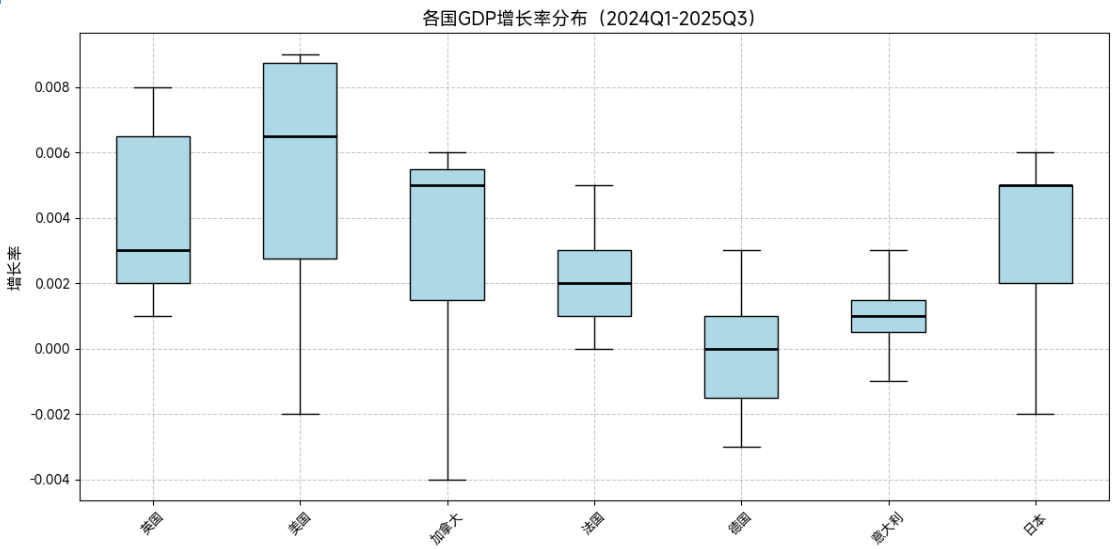
英国2025年三季度GDP环比增速放缓至 0.1% 服务业成增长主要支撑
Xin Hua Cai Jing· 2025-11-13 09:25
Economic Growth Overview - The UK economy continues to slow down, with a 0.1% quarter-on-quarter GDP growth in Q3 2025, down from 0.3% in the previous quarter, and a year-on-year growth of 1.3%, indicating moderate expansion [1][6] - Nominal GDP increased by 1.2% quarter-on-quarter and 5.1% year-on-year, primarily driven by rising employee compensation [1] Sector Performance - The production sector experienced a significant decline, with a 0.5% quarter-on-quarter and 0.9% year-on-year decrease, marking two consecutive quarters of decline [4] - The services sector showed resilience, with a 0.2% quarter-on-quarter and 1.6% year-on-year growth, becoming the core driver of economic growth [3] - Construction output grew by 0.1% quarter-on-quarter, relying mainly on maintenance activities, while new construction projects saw a decline [3] Consumer and Investment Trends - Household final consumption expenditure rose by 0.2% quarter-on-quarter and 0.7% year-on-year, with clothing and entertainment being key growth areas [4] - Gross fixed capital formation (GFCF) increased by 1.8% quarter-on-quarter and 3.8% year-on-year, although corporate investment showed a slight decline [4] Trade and International Comparison - Exports and imports both saw slight declines, with trade deficit accounting for 0.6% of nominal GDP [4] - Compared to other G7 economies, the UK's Q3 growth rate of 0.1% is lower than the US (0.9%) and Canada (0.1%), but on par with Germany and Italy [4] Future Outlook - Analysts suggest that the UK's GDP slowdown reflects pressures from both production and demand sides, but the resilience of the services sector and capital formation may prevent economic contraction [6] - Wage growth and moderate inflation could reduce the urgency for further interest rate hikes by the Bank of England [6]