
数字化

Search documents
创维集团发布2025年中期业绩:营收同比增长20.3% 新能源与全球化双引擎动力十足
Zheng Quan Ri Bao Wang· 2025-08-29 13:48
Core Insights - The company reported a significant revenue increase of 20.3% year-on-year, reaching 36.264 billion RMB, marking a historical high for the same period [1] - The mainland China market contributed approximately 28.290 billion RMB, up 24.6% from the previous year, driven by strong performance in the new energy sector [1] - The overseas market revenue reached 8.053 billion RMB, a 7.1% increase year-on-year, indicating an expansion in global operations [1] New Energy Business - The new energy segment achieved remarkable growth, generating 13.801 billion RMB, a nearly 54% increase year-on-year, and now accounts for 38% of total revenue [2] - The company has successfully built and operated solar power plants with a cumulative installed capacity exceeding 25.6 GW, leading the industry in both scale and efficiency [2] - The innovative "solar + inclusive + digital technology" business model has established the company as a leader in the distributed solar market [2] Smart Home Appliances - The smart home appliance segment reported revenue of 17.044 billion RMB, a 9.4% year-on-year growth, demonstrating strong market appeal [3] - Growth in this segment was supported by over 34% and 35% year-on-year increases in the mainland and overseas markets, respectively [3] - The company’s smart TVs ranked among the top five global brands in sales, with new high-end products setting market benchmarks [3] Share Buyback Program - The company successfully completed a share buyback program, reflecting confidence in future growth and commitment to shareholder returns [4] - The buyback involved repurchasing approximately 341 million shares, representing about 15.28% of the total shares issued as of June 6, 2025, at a total cost of approximately 1.061 billion HKD [4] - This initiative not only optimized the capital structure but also enhanced earnings per share, showcasing the company's robust financial foundation [4]
青云科技2025半年报:云服务首次实现盈利
Zheng Quan Ri Bao Wang· 2025-08-29 13:46
Core Insights - Beijing Qingyun Technology Group Co., Ltd. reported a revenue of 100 million yuan for the first half of 2025, with significant performance in its two main businesses: cloud services and cloud products [1] - The cloud services segment achieved profitability for the first time, with a gross profit of 4.3773 million yuan and a gross margin of 6.60%, an increase of 7.89 percentage points year-on-year [1] - Cloud products maintained a high gross margin of 63.04%, indicating stable and healthy growth [1] Business Strategy - The company continued its strategic adjustment from the previous year, focusing on increasing the scale of high-margin businesses and developing core advantage products aimed at value enterprise customers with stable digitalization needs [1] - Qingyun Technology is enhancing operational efficiency in its cloud services by optimizing infrastructure investment costs and improving return on investment [1] - The AI computing power service is a key focus, with the cloud services segment generating 22.8207 million yuan in revenue from AI computing power [1] Product Development and Partnerships - Qingyun Technology is committed to creating standardized, user-friendly, and reliable products in the digitalization, intelligent computing, and cloud-native fields, significantly improving R&D efficiency and customer experience [2] - The company is implementing a value channel strategy, focusing on "core channels + benchmark channels," treating channel partners as "external partners" to collaboratively meet customer needs [2] - In the first half of 2025, Qingyun Technology expanded its service boundaries through strategic partnerships with Haiguang Information, Northern Computing Network, and Shudao Intelligent Computing, and joined the "AI + Ecological Going Global Alliance" with China Telecom [2]

青云科技发布2025年半年报 云服务首次实现盈利
Zheng Quan Shi Bao Wang· 2025-08-29 11:49
Core Insights - The company reported strong performance in its two main business segments, cloud services and cloud products, with cloud services achieving profitability for the first time in the first half of 2025 [1] - The company implemented a strategic adjustment in 2024, focusing on increasing high-margin business scale and optimizing organizational processes to enhance overall competitiveness [1] Financial Performance - In the first half of 2025, the company achieved a gross profit of 5.32 million yuan in cloud services, with a gross margin of 6.60%, an increase of 7.89 percentage points year-on-year [1] - The gross margin for cloud products remained high at 63.04% [1] - The company reported a net profit attributable to shareholders of -41.56 million yuan, a year-on-year narrowing of 10.43% [1] Cloud Services Strategy - The company focused on value enterprise clients with stable digitalization needs and significantly developed AI computing power services, capturing major market opportunities in the AI computing sector [2] - The cloud services business achieved a gross profit of 4.38 million yuan and AI computing cloud revenue of 22.82 million yuan in the first half of 2025 [2] - The company emphasized creating standardized, user-friendly, and reliable products to meet clients' digital needs, enhancing research and development efficiency [2] Channel Strategy - The company adopted a value channel strategy, focusing on "core channels + benchmark channels" and viewing channel partners as external partners to collaboratively meet customer needs [3] - In the first half of 2025, the company expanded its service boundaries through strategic partnerships with various organizations and participated in key projects [3]
调研速递|长虹美菱接受开源证券等3家机构调研 上半年空调业务收入115.75亿元
Xin Lang Cai Jing· 2025-08-29 11:25
Group 1 - The core viewpoint of the news is that Changhong Meiling Co., Ltd. is actively engaging with institutional investors to discuss its business strategies and performance, particularly in the air conditioning and refrigerator sectors [1] Group 2 - In the first half of 2025, the air conditioning business achieved revenue of approximately 11.575 billion yuan, representing a year-on-year growth of 36.18% [1] - The company plans to drive innovation and digital transformation in the second half of 2025, focusing on resource integration and strengthening market foundations [1] - The domestic strategy for the refrigerator sector includes a marketing transformation and user-centric operations, with plans to launch multiple fresh products and enhance brand differentiation [1] - The overseas strategy for the refrigerator sector aims to reshape product platforms based on mainstream market structures and increase product investment to meet global consumption trends [1] - The air conditioning overseas strategy focuses on enhancing customer service systems and deepening cooperation with key clients in Latin America, the Middle East, and Europe [1]

J&T EXPRESS(01519) - 2025 Q2 - Earnings Call Transcript
2025-08-29 10:30
Financial Data and Key Metrics Changes - The company's parcel volume reached 13.99 billion parcels, a year-on-year increase of 27% [8] - Revenue increased to $5.5 billion, representing a year-on-year growth of 13% [8] - Adjusted net profit rose to $160 million, a significant year-on-year increase of 147% [8][30] - Gross profit margin declined from 11% to 9.8% due to competitive pressures in the China market [21] Business Line Data and Key Metrics Changes - In Southeast Asia, parcel volume reached 3.23 billion parcels, a year-on-year increase of 58%, with market share rising to 32.8% [9] - Revenue in Southeast Asia increased by 29.6% year-on-year to $2 billion, with adjusted EBIT growing by 74% [22] - In China, parcel volume reached 10.6 billion parcels, a year-on-year increase of 20%, but revenue per parcel decreased to $0.30 [13][25] - New markets saw parcel volume increase to 170 million parcels, a year-on-year growth of 22%, achieving positive EBITDA for the first time [15][27] Market Data and Key Metrics Changes - Southeast Asia's market share increased by 5.4 percentage points year-on-year, solidifying the company's leadership position [9] - The new markets segment achieved a significant turnaround, with a market share increase of 6.2% [15] Company Strategy and Development Direction - The company focuses on continuous cost reduction and developing non-ecommerce platform customers to enhance profitability [11] - Plans to replicate China's cost reduction experience in Southeast Asia and new markets [16] - Emphasis on investing in network capacity and automation to improve operational efficiency [16][28] Management's Comments on Operating Environment and Future Outlook - The global economic environment remains volatile, with geopolitical conflicts and trade uncertainties posing challenges [7] - Management expressed confidence in future growth, particularly in Southeast Asia and Latin America, driven by strong local partnerships [16][39] - The company aims to maintain a long-term focus on value creation amidst competitive pressures [17] Other Important Information - The company achieved a strong cash flow, with net cash flow from operating activities amounting to $421 million, an increase of 21.8% [30][32] - Total cash and cash equivalents reached $1.7 billion as of June 30, 2025 [32] Q&A Session Summary Question: Impact of domestic policy on earnings and performance in Latin America - Management noted price recovery in certain provinces due to anti-involution policies, which may improve earnings [36] - The Latin American market is expected to grow further, supported by partnerships with platforms like TikTok and MercadoLibre [39] Question: Update on non-ecommerce platform businesses and operational capacity in Southeast Asia - Non-ecommerce business accounts for less than 10% of total parcels but contributes higher margins [44] - Current capacity in Southeast Asia can handle over 30 million parcels daily, with ongoing investments in capacity expansion [47] Question: Cost reduction potential and market share expansion plans - Transportation and sorting costs per parcel have decreased, with ongoing efforts to further reduce costs [51] - The company is evaluating potential new markets for expansion, with a focus on maintaining leadership in Southeast Asia [60] Question: Unit economics guidance and franchise model adoption - The company aims to balance parcel volume growth with ASP strategy, maintaining stable EBIT per parcel [72] - The network partner model is being implemented across Southeast Asia, with 30% of the network run by partners [77] Question: Cooperation with MercadoLibre and AI technology initiatives - Collaboration with MercadoLibre is progressing well, with significant potential for growth [90] - The company has deployed over 900 autonomous delivery vehicles in China, enhancing last-mile delivery efficiency [94]
华设集团: 华泰联合证券有限责任公司关于华设设计集团股份有限公司部分募投项目延期的核查意见
Zheng Quan Zhi Xing· 2025-08-29 10:24
Summary of Key Points Core Viewpoint - The company has decided to postpone the completion date of the Huase Innovation Center project to June 30, 2026, due to adverse weather conditions affecting construction progress, while ensuring that the project’s implementation subject, funding usage, and investment scale remain unchanged [3][14][16]. Fundraising Overview - The company raised a total of RMB 400 million through the issuance of convertible bonds, with a net amount of RMB 391.61 million after deducting issuance costs [2][3]. - As of June 30, 2025, the total investment in fundraising projects was RMB 391.61 million, with a progress rate of 52.06% [2][3]. Postponement Details - The Huase Innovation Center project’s original completion date was September 1, 2025, which has now been adjusted to June 30, 2026 [3][16]. - The delay is attributed to extreme weather conditions and compliance with environmental regulations, which limited effective construction time [3][14]. Project Re-evaluation - The necessity and feasibility of the Huase Innovation Center project remain unchanged, aligning with national policies on digital technology and green development [4][5][6]. - The project aims to enhance the company’s design and research capabilities, contributing to its long-term strategic goals [13][14]. Implementation Measures - The company will closely monitor the project’s progress and implement a structured plan to ensure timely completion [14][15]. - Dedicated personnel will be assigned to oversee the project, ensuring effective coordination and dynamic control during the implementation phase [14][15]. Internal Decision-Making Process - The postponement was approved by both the board of directors and the supervisory board, confirming compliance with relevant regulations and ensuring no adverse impact on shareholder interests [16][17].

微信最新数据报告:行业生态覆盖全球,加速中国企业出海
Zhong Guo Jing Ji Wang· 2025-08-29 10:11
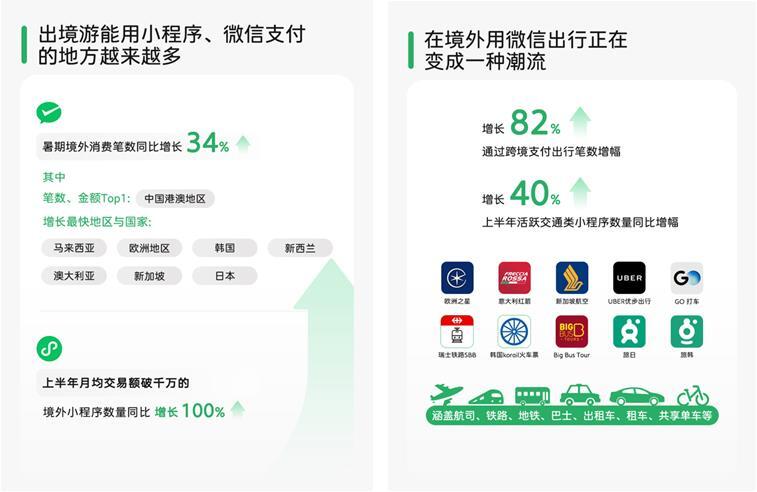
Group 1 - The core viewpoint of the articles highlights the rapid growth of the WeChat ecosystem overseas, particularly in the context of cross-border travel, with a significant increase in the use of WeChat Mini Programs and WeChat Pay by global merchants to cater to Chinese tourists [1][8] - During the summer vacation period (July 1 to August 20), the number of overseas offline consumption transactions increased by 34%, and the number of active overseas Mini Programs rose by 30 year-on-year, with the number of Mini Programs achieving an average monthly transaction volume exceeding 10 million doubling year-on-year [1][7] - WeChat Mini Programs have become essential tools for overseas travel, covering 92 countries and regions and spanning 103 sub-industries, thus enhancing the digital experience for Chinese tourists [3][9] Group 2 - The transportation sector has seen significant growth, with a notable increase of over 40% in Mini Program activity, particularly in the Korean transportation industry, where transaction numbers surged by 100% [5][8] - The Hong Kong and Macau regions have also embraced digital convenience, with WeChat Pay transactions increasing by over 26% during the summer, and popular travel destinations expanding beyond the Greater Bay Area [3][8] - The number of overseas merchants supporting WeChat Pay has surged by 64% in the first half of the year, with various sectors, including fashion brands, experiencing rapid growth in transaction volumes [8][10] Group 3 - The WeChat ecosystem is facilitating the global expansion of Chinese brands, with companies like Heytea and Pop Mart utilizing Mini Programs and WeChat Pay to serve international customers [10][12] - The number of active overseas service providers within the WeChat ecosystem has grown by nearly 30% year-on-year, with a 45% increase in the number of Mini Programs they support across major countries and regions [10][12] - WeChat is also enhancing its offerings with features like the "Global Cashier" and "Two-Code Integration," currently being tested in Singapore, to provide convenient payment options for local and global users [10][12]


力诺药包:以科技与品质赢得全球信赖铸就医药包装领军企业
Xin Lang Cai Jing· 2025-08-29 09:20
Core Viewpoint - Shandong Linuo Pharmaceutical Packaging Co., Ltd. successfully listed on the Shenzhen Stock Exchange's Growth Enterprise Market, marking a new development phase for the company after nearly 30 years of solid accumulation and continuous innovation in the pharmaceutical packaging sector [1] Company Overview - Founded in 1995, the company has focused on the pharmaceutical packaging field, achieving breakthroughs in the research, manufacturing, and application of borosilicate glass [1] - The company has established a complete industrial chain from tube production to bottle manufacturing and completed the production of borosilicate glass tubes in 2022 [1] Product Portfolio - Linuo Pharmaceutical Packaging has developed a diverse product matrix, including borosilicate glass tubes, ampoules, vials, pre-filled syringes, and molded injectable bottles, along with high-end packaging solutions such as no-wash, no-sterilization, coated, and COP materials [1] - In addition to pharmaceutical packaging, Linuo Glass Technology, a subsidiary, excels in heat-resistant glass products, with an annual production capacity of 150 million pieces, capturing a significant share of the global microwave glass turntable market [1] Innovation and R&D - The company holds over 130 patents and has participated in the formulation and revision of more than 20 international, national, and industry standards, supported by a CNAS-accredited laboratory and provincial-level enterprise technology center [1] Strategic Projects - In 2023, the company launched a phase three high-end pharmaceutical packaging project with a total investment of 2 billion yuan, aiming to build a "lighthouse factory" that integrates digital twin technology, 5G, AI, and big data [1] Sustainability Initiatives - Linuo Pharmaceutical Packaging actively practices ESG principles, implementing a digital carbon management system to promote green and low-carbon production, recognized as an A-level enterprise for environmental performance by the Ministry of Ecology and Environment [1] International Expansion - The company is steadily advancing its global strategy, leveraging its technological innovation and intelligent manufacturing advantages in the pharmaceutical packaging sector to enhance its competitiveness in the global market [1] Corporate Philosophy - Adhering to the spirit of "serving the country through industry and pursuing excellence," the company emphasizes "productism, long-termism, and altruism" as its core values, continuously strengthening its position in the global pharmaceutical packaging market through smart manufacturing, technological innovation, and green development [1]

李扬:改革的重点在于将居民储蓄转化为企业资本金
和讯· 2025-08-29 09:15
Group 1 - The core challenge for the banking sector is the downward trend in interest rates, which is expected to continue, impacting financial operations in China [2][3] - The phenomenon of "disintermediation" is emerging, where funds are flowing from banks to non-bank financial institutions and markets, indicating a positive shift in the financing structure favoring capital market development [3][4] Group 2 - Financial intermediaries, particularly banks, must undergo transformation in four key areas: 1. Transition from selling products to providing financial services, as many banks still operate in a traditional manner reliant on interest margins [5] 2. Development of asset management businesses to enhance direct financing efficiency, which is crucial for implementing central financial policies [5][6] 3. Strengthening asset trading operations through market mechanisms, leveraging advancements in technology such as digitalization and blockchain [6] 4. Promoting integrated operations to overcome the limitations of segmented business and regulatory practices [6] Group 3 - There is a significant opportunity for the capital market to develop, driven by declining interest rates and the disintermediation trend, which creates a favorable environment for asset management markets [7][8] - The focus of reform should be on converting household savings into corporate capital, as the capital market plays a central role in this transformation [7][8] Group 4 - The international economic landscape is undergoing profound changes, with a shift towards bilateral negotiations and a decline in the effectiveness of global governance mechanisms established post-World War II [9][10] - Despite external challenges, the resilience of the Chinese economy remains strong, with confidence in the ability to manage the impacts of tariffs and maintain a robust manufacturing and service sector [10][11]

海通恒信发布中期业绩 净利润7.85亿元 同比减少3.4% 中期股息每10股0.42元
Zhi Tong Cai Jing· 2025-08-29 09:14
Core Viewpoint - The company reported a decline in revenue and net profit for the first half of 2025, while actively enhancing its collaboration with partners and expanding its financing channels to optimize its financial structure and reduce costs [1][2]. Group 1: Financial Performance - Total revenue and other income for the first half of 2025 amounted to RMB 3.521 billion, a decrease of 12.6% year-on-year [1] - Net profit was RMB 785 million, down 3.4% year-on-year [1] - Basic earnings per share were RMB 0.09, with an interim dividend of RMB 0.42 per 10 shares (tax included) [1] Group 2: Strategic Initiatives - The company strengthened collaboration with Guotai Junan Securities to enhance its industrial research capabilities through an integrated "investment banking - investment - research" system [1] - It actively engaged in the group’s enterprise customer service system to optimize customer resources and deepen strategic collaboration between securities and leasing [1] Group 3: Industry Engagement and Recognition - The company participated in various industry events to enhance external cooperation and was awarded the "Outstanding Action Agency Award" by the Shanghai Green Finance Service Platform [1] - Multiple financing leasing projects were recognized with the "Green Benefit Contribution Award" [1] Group 4: Financing and Cost Management - The company successfully launched the industry’s first ESG-linked syndicated loan and signed an environmental special syndicated loan with the New Development Bank and Bank of China [2] - The average interest rate on interest-bearing liabilities was 2.94%, a decrease of 0.59 percentage points compared to the same period last year, indicating reduced financing costs [2] Group 5: Technological and Talent Development - The company increased investment in financial technology to enhance digitalization and intelligence across business processes [2] - It focused on improving risk management tools and compliance governance capabilities while developing a talent system to support industrial transformation [2]