智能驾驶

Search documents
L3级自动驾驶获批上路 机构看好智驾行业进入高速发展期(附概念股)
Zhi Tong Cai Jing· 2025-12-22 00:55
Group 1 - The Ministry of Industry and Information Technology officially announced the first batch of L3 conditional autonomous driving vehicle permits in China, marking a significant step towards commercial application of L3 autonomous driving [1][2] - Longhua Securities noted that the approval of L3 autonomous driving vehicles indicates that China is the second country after Germany to allow L3 vehicles on the road, with the potential for large-scale deployment [1][2] - The approval is expected to accelerate the commercialization of autonomous driving technology, benefiting the entire industry chain [1][2] Group 2 - Investment opportunities are suggested in sectors such as intelligent driving algorithms, related hardware providers, and Robotaxi operation platforms, as the approval of L3 vehicles transitions the industry from testing to product entry and road trials [2] - Companies like Junsen Electronics and Sailyus are actively engaging in strategic partnerships and product launches to enhance their positions in the autonomous driving market [3][4] - The development of L3 intelligent driving systems is being pursued by companies like ZF and Horizon Robotics, with expectations for mass production in 2026 [4][5] Group 3 - TuDatong is recognized as the first global supplier to achieve mass production of automotive-grade high-performance LiDAR solutions, with a projected delivery of approximately 230,000 units in 2024 [5][6] - The establishment of a new manufacturing headquarters by Nexperia in Suzhou, with an investment of 1 billion yuan, aims to focus on electric power steering and steering-by-wire technologies to meet various levels of assisted and autonomous driving needs [7]
机构:自动驾驶技术走向量产应用
Zheng Quan Shi Bao Wang· 2025-12-22 00:53
Core Viewpoint - The issuance of the first L3-level autonomous driving license plate in China marks a significant milestone for Changan Automobile, indicating the country's entry into the L3 autonomous driving era [1] Group 1: Industry Insights - The approval of L3-level autonomous vehicles signifies progress in both technology and policy, laying the groundwork for future commercialization of intelligent driving [1] - The commercial process for intelligent driving is expected to accelerate by 2026, despite current operational limitations for approved L3 models [1] Group 2: Market Projections - According to CITIC Securities, 2025 is projected to be a pivotal year for the intelligent driving industry, with significant penetration rates for high-speed NOA (16%) and urban NOA (14%), translating to sales of approximately 3.63 million and 3.33 million vehicles, respectively [1] - By 2026, the penetration rates for high-speed NOA and urban NOA are forecasted to reach 21% and 22%, respectively, creating investment opportunities for leading intelligent driving companies and upstream supply chains [1]

港股概念追踪|L3级自动驾驶获批上路 机构看好智驾行业进入高速发展期(附概念股)
智通财经网· 2025-12-22 00:50
Group 1 - The Ministry of Industry and Information Technology of China has officially announced the first batch of L3 conditional autonomous driving vehicle permits, marking a significant step towards commercial application of L3 autonomous driving in China [1] - Longyuan Securities reports that the approval of L3 autonomous driving vehicles indicates a transition from testing to commercial application, with the industry moving towards higher levels of intelligent driving [1] - Changjiang Securities states that China becomes the second country after Germany to officially permit L3 vehicles, with the approval of two models indicating a new phase for intelligent connected vehicles in mass production [1] Group 2 - The approval of L3 vehicles is expected to accelerate the development of the intelligent driving industry chain, with recommendations to focus on intelligent driving algorithm providers, hardware suppliers, and Robotaxi operation platforms [1] - Huatai Securities emphasizes that the approval will lead to a restructuring of the value chain in the intelligent driving industry, with significant investment opportunities in core areas such as intelligent vehicles, control chassis, domain control chips, and lidar [1] - Companies like Junsheng Electronics and CAOCAO Mobility are actively engaging in strategic partnerships and launching new autonomous driving platforms, indicating a competitive landscape in the autonomous driving sector [2][3] Group 3 - Leap Motor has officially started nationwide deliveries of its Lafa5 model, which supports dual AI models and a lidar perception system [3] - Horizon Robotics and ZF have announced a joint development of an L3 intelligent driving system, expected to be mass-produced in China by 2026 [3] - Companies like Black Sesame Intelligence and TuDatong are advancing in the autonomous driving field with innovative products and significant market presence, including high-performance lidar solutions [4][5]
车轮上的新体验
Xin Lang Cai Jing· 2025-12-21 20:41
智驾给消费者带来的不仅是便利,还有更全面的驾驶体验提升。 (来源:经济参考报) "现在的车就像有个隐形停车助手,不但能自己停进划线车位,还能用手机遥控进出窄位,再也不用担 心停好车开不了门了。"北京车主陈女士说,"不到10万元的车也能有这些功能,智驾普及的速度真是超 乎想象。" 车主越来越从容的背后,是一场席卷中国汽车产业的智能驾驶普及浪潮。2025年,随着智能泊车、车道 保持等驾驶辅助功能成为越来越多车型的标配,一"键"入库、主动避让障碍物等场景,正从炫酷演示变 为日常体验。 工信部数据显示,2025年前三季度,具备组合驾驶辅助功能(L2)的乘用车新车销量同比增长21.2%, 渗透率达64%。这意味着,每卖出10辆新车中,有超过6辆具备智能泊车、自适应巡航、车道保持等基 础智驾能力。 技术的持续突破与成本的快速下探,助推了这场车轮上的"智变"风潮。蔚来技术有关负责人透露,今年 以来,不仅端到端大模型、视觉语言动作模型(VLA)、世界模型等技术接连实现突破,各家主机厂 以及第三方技术供应商也在加快步伐,将自身技术推向成熟以实现广泛应用。 "目前智驾硬件成本每两年减半,而智驾的体验有望实现两年十倍的提升。"一位 ...
新能源车险“新变局”:年保费冲击2000亿元
Zheng Quan Ri Bao· 2025-12-21 16:28
Core Viewpoint - The rapid growth of the new energy vehicle (NEV) insurance market in China is driven by increasing NEV sales, regulatory support, and evolving market dynamics, with a projected insurance premium scale reaching 200 billion yuan by 2025, reflecting a significant transformation from a supplementary to a core segment of the insurance market [1][2][3]. Group 1: Market Growth and Trends - In the first eleven months of 2023, NEV sales reached 14.78 million units, marking a year-on-year increase of 31.2% [1]. - The NEV insurance premium scale is expected to reach 200 billion yuan in 2023, with a growth rate exceeding 30% [1]. - The commercial insurance premium for NEVs is projected to grow by over 30% year-on-year for 2023, 2024, and 2025 [1]. - The NEV commercial insurance premium was approximately 484.4 billion yuan in 2022, with 2023, 2024, and 2025 projected at 769.77 billion yuan, 1.1773 trillion yuan, and 1.391 trillion yuan respectively, reflecting year-on-year growth rates of 58.9%, 52.9%, and 34.52% [2]. Group 2: Regulatory and Pricing Developments - The insurance industry is facing challenges with high premiums, high claim rates, and high payout rates, leading to a mismatch between pricing and risk [4]. - The new pricing rules allow for greater flexibility in premium setting, with the range for NEV insurance pricing coefficients adjusted to [0.5, 1.5], aligning more closely with traditional fuel vehicles [5]. - The shift in pricing strategy aims to better match risk levels and improve underwriting efficiency, allowing for differentiated pricing based on actual risk [5]. Group 3: Emerging Variables and Challenges - The introduction of L3-level autonomous driving vehicles is expected to significantly impact insurance products, pricing, and operations in the NEV insurance sector [6][7]. - The integration of advanced driver assistance systems is pushing the insurance industry into a "risk reconstruction" era, necessitating new insurance products to address liability issues arising from these technologies [7]. - The industry faces ongoing challenges, including high repair and compensation costs, risk management difficulties, and the need for improved data accumulation for risk pricing [8][9]. Group 4: Collaborative Efforts for Improvement - Collaboration among regulators, insurance companies, and automotive manufacturers is essential to address the challenges in the NEV insurance market [8]. - The establishment of a repair ecosystem between insurers and automakers is seen as a key direction for resolving current issues, leveraging data from smart connected vehicles to create refined risk profiles and dynamic pricing models [9]. - The future of NEV insurance is expected to focus on risk matching, cost control, and high-quality service to support the development of green transportation [9].
股价狂飙55000%!史上最牛妖股,横空出世!
2 1 Shi Ji Jing Ji Bao Dao· 2025-12-21 14:05
据新华社报道,12月20日,国内首块L3级自动驾驶专用正式号牌"渝AD0001Z"在重庆诞生,由重庆市公安局交通管理总队正式授 予长安汽车,标志着长安汽车在国内率先开启L3级自动驾驶时代。 热点情报 智能驾驶产业又传来利好 此前12月15日,工信部正式公布我国首批L3级自动驾驶车型准入许可,长安深蓝SL03和极狐阿尔法S6两款车型获准上路试点。这 是我国L3级自动驾驶从测试阶段迈入商业化应用的关键一步。 近年来A股上市公司分红意愿显著提升,市场分红生态持续优化,呈现出分红总额、参与分红公司数量占比以及年内多次分红公司 数量逐年递增的趋势。choice数据统计,截至发稿,以股权登记日计算,今年以来A股上市公司现金分红总额达到2.61万亿元,已 超过2024年全年,创出历史新高。 数据显示,今年以来,A股上市公司迈瑞医疗、三七互娱、御银股份和玲珑轮胎分红次数均为三次。山东路桥、雅戈尔、深圳华 强、奕帆传动、陕国投A、鱼跃医疗、行动教育、南山铝业、隆扬电子、艾融软件、分众传媒、药明康德、百龙创园、华宝股份、 新坐标等公司分红次数均为两次。 中国机器人在格斗机器人大赛中夺冠 长江证券表示,L3级自动驾驶获批上路,中国 ...

锚定4000亿目标 中国重汽2026年全球供应链战略合作伙伴大会召开
第一商用车网· 2025-12-21 13:03
Core Viewpoint - The article highlights the successful collaboration between China National Heavy Duty Truck Group (CNHTC) and its global supply chain partners, emphasizing the company's strategic goals and achievements in the commercial vehicle industry, particularly in the context of the upcoming "14th Five-Year Plan" period [3][7]. Group 1: Achievements and Performance - In the first eleven months of 2025, Shandong Heavy Industry achieved a revenue of 551.9 billion yuan, a year-on-year increase of 12.3%, with an expected annual revenue exceeding 600 billion yuan [3]. - CNHTC's revenue is projected to surpass 225 billion yuan, reflecting a 17% year-on-year growth, with total vehicle sales expected to exceed 450,000 units, marking a 25% increase [3][4]. - The heavy truck sales volume is anticipated to exceed 300,000 units, making CNHTC the global leader in heavy truck sales for the first time [4]. Group 2: Technological Innovations - CNHTC has made significant advancements in three major technology routes: pure electric, hybrid, and hydrogen fuel cell technologies, with a comprehensive lineup of electric vehicles including tractors, dump trucks, and cargo trucks [6]. - The company has also introduced L2 level intelligent driving assistance features and developed high-level intelligent driving cockpits based on AI models [6]. Group 3: Strategic Goals and Supply Chain Development - For the "14th Five-Year Plan" period, CNHTC aims to achieve a sales target of 800,000 vehicles and revenue exceeding 400 billion yuan by 2030 [7]. - The company has outlined four key growth drivers and four core advocacy points for supply chain development, focusing on deep integration with corporate strategy and collaborative upgrades [7]. Group 4: Future Collaboration and Ecosystem Building - CNHTC emphasizes value co-creation with suppliers, encouraging them to transition from mere parts providers to partners in creating customer value [9]. - The company advocates for an open innovation chain, fostering joint research and development efforts and breaking down technological barriers [9][11]. - A digital transformation of the supply chain is prioritized to enhance efficiency and responsiveness, while maintaining integrity and compliance in operations [11]. Conclusion - The successful hosting of the conference not only summarized CNHTC's achievements in global supply chain collaboration but also outlined a clear path for industrial cooperation during the "14th Five-Year Plan," reinforcing the company's commitment to becoming a world-class commercial vehicle group [11].

商业航天与核聚变之后,还能关注哪些主题赛道投资机会?
Soochow Securities· 2025-12-21 06:04
Core Insights - The report discusses the recent market adjustments driven by global liquidity pressures, concerns over an "AI bubble," and the A-share Q4 settlement season, highlighting a potential market recovery following the easing of these uncertainties [1] - It emphasizes the importance of structural adjustments in the upcoming 2025 Central Economic Work Conference, suggesting a focus on expanding domestic demand while acknowledging the need for a solid economic recovery [1] - The report identifies potential investment opportunities in the AI sector, particularly in application areas such as AI healthcare, AI edge computing, intelligent driving, and embodied intelligence, as well as in key industries related to the 14th Five-Year Plan, including commercial aerospace, nuclear power, hydrogen energy, quantum communication, and brain-computer interfaces [1][2] AI Sector Opportunities - AI healthcare shows significant potential for deep applications in pathology detection and pharmaceuticals, with a focus on building high-quality datasets and breaking down data barriers [2] - The report notes the recent release of AI medical models and their rising popularity, indicating a strong consumer demand for accessible healthcare services [2] - AI edge computing is being explored by companies like ByteDance, with new AI phone models being introduced, although challenges related to data privacy and competition remain [3] - The report highlights advancements in AI glasses, which are expected to see increased consumer adoption and order releases in the near future [5] Intelligent Driving - The initiation of L3 autonomous driving trials in China is expected to enhance the value of intelligent driving hardware, with companies like Changan and Xiaopeng leading the way [6] - The report mentions the successful commercialization of Robotaxi models, indicating a positive trend in the intelligent driving sector [6] - It also notes the importance of smart traffic infrastructure as part of the broader "Transportation Power" goals outlined in the 14th Five-Year Plan [6] Embodied Intelligence - The humanoid robot sector is poised for significant developments, with key catalysts including IPOs and product launches from companies like Tesla [7] - The report emphasizes the need for practical applications of humanoid robots in industrial settings to validate their market potential [7] Key Industries from the 14th Five-Year Plan - Commercial aerospace is highlighted as a critical area for national strategy, with ongoing developments in satellite internet and 6G technology [8] - The report discusses the increasing focus on nuclear power and controlled nuclear fusion projects, with significant funding and project announcements expected [11] - Hydrogen energy is noted for its growing economic viability due to decreasing production costs and increasing demand for green energy solutions [12] - Quantum communication is positioned as a strategic area for national competition, with ongoing efforts to standardize and commercialize technologies [13] - Brain-computer interfaces are advancing rapidly, with recent breakthroughs in clinical trials and applications in healthcare [14]

刚刚!A股又传“利好”!
天天基金网· 2025-12-21 03:12
Core Viewpoint - The emergence of China's first L3 autonomous driving license plate marks a significant step towards the commercialization of L3 autonomous driving technology, with Changan Automobile leading the way in this development [2][3][4]. Group 1: L3 Autonomous Driving License and Models - The first L3 autonomous driving license plate "渝AD0001Z" was awarded to Changan Automobile in Chongqing, indicating the start of the L3 autonomous driving era in China [2][3]. - The Ministry of Industry and Information Technology (MIIT) has approved the first batch of L3 autonomous driving models, including Changan's Deep Blue SL03 and Arcfox Alpha S6, for trial operations in designated areas of Beijing and Chongqing [4][5]. - Changan's L3 autonomous driving system has undergone over 5 million kilometers of testing on complex roads in Chongqing, demonstrating its readiness for commercial application [3][5]. Group 2: Market Impact and Future Prospects - Following the announcement of L3 autonomous driving approvals, related stocks surged, with multiple companies seeing significant gains in the stock market [2]. - Analysts believe that the approval of L3 models signifies a new phase in the mass production and application of intelligent connected vehicles in China, potentially leading to a restructuring of the autonomous driving industry [6][7]. - The gradual implementation of L3 autonomous driving is expected to expand from B-end (business) to C-end (consumer) markets, with increasing opportunities for component suppliers and testing institutions [7].

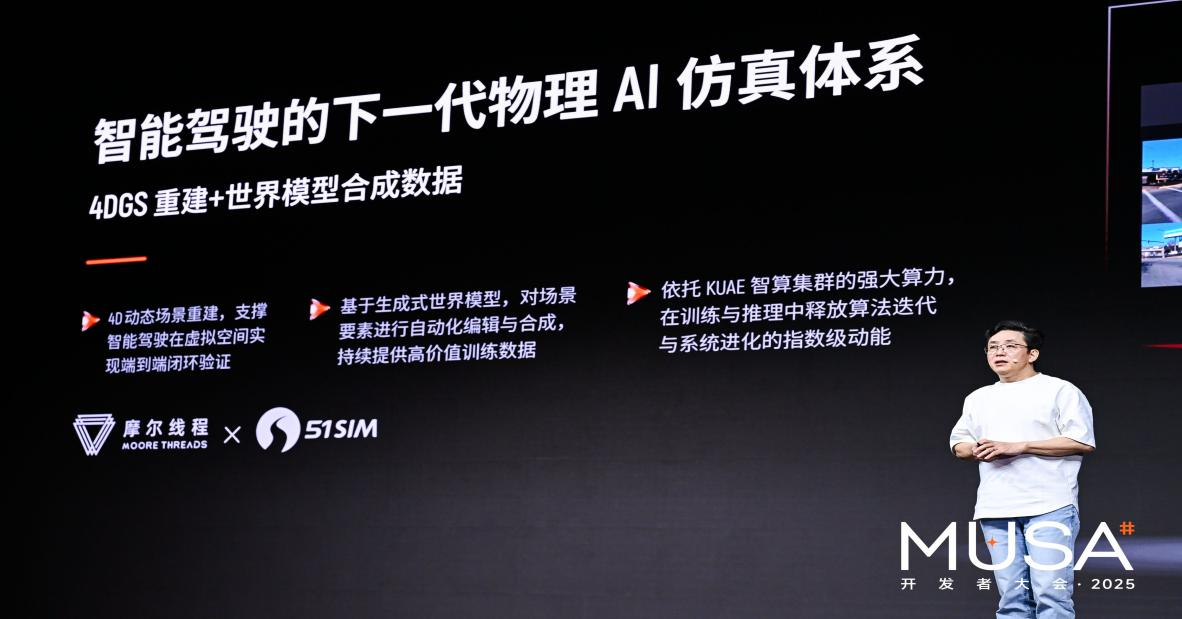
基于摩尔线程KUAE 智算集群,51视界构建下一代物理仿真体系
Xi Niu Cai Jing· 2025-12-20 13:18
Group 1 - The core focus of the collaboration between Moore Threads and 51WORLD's simulation platform 51Sim is to build a next-generation physical AI simulation system based on the KUAE intelligent computing cluster [1] - The partnership aims to leverage domestic GPU computing power and new simulation and world model technologies to explore infrastructure construction paths for end-to-end intelligent driving and embodied intelligence [1][3] - The traditional simulation methods have limitations such as long construction cycles, high costs, and limited generalization capabilities, which the new "reconstruction + generation" approach seeks to address [3] Group 2 - The "reconstruction + generation" physical AI simulation system requires unprecedented computing power for tasks like neural scene reconstruction, world model training, and large-scale synthetic data generation [3] - The collaboration has already achieved large-scale application in the intelligent driving sector, supporting the closed-loop verification of end-to-end intelligent driving algorithms [3] - Future plans include expanding the application of their experiences in intelligent driving to broader physical AI scenarios, aiming to create a replicable and scalable development path for physical AI [3] Group 3 - Moore Threads is a strategic shareholder of 51WORLD, providing strong support as the latter aims to become the first publicly listed company in the Physical AI sector by December 30, 2025, on the Hong Kong Stock Exchange [4] - Both companies are pursuing capitalization to secure funding for accelerating technology development and market expansion, which is expected to enhance the synergy and drive the development of the domestic GPU and Physical AI industry chain [4]