
贸易战

Search documents
今夜 无眠!市场等待联储会议结果
Zhong Guo Ji Jin Bao· 2025-07-30 16:17
大家,今晚继续关注海外市场的消息。 市场等待美联储 另一方面,巴克莱银行策略师Emmanuel Cau指出,美股反弹的动力主要来自散户交易者,而机构买盘则相对温和。散户交易量已处于 历史高位。该行认为,如果没有增长冲击,这种持仓结构可能推动股市在下半年进一步上涨。 7月30日晚间,美股涨跌不一。投资者迎来一系列关键经济数据和财报,同时市场正关注当天稍晚的美联储利率决议以及主席鲍威尔的 讲话。 标普500指数微涨0.05%,纳斯达克综合指数上涨0.23%,道琼斯工业平均指数下跌46点。 在美联储公布利率决议前,投资者大多保持观望。根据芝商所(CME Group)的FedWatch工具,联邦基金利率期货显示,市场预计美 联储将把关键利率维持在4.25%至4.5%区间的概率接近98%。 公告定于美东时间下午2点发布。下午2点30分,美联储主席鲍威尔将在记者会上发表讲话,投资者将从中寻找货币政策走向的信号。 特朗普则试图向美联储施压,要求其降低借贷成本。 自4月低点以来,美股已大幅反弹。一些市场专业人士警告,这波涨势可能需要"喘口气"。 摩根大通资产管理公司全球首席策略师大卫·凯利在接受采访时表示:"我认为,市场涨得 ...


今夜,无眠!
中国基金报· 2025-07-30 16:12
【导读】 市场等待联储会议结果 中国基金报记者 泰勒 大家,今晚继续关注海外市场的消息。 市场等待美联储 7月30日晚间,美股涨跌不一。投资者迎来一系列关键经济数据和财报,同时市场 正关注当天稍晚的美联储利率决议以及 主席鲍威尔的讲话 。 标普500指数微涨0.05%,纳斯达克综合指数上涨0.23%,道琼斯工业平均指数下跌46点。 在美联储公布利率决议前,投资者大多保持观望。根据芝商所(CME Group)的FedWatch工具,联邦基金利率期货显 示, 市场预计美联储将把关键利率维持在4.25%至4.5%区间的概率接近98%。 公告定于美东时间下午2点发布。下午2点30分,美联储主席鲍威尔将在记者会上发表讲话,投资者将从中寻找货币政策 走向的信号。 特朗普则试图向美联储施压,要求其降低借贷成本。 自4月低点以来,美股已大幅反弹。一些市场专业人士警告,这波涨势可能需要"喘口气"。 摩根大通资产管理公司全球首席策略师大卫·凯利在接受采访时表示: "我认为,市场涨得越高,越容易变得脆弱。" 根据本周三公布的初步政府数据,美国第二季度经济活动回升,缓解了外界对特朗普政府贸易战抑制经济增长的担忧。经 通胀调整的国内生 ...

策略日报:甩轿-20250730
Tai Ping Yang Zheng Quan· 2025-07-30 15:22
Group 1: Market Overview - The report indicates that the stock market is expected to continue its upward trend despite recent adjustments, with the A-share financing ratio reaching 10%, indicating overheated speculative sentiment [5][20][24] - The U.S. stock market is projected to reach new highs as trade agreements with major economies are expected to boost risk appetite and profit expectations [26][28] - The report highlights that the bond market is anticipated to experience fluctuations, with a downward trend expected after recent gains [4][10][17] Group 2: Sector Performance - The report notes that sectors such as film and television, and oil and gas development are leading the market, while previously strong sectors like batteries and electronics are experiencing declines [21] - The commodity market is showing signs of recovery, with the Wenhua Commodity Index rising by 0.83%, although some commodities are experiencing price divergence [34][37] Group 3: Policy and Economic Indicators - The report emphasizes the importance of ongoing U.S.-China trade negotiations and domestic policies aimed at stabilizing growth and reducing competition in key industries [9][38] - It mentions that the Central Political Bureau has set a dual expansion policy for fiscal and monetary measures to support economic recovery [38]

商务部长一嘴滑,把波音特权曝光了!美国人都傻了眼…
Sou Hu Cai Jing· 2025-07-30 07:49
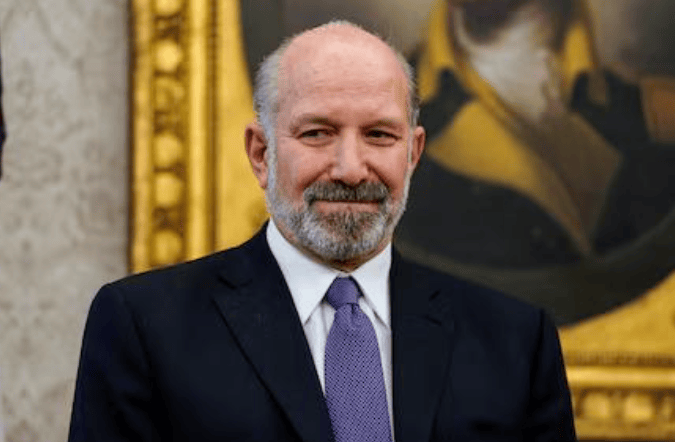
Core Viewpoint - The statement made by U.S. Secretary of Commerce Howard Lutnick regarding Boeing's exemption from import tariffs reveals a significant disparity in the treatment of large corporations versus smaller businesses and consumers, highlighting structural issues within the U.S. economic system [1][3][9]. Group 1: Boeing's Tariff Exemption - Boeing imports key components worth over $12 billion annually from countries like Italy, Japan, and South Korea, yet it is exempt from paying any tariffs on these imports [3][5]. - The U.S. Commerce Department has effectively created a "green light" for Boeing, allowing it to operate without the burden of tariffs, while other companies are left to navigate the tax landscape on their own [3][5][9]. Group 2: Impact on Consumers and Smaller Businesses - Consumers purchasing imported goods are indirectly subsidizing Boeing's operations, as they bear the cost of tariffs that Boeing does not have to pay [5][11]. - The preferential treatment for Boeing raises questions about fairness in trade practices, especially when smaller businesses and taxpayers are left to shoulder the financial burden [9][11]. Group 3: Broader Economic Implications - The situation illustrates a broader issue within the U.S. economic framework, where large corporations receive special privileges while the narrative of protecting American workers and industries is undermined [7][9]. - The existence of "white list" companies in various sectors, including chips and defense, suggests a systemic bias favoring large firms, which can distort market dynamics and limit opportunities for smaller enterprises [9][11].

富格林投资:多空拉锯金价反弹 美联储携非农引爆行情
Sou Hu Cai Jing· 2025-07-30 07:33
Group 1 - The core viewpoint of the articles highlights the volatility in gold prices driven by multiple factors, including trade negotiations, Federal Reserve policy decisions, and geopolitical tensions [1][3][4] - On July 29, gold prices rebounded, reaching a peak of $3333.93 per ounce after a drop to $3302, indicating a rapid shift in market sentiment [1][2] - The recent agreement between the US and EU to impose a 15% tariff on EU goods has provided some certainty to global markets, while the extension of the tariff truce between the US and China has also influenced gold prices [3][4] Group 2 - The Federal Reserve's monetary policy is a significant factor affecting gold price fluctuations, with expectations that interest rates will remain unchanged during the upcoming meeting [4][6] - Recent economic data presents a mixed picture, with a decrease in job openings and a rise in consumer confidence, contributing to the ongoing debate within the Federal Reserve regarding potential interest rate cuts [4][6] - The geopolitical landscape is further complicated by President Trump's pressure on Russia regarding the Ukraine conflict, which has heightened geopolitical risks and supported gold as a safe-haven asset [3][6] Group 3 - Oil prices have also been influenced by geopolitical tensions, with concerns over potential disruptions to Russian oil exports driving prices higher [6][7] - The announcement of new sanctions against Russia by the EU has intensified the pressure on the global energy market, with significant implications for oil supply and pricing [7] - The upcoming OPEC+ meeting is expected to address production strategies, which could further impact oil price volatility [7]

弱美元提振全球经济,IMF上调全球经济增长预期至3.1%
Hua Er Jie Jian Wen· 2025-07-30 03:04
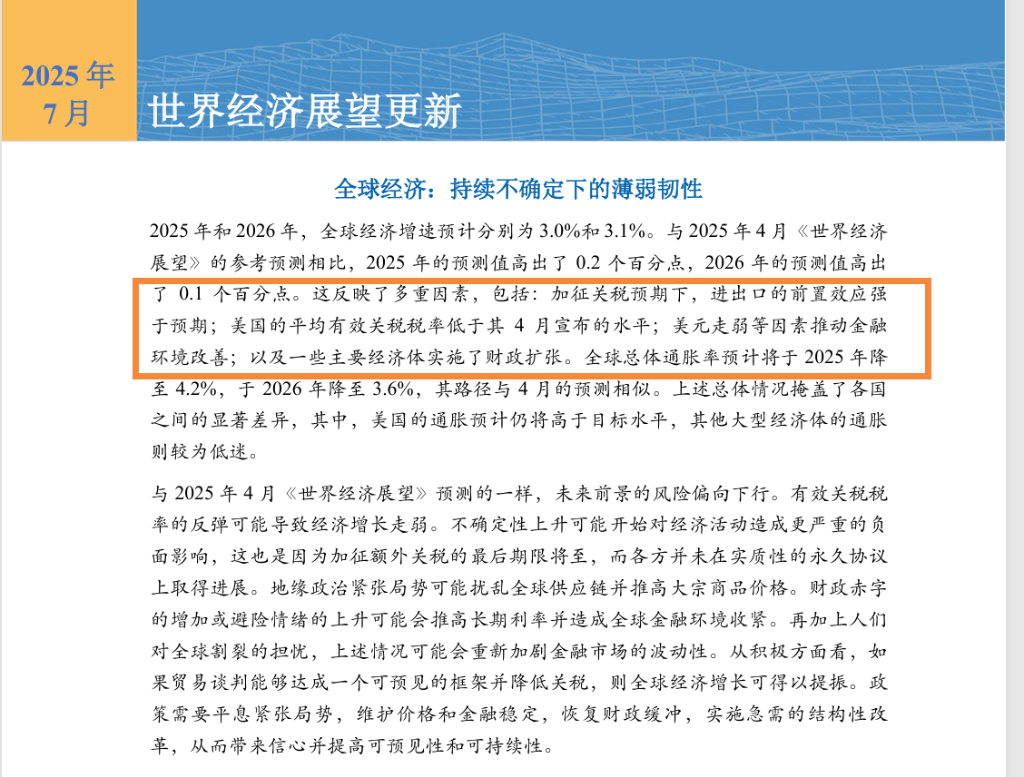
尽管贸易紧张局势和地缘政治风险挥之不去,但弱势美元和"打了折扣"的关税为全球经济提供了意想不到的缓冲。IMF将2026年全球经济增长预 期从3.0%上调至3.1%,2025年预期从2.8%上调至3.0%。美国和中国的经济增长预期也获得上调。 7月29日(周二),国际货币基金组织(IMF)最新《世界经济展望》报告,为笼罩在贸易战阴影下的全球经济带来了些许曙光。 国际货币基金组织(IMF)上调了其对全球经济增长的预测,指出弱势美元和低于预期的美国关税,共同为世界经济提供了缓冲,使其得以展现 出一种"薄弱的韧性"。 IMF预计,2026年全球经济增长率将达到3.1%,高于4月份预测的3.0%;2025年的增长预期也从2.8%上调至3.0%。作为世界最大的两个经济体, 美国和中国的增长前景同样获得了上调。 IMF首席经济学家Pierre-Olivier Gourinchas表示,美元走弱缓解了全球金融环境,因为这降低了许多新兴市场和外国公司以美元计价的债务的偿债 成本。同时,他指出,目前美国对进口商品征收的有效关税率约为17%,低于4月份预测时所依据的24%,"关税压力有所缓解"。 然而,IMF警告称,这种复苏的根基 ...
【真灼财经】美联储决策日;中美关税休战磋商
Sou Hu Cai Jing· 2025-07-30 02:38
| 12 7 0 | 4 1.28096 | 0,20078 @ | 00 | | | | | | | | | | | | | | | --- | --- | --- | --- | --- | --- | --- | --- | --- | --- | --- | --- | --- | --- | --- | --- | --- | | . | . | | | | | | | | | | | | | | | | | Host | Profit | Commissions Vaca | TV CHICH DIRECT | SHOP | Tammer | 80 | -56.70 | | | | | | | | | | | of Real Property | -567.0 | -0.51 | 0.00 | 274,06 | 0 | 309.6 | 0.00 | | | | | | | | | | | 0 | (80.000 | -45.74 | -118.33 | 0 | THE THE PERFECT FOR FOR | -133.0 | Rist | 0.00 | 0 | 4.0179 | 65.40 | ...
豆粕:美豆微跌、菜粕偏强,连粕或震荡,豆一:震荡
Guo Tai Jun An Qi Huo· 2025-07-30 02:34
商 品 研 究 2025 年 07 月 30 日 豆粕:美豆微跌、菜粕偏强,连粕或震荡 国 泰 君 安 期 货 研 究 所 吴光静 投资咨询从业资格号:Z0011992 wuguangjing@gtht.com 【基本面跟踪】 豆粕/豆一基本面数据 | | | 收盘价 (日盘) | 涨 跌 收盘价 (夜盘) 涨 跌 | | --- | --- | --- | --- | | | DCE豆一2509 (元/吨) | 4144 -39 | (-0.93%) 4149 +13(+0.31%) | | 期 货 | DCE豆粕2509 (元/吨) | 2983 | -18(-0.60%) 2993 +19 (+0.64%) | | | CBOT大豆11 (美分/蒲) | 1008.25 | -3.25(-0.32%) | | | CBOT豆粕12 (美元/短吨) | 276.3 -3.1 | n a (-1.11%) | | | | | 豆粕 (43%) | | | | 2860~2900, 较昨-20至持平; M2509+0/+30/+50/+60, | 8月10日前提货M2509-100, 持平; 8-9月 持平; ...
大越期货原油早报-20250730
Da Yue Qi Huo· 2025-07-30 02:33
Report Industry Investment Rating There is no information provided regarding the report industry investment rating. Core Viewpoints - The short - term optimistic sentiment about oil prices has rebounded, and oil prices are expected to run strongly. In the short term, it will run strongly in the range of 525 - 535, and long - term long positions should be held lightly [3]. Summary by Directory 1. Daily Prompt - **Fundamentals**: Sino - US trade negotiations are proceeding smoothly, and both sides intend to extend the sanctions exemption period. Trump has significantly shortened the deadline for Russia to reach a cease - fire agreement and threatened to impose tariffs [3]. - **Basis**: On July 29, the spot price of Oman crude oil was $73.02 per barrel, and that of Qatar Marine crude oil was $71.80 per barrel. The basis was 19.95 yuan/barrel, with the spot at a premium to the futures [3]. - **Inventory**: The US API crude oil inventory for the week ending July 25 increased by 1.539 million barrels, contrary to the expected decrease of 2.5 million barrels. The EIA inventory for the week ending July 18 decreased by 3.169 million barrels, more than the expected decrease of 1.565 million barrels. The Cushing area inventory for the week ending July 18 increased by 0.455 million barrels [3]. - **Disk**: The 20 - day moving average was flat, and the price was above the average [3]. - **Main Position**: As of July 22, the main positions of WTI and Brent crude oil were long, but the number of long positions decreased [3]. - **Expectation**: Overnight, Trump's threat to impose tariffs on Russia led to a sharp rise in international crude oil futures. Sino - US trade negotiations are in line with market expectations. Short - term oil prices will run strongly in the 525 - 535 range, and long - term long positions should be held lightly [3]. 2. Recent News - Trump shortened the deadline for Russia to reach a cease - fire agreement in the Russia - Ukraine conflict from 50 days to 10 days. If there is no progress, the US will impose tariffs and take other measures in 10 days [5]. - Sino - US officials held "constructive" talks in Stockholm, aiming to ease the trade war. Both sides agreed to strive to extend the current 90 - day tariff truce period. Whether to extend it will be decided by Trump [5]. 3. Long - Short Concerns - **Positive Factors**: The intensification of the Russia - Ukraine conflict and the increase in summer demand [6]. - **Negative Factors**: OPEC+ has increased production for three consecutive months, the US has tense trade relations with other economies, and there is a cease - fire between Iran and Israel [6]. - **Market Drivers**: Short - term geopolitical conflicts drive up prices, and in the medium - to - long - term, the market awaits the summer demand peak season [6]. 4. Fundamental Data - **Futures Prices**: The settlement prices of Brent, WTI, SC, and Oman crude oil increased, with increases of 2.36, 2.50, 9.20, and 1.72 respectively, and the ranges were 3.40%, 3.75%, 1.82%, and 2.41% respectively [7]. - **Spot Prices**: The spot prices of various types of crude oil, such as UK Brent, WTI, Oman, etc., also increased [9]. 5. Position Data - **API Inventory**: The US API crude oil inventory for the week ending July 25 increased by 1.539 million barrels [3][10]. - **EIA Inventory**: The US EIA crude oil inventory for the week ending July 18 decreased by 3.169 million barrels [3][13]. - **WTI and Brent Net Long Positions**: As of July 22, the net long positions of WTI and Brent crude oil decreased [3][15][18].
“反内卷”前夜,各行业经营效益如何了?
2025-07-30 02:32
Summary of Conference Call Records Industry Overview - The conference call discusses the performance of industrial enterprises in the first half of 2025, highlighting the impact of trade wars and price wars on various sectors [1][2][3]. Key Points and Arguments - **Profit Growth Trends**: In the first half of 2025, industrial enterprises experienced a profit growth improvement in the first quarter, but a decline was noted in May and June due to the introduction of equal tariffs and price wars. June showed a slight improvement in profit growth, but it remained weak overall [2][3]. - **Impact of Trade Wars**: The trade war has led to a pattern where midstream raw materials and downstream industrial products saw initial revenue and profit growth, followed by a decline. This trend aligns with the timing of export rush and tariff policies [3][4]. - **"Revenue without Profit" Phenomenon**: The downstream consumer goods sector exhibited a "revenue without profit" characteristic, where revenue remained stable but profits declined due to price wars [4][5]. - **Sector Performance**: In June 2025, midstream dye processing, non-ferrous processing, and downstream sectors like instrumentation and automotive manufacturing showed improvements in both revenue and profit growth. However, the communication electronics manufacturing sector faced continuous profit decline despite revenue growth, likely due to price competition and tariff costs [5][6]. - **Inventory Cycle Trends**: The inventory cycle in the first half of 2025 showed a trend of initial replenishment followed by destocking, reflecting unstable business expectations. Midstream raw materials began destocking in the second quarter, while downstream industrial and consumer goods sectors continued to destock, indicating a lack of replenishment motivation [6][7]. - **High Inventory Turnover**: Industrial enterprises faced high product turnover days and extended accounts receivable collection periods, indicating weak replenishment intentions due to unstable demand [8]. Additional Important Insights - **Future Policy Expectations**: Anticipation of upcoming political meetings and ongoing US-China negotiations may influence future policies. There is a possibility of focusing on domestic demand policies in the latter half of the year, especially if fundamental pressures begin to emerge [9][10]. - **Export and Consumption Outlook**: The overall export orders are expected to face pressure in the second half of the year, particularly in the latter part of the third quarter, necessitating attention to domestic demand policies to address potential challenges [10].