新零售

Search documents
格力电器深度报告:空调龙头,信心重塑
ZHESHANG SECURITIES· 2025-05-25 00:15
Investment Rating - The report assigns a "Buy" rating for Gree Electric Appliances, marking the first coverage of the company [6]. Core Viewpoints - Gree Electric Appliances is recognized as a leading air conditioning manufacturer in China, with a young management team expected to enhance governance and operational efficiency, indicating a potential upward trend [1][2]. - The company has successfully navigated through the pain of channel reform, with net profit margins improving from 12.3% in 2019 to 16.9% in 2024, reflecting the effectiveness of these reforms [3][4]. - Gree's revenue and profit growth are projected to continue, with expected revenues of 200.12 billion, 208.32 billion, and 216.82 billion yuan for 2025, 2026, and 2027 respectively, alongside net profits of 35.51 billion, 38.34 billion, and 40.97 billion yuan for the same years [6]. Summary by Sections Company Overview - Gree Electric Appliances has experienced a significant growth trajectory from 1993 to 2014, establishing itself as a prominent player in the air conditioning market with a CAGR of 29% in revenue and 31% in net profit during this period [18][19]. - The company faced challenges from 2015 to 2019 due to intensified competition and a price war, leading to a decline in revenue and profit, but it began to recover post-2019 with a focus on channel reform [19][20]. Market Potential - The air conditioning market in China still has substantial growth potential, with an ideal ownership rate of 234 units per 100 urban households and 161 units per 100 rural households, indicating a 37% growth opportunity from the current ownership levels [5][56]. - Emerging markets in Southeast Asia and South America also present significant growth opportunities, with ownership rates in these regions showing potential for 124% and 114% growth respectively [5]. Channel Reform and Retail Strategy - Gree has successfully completed its channel reform, stabilizing its dealer network and enhancing its market position, which is expected to lead to further improvements in profitability [3][4]. - The company is actively pursuing new retail strategies, including the implementation of a "cloud network" system to improve logistics efficiency and digital capabilities [4]. Financial Projections - The financial outlook for Gree Electric Appliances is positive, with projected revenues and net profits showing consistent growth through 2027, alongside an increase in earnings per share [6][12].

董明珠与孟羽童,再见老板比再见爱人更难?
Xin Lang Cai Jing· 2025-05-24 04:41
Group 1 - The core narrative revolves around the complex relationship between Dong Mingzhu and her former assistant Meng Yutong, highlighting a mix of mentorship, criticism, and the challenges of transitioning from employee to independent figure [3][6][8] - The live broadcast event titled "Goodbye Boss" featured Dong Mingzhu and Meng Yutong, drawing significant public interest due to their past and the dramatic nature of their interactions [3][4][6] - Dong Mingzhu's critical remarks during the live session included Meng Yutong's decision to take on endorsements, which she deemed a significant mistake, and emphasized the importance of maintaining values and loyalty to the company [6][8][19] Group 2 - The live stream aimed to promote products, particularly the "Rose Air Conditioner," which Dong Mingzhu passionately endorsed despite criticisms of its design [11][31] - The event's sales performance was underwhelming, with the broadcast ranking dropping significantly, indicating challenges in the effectiveness of live selling strategies [12][31] - Dong Mingzhu's management style is characterized by a strong emphasis on loyalty and a reluctance to rehire former employees, reflecting her belief in the importance of commitment to the company [19][21][32] Group 3 - The competitive landscape for Gree Electric Appliances is intensifying, with market share for air conditioners declining from 21% to 18.48%, while competitors like Xiaomi are gaining ground [32] - Dong Mingzhu's approach to business has been aggressive, often positioning herself against competitors, particularly Xiaomi, which has become a significant rival in the market [27][32] - The company is facing challenges in adapting to new market dynamics, with a need to innovate beyond traditional product lines to regain growth momentum [31][32]


H&M在中国,悄悄换了打法
36氪未来消费· 2025-05-23 08:58
Core Viewpoint - H&M is undergoing a significant transformation in the Chinese market, focusing on store renovations, digitalization, and enhanced customer experience to adapt to changing consumer preferences and competitive pressures [2][4][11]. Store Renovation Strategy - H&M's store strategy is characterized by "closing old stores and renovating," which involves shutting down underperforming locations while upgrading existing stores to create larger, more engaging flagship experiences in key commercial areas [4][9]. - The newly renovated flagship store in Beijing features improved layout and design, including spacious fitting rooms, comfortable seating areas, and a focus on seasonal displays, enhancing the overall shopping experience [6][10]. Digital Transformation - H&M is accelerating its digital transformation, moving from a traditional retail model to a more integrated digital experience, allowing consumers to purchase items instantly through platforms like Douyin and Pinduoduo [11][14]. - The brand aims to create a seamless omnichannel experience, emphasizing the importance of digital engagement alongside physical retail [12][15]. Design and Product Strategy - H&M is shifting its focus from seasonal collections to more frequent, smaller-scale product launches, responding to consumer demand for real-time updates and higher quality [14][20]. - The company is increasing collaboration with local designers and enhancing its Studio series to improve overall design quality and brand positioning, aiming to carve out a unique space between fast fashion and high-end brands [19][22]. Market Positioning - H&M's approach reflects a broader trend in the fashion industry, where brands are adapting to a faster-paced market and changing consumer expectations, particularly in China, which is seen as a key growth area [18][22]. - The establishment of a design center in Shanghai allows H&M to create products tailored to local tastes, leveraging digital advantages unique to the Chinese market [22].

“互联网+”助力白酒行业转型,遵义白酒专卖平台焕新升级!
Sou Hu Cai Jing· 2025-05-23 06:49
Industry Overview - The Chinese liquor industry, particularly the baijiu sector, is experiencing new development opportunities due to the upgrading of the consumer market and the rising popularity of traditional culture [1] - The industry is in a critical period of innovative development, with a steady increase in the number of large-scale brewing enterprises and a growing demand for high-end and personalized products [1][2] Company Insights - "Zunyi Baijiu Specialty" was founded by Mr. Deng, who has over ten years of experience in the local quality brewing industry, focusing on promoting authentic local liquor [1] - The company is leveraging digital transformation to enhance product services and user experience, utilizing a self-developed information management system for real-time control over inventory, orders, and logistics [3] Market Dynamics - The "Internet Plus" model has significantly changed the traditional liquor distribution system, enabling faster access to quality products through e-commerce platforms and social media [2] - Data analysis and intelligent recommendation systems have improved marketing precision and user experience, while online channels have broken down regional barriers, providing a fair competition platform for small brands [2] Service and Customer Engagement - The company emphasizes user experience by establishing a 24/7 online customer service mechanism and creating a membership points system for community interaction [4] - It aims to provide a sense of belonging for both novice and experienced consumers through shared tasting experiences and lifestyle discussions [4] Future Outlook - "Zunyi Baijiu Specialty" plans to continue prioritizing quality and technological innovation, expanding its online and offline service network, and accelerating its market presence both nationally and globally [4] - The company is positioned to meet the growing demand for high-quality local liquor, contributing to industry upgrades and the preservation of traditional Chinese culture [4]

鸡蛋、猕猴桃接连出事 “每5天开1家店”的盒马怎么了?
Zhong Guo Xin Wen Wang· 2025-05-19 07:41
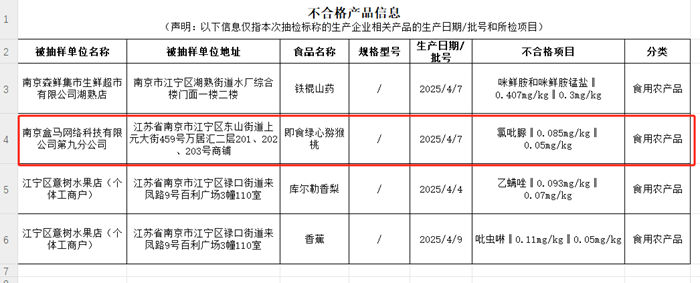
Core Viewpoint - Hema has faced multiple food safety issues recently, including non-compliance in the sale of kiwifruit and eggs, raising concerns in the market [1][3][4]. Group 1: Food Safety Issues - Hema's kiwifruit was found to have a chlorpyrifos residue level of 0.085 mg/kg, exceeding the standard limit of 0.05 mg/kg [1][2]. - A recent inspection revealed that Hema's eggs had exceeded the allowable limits for agricultural and veterinary drug residues, leading to significant public discussion [3]. - Hema has been involved in several food safety incidents this year, including non-compliance with pesticide standards for pears and fish [4]. Group 2: Company Response and Market Impact - Hema has not yet responded to the recent kiwifruit contamination issue, while the egg supplier claimed that the non-compliance was due to operational oversights at a new store [3]. - The company has been criticized for its supply chain management and food safety practices, which were once considered innovative in the retail sector [4]. - Hema's expansion strategy includes opening 72 new stores in 2024, with a focus on second and third-tier cities, indicating a significant growth trajectory despite the ongoing food safety challenges [6]. Group 3: Industry Context - The retail industry is undergoing significant changes, with traditional supermarkets like Yonghui and Wumart adjusting their strategies in response to competitive pressures [6]. - Hema's founder stepped down in March 2024, and the company is accelerating its expansion, which raises questions about maintaining product quality amid rapid growth [6]. - Ensuring food safety is a critical issue not only for Hema but for all food production and retail companies, as consumer trust is paramount [6].
阿里巴巴财年收入逼近万亿创新高 AI相关产品连续七季度三位数上涨
Chang Jiang Shang Bao· 2025-05-19 01:00
Core Insights - Alibaba reported its strongest financial results ever for the fiscal year 2025, with total revenue reaching 996.35 billion yuan, a year-on-year increase of 6% [2][3] - The adjusted EBITA for the fiscal year was 173.07 billion yuan, up 5% year-on-year, while net profit attributable to ordinary shareholders surged by 62.36% to 129.47 billion yuan, marking a historical high [2][3] Financial Performance - For the fourth quarter, Alibaba's revenue was 236.45 billion yuan, reflecting a 7% year-on-year growth, and adjusted EBITA increased by 36% to 32.62 billion yuan [3] - The company achieved a net cash flow from operating activities of 163.51 billion yuan, a decrease of 10% year-on-year, and free cash flow dropped by 53% to 73.87 billion yuan, primarily due to increased cloud infrastructure spending [6] Strategic Initiatives - Alibaba's CEO emphasized the effectiveness of the "user-first, AI-driven" strategy, with core business growth accelerating, particularly in the cloud segment, which saw an 18% revenue increase driven by strong AI demand [2][3] - The company launched the new mixed reasoning model Qwen 3, which outperformed top global models, showcasing its technological competitiveness [3] Business Segments - The Taobao Group reported a profit of 41.75 billion yuan for the fourth quarter, an 8% increase, while the Cloud Intelligence Group's profit surged by 69% to 2.42 billion yuan [4] - The Digital Entertainment Group turned a profit of 36 million yuan, primarily due to Youku's profitability, while other segments like the International Digital Commerce Group and Local Life Group saw reduced losses [4] Shareholder Returns - Alibaba announced a total annual and special dividend of 4.6 billion USD (approximately 33.1 billion yuan) for the fiscal year 2025, an increase from 4 billion USD in the previous fiscal year [7] - The company repurchased 11.97 billion shares for 11.9 billion USD (approximately 86.7 billion yuan), making it one of the largest buyback programs among Chinese concept stocks [7] Market Positioning - Alibaba is actively competing in the instant retail market, launching the "Flash Purchase" service in over 50 cities, with significant order volume growth reported shortly after its launch [5][6] - The company aims to leverage its extensive user base and logistics capabilities to enhance its position in the instant retail sector, focusing on converting Taobao users into instant retail customers [6]


大连友谊分析师会议-20250517
Dong Jian Yan Bao· 2025-05-17 08:01
Group 1: Research Basic Information - The research object is Dalian Youyi, belonging to the commercial and department store industry [17] - The reception time is May 16, 2025, and the reception personnel include the chairman, director, general manager, secretary, financial director, and independent director [17] Group 2: Detailed Research Institutions - The institutions participating in the research are mainly investors and others [20] Group 3: Research Institution Proportion - No specific proportion information is provided in the content Group 4: Main Content Information Cross - border E - commerce Business - In 2024, the revenue of the company's bonded goods retail business was 104.6246 million yuan, accounting for 28.11% of the annual operating income [24] Future Development Plan Retail Industry - **Offline Department Store Format**: Adhere to the business concept of "Good quality, at Youyi", optimize the product structure, promote the transformation of department stores into shopping centers, promote sales through multiple channels, and try to integrate online and offline operations [24][28] - **Online New Retail Business**: Deepen the layout of new retail business, focus on the "retail to C" direction, enrich the business matrix, improve the product cooperation system, optimize the business management mode, and optimize warehousing cooperation [26][29] Real Estate Industry - Focus on the transformation and development of the Dalian Jinshigu project, strengthen communication with relevant management departments, clarify the industrial positioning, and seek external cooperation [26][31] Company Control and Profitability - As of now, the actual controller of the company is Chen Zhixiang [26] - In 2024, the company's operating income was 372.2469 million yuan, a year - on - year increase of 127.90%; the net profit attributable to shareholders of listed companies was a loss of 77.6399 million yuan, and the loss increased by 108.89% year - on - year [26]

大连友谊(000679) - 2024年度业绩说明会投资者活动记录表
2025-05-16 09:08
Group 1: Business Performance - In 2024, the company achieved an operating income of 37,224.69 million yuan, representing a year-on-year increase of 127.90% [3] - The net profit attributable to shareholders was a loss of 7,763.99 million yuan, with a year-on-year increase in loss of 108.89% [3] Group 2: Cross-Border E-commerce - The retail income from bonded goods in 2024 was 10,462.46 million yuan, accounting for 28.11% of the total annual operating income [1] Group 3: Future Growth Strategies - The company plans to enhance revenue and profitability through: - Retail sector: Maintaining stable operations in offline department stores while seizing opportunities in new retail [4] - Online new retail: Deepening the new retail layout and optimizing the product cooperation system [4] - Real estate: Focusing on the transformation of the Dalian Jinshigu project [4]
自营生鲜供应链再亮红灯,盒马百店计划遭遇食安考验
Hua Xia Shi Bao· 2025-05-16 07:21
Core Viewpoint - The rise of new retail combining online and offline shopping has led to increasing concerns about food safety, particularly highlighted by recent food safety inspections revealing non-compliance issues with products sold by Hema, a leading new retail company [1][2]. Group 1: Food Safety Issues - Recent inspections by Shandong Provincial Market Supervision Administration found that Hema's products, specifically eggs and kiwis, did not meet national food safety standards, raising public health concerns [1][2]. - The detected levels of harmful substances in the products exceeded the maximum residue limits set by national standards, with the eggs showing a residue of 13.0μg/kg for甲氧苄啶, above the limit of 10μg/kg, and kiwis showing 0.085mg/kg of氯吡脲, exceeding the limit of 0.05mg/kg [2]. Group 2: Supply Chain Management - Hema's supply chain management has come under scrutiny due to these food safety issues, especially as the company plans to open 100 new fresh stores this year, highlighting the challenge of balancing rapid expansion with effective supply chain oversight [1][6]. - Hema has reportedly ended its partnership with the supplier of the non-compliant eggs due to supply chain capacity issues, indicating a proactive approach to managing supplier relationships and product quality [2][3]. Group 3: Expansion Strategy - Hema has been rapidly expanding its store presence, with plans to open nearly 100 new stores in various cities, leveraging lower commercial real estate rental costs and a strategy that integrates immediate retail with its larger e-commerce ecosystem [6][7]. - The company aims to replicate successful business models in its core operations, focusing on profitability and growth, as evidenced by its reported double-digit growth and profitability over the past year [6][7].
深圳超市兴衰史:把山姆买成全球销冠,却造不出“胖东来”
Hu Xiu· 2025-05-16 03:14
5月初,"人人乐"被退市了。 这家深圳老牌超市已经连续4年亏损,在过去的一年,人人乐超市共关闭门店45家,转让门店15家。 新开的门店,只有1家。 作者供图 相比之下,山姆在深圳的第五家门店即将在今年开业,深圳也成为了全国拥有山姆超市第二多的城市。 更多人不知道的是,早在2008年开始,福田的山姆超市连续15年成为山姆全球单店销售额冠军。 真的是外来的和尚会念经吗?事实上,深圳曾是中国超市的代表。 今年是深圳特区建立45周年,在小圳子看来,深圳零售业最大的遗憾不是捧出了一家外来的山姆销冠,而是这里曾经诞生了一堆本土超市巨头,最终却出 不来一家"胖东来"。 一、深圳超市"三巨头" 深圳,是改革开放的窗口。 这是全国首家仓储式平价超市,在朴素的水泥地和仓库货架中,深圳人第一天就贡献了24万元的营业额,创下深圳零售业最高纪录。 万佳这只"现金牛"的成功,让当时身穿吊带裤的王石,常常亲自去现场视察。而作为万佳的投资人,毕业于中山大学的李彬兰嗅到了商机。 1995年,年仅33岁的李彬兰带着部分万佳员工离职,在拿到中国核电集团的投资后,在宝安开设了自己的第一家超市——"新一佳"。 这种开放式自选购物的方式,让深圳人眼前一 ...