国际油价走势

Search documents
下周成品油价格将迎年内最大涨幅
第一财经· 2026-03-06 14:29
Core Viewpoint - The article discusses the anticipated increase in domestic refined oil prices in China, expected to be the largest increase of the year, driven by rising international crude oil prices and geopolitical tensions in the Middle East [2][5]. Group 1: Price Adjustments - The domestic refined oil price is expected to rise for the fourth time this year, with an estimated increase of approximately 520 yuan per ton, translating to an additional cost of around 27 yuan for filling a 70-liter tank [2][6]. - Since the beginning of the year, domestic oil prices have undergone four adjustments, resulting in increases of 465 yuan per ton for gasoline and 450 yuan per ton for diesel compared to the end of the previous year [6]. Group 2: Supply and Demand Factors - On the supply side, ongoing tensions in the Middle East, particularly the conflict involving Iran, have led to concerns about crude oil supply disruptions, which are expected to support higher oil prices [4][7]. - On the demand side, despite some improvements in economic data, institutions remain cautious about future demand prospects, with expectations that the Federal Reserve's interest rate cuts may not occur until later in the year [4]. Group 3: Geopolitical Impact - The situation in the Middle East, particularly the control of the Strait of Hormuz by Iran, has heightened global concerns over oil supply, contributing to significant increases in international oil prices [5]. - Analysts suggest that if the conflict continues for several months, it could lead to oil prices exceeding 100 dollars per barrel, with some forecasts predicting prices could reach 120 dollars per barrel [5].


A股油气股领跌,洲际油气跌超7%,高盛称油价或突破100美元
21世纪经济报道· 2026-03-06 02:42
Market Overview - International oil prices experienced a decline after a previous surge, with WTI crude oil dropping over 3.4% at one point, and later narrowing the loss to approximately 2%, following a cumulative increase of over 18% in the previous week [1] - ICE Brent crude also saw a decrease of more than 1.5% [1] Futures Market - In the domestic futures market, the main crude oil futures contract fell over 4%, while the shipping index (European line) initially dropped over 8%, with losses narrowing to 3.5% and 6.5% respectively by the time of reporting [2] Stock Market Performance - The A-share oil and gas sector led the decline, with Intercontinental Oil and Gas falling over 7%, and the "Big Three" oil companies each dropping over 3% [3] - In the Hong Kong stock market, the "Big Three" oil companies also experienced declines of over 1%, with Zhongcheng Energy dropping nearly 4% [3] Geopolitical Factors - Ongoing tensions in the Middle East continue to affect investor sentiment, with reports indicating that Iran has not closed the Strait of Hormuz, asserting its right to control passage during wartime [4] - A facility of the Bahrain National Oil Company was reportedly hit by an Iranian missile, causing a fire, but operations at the refinery, which has a crude processing capacity of 267,000 barrels per day, are continuing [5] - Goldman Sachs warned that developments in the coming weeks could significantly influence international oil prices, suggesting that prolonged closure of the Strait of Hormuz could push prices above $100 per barrel [5]





道指新高!“中国金龙” 四连涨
Zhong Guo Zheng Quan Bao· 2026-02-10 23:19
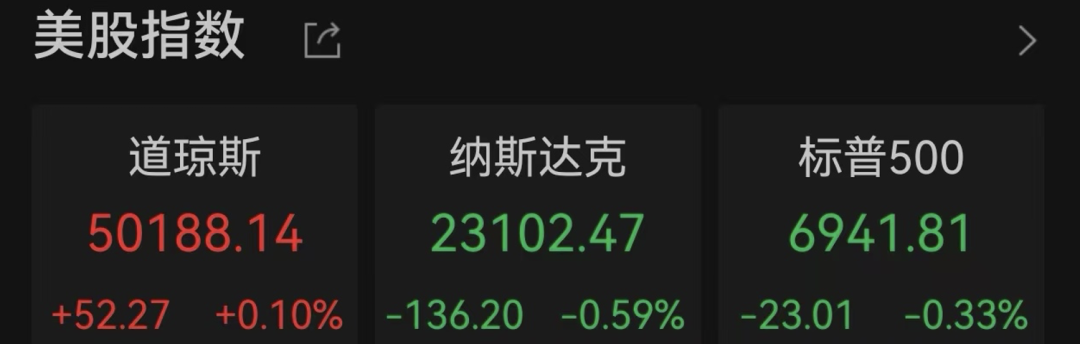
Market Performance - The Dow Jones Industrial Average reached a new all-time high, peaking at 50,512.79 points during the day, closing with a slight gain of 0.1% [2] - The Nasdaq and S&P 500 indices turned negative, with declines of 0.59% and 0.33% respectively [2] - Large-cap tech stocks showed mixed results, with Tesla rising nearly 2%, while major players like Microsoft, Apple, Nvidia, Amazon, and Meta experienced declines [4][5] Chinese Stocks - The Nasdaq Golden Dragon China Index saw a continuous rise for four trading days, increasing by nearly 1% [5] - Notable Chinese stocks such as Shengda Technology and Dingdong Maicai surged over 7%, while Hesai Technology and Zai Ding Pharmaceutical rose over 6% [5][6] Precious Metals - International gold prices fluctuated around $5,000 per ounce, while silver prices hovered near $80 per ounce [8] - As of February 11, gold futures and spot prices fell by 0.6% and 0.71%, respectively, while silver futures and spot prices dropped over 2% and 3% [8] - Analysts suggest that while gold remains at high levels, silver still has relative upside potential, although caution is advised due to high volatility [10] Oil Market - International oil prices experienced slight declines, with NYMEX crude futures and ICE Brent futures reported at $64.19 per barrel and $69.01 per barrel, respectively [8]
ATFX汇市前瞻:美国褐皮书与CPI数据双双来袭 黄金汇市或加剧波动
Xin Lang Cai Jing· 2026-01-12 11:59
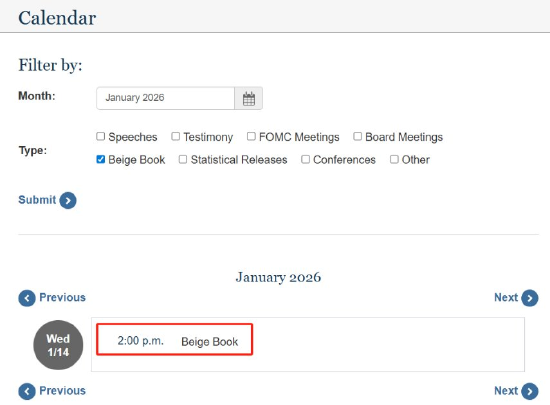
Group 1: Beige Book Insights - The Federal Reserve will release the first Beige Book of 2026 on January 12, which will provide insights into macroeconomic changes across various U.S. regions since the last report on November 26, 2025 [1][10] - The Beige Book is published eight times a year and is based on interviews with business contacts, economists, and market experts, compiled by twelve regional Federal Reserve Banks [2][10] - Observers analyze the wording changes in the Beige Book to gauge the U.S. economy; if the upcoming report indicates an increase in regions reporting economic decline, it may suggest ongoing economic weakness [2][10] Group 2: Labor Market and Inflation Analysis - The Beige Book will include specific analyses of the labor market and inflation; the previous report noted a slight decline in employment and weakened labor demand in about half of the regions, alongside moderate price increases [11] - Changes in the Beige Book's commentary on the labor market and inflation could influence the Federal Reserve's willingness to continue lowering interest rates [11] Group 3: December CPI Data - The U.S. Labor Department will release the December unadjusted CPI year-on-year data on January 9, which is significant as it is the first month unaffected by the government shutdown [3][12] - The previous unadjusted CPI year-on-year was 2.7%, with expectations for December remaining stable; the core CPI year-on-year was previously 2.6%, with a forecast of 2.7% [6][15] - Historical data shows that the CPI had been running high at 2.8% to 3% until November, when it dropped to 2.6%, indicating a trend of weakening inflation [15] Group 4: PPI and Future Inflation Expectations - The PPI data for November will be released on January 10, which serves as a leading indicator for CPI; however, its predictive power is limited as it is released after the CPI data [15] - Current expectations suggest that if inflation remains weak, the Federal Reserve may initiate rate cuts, potentially starting in March with a total of three 25 basis point cuts throughout the year [15] Group 5: Oil Inventory Reports - The EIA will release its monthly short-term energy outlook report on January 10, coinciding with OPEC's monthly oil market report [16][19] - The EIA report is based on U.S. crude oil market supply and demand data, while OPEC's report is based on production data from OPEC+ member countries, providing insights into the international oil price outlook [19] - The situation has become more complex due to U.S. policies forcing Venezuelan oil to be sold exclusively to the U.S., impacting OPEC+ supply statistics and member countries' production decisions [19]
道指深夜下挫460点,白银重挫,油价飘绿
2 1 Shi Ji Jing Ji Bao Dao· 2026-01-08 00:37
Market Performance - The three major U.S. stock indices showed mixed performance, with the S&P 500 and Dow Jones reaching historical highs before retreating, with the Dow Jones dropping 466 points, a decline of nearly 1% [2] - Large tech stocks exhibited varied movements, with Google rising over 2% to surpass Apple in market capitalization, while Facebook fell nearly 2% [2] - Intel experienced a significant increase, rising over 6% and peaking at more than 11% during the trading session [2] Commodity Prices - Spot gold and silver saw substantial declines, with gold down 0.87% and silver down 3.56% in night trading [2] - As of 7:00 AM Beijing time, spot gold slightly increased to $4,459.53 per ounce, while spot silver fluctuated around $78 per ounce [2] - International oil prices experienced a downward trend, with NYMEX WTI crude oil falling over 1% to $56.4 per barrel, and ICE Brent crude dropping more than 0.4% [2] Oil Market News - Reports indicated that Venezuela is set to transfer between 30 million to 50 million barrels of oil to the United States, as stated by Trump [2]




加拿大通胀数据主导汇率走向
Jin Tou Wang· 2025-11-20 03:30
Core Viewpoint - The USD/CAD exchange rate is influenced by the balance between oil price fluctuations and the hawkish stance of the Federal Reserve, with upcoming U.S. CPI and Canadian inflation data expected to dictate the currency's direction [1] Economic Fundamentals - The USD/CAD exchange rate is affected by differences in the economic fundamentals of the U.S. and Canada, diverging monetary policy expectations, and international oil price trends [1] - U.S. core PCE inflation for October was reported at 3.5%, which was lower than expected, while Federal Reserve officials emphasized maintaining high interest rates to combat inflation, pushing back rate cut expectations to 2025, thus supporting the resilience of the USD [1] - The U.S. GDP growth rate for Q3 was 2.9%, providing a solid foundation for the USD [1] - In Canada, as an oil-exporting country, the recent decline in international oil prices below $80 per barrel has led to a narrowing trade surplus, creating pressure on the economy [1] - Canada's October CPI year-on-year was 3.1%, above the central bank's 2% target, but core inflation showed a marginal decline, leading to market expectations for potential rate cuts next year, which could suppress the CAD [1] Technical Analysis - From a technical perspective, the USD/CAD has entered a bullish channel after rebounding from a low of 1.33520, currently trading at 1.4654, with key support levels at 1.4640 and 1.4630 [2] - If the exchange rate breaks below the support level of 1.4620, it may trigger a short-term correction, while resistance levels are concentrated around 1.4660, 1.4680, and the upper boundary of the previous trading range at 1.4700 [2] - Technical indicators suggest a gradual emergence of an upward trend, with MACD showing a slight increase in bullish momentum and the average directional index rising to around 23, indicating a likely range-bound movement between 1.4630 and 1.4670 in the short term [2] - If the price stabilizes above 1.4680, the target could shift towards 1.4700-1.4720; conversely, a drop below 1.4630 could extend the downside to 1.4625-1.4610 [2]
“双节”期间,成品油价维持低位
2 1 Shi Ji Jing Ji Bao Dao· 2025-09-23 12:17
Core Viewpoint - Domestic retail prices for refined oil have remained unchanged for the sixth time this year, with the current pricing cycle expected to last until after the National Day and Mid-Autumn Festival holidays, indicating stable fuel costs for residents and logistics in the near term [1][2]. Group 1: Price Adjustments - In 2023, domestic refined oil retail prices have undergone 19 adjustment cycles, including 6 increases, 6 instances of price stability, and 7 decreases. The prices for gasoline and diesel have decreased by 405 yuan/ton and 390 yuan/ton, respectively, compared to the end of last year [1]. - The next price adjustment window is set for October 13, 2023, with significant uncertainty due to the adjustment period overlapping with the holidays [3]. Group 2: Market Analysis - Analysts note that the international oil price experienced fluctuations, initially rising and then falling, with limited support from market news. The market is currently characterized by flexible transaction activities and limited price volatility among major suppliers [2]. - Future oil price trends are expected to be influenced by oil inventory data, with a potential downward pressure from inventory accumulation. However, factors such as the Federal Reserve's interest rate cuts and geopolitical disturbances in Europe may provide some support for oil prices [2]. - The anticipated resumption of oil exports from Iraq's Kurdish region raises concerns about oversupply, compounded by a bleak global economic outlook and demand prospects, making it unlikely for international oil prices to exhibit a strong upward trend in the short term [2].
油价,大跌!
Sou Hu Cai Jing· 2025-09-04 08:55
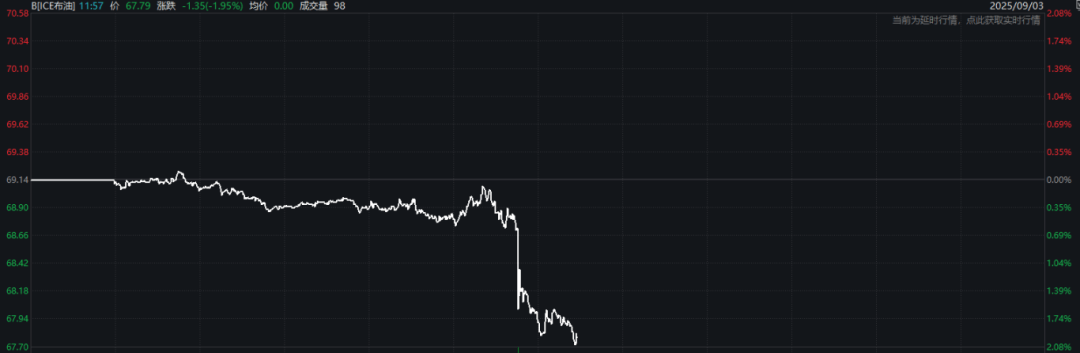
Core Viewpoint - International oil prices experienced a significant drop, with Brent crude oil falling nearly 2% and WTI crude oil declining over 2% during trading on September 3 [1][3]. Group 1: Oil Price Trends - Brent crude oil prices dropped nearly 2%, with intraday declines exceeding 2% [1]. - WTI crude oil saw a decline of over 2%, with intraday highs approaching a 2.4% drop [3]. Group 2: Future Oil Demand and Price Predictions - OPEC's July forecast indicated that global daily oil demand is expected to increase by 1.28 million barrels in 2026 compared to 2025, driven by improved economic growth expectations in certain regions, including the OECD, the Middle East, and Africa [5]. - Goldman Sachs predicts that due to an anticipated oversupply of oil next year, Brent crude futures prices could fall to the low $50 range by the end of 2026 [5]. - The forecast suggests that while oil prices may remain near current forward contract levels in 2025, this balance is expected to break in 2026, with Brent oil's "fair value" decreasing from the current $70 range to the $50 range, particularly as inventories continue to accumulate [5].
国际油价下行,“三桶油”上半年日子不好过,仍豪气分红825亿元
Hua Xia Shi Bao· 2025-08-30 13:18
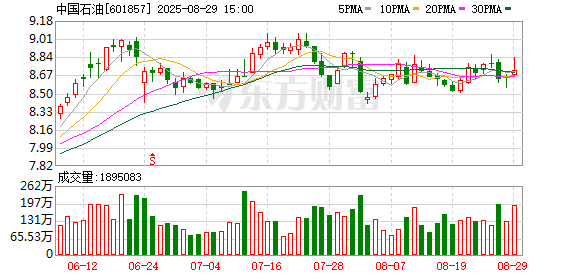
Core Viewpoint - The "Big Three" oil companies in China, namely China National Petroleum Corporation (CNPC), China Petroleum & Chemical Corporation (Sinopec), and China National Offshore Oil Corporation (CNOOC), reported a decline in revenue and net profit for the first half of 2025 due to falling international oil prices, despite continuing to distribute substantial dividends [2][4][8]. Financial Performance - In the first half of 2025, the combined revenue of CNPC, Sinopec, and CNOOC reached approximately 3.07 trillion yuan, with a net profit of 175.01 billion yuan, representing a decrease of over 29 billion yuan compared to the same period last year [2][4]. - CNPC, Sinopec, and CNOOC reported revenues of 1.45 trillion yuan, 1.41 trillion yuan, and 207.61 billion yuan respectively, with year-on-year declines of 6.74%, 10.60%, and 8.45% [4]. - Corresponding net profits for the three companies were 839.93 billion yuan, 214.83 billion yuan, and 695.33 billion yuan, reflecting year-on-year decreases of 5.42%, 39.83%, and 12.79% [4]. Oil Price Impact - The average Brent crude oil price for the first half of 2025 was 71.87 USD/barrel, down 14.5% from 84.06 USD/barrel in the previous year, while the average price for West Texas Intermediate (WTI) was 67.60 USD/barrel, down 14.4% from 78.95 USD/barrel [4]. - The average selling prices of crude oil for CNPC, Sinopec, and CNOOC were 66.21 USD/barrel, 67 USD/barrel, and 69.15 USD/barrel, showing declines of 14.5%, 12.9%, and 13.9% respectively [5]. Natural Gas Performance - CNPC's natural gas segment saw a volume increase of 2.9% year-on-year, with sales reaching 151.5 billion cubic meters and operating profit rising to 18.6 billion yuan [6]. - CNOOC's natural gas revenue grew by over 16% to 27.75 billion yuan, driven by the full production of the "Deep Sea No. 1" project [6]. Dividend Distribution - Despite the decline in performance, the "Big Three" maintained a high dividend payout strategy, distributing a total of over 82.5 billion yuan, although this was a reduction of approximately 7.7 billion yuan compared to the previous year [2][8]. Future Outlook - Analysts predict that the average international oil price for 2025 will hover around 70 USD/barrel, with potential upward risks to 90 USD/barrel and downward risks to 45 USD/barrel [3][9]. - The outlook for oil prices remains cautious, with expectations of increased downward pressure due to geopolitical factors and seasonal demand fluctuations [8][10].

乌军袭击俄境内输油泵站,俄向欧洲输油管道输油中断,欧洲能源可能受其影响
Sou Hu Cai Jing· 2025-08-19 07:35
Core Points - Ukrainian military conducted a drone attack on an oil pumping station in Russia, disrupting the "Friendship" oil pipeline, a crucial route for oil supply to Europe [1][3] - The operation indicates a shift in tactics, showcasing Ukraine's capability to strike deep within Russian territory [3] - The interruption of oil supply may lead to uncertainty in international oil prices and impact energy supply in Europe, potentially increasing pressure on local populations [3] Summary by Categories Military Actions - Ukrainian forces executed a drone strike on an oil pumping station in Russia, halting operations that supply the "Friendship" pipeline [1] - This action reflects a proactive military strategy by Ukraine, demonstrating their ability to target critical infrastructure within Russia [3] Energy Impact - The disruption of the "Friendship" pipeline could have significant implications for energy transportation, affecting oil supply to Europe [1][3] - There is potential for increased volatility in international oil prices due to the interruption, which may strain energy resources in Europe [3]