类滞胀交易

Search documents
全球资产短期类滞胀交易特征的宏观线索
GF SECURITIES· 2026-03-20 08:04
Group 1: Macroeconomic Context - The escalation of the Middle East situation and overlapping hawkish FOMC policies have led to a "stagflation-like" trading environment globally, characterized by rising oil prices, elevated U.S. Treasury yields, a stronger dollar, and a decline in gold prices[3] - Historical stagflation periods occurred in 1973-1974, 1979-1980, and 2021-2022, all marked by significant oil price increases exceeding 100% due to wars or conflicts, alongside prior monetary easing and high inflation[4] - In the current context, the U.S. economy is experiencing a K-shaped recovery, with advanced manufacturing and AI sectors thriving while traditional manufacturing stagnates, indicating a structural stagflation rather than a broad-based one[9] Group 2: Asset Performance and Predictions - In the initial phase of stagflation trading, assets sensitive to supply and demand, such as upstream commodities and energy stocks, are expected to outperform, while long-duration equities and emerging market indices may underperform[9] - The second phase will see a shift towards defensive assets like bonds and gold as inflation pressures begin to squeeze corporate profits, leading to a broad adjustment in risk assets[10] - The third phase will focus on the sustainability of inflation, with potential for a return to growth and inflation dynamics, impacting asset classes differently based on commodity price movements and supply-demand dynamics[12] - Historical asset performance during stagflation shows that U.S. Treasury yields lagged behind inflation, leading to negative real rates and a depreciation of the dollar, which supported gold and commodity price increases[13]
【广发宏观陈礼清】全球资产短期类滞胀交易特征的宏观线索
郭磊宏观茶座· 2026-03-20 07:51
Core Viewpoint - The article discusses the current global market dynamics characterized by a "quasi-stagflation" trading environment due to escalating geopolitical tensions in the Middle East and a hawkish stance from the FOMC, leading to rising oil prices, higher U.S. Treasury yields, a stronger dollar, and a decline in gold prices [1][6]. Group 1: Historical Context of Stagflation - Historical stagflation periods occurred during 1973-1974, 1979-1980, and 2021-2022, marked by wars or conflicts that drove oil prices significantly higher, with inflation preceding economic downturns [2][8]. - In these periods, oil prices saw substantial increases: from $2.48 to $11.58 per barrel (367% increase) in 1973-1974, from $14.02 to $36.83 (163% increase) in 1979-1980, and from $41.84 to $101.32 (142% increase) in 2021-2022 [11][19][23]. Group 2: Asset Impact Analysis - The quasi-stagflation trading process has three phases: 1. In the first phase, inflation expectations rise, favoring assets sensitive to supply and demand, such as commodities and energy stocks, while long-duration equities and emerging market indices underperform [26][27]. 2. The second phase sees a shift to defensive assets as inflation pressures corporate profits, leading to broad adjustments in risk assets [26][30]. 3. In the third phase, the market seeks new growth narratives, with asset performance depending on the extent of commodity price corrections and supply-demand dynamics [29][30]. Group 3: Current Market Characteristics - The current asset landscape is more complex, with U.S. Treasury yields rising rapidly in response to geopolitical tensions, reflecting a "growth" phase, while the stock market remains in a "quasi-stagflation" phase, which may alleviate valuation pressures on tech stocks [36][39]. - China's asset market is influenced by its low inflation baseline, which is expected to support corporate profitability and investment activity, with significant improvements in fixed asset investment and infrastructure spending [39].


金价爆了!紧急提示
Zhong Guo Ji Jin Bao· 2025-04-21 07:08
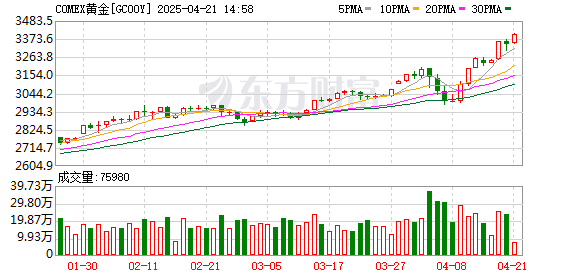
Core Viewpoint - Gold prices have surged, with COMEX gold futures breaking the $3400 per ounce mark, reaching a new historical high, driven by various market factors including inflation, growth, tariffs, and geopolitical tensions [2][3]. Group 1: Gold Price Movements - As of April 21, COMEX gold prices increased by 2.17%, surpassing $3400 per ounce, marking a new historical high [2]. - London spot gold prices also rose significantly by 1.9%, exceeding $3390 per ounce [3]. - Asian buying activity has notably increased, with significant purchases from official institutions contributing to the price surge [4]. Group 2: Market Influences - The decline of the US dollar index below 99 has provided support for rising gold prices, influenced by fluctuating US tariff policies [3]. - A report from CITIC Securities indicates that the recent highs in gold prices are primarily due to panic trading triggered by overseas market recession fears and changing US tariff policies [3]. - Goldman Sachs has raised its year-end gold price target to $3700 per ounce, citing strong demand from Asian buyers [4]. Group 3: Future Price Predictions - Goldman Sachs has adjusted its 2025 gold price forecast from $3100 to $3300 per ounce, with a potential range of $3250 to $3520 per ounce [4]. - Bank of America predicts gold prices for 2025 and 2026 to be $3063 and $3350 per ounce, respectively, up from previous estimates [5]. - UBS's Chief Investment Officer suggests that gold remains a viable hedge against trade uncertainties, with a baseline prediction of $3500 per ounce for this year [5].
避险资金涌入,国内期货市场买爆了
证券时报· 2025-04-01 03:57
Core Viewpoint - The global financial market is experiencing a classic risk-averse trend, with significant capital flowing into traditional safe-haven assets like gold, yen, and U.S. Treasuries, indicating heightened market uncertainty [1][4]. Group 1: Gold Market Performance - On March 31, gold futures on the New York Mercantile Exchange reached a record high of $3162 per ounce, while London spot gold peaked at $3128 per ounce, marking an over 18% increase in gold prices this year, outperforming major global stock indices [1][4]. - Domestic gold futures saw a significant inflow of over 1.1 billion yuan, with the main contract reaching a high of 732.10 yuan per gram [3][4]. - The gold market is one of the few sectors experiencing net capital inflows, contrasting with the outflows seen in the non-ferrous metals sector, particularly copper, which faced over 900 million yuan in withdrawals [4]. Group 2: Market Sentiment and Future Outlook - Analysts suggest that the likelihood of a significant pullback in gold prices during the second quarter remains low due to persistent risk-averse sentiment and ongoing geopolitical tensions [2][6]. - The recent surge in gold prices is attributed to fears of recession and tariff-related anxieties, with expectations of continued inflation and geopolitical uncertainties supporting gold's performance [6]. - Global gold ETFs have seen net inflows exceeding $19 billion (approximately 207 tons) this year, marking the strongest first quarter since 2022, with significant contributions from the Indian market [6]. Group 3: Investment Trends and Projections - The U.S. Commodity Futures Trading Commission (CFTC) reported a mixed trend in gold fund net long positions, indicating that the overall trading volume and enthusiasm in the gold market have not yet reached historically crowded levels, suggesting room for further capital inflow [8]. - Major banks have revised their gold price forecasts upward, with Goldman Sachs predicting a year-end price of $3300 per ounce, up from a previous estimate of $3100 [8].
全球屏息!避险资金涌入,国内期货市场买爆了
券商中国· 2025-03-31 23:40
Core Viewpoint - The article discusses the significant influx of funds into the gold market as a safe haven due to the impending implementation of reciprocal tariffs by the U.S. on April 2, which has heightened global market risk aversion [1][4]. Group 1: Market Reactions - On March 31, the global financial market experienced a classic risk-averse trend, with substantial funds flowing into traditional safe-haven assets like gold, yen, and U.S. Treasuries [2][4]. - The price of gold futures on the New York Mercantile Exchange (COMEX) reached a historic high of $3162 per ounce, while the London spot gold price hit $3128 per ounce, marking an over 18% increase in gold prices this year, significantly outperforming major global stock indices [4][6]. - In the domestic market, gold futures saw a peak of 732.10 yuan per gram, with the spot gold T+D closing at 730.60 yuan per gram [4]. Group 2: Fund Inflows and ETF Performance - Over 11 billion yuan flowed into the domestic gold futures market on March 31, while the copper sector experienced a net outflow of over 900 million yuan, indicating a strong preference for gold among investors [4][6]. - Global gold ETFs saw net inflows exceeding $19 billion (approximately 207 tons) in the first quarter of 2025, marking it as the strongest first quarter since 2022 [7]. - The domestic market's 14 gold ETF products are nearing a total scale of 100 billion yuan, with the Huaxia Gold ETF (518850) reaching a net asset value of over 7.007 yuan, becoming the first in its category to surpass this threshold [7]. Group 3: Future Outlook for Gold - Despite a 3-month price increase of over 18%, the likelihood of a price correction in gold remains low due to ongoing international uncertainties, including inflation, growth, tariffs, and geopolitical factors [6][8]. - Analysts from CITIC Securities suggest that the current gold market dynamics are driven by recession fears and tariff anxieties, indicating that the bullish trend for gold is likely to continue into the second quarter and beyond [6][8]. - The U.S. Commodity Futures Trading Commission (CFTC) reported a decrease in speculative net long positions in gold, suggesting that the overall trading volume and enthusiasm in the gold market have not yet reached historically crowded levels, allowing for further accumulation [9].
国际金价站上3100美元关口,贵金属板块逆市领涨,后市还能涨多久?
Di Yi Cai Jing· 2025-03-31 03:08
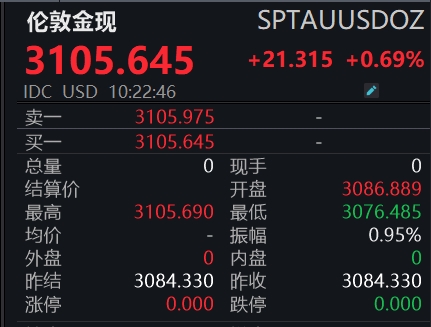
Group 1 - Precious metals sector leads the market with significant gains, including a rise of over 7% for Western Gold, and increases for Chifeng Jilong Gold Mining, Shandong Gold International, and Sichuan Gold [1][3] - On March 31, the international spot gold price reached a new historical high, surpassing $3100 per ounce, closing at $3105.645, marking an increase of $21.315 or 0.69% from the previous day [2][5] Group 2 - Multiple institutions have raised their gold price targets, with Goldman Sachs increasing its forecast for gold prices by the end of 2025 from $3100 to $3300, citing unexpected demand from central banks and steady inflows into gold ETFs [5] - Goldman Sachs anticipates that major Asian central banks may continue to rapidly purchase gold over the next 3 to 6 years, with countries like China potentially increasing their gold reserve ratios from the current 8% to between 20% and 30% [5] - Citic Securities notes that the recent surge in gold prices is primarily driven by recession fears and tariff-related anxieties in overseas markets, suggesting that the current gold market conditions are unlikely to end soon [5][6]


今日投资参考:国际金价持续攀升 大行注资靴子落地
Zheng Quan Shi Bao Wang· 2025-03-31 01:58
Market Overview - Major stock indices in China experienced a downward trend, with the Shanghai Composite Index closing down 0.67% at 3351.31 points and the Shenzhen Component Index down 0.57% at 10607.33 points [1] - The total trading volume in the Shanghai, Shenzhen, and Beijing markets was 11,452 billion yuan, a decrease of over 700 billion yuan compared to the previous day [1] - Sectors such as chemical fiber, chemicals, oil, coal, food and beverage, and liquor saw declines, while media and brokerage sectors rose [1] Banking Sector - Four major banks, including China Construction Bank and Bank of China, announced plans to raise a total of 5,200 billion yuan through A-share issuance to supplement core tier one capital [9] - The Ministry of Finance will subscribe to the new shares of China Construction Bank and Bank of China in cash, reflecting strong support for the stability and health of large banks [2][9] Semiconductor Industry - The SEMICON China event showcased over 1,400 exhibitors, indicating a robust growth trajectory for the domestic semiconductor industry [3] - The global semiconductor market is projected to grow by 19% in 2024, reaching 628 billion dollars, with expectations of over 10% growth in 2025 [3] Gold Market - International gold prices reached a new historical high, with spot gold closing at 3,084.33 dollars per ounce [4] - The rise in gold prices is attributed to increased market risk aversion and ongoing geopolitical tensions, with expectations for continued strong performance in the gold market [4] Rare Metals Supply - Recent earthquakes in Myanmar may impact the supply of antimony, tin, and rare earth elements, potentially leading to price increases in these commodities [5] - The earthquake is expected to disrupt mining and transportation in the Shan State, affecting global supply chains [5] Agricultural Development - The Chinese government aims to establish high-standard farmland, targeting 1.35 billion mu by 2030, with a focus on improving irrigation and agricultural infrastructure [6][8] - The initiative emphasizes comprehensive management of agricultural resources to enhance resilience against climate challenges [6][8] Pension Finance Reform - The National Financial Regulatory Administration has issued a plan to promote high-quality development in commercial pension finance, encouraging the creation of new insurance products that combine risk protection and wealth management [7] - The plan includes expanding pilot programs for pension financial products and establishing mechanisms for the transfer of these products [7] Technology Demand Surge - The launch of DeepSeek has led to a surge in demand for GPUs in China, with major tech companies like Tencent and Alibaba placing large orders for H20 servers [11] - The increased demand for computing power is driving significant sales for NVIDIA's specially supplied GPUs in the Chinese market [11]



A股三大指数低开,智谱AI板块跌幅居前
Feng Huang Wang Cai Jing· 2025-03-31 01:38
Core Viewpoint - The A-share market is experiencing a weak trend due to structural market issues, liquidity decline, and seasonal effects, with expectations of limited upward movement and potential for downward risks [2] Group 1: Market Overview - The A-share market opened with the Shanghai Composite Index down 0.24%, the Shenzhen Component Index down 0.45%, and the ChiNext Index down 0.49%, with sectors like media, photolithography, and AI facing significant declines [1] - The market is currently in a consolidation phase, with the potential for volatility to increase in April, particularly in the first half of the month [5] Group 2: Institutional Insights - CITIC Securities notes that the recent rise in gold prices is driven by recession fears and tariff-related anxieties, indicating that the gold market may not be finished yet, with further room for investment [3] - Huatai Securities maintains that the market is in a consolidation period ahead of the impacts of tariffs and earnings reports, emphasizing the need to focus on large-cap stocks and sectors with resilient performance [4] - Huazhang Securities highlights three main investment themes: stable value sectors like banks and insurance, consumer sectors supported by policy, and metals with favorable market conditions [5] Group 3: Sector Focus - Key sectors to watch include banking, automotive, home appliances, small metals, and public utilities, with a focus on structural opportunities in technology and cyclical sectors [2] - The consumer sector, particularly automotive and home appliances, is expected to benefit from policy support, while the pharmaceutical sector may see a phase of valuation recovery [5]




海外研究|黄金价格创新高,但行情可能仍未结束
中信证券研究· 2025-03-31 00:06
Core Viewpoint - Recent gold prices have reached new highs, driven by recession fears and tariff-related trading, indicating that the current gold market may not be over yet [1][2]. Group 1: Economic Factors - The recent surge in gold prices is attributed to recession trading and tariff-related fears, with inflation, growth, tariffs, and geopolitical factors playing significant roles [2]. - The "stagflation" trading environment is expected to persist from Q2 to mid-year, benefiting gold prices, while the potential for U.S. inflation to decrease could signal a shift in the relationship between the dollar and gold [2]. - Current market expectations for U.S. GDP growth in 2025 are 2.1%, 1.9%, 1.9%, and 2.0% for each quarter, indicating a cautious outlook on economic recovery [2]. Group 2: Tariff Impacts - The market is currently pricing in potential tariffs from the Trump administration, with concerns that these tariffs may not fully reflect in asset prices, leading to possible short-term corrections in gold prices [3]. - The uncertainty surrounding U.S.-China trade negotiations and the implementation of tariffs suggests that the impact on gold prices is ongoing and not yet resolved [3]. Group 3: Geopolitical Conflicts - The ongoing Russia-Ukraine conflict remains a source of uncertainty, with recent negotiations facing significant challenges, which could continue to influence gold prices [4]. - Other geopolitical tensions, such as conflicts in the Middle East, may also contribute to fluctuations in gold prices [4]. Group 4: Market Sentiment and Investment Trends - Gold's current trading volume and market enthusiasm have not reached historical "crowded" levels, indicating that there is still room for further investment in gold [5]. - Despite high levels of bullish positions in gold, concerns about potential price corrections exist, but the overall trading activity remains above average [5].