
美元信用下行

Search documents
资金坚定布局,黄金股票ETF基金(159322)连续4天净流入
Xin Lang Cai Jing· 2026-01-30 05:09
Group 1 - The core viewpoint of the articles highlights the performance of the gold industry stocks, with the China Securities Hong Kong Gold Industry Stock Index showing mixed results, led by Hunan Gold's increase of 9.99% and a significant inflow into gold ETFs [1][2] - The gold stock ETF fund has reached a new high in scale at 399 million yuan, with a notable net inflow of 240 million yuan over the past four days, averaging nearly 60 million yuan per day [1] - UBS maintains a bullish stance on gold, raising its price targets for March, June, and September 2026 to $6,200 per ounce, up from the previous target of $5,000 per ounce [1] Group 2 - The China Securities Hong Kong Gold Industry Stock Index consists of 50 large-cap companies involved in gold mining, refining, and sales, with the top ten stocks accounting for 63.58% of the index [2] - The top ten weighted stocks in the index include Zijin Mining, Shandong Gold, and China National Gold, indicating a concentration in a few key players within the gold industry [2]
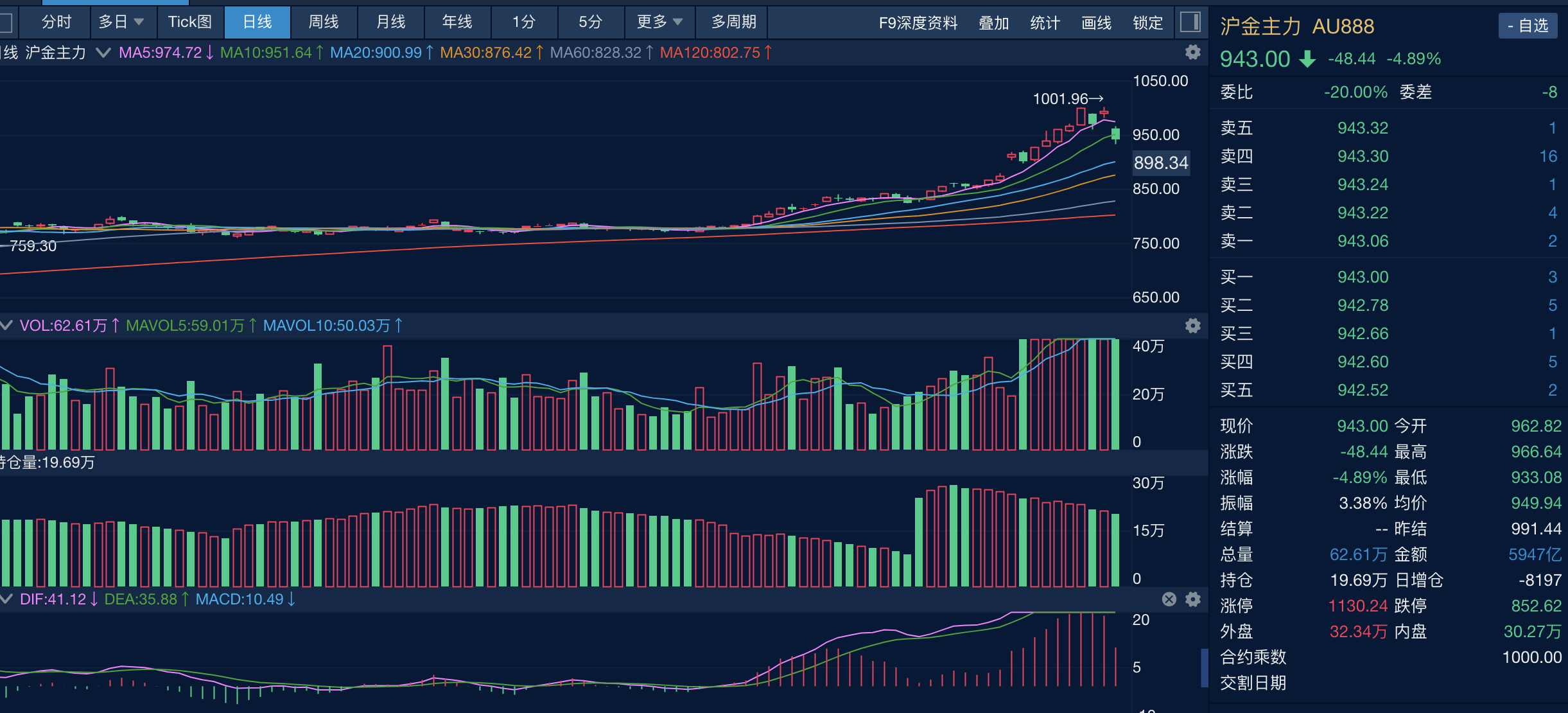
金银向上突破后去向何方?
Zhong Xin Qi Huo· 2026-01-27 02:06
Report Summary 1. Industry Investment Rating - Not provided in the report 2. Core View - The long - term upward trend of gold and silver prices is expected to continue, and the target range for this year is raised. The upper limit of spot gold is expected to be 5900 - 6000 US dollars per ounce, and the upper limit of spot silver is expected to be 120 - 150 US dollars per ounce. However, the risk of overheating in the short - term market continues to increase, and investors need to pay attention to the rhythm and holding position risks [8][11] 3. Summary by Related Contents Price Movement - On January 26th, the prices of gold and silver rose sharply. The Shanghai Gold Index rose by 3.67% and the Shanghai Silver Index rose by 12.78%. The spot price of gold in London broke through $5,100 per ounce, and the spot price of silver in London approached $110 per ounce [3][4] Commentary and Outlook - **Geopolitical Factors**: In January, the US had frequent conflicts with South America, Europe, and Iran. Geopolitical risks led to a credit crisis in the US dollar, which was an important upward driver for precious metals. Disputes over Greenland between the US and Europe and the tense situation in Iran repeatedly disturbed the market, and the risk - aversion sentiment provided direct impetus for precious metals. The poor performance of US stocks, bonds, and currencies in January further supported the long - term upward trend of precious metals [6][9] - **Federal Reserve Factors**: The chairperson of the Federal Reserve was undecided, and the independence risk exceeded the impact of delaying the interest rate cut. The recently disclosed economic data in the US maintained overall resilience, and the Fed's attendance for the interest rate cut this year was postponed to June. However, the precious metals market responded minimally to the delay of the interest rate cut expectation. Reid became the candidate with the highest winning probability, and his dovish remarks injected a strong stimulant into the future interest rate cut space [7][10] - **Market Risk and Target Range**: The risk of overheating in the short - term market continues to increase. The volatility of silver prices has remained at a historical high, and gold prices have risen. The conclusion of the 232 investigation on key minerals eliminated the short - term tariff risk for silver, and the return of inventory led to a decline in the London silver lease interest rate. If geopolitical issues ease temporarily or the Federal Reserve makes an unexpected hawkish statement, it may increase the risk of short - term market adjustment. Based on multiple factors, the target range for gold and silver this year is raised [8][11]
突破整数关口后,金银去向何方?
Zhong Xin Qi Huo· 2026-01-26 08:51
Group 1: Report's Investment Rating for the Industry - No relevant content provided Group 2: Core Viewpoints of the Report - On January 26, gold and silver prices rose significantly, with Shanghai gold up 3.67% and Shanghai silver up 12.78%. London gold exceeded $5100/oz and London silver approached $110/oz. Geopolitical risks and the implied US dollar credit crisis are the driving factors [4]. - The uncertainty of the Fed chair nomination and independence risk are more important than the delayed rate - cut expectation. The market focuses on the Fed's independence as a new chair nomination nears [5]. - Short - term over - heating risk of gold and silver is increasing, and investors should pay attention to trading rhythm. The long - term upward trend is expected to continue, and the annual target range is raised [6]. Group 3: Summary by Related Content 1. Price Movement and Driving Factors - On January 26, gold and silver prices soared. Geopolitical conflicts in January, such as those between the US and South America, Europe, and Iran, led to a US dollar credit crisis, driving up precious metals. The US's actions around Greenland also affected the market [4]. 2. Fed - Related Factors - US economic data is resilient, and the expected Fed rate - cut is postponed to June. But the market focuses on the Fed's independence risk as a new chair nomination nears. Reed is the most likely nominee and his dovish remarks support long - term rate - cut expectations [5]. 3. Market Outlook and Target Range - Short - term over - heating risk of gold and silver is rising. If geopolitical issues ease or the Fed makes unexpectedly hawkish statements, short - term market adjustments may occur. The annual target range for spot gold is raised to $5900 - 6000/oz, and for spot silver to $120 - 150/oz [6]
金价持续火热 涉矿类上市公司业绩大幅预喜
Zhong Guo Zheng Quan Bao· 2026-01-13 22:04
Group 1: Company Performance Forecasts - Chifeng Jilong Gold Mining Co. expects a net profit attributable to shareholders of 3 billion to 3.2 billion yuan for 2025, representing a year-on-year increase of 70% to 81% [1] - Zijin Mining Group anticipates a net profit attributable to shareholders of 51 billion to 52 billion yuan for 2025, reflecting a year-on-year growth of 59% to 62% [2] - Both companies attribute their profit growth to increased production and rising prices of gold and other minerals [1][2] Group 2: Gold Price Outlook - Major institutions remain bullish on gold prices, with Goldman Sachs predicting prices will reach approximately $4,900 per ounce by the end of 2026 [3] - JPMorgan forecasts that gold prices could rise to $5,055 per ounce in Q4 2026, potentially reaching $6,000 per ounce [3] - ICBC Credit Suisse highlights that gold will benefit from global multipolarity and a reshaping of credit structures, which will enhance gold's role in foreign exchange reserves [3] Group 3: Central Bank Gold Purchases - In November 2025, global central banks net purchased 45 tons of gold, maintaining a high level of demand despite a slight decrease from October [4] - From the beginning of 2025 to the end of November, central banks reported a cumulative net purchase of 297 tons of gold [4] - The World Gold Council indicates that while the growth rate of net purchases has slowed compared to previous years, the overall demand for gold from central banks remains robust [4]


黄金白银2026年能冲到多高?机构研判:牛市格局,涨幅或收敛
Xin Lang Cai Jing· 2025-12-27 06:39
Core Viewpoint - The gold and silver markets are experiencing a significant resurgence, with gold surpassing $4500 per ounce and silver exceeding $79.3 per ounce, both reaching historical highs as uncertainties dissipate [1]. Group 1: Market Performance - Gold has seen a year-to-date increase of 72.69%, approaching the second-highest historical record from 1974, while silver's annual increase stands at 173.99%, significantly surpassing the 83.61% rise in 2010 [1][2]. - The silver market is expected to set a historical record for annual growth in 2025, with a market dynamic characterized by gold leading and silver experiencing explosive growth [2]. Group 2: Factors Influencing Market Trends - Investment demand has overtaken central bank gold purchases as the primary driver of the market, alongside structural squeezes in the silver market due to global inventory issues and strong industrial demand [2]. - A decline of approximately 10% in the US dollar index, coupled with the Federal Reserve's resumption of rate cuts and technical balance sheet expansion, has contributed to the bullish sentiment in precious metals [2]. Group 3: Future Outlook - Analysts generally expect the strong performance of gold and silver to continue, although they anticipate that the rate of increase will not match the extraordinary levels seen in 2025 [5]. - The macroeconomic environment for 2026 is viewed as optimistic, with expectations of continued Federal Reserve rate cuts and a global liquidity environment remaining loose, which may influence the performance of risk assets and the appeal of gold as a safe haven [5][6]. Group 4: Strategic Positioning - The global precious metals market is deemed suitable for strategic allocation, with gold recommended as a core defensive asset supported by central bank purchases and ETF inflows, while silver is suggested for high-elasticity allocation during phases of capital inflow [6]. - Analysts have identified potential risks for silver, including rapid capital withdrawal from ETFs, the return of US silver stocks to London, and the lack of inclusion of silver in global central bank balance sheets, which may affect its status as a defensive reserve asset [6].


美国就业市场疲软,贵?属跌幅收窄
Zhong Xin Qi Huo· 2025-11-19 01:33
1. Report Industry Investment Rating - No relevant content provided. 2. Core Viewpoints of the Report - On Tuesday, precious metal prices rebounded slightly after a decline, with the adjustment range narrowing. The high levels of initial and continuing jobless claims in the US, along with the government's long - term shutdown, increased the downward risk in the labor market. US stocks remained weak, and US bonds strengthened slightly. Gold and silver may fluctuate in the short term, and the long - term bullish trend of precious metals remains. The core drivers of the decline in the US dollar's credit, such as excessive debt issuance and de - globalization, have not reversed. Gold is the preferred asset to hedge against the risk of the US dollar's credit, and silver will benefit from spill - over effects. In 2026, the global economy may shift from a soft landing to a mild recovery, which is conducive to the release of silver's long - term elasticity [1][3]. 3. Summary by Relevant Catalogs 3.1 Key Information - As of the week ending October 18, the number of initial jobless claims was 232,000, and the number of continuing jobless claims was 1,957,000, an increase from the previous week. The data for several weeks were either revised or not released due to the government shutdown [2]. - According to the Cleveland Fed, the number of large - scale layoff notices issued by US enterprises in October reached one of the highest levels in history, with about 39,006 people receiving advance notice [2]. - The ADP weekly employment report showed that in the four weeks ending November 1, private - sector employers in the US reduced an average of 2,500 jobs per week [2]. 3.2 Price Logic - In the short term, due to high jobless claims and the government shutdown, precious metals may fluctuate. In the long term, the bullish trend of precious metals remains. Gold is a hedge against the US dollar's credit risk, and silver will benefit from spill - over effects and the global economic recovery. The expected range for spot London gold this week is [3,800, 4,200] US dollars per ounce, and for spot London silver is [46, 53] US dollars per ounce [3]. 3.3 Commodity Index - On November 18, 2025, the comprehensive index was 2,234.87, down 0.86%; the commodity 20 index was 2,534.70, down 0.83%; the industrial products index was 2,208.90, down 0.88% [43]. 3.4 Precious Metals Index - On November 18, 2025, the precious metals index was 3,263.58, with a daily decline of 1.39%, a decline of 2.97% in the past 5 days, a decline of 5.62% in the past month, and an increase of 47.51% since the beginning of the year [45].
12?降息概率延续?低,贵?属调整
Zhong Xin Qi Huo· 2025-11-18 01:50
Report Summary 1. Report Industry Investment Rating No relevant information provided. 2. Core Viewpoints - In the short term, the precious metals market is expected to enter a price regression phase after over - anticipation. The price adjustment with reduced volatility will continue, and attention should be paid to the release of US GDP and non - farm payroll data this week [1][3]. - In the long term, the bullish trend of precious metals remains. Debt over - issuance and de - globalization, as the core drivers of the decline in the US dollar's credit, have not reversed. Gold is the preferred asset to hedge against the risk of the US dollar's credit, and silver benefits from the spill - over effect. In 2026, the global economy may shift from a soft landing to a mild recovery, which is conducive to the release of silver's long - term elasticity [3]. 3. Summary by Related Catalogs 3.1 Key Information - The US government has ended the "shutdown", and states are restarting the distribution of "Supplemental Nutrition Assistance Program" (SNAP) relief funds. However, the "big and beautiful" tax and expenditure bill has tightened the SNAP system, and about 300,000 people in the US are expected to lose SNAP eligibility [2]. - According to the minutes of the Japanese Economic and Fiscal Policy Meeting, Bank of Japan Governor Kazuo Ueda said that the Bank of Japan is pursuing an interest rate level that ensures a smooth landing. The potential inflation rate is still below the target level, so it will maintain an accommodative monetary policy stance, but there are risks in maintaining an overly accommodative monetary policy for a long time [2]. - The US November New York Fed Manufacturing Index was 18.7, the highest since November 2024, with an expected value of 5.8 and a previous value of 10.7; the employment index was 6.6 (previous value 6.2); the new orders index was 15.9 (previous value 3.7); the price acquisition index was 24 (previous value 27.2) [2]. - According to CME's "FedWatch", the probability of the Fed cutting interest rates by 25 basis points in December is 44.4%, and the probability of keeping interest rates unchanged is 55.6%. The probability of the Fed cutting interest rates by a cumulative 25 basis points by January next year is 48.6%, the probability of keeping interest rates unchanged is 34.7%, and the probability of a cumulative 50 - basis - point cut is 16.7% [2]. 3.2 Price Logic - On Monday, precious metal prices continued to adjust. As the Fed's statements became more hawkish, the probability of a December interest rate cut further decreased. At the same time, the silver lease rate turned down, and the tension in the spot market eased. Gold and silver both maintained an adjustment pattern [1][3]. - The long - term bullish trend of precious metals remains. Debt over - issuance and de - globalization are the core drivers of the decline in the US dollar's credit. Gold is the preferred asset to hedge against the risk of the US dollar's credit, and silver benefits from the spill - over effect. In 2026, the global economy may shift from a soft landing to a mild recovery, which is conducive to the release of silver's long - term elasticity [3]. - The expected range for spot London gold this week is [3800, 4200] US dollars per ounce, and the expected range for spot London silver is [46, 53] US dollars per ounce [3]. 3.3 Commodity Index - **Composite Index**: No specific data provided. - **Special Index**: The commodity index was 2254.19, down 0.24%; the commodity 20 index was 2555.84, down 0.42%; the industrial products index was 2228.52, up 0.56% [41]. - **Sector Index**: The precious metals index on November 17, 2025, was 3309.51, with a daily decline of 2.83%, a decline of 1.35% in the past 5 days, a decline of 2.51% in the past month, and an increase of 49.59% since the beginning of the year [43].
市场震荡维持,ADP就业数据强于预期
Zhong Xin Qi Huo· 2025-11-06 05:21
Report Summary 1. Industry Investment Rating No industry investment rating is provided in the report. 2. Core Viewpoints - Wednesday saw a slight rebound in precious metal prices, with gold and silver maintaining an overall oscillatory pattern. The U.S. ADP employment data exceeded expectations, and the number of newly - employed people stopped falling and rebounded, recovering from the previous two months' weak employment situation. After the data disclosure, the U.S. dollar index and U.S. Treasury yields rebounded slightly, while other assets showed a relatively calm performance. Overseas equities oscillated, and commodities rebounded strongly in the short - term [1][4]. - Precious metal prices currently lack significant drivers and are expected to maintain an oscillatory pattern in the short term. The trading window in December should be closely watched, as the space for interest rate cuts next year may be speculated around the December FOMC meeting. Additionally, U.S. Treasury official Bessent stated that the nominee for the new Fed Chair is expected to be confirmed before Christmas, and the independence risk brought by personnel changes may become a bullish driver at that time. In the long run, excessive debt issuance and de - globalization are the core factors driving the decline of the U.S. dollar's credit. As a currency beyond sovereignty, gold remains the preferred asset to hedge against the risk of the U.S. dollar's credit. The global central banks' gold - buying trend persists, and the long - term price center of gold is expected to rise. The trend of silver remains consistent with that of gold. In the short term, it is expected to adjust oscillatory in tandem, and in the long run, the depreciation of credit currency will spill over, and the suppression of silver price elasticity due to the relaxed expectation of a U.S. soft landing, so the silver price center is expected to move up in the long term following gold [4][5]. - The weekly price of London gold is expected to be in the range of [3800, 4200], and the price of London silver is expected to be in the range of [46, 52] [5]. 3. Summary by Relevant Catalogs Key Information - In October, the U.S. ADP employment increased by 42,000 people, exceeding the expected increase of 28,000 people. The previous value was revised from a decrease of 32,000 people to a decrease of 29,000 people. ADP reported that last month, U.S. employment rebounded from two months of weakness, but the scope of the rebound was not broad. Education, healthcare, trade, transportation, and utilities led the growth, while employers in professional business services, information, leisure, and the hotel industry laid off employees for the third consecutive month. In October, the year - on - year salary increase remained the same as the previous month, with 4.5% for those who did not change jobs and 6.7% for job - hoppers [2]. - The U.S. Treasury set the quarterly refinancing scale at $125 billion, in line with market expectations. It plans to issue $58 billion of 3 - year Treasury bonds on November 10, $42 billion of 10 - year Treasury bonds on November 12, and $25 billion of 30 - year Treasury bonds on November 13, and keep the new issuance auction scale of 10 - year inflation - protected bonds (TIPS) in January at $21 billion. The U.S. Treasury expects the auction market to remain stable for at least the next few quarters and plans to increase the Treasury issuance scale by mid - 2026 [2]. - The U.S. federal government's "shutdown" has entered its 36th day, breaking the previous record of 35 days from the end of 2018 to the beginning of 2019, becoming the longest - lasting government "shutdown" in U.S. history. The U.S. Congressional Budget Office stated that if the "shutdown" lasts for six weeks, the economic loss will rise to $11 billion, and it is expected that the annual growth rate of the U.S. real GDP in the fourth quarter will decline by 1 - 2 percentage points. The record - breaking "shutdown" has severely impacted people's livelihoods in areas such as U.S. aviation safety and food relief [3]. Price Logic - Wednesday witnessed a slight rebound in precious metal prices, with gold and silver maintaining an overall oscillatory pattern. The U.S. ADP employment data exceeded expectations, and the number of newly - employed people stopped falling and rebounded, recovering from the previous two months' weak employment situation. After the data disclosure, the U.S. dollar index and U.S. Treasury yields rebounded slightly, while other assets showed a relatively calm performance. Overseas equities oscillated, and commodities rebounded strongly in the short - term [1][4]. - Precious metal prices currently lack significant drivers and are expected to maintain an oscillatory pattern in the short term. The trading window in December should be closely watched, as the space for interest rate cuts next year may be speculated around the December FOMC meeting. Additionally, U.S. Treasury official Bessent stated that the nominee for the new Fed Chair is expected to be confirmed before Christmas, and the independence risk brought by personnel changes may become a bullish driver at that time. In the long run, excessive debt issuance and de - globalization are the core factors driving the decline of the U.S. dollar's credit. As a currency beyond sovereignty, gold remains the preferred asset to hedge against the risk of the U.S. dollar's credit. The global central banks' gold - buying trend persists, and the long - term price center of gold is expected to rise. The trend of silver remains consistent with that of gold. In the short term, it is expected to adjust oscillatory in tandem, and in the long run, the depreciation of credit currency will spill over, and the suppression of silver price elasticity due to the relaxed expectation of a U.S. soft landing, so the silver price center is expected to move up in the long term following gold [4][5]. Outlook - The weekly price of London gold is expected to be in the range of [3800, 4200], and the price of London silver is expected to be in the range of [46, 52] [5].
金价“高位跳水”,贵金属板块跌幅居前
Xin Hua Cai Jing· 2025-10-22 02:44
Core Viewpoint - The precious metals market has experienced a significant decline due to a decrease in risk aversion, with gold prices dropping sharply [1][3] Group 1: Market Performance - On October 22, spot gold prices fell over 2%, reaching a low of $4002 per ounce before recovering slightly to $4095 per ounce, marking a 0.68% decline [1] - On October 21, spot gold closed at $4130.41 per ounce, reflecting a 5.18% drop, the largest single-day decline in five years [3] - COMEX gold futures also fell by 4.94%, closing at $4144.10 per ounce [3] - Spot silver saw a significant drop of 8.7%, reaching $47.89 per ounce, the worst single-day performance since February 2021 [3] Group 2: Domestic Market Impact - Domestic gold jewelry prices were significantly reduced on October 22, with major brands like Lao Miao and Zhou Sheng Sheng lowering their prices by 83 yuan and 39 yuan per gram, respectively [3] - The gold mining sector experienced widespread declines, with companies like Zhaojin Gold hitting their daily limit down, and others like Western Gold and Hunan Gold also seeing substantial losses [3] Group 3: Analyst Insights - Analysts suggest that the fundamental factors supporting precious metals have not changed, indicating potential buying interest may limit further declines [4] - According to CITIC Futures, the current market may be entering a phase of adjustment after nearly two months of rising prices, with future focus on U.S. monetary policy and geopolitical changes [4] - The precious metals market is viewed as being in a bull market, with the decline of dollar credit being a core factor supporting long-term strategic value in gold and silver [4] Group 4: ETF Trends - The World Gold Council reported that in September 2025, global physical gold ETFs recorded the largest monthly inflow ever, contributing to a record total inflow of $26 billion in the third quarter [5] - As of the end of the third quarter, total assets under management (AUM) for global gold ETFs reached a historic high of $472 billion, with total holdings increasing by 6% to 3838 tons [5]

银华鑫禾拟任基金经理和玮:舍弃锐度追求长期稳健收益
Zhong Guo Ji Jin Bao· 2025-10-20 01:04
Core Viewpoint - The investment philosophy of the new fund manager, He Wei, emphasizes long-term stable returns over short-term gains, aiming to provide a steady holding experience for investors [2][4]. Investment Philosophy - The team led by He Wei focuses on "absolute return" principles, integrating this approach into their relative return public funds, prioritizing long-term stability [4][5]. - The investment strategy involves taking meaningful risks while maintaining a defensive posture during market bubbles, concentrating on stable blue-chip stocks to control drawdowns [4][5]. Fund Performance - The Silver Hua Hu Shen Stock Connect Fund, managed by He Wei, achieved a three-year unit net value growth rate of 24.08%, ranking in the top 3% of its category [5]. - The fund has consistently delivered excess returns of 3% to 12% annually from 2022 to 2024 [5]. Investment Framework - The investment framework includes selecting fundamentally driven stocks with safety margins, prioritizing win rates over potential returns, and avoiding overvalued and crowded trades [6]. - Emphasis is placed on macroeconomic trends and future developments, with a focus on risk-reward ratios and controlling drawdowns [6]. Market Outlook - He Wei expresses optimism about the long-term potential of the Chinese capital market, citing strong fundamentals in manufacturing, technology, and healthcare [10]. - The market is viewed as undervalued due to geopolitical tensions, with expectations of improved performance as foreign capital begins to enter [10]. Sector Focus - The long-term investment value in the non-ferrous metals sector is highlighted, with a favorable supply-demand structure for commodities like gold, copper, and aluminum [11]. - The financial sector, particularly bank stocks, is seen as having reasonable dividend yields and potential for valuation recovery as market conditions improve [11]. New Fund Launch - The upcoming Silver Hua Xin He Mixed Securities Investment Fund will feature a floating management fee structure, aiming to build a long-term relationship with investors through steady returns [9]. - This new fund will include investments in the Hong Kong stock market, which is perceived to offer attractive opportunities compared to A-shares [9].