
美国生物柴油政策

Search documents
农产品日报-20260326
Guo Tou Qi Huo· 2026-03-26 13:39
Report Industry Investment Ratings - Bean: ★★★ [1] - Soybean oil: ★★★ [1] - Palm oil: ★★★ [1] - Soybean meal: ★★★ [1] - Rapeseed meal: ★★★ [1] - Corn: ★★★ [1] - Live hog: ★★★ [1] - Egg: ★☆☆ [1] Core Views - The prices of domestic soybeans have stopped falling, and the auction price has provided phased support for soybean prices. The impact of the Middle East situation on energy prices, as well as macro expectations and capital trends, need to be continuously monitored [2]. - The average expected planting area of new - season soybeans in the United States is 85.549 million acres, and the soybean inventory is expected to reach 2.063 billion bushels, a 8% increase year - on - year. Multiple factors affect the prices of soybeans and soybean meal, and uncertainties are increasing [3]. - Due to the rising crude oil prices, soybean oil and palm oil have also increased. The market is waiting for the guidance of the US biodiesel policy, and the Middle East situation and macro factors need to be monitored [4]. - The rapeseed sector has risen slightly, and the supply - demand fundamentals will face pressure from increased supply. The US biodiesel policy and the Middle East geopolitical situation are important factors [6]. - Dalian corn futures are fluctuating weakly. The increase in the auction volume of state - supported wheat may impact corn prices [7]. - The live hog futures have increased in positions, and the 05 contract has reached a new low. The supply - demand situation in 2026 is loose, and the pig price is expected to remain low to promote capacity reduction [8]. - The egg futures have increased in positions, and the spot price is stable. The egg inventory is expected to decline in the next five months, and a long - position strategy at low levels is recommended [9]. Summary by Related Catalogs Soybean - The price of domestic soybeans has stopped falling. The auction of 104,000 tons of soybeans by CGSGB resulted in an actual transaction of 64,900 tons, with a base price of 4,500 yuan/ton and an average transaction price of 4,505 yuan/ton, providing phased support for soybean prices [2]. Soybean & Soybean Meal - The average expected planting area of new - season soybeans in the United States is 85.549 million acres, higher than the previous value of 81.215 million acres and the USDA's February forecast of 85 million acres. The average predicted soybean inventory in the United States is 2.063 billion bushels, an 8% increase year - on - year [3]. Soybean Oil & Palm Oil - Crude oil prices have risen again due to concerns about the continuous conflict in the Middle East. Soybean oil and palm oil have followed suit. The market is waiting for the guidance of the US biodiesel policy [4]. Rapeseed Meal & Rapeseed Oil - The rapeseed sector has risen slightly, with rapeseed oil performing better than rapeseed meal. The US biodiesel policy and the Middle East geopolitical situation are important factors affecting the supply - demand fundamentals [6]. Corn - Dalian corn futures are fluctuating weakly. The domestic port prices are stable, and the increase in the auction volume of state - supported wheat may impact corn prices [7]. Live Hog - Live hog futures have increased in positions, and the 05 contract has reached a new low. The supply - demand situation in 2026 is loose, and the pig price is expected to remain low to promote capacity reduction [8]. Egg - Egg futures have increased in positions, and the spot price is stable. The egg inventory is expected to decline in the next five months, and a long - position strategy at low levels is recommended [9].
豆粕、豆油期货品种周报-20260309
Chang Cheng Qi Huo· 2026-03-09 06:18
1. Report Industry Investment Rating - Not provided in the report 2. Core Viewpoints of the Report - For soybean meal futures, the mid - term trend is in a wide - range oscillation pattern due to the game between cost support and supply pressure. The price is affected by factors such as the recovery of domestic oil mill operating rates, downstream aquaculture profit losses, rising imported soybean prices, and downstream feed companies' replenishment needs [6]. - For soybean oil futures, the mid - term trend is in a relatively strong oscillation pattern. Although the supply is becoming more abundant and the downstream consumption is slow to recover, the price is supported by geopolitical conflicts in the Middle East and the expected strengthening of US biodiesel policies [29]. 3. Summary According to the Directory 3.1 Soybean Meal Futures 3.1.1 Mid - line Market Analysis - Mid - line trend: The soybean meal main contract is in a wide - range oscillation stage. The domestic oil mill operating rate has recovered, and the supply of soybean meal is becoming more abundant. However, downstream aquaculture profit losses lead to cautious purchases by feed companies, resulting in continuous light spot transactions. At the same time, imported soybean prices are rising, and downstream feed companies' rigid demand for replenishment supports the price [6]. - Trend judgment logic: In the 9th week, the actual soybean crushing volume of oil mills was 588,600 tons, the operating rate was 16.19%, and the soybean meal inventory was 701,200 tons [6]. - Mid - line strategy suggestion: Pay attention to South American weather changes, US tariff policies, and domestic aquaculture demand [6]. 3.1.2 Variety Trading Strategy - Last week's strategy review: The overall trend of soybean meal futures prices was in an upward channel, and the funds were relatively bearish. The M2605 was expected to be in an oscillation pattern in the short term, with an expected operating range of 2730 - 2900 [9]. - This week's strategy suggestion: The overall trend of soybean meal futures prices is in an upward channel, and the funds are slightly bearish. In the short term, under the transmission of cost support and geopolitical risk premiums, the M2605 may be in a slightly stronger oscillation pattern [10]. 3.1.3 Related Data Situation - Data includes soybean meal weekly output, weekly inventory, apparent consumption, weekly inventory days, basis, and oil - meal ratio. The data sources are Wind, Mysteel, and the Great Wall Futures Trading Consultation Department [19][22][25] 3.2 Soybean Oil Futures 3.2.1 Mid - line Market Analysis - Mid - line trend: The soybean oil main contract is in a relatively strong oscillation stage. Although the supply is becoming more abundant and the downstream consumption is slow to recover, the price is supported by geopolitical conflicts in the Middle East and the expected strengthening of US biodiesel policies [29]. - Trend judgment logic: In the 9th week, the actual output of soybean oil from 125 oil mills was 111,800 tons, and the commercial inventory of soybean oil in key regions across the country was 913,300 tons [29]. - Mid - line strategy suggestion: Pay attention to US biodiesel policies, crude oil trends, and domestic demand [29]. 3.2.2 Variety Trading Strategy - Last week's strategy review: Supported by geopolitical risk premiums and biodiesel policies, but the high inventory suppresses the upward space. In the short term, the Y2605 may show a slightly stronger oscillation pattern. Pay attention to crude oil price fluctuations and inventory destocking rhythms [32]. - This week's strategy suggestion: Under the emotional support of geopolitical conflicts and the expected US biodiesel policy, the Y2605 may be mainly in a slightly stronger oscillation pattern in the short term. Pay attention to the progress of the US - Iran situation and crude oil price fluctuations [33]. 3.2.3 Related Data Situation - Data includes soybean oil weekly output, weekly inventory, basis, trading volume, soybean weekly arrival volume, weekly inventory, weekly crushing volume, and weekly operating rate. The data sources are Wind, Mysteel, and the Great Wall Futures Trading Consultation Department [43][48][50][56]
建信期货油脂日报-20260302
Jian Xin Qi Huo· 2026-03-02 00:55
Report Information - Report Date: March 2, 2026 [2] - Industry: Oil and Fat [1] - Research Team: Agricultural Product Research Team [4] - Researchers: Yu Lanlan, Lin Zhenlei, Wang Haifeng, Hong Chenliang, Liu Youran [3] Investment Rating - Not provided Core Viewpoints - The three major oils are in a fierce game between "strong expectations and weak reality." The biofuel blending volume authorization proposal may be finalized before the end of March. The US biodiesel policy and Indonesia's B35 policy provide long - term demand support and price bottom for the oil and fat sector. It is recommended to maintain a bullish mindset before the final US biodiesel policy is released, but be vigilant against the callback risk of "buy on expectation, sell on fact" [6]. - For palm oil, pay attention to whether the export data brought by Ramadan stocking can trigger a market rebound. Later, the main palm oil producing areas will gradually enter the seasonal production - increasing cycle, which will suppress the market again. For rapeseed oil, pay attention to the upcoming results of the anti - dumping investigation on Canadian rapeseed and whether there will be adjustments to the additional tariffs on rapeseed oil and rapeseed meal. Recently, the overall trend of the oil and fat market is unclear, but the volatility may increase significantly [6]. Summary by Directory 1. Market Review and Operation Suggestions - From February 1 - 25, 2026, the palm oil production in Malaysia decreased by 16.25% month - on - month according to SPPOMA data. The fresh fruit bunch (FFB) yield per unit decreased by 17.78% month - on - month, and the oil extraction rate (OER) increased by 0.1% month - on - month [8]. - From February 1 - 20, 2026, the palm oil production in Malaysia decreased by 12.29% month - on - month according to MPOA data. The production in the Malaysian Peninsula decreased by 10.74% month - on - month, the production in Sabah decreased by 15.23% month - on - month, the production in Sarawak decreased by 11.20% month - on - month, and the production in East Malaysia decreased by 14.19% month - on - month [8]. 2. Industry News - Not provided 3. Data Overview - South China rapeseed oil: From June to September, the price of No. 3 rapeseed oil is 09 + 250, and the price of No. 1 rapeseed oil is 09 + 450. In the East China market, the basis price of soybean oil: For No. 1 soybean oil, the spot price is Y05 + 350; the far - month price is 05 + 350 (March), 05 + 230 (May - July), 09 + 260 (June - September); for No. 3 soybean oil, it is 05 + 320; for degummed soybean oil, it is 05 + 120 from March to May. The palm oil quotes of Dongguan traders are stable with a downward trend: Guangzhou Yihai's 18 - degree palm oil is 05 + 150; the 24 - degree palm oil of various factories in Dongguan is 05 - 40; the national standard 24 - degree palm oil in Guangdong is 05 + 0; the 52 - degree palm oil of various factories in Dongguan is 05 - 200; the 33 - degree palm oil of various factories in Dongguan is 05 + 20 [6]. - There are multiple data charts including the spot price of South China 24 - degree palm oil, palm oil basis change, East China No. 3 rapeseed oil spot price, East China No. 4 soybean oil spot price, soybean oil basis change, rapeseed oil basis change, P1 - 5 spread, P5 - 9 spread, P9 - 1 spread, US dollar to Malaysian ringgit exchange rate, and US dollar to RMB exchange rate, with data sources from Wind and the Research and Development Department of CCB Futures [12][15][21][23][29][30]
豆油期货周报-20260203
Guo Jin Qi Huo· 2026-02-03 08:38
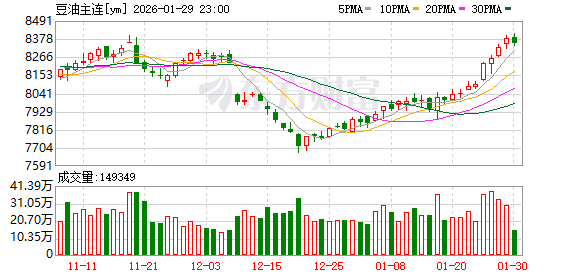
Group 1: Report Overview - Research variety: Soybean oil [1] - Report cycle: Weekly report [1] - Written date: January 30, 2026 [1] Group 2: Futures Market - The DCE soybean oil main contract (Y2605) showed a trend of "four consecutive rises and then a callback" this week, reaching a weekly high of 8,410 yuan/ton and finally closing at 8,282 yuan/ton, with a weekly increase of 2.35% [2] - The expectation of the US biodiesel policy implementation and domestic inventory depletion provided main supports. However, on Friday, affected by foreign fund selling and weakening demand at the end of the Spring Festival stocking, the futures price dropped from a high level, and the trading volume significantly increased, indicating intensified divergence between bulls and bears [2] Group 3: Spot Market - The weekly basis fluctuated in the range of 452 - 494 yuan/ton, with a basis rate of 5.19% - 5.60%, remaining at a relatively high level in the same historical period, reflecting that the tight spot supply pattern remained unchanged [3][5] - On January 30, the spot price was 8,680 yuan/ton (down 120 yuan/ton from the previous day), the basis was 488 yuan/ton, and the linkage between spot and futures strengthened [5] Group 4: Influencing Factors - Industry News - Inventory continued the depletion trend: The national port soybean oil inventory dropped to 892,000 tons on January 27, a 18.6% week - on - week decrease from 1.0963 million tons on January 23, with seven consecutive weeks of inventory reduction [6] - The registered warehouse receipts decreased from 26,525 lots to 25,960 lots, and the reduction of deliverable goods further supported the basis [6] - Pressure emerged on the supply side: The oil mill operating rate remained at a high level (about 62.38% on January 30), last week's soybean crushing volume was 2.09 million tons (a week - on - week increase of 170,000 tons), and the incremental soybean oil supply was gradually released, which might suppress the subsequent inventory depletion speed [6] Group 5: Influencing Factors - Technical Analysis - Price pattern: It showed a pattern of "step - by - step increase + single - day callback" this week. In the first four trading days, it steadily rose along the 5 - day moving average, and on Friday, it broke below the 5 - day moving average (8,310 yuan/ton), forming a negative line with a long upper shadow, indicating significant pressure near 8,400 yuan/ton [7] - Support and pressure: The 8,300 - 8,350 yuan/ton range was a short - term strong pressure zone (tested multiple times but not broken on January 28 - 29), and the 8,200 - 8,250 yuan/ton range was a key support (the Friday low of 8,224 yuan/ton was close to the lower limit of this range) [7] - Volume - price cooperation: The trading volume moderately increased during the rising stage (384,400 lots on January 27), and suddenly increased to 389,700 lots on the callback day. The volume - price divergence implied short - term adjustment demand [7] Group 6: Market Outlook - Policy and inventory are still the core drivers. The implementation rhythm of the US biodiesel policy and the domestic inventory depletion speed will dominate the short - term trend. If the policy exceeds expectations or the inventory continues to decline, the futures price is expected to resume an upward trend; otherwise, the expectation of a bumper harvest and weakening demand may intensify the callback [8][9]
油脂:宏观因素及资金离场扰动,高位波动加剧
Chang Jiang Qi Huo· 2026-02-03 07:58
1. Report Industry Investment Rating No relevant information provided. 2. Core Viewpoints of the Report - In the short - term, the easing of tensions in the Middle East and between Russia and Ukraine has led to a decline in international crude oil prices, weakening support for vegetable oils. Coupled with profit - taking by funds after the previous sharp rise, the risk of a short - term high - level correction in domestic oils has increased. However, the strong fundamentals of soybean and palm oils remain unchanged, so the correction range is expected to be limited. It is recommended to wait for the correction and then go long. Among them, palm oil and soybean oil are expected to be relatively stronger, while rapeseed oil will be relatively weaker [1][19]. - In the long - term, after the Spring Festival, the supply - demand of domestic and international oils will gradually ease, leading to a correction in domestic oils. But with the strong expectation of the Fed's interest rate cut and positive macro - situation, along with potential positive factors such as Indonesia's production reduction risk and the US biodiesel policy, the general direction of oils is upward. After the correction caused by the increase in Malaysian palm oil production and the large arrival of Brazilian soybeans, a bullish approach should still be taken [2][20]. 3. Summary by Variety Palm Oil - Short - term: The strong fundamentals of palm oil will last until February, and with the spill - over effect of US biodiesel policies, the correction range of spot and futures prices is limited. After the emotional decline, there is still upward momentum. However, the relatively high inventory levels in Malaysia and China will limit its further upward space. For example, in January 2026, Malaysian palm oil production decreased while exports increased, and the inventory is expected to decline further in February [5]. - Long - term: Starting from March, Malaysian palm oil production may rebound, while consumption demand will weaken, which may lead to a price correction. But considering the positive domestic macro - situation in 2026, low inventory and potential production reduction in Indonesia, and the possibility of implementing the B50 biodiesel plan, the correction range is expected to be limited, and a long - term bullish view is maintained [6]. Soybean Oil - Short - term: Similar to palm oil, soybean oil is supported by both domestic and foreign positive factors, and the correction is expected to be limited. Positive factors include strong US soybean demand, potential US biodiesel policies, the early - stage harvest of Brazilian soybeans in the 25/26 season, and the drought in Argentina. However, the expected high yield of Brazilian soybeans and the risk of the US biodiesel policy falling short of expectations will limit its upward space [12]. - Long - term: After the Spring Festival, the large arrival of Brazilian soybeans and the easing of domestic soybean supply - demand will put pressure on US soybean and domestic soybean oil prices. In the third quarter, soybean oil prices are expected to fluctuate widely, with attention on the purchase progress of Brazilian soybeans, the sowing and growth of US new - crop soybeans, and the progress of biodiesel policies [13]. Rapeseed Oil - Short - term: Although the current spot supply - demand of domestic rapeseed oil is still tight, after the China - Canada negotiation, there is news that China has increased the purchase of Canadian rapeseed, and the first batch of Australian rapeseed has been processed. The supply - demand tension is expected to ease marginally, making its fundamentals weaker than those of soybean and palm oils. The price trend will follow the latter two, and attention should be paid to China - Canada and China - US relations [15][16]. - Long - term: In the 25/26 season, global rapeseed production (except in Ukraine) has increased year - on - year, with general demand, showing a clear pattern of looser supply - demand. In China, due to the improvement of China - Canada and China - Australia relations, the supply - demand of rapeseed is expected to continue to ease, and the price of far - month rapeseed oil may be relatively weak [17].
涨了逾一个月 豆油行情未完待续?
Qi Huo Ri Bao· 2026-01-30 00:36
Group 1 - The core viewpoint of the article is that the recent surge in soybean oil futures prices is driven by multiple factors, including rising biodiesel policy expectations in the U.S. and increasing international crude oil prices [2] - Analysts believe that the anticipated increase in the U.S. EPA's biodiesel quota for 2026 and adjustments to exemption ratios have contributed to the rise in CBOT soybean oil prices, which has also affected domestic prices [2] - Geopolitical tensions have strengthened crude oil prices, providing additional support for the oilseed sector [2] Group 2 - Domestic apparent demand for soybean oil remains high, with continuous destocking since the fourth quarter of last year, and the lowest inventory levels are expected around March to April [2] - The commercial inventory of soybean oil has decreased by approximately 15% compared to the previous month due to pre-holiday stocking demands, with some oil mills experiencing delivery queues extending into early next month [2] - The price gap between soybean oil and palm oil has widened, driving demand towards soybean oil [2] Group 3 - On the supply side, expectations for Brazil's soybean production in the 2025/2026 season are optimistic, with estimates ranging from 176 million to 181 million tons [3] - Concerns about domestic soybean shortages may be overestimated, as the national auction of reserve soybeans has resulted in over 2 million tons sold, with deliveries concentrated in the January to April period [3] - Future trends in the oilseed sector may continue to rise, with attention needed on palm oil inventory at the end of January and production-demand data in February [3] Group 4 - Some analysts express caution, suggesting that the upside potential for soybean oil prices may be limited, and there could be downward pressure in the medium term [4]

油脂产业周报:驱动尚不明确,油脂市场维持震荡-20260106
Nan Hua Qi Huo· 2026-01-06 12:21
Report Industry Investment Rating - Not provided in the report Core Viewpoints - The domestic油脂 market is constrained by high supply pressure and weak demand, lacking positive factors. The core driver lies in the overseas market. The market will maintain a wide - range volatile trend, waiting for the impact of US energy policies, Malaysia's inventory reduction progress, and new developments in Indonesia's B50 plan. Due to the lack of trend - driving factors, the short - term trading should be treated within a range. As palm oil enters the production - reduction season and the Ramadan in Southeast Asia in 2026 is earlier, the pressure on palm oil producing areas will gradually weaken, and its cost - effectiveness will increase. We should wait to see if it can start an upward trend after inventory reduction [1][2] Summary by Directory Chapter 1: Core Contradictions and Strategy Recommendations 1.1 Core Contradictions - The core contradictions in the油脂 market mainly include the game between palm oil inventory pressure and demand growth in producing areas. Malaysia's palm oil inventory is at a six - and - a - half - year high. Although the production - reduction season at the end of the year is expected to improve supply pressure, insufficient export boost may slow down inventory reduction. Indonesia's B50 plan has no new news and is expected to be implemented in the second half of 2026, which supports long - term palm oil demand but has limited short - term benefits [1] - The US biodiesel policy is still unclear, and the allocation ratio is uncertain, providing limited support to the market [1] - The result of the China - Canada negotiation is unclear. The global new - season rapeseed harvest is abundant, and the arrival of Australian rapeseed eases the supply tension. If China - Canada relations improve, the supply pressure of rapeseed oil will increase [1] - The overall supply of the three major domestic油脂 remains sufficient, lacking upward momentum. Rapeseed oil is in the process of inventory reduction with relatively limited pressure, while soybean oil has the highest inventory and the greatest pressure [1] 1.2 Trading - Type Strategy Recommendations - Not provided in detail in the report 1.3 Industry Customer Operation Recommendations - Trend judgment: Short - term range - bound oscillation, and there is still upward space for palm oil in the medium term. The oscillation range of P2605 is [8200 - 8800], Y2605 is [7600 - 8100], and OI2605 is [8600 - 9500] [18] - Technical analysis: Unilateral trading oscillates within the range. For arbitrage, we can observe the weakening trend of the spread between rapeseed oil and palm oil, and rapeseed oil and soybean oil. The current basis should be treated with a short - term weak - oscillation mindset. There is no month - spread strategy for now. The spread between rapeseed oil and palm oil, and rapeseed oil and soybean oil should be treated as weakening [18] - A series of historical strategy recommendations are listed, including stop - loss exits, profit - taking exits, and waiting for appropriate opportunities [18] 1.4 Basic Data Overview - Palm oil: The latest prices of palm oil 01, 05, and 09 contracts are 8342 yuan/ton, 8488 yuan/ton, and 8376 yuan/ton respectively, with corresponding declines of 1.42%, 1.12%, and 1.02%. The price of BMD palm oil main contract is 4000 ringgit/ton, down 0.35% [20] - Soybean oil: The latest prices of soybean oil 01, 05, and 09 contracts are 8140 yuan/ton, 7912 yuan/ton, and 7774 yuan/ton respectively, with corresponding increases of 0.99%, 0.8%, and 0.56%. The price of CBOT soybean oil main contract is 49.85 cents/pound, up 1.07% [20] - Rapeseed oil: The latest prices of rapeseed oil 01, 05, and 09 contracts are 9736 yuan/ton, 9044 yuan/ton, and 9009 yuan/ton respectively, with no change. The price of ICE Canadian rapeseed near - month contract is 613.6 Canadian dollars/ton, up 2.8 [20] Chapter 2: This Week's Important Information and Next Week's Attention Events 2.1 This Week's Important Information - **Positive Information**: As of January 2, 2026, the commercial inventory of the three major domestic油脂 decreased slightly to 2110000 tons, with a week - on - week and month - on - month decrease of 20000 tons, a year - on - year increase of 250000 tons, and an increase of 190000 tons compared with the average of the past three years. As of December 26, 2025, the commercial inventory of soybean oil in key national regions was 1089000 tons, a decrease of 34500 tons from the previous week, a decline of 3.07%. From January 1 - 5, 2026, Malaysia's palm oil export volume was 239675 tons, a 31.12% increase compared with the same period last month [22][23] - **Negative Information**: Brazil's soybean export volume in 2025 reached a record high of 108.68 million tons, a 11.7% increase compared with 2024. Its soybean meal and corn export volumes also reached record levels. In December 2025, the domestic oil - mill soybean crushing volume remained high, and the import volume of soybeans in January is expected to decrease, with the crushing volume expected to drop slightly to about 8 million tons. India's palm oil import volume in December decreased by 20% month - on - month to 507000 metric tons, the lowest level since April 2025. Due to the increase in soybean oil and sunflower oil imports, India's total edible oil import volume increased by 19% month - on - month, reaching a three - month high of 1.37 million tons. The market generally expects Malaysia's palm oil inventory in December 2025 to continue to accumulate, with Reuters expecting 2.97 million tons (a 4.7% month - on - month increase) and Bloomberg expecting 2.99 million tons (a 5.3% month - on - month increase) [24][27] - **Spot Transaction Information**: Recent油脂 transactions are average, with relatively high soybean oil transactions and no transactions for rapeseed oil for now [25] 2.2 Next Week's Important Events to Follow - Not provided in detail in the report Chapter 3: Disk Interpretation 3.1 Price - Volume and Capital Interpretation - **Domestic Market**: The油脂 market continued its wide - range volatile trend this week. Due to unresolved pressure in producing areas and unclear US biodiesel policies, the global油脂 market demand expansion is limited. We should pay attention to US bio - energy policy information and inventory reduction progress in producing areas [30] - Capital trends: The positions of key profitable seats for palm oil, soybean oil, and rapeseed oil have been cautious recently. Foreign investors have insufficient confidence in the油脂 sector. The net short positions of foreign investors and retail investors in palm oil have increased slightly, with prices continuously falling and positions decreasing significantly, but the trend degree has slightly turned positive, and volatility is low, indicating that the market may enter a consolidation stage. Soybean oil prices have stabilized recently after a continuous decline, with positions decreasing, a weak trend but a slowdown in the decline. Foreign investors have increased short positions, and retail investors have slightly increased long positions, and the market maintains a volatile consolidation. Rapeseed oil prices have stabilized at a low level after a continuous decline, with positions dropping to the lowest in two years, continuous capital outflows, and the basis approaching the spot price, indicating that the market may be approaching the bottom area [30] - Basis structure: The main - contract basis of油脂 continued to bottom - out and consolidate this week. Due to high domestic油脂 inventory and average downstream demand, the basis continued to operate weakly [32] - Month - spread structure: The油脂 market still shows a near - strong and far - weak Back structure. This week, the Back structure of palm oil has become shallower. Weak reality continues to suppress the disk. Due to the lack of information on Indonesia's B50, market sentiment is weak. High soybean oil supply still suppresses prices, and the supply tension of rapeseed oil has gradually improved [32] - Spread structure: Due to the lack of further information this week, cross - variety spreads mainly oscillated. As palm oil enters the production - reduction season and starts inventory reduction, its support has improved. With the continuous supply of rapeseed oil, the spread between rapeseed oil and palm oil is still expected to weaken [53] - **Overseas Market**: The overseas market oscillated this week. The inventory pressure of Malaysian palm oil has not been relieved, and there is insufficient weather disturbance. Indonesia's B50 lacks new progress, and the quotes in producing areas continue to consolidate. The global soybean supply pattern is loose, and US soybeans lack positive driving factors and oscillate weakly. The US energy policy guidance is unclear, and US soybean oil continues to oscillate. The cost - effectiveness of international palm oil has not been reflected for now. There is no expectation of a relaxation in China - Canada relations, but the arrival of Australian rapeseed has eased some supply tension. Currently, the positions of CBOT soybean oil managed funds have decreased slightly, with a pessimistic sentiment and insufficient market confidence in a rise. The net positions of producers/ traders/ processors/ users have rebounded, and confidence has increased [56] Chapter 4: Valuation and Profit Analysis 4.1 Upstream - and - Downstream Profit Tracking in the Industrial Chain - This week, the POGO spread decreased slightly. Due to the lack of price support for palm oil, the production cost of palm - oil - based biofuels has declined. The BOHO spread continued to weaken. Due to the good global soybean harvest expectation, the cost of US soybean - oil - based biodiesel has remained at the lowest level in recent years due to the sufficient global soybean supply [64] 4.2 Import - and - Export Profit Tracking - China is a net importer of palm oil. Recently, the prices in producing areas have been consolidating at a low level. The import profit has changed slightly, but the profit range is not large. After the basis turned positive, domestic buyers started to place orders, but the downstream acceptance is average, and the profit still remains negative [67] Chapter 5: Supply - Demand and Inventory Deduction 5.1 Deduction of the Supply - Demand Balance Sheet in Producing Areas - In November, Malaysia's palm oil production decreased month - on - month, but the inventory exceeded expectations, and the supply pressure was not relieved. We should pay attention to the production changes in producing areas. Currently, La Niña climate has appeared in producing areas, but the rainfall is limited, and the impact on the main producing areas is temporarily small, and the subsequent impact remains to be observed. The latest high - frequency data shows that Malaysia's production decreased month - on - month in December, but export boost was insufficient, and the inventory inflection point is difficult to appear for the time being. It is expected that the inventory inflection point may be seen as early as January [69] 5.2 Supply - Side and Deduction - Palm oil: In the current procurement situation, transactions are difficult to improve in the off - season. Producing areas have entered the production - reduction stage, and the willingness to sell goods during inventory reduction is limited. In addition, palm oil is easy to solidify in winter, and demand is weak. The import profit in China is inverted, and it is expected that the number of orders will be difficult to increase. We should wait for the rebound after the inventory pressure in producing areas is relieved [71] - Soybean oil: In the first quarter, the arrival of soybeans reaches the seasonal low point, and the crushing volume decreases. However, the current inventory pressure is relatively large, and the overall supply is still relatively loose. We should pay attention to whether there will be short - term supply shortages due to the arrival rhythm [71] - Rapeseed oil: The downstream demand is limited. Although Australian rapeseed is arriving successively, the quantity is limited, and inventory reduction will continue. However, the global rapeseed harvest is abundant, and the cost price is weak. Coupled with the increased import of Russian rapeseed oil, the supply gap is gradually disappearing. If China - Canada relations improve, the domestic rapeseed oil supply will further increase [71] 5.3 Demand - Side and Deduction - In the short term, the inventory of the three major油脂 is still high year - on - year, and the downstream demand is sluggish and lags behind the average level. Although the fourth quarter is the traditional consumption peak season for油脂, the market boost is limited after the festival stocking is over. Due to limited population growth and the diversification and health - orientation of residents' diet structures, the overall terminal demand for油脂 is still relatively weak and may continue to operate steadily and weakly [77]
供应宽松 棕榈油或维持低位震荡
Xin Lang Cai Jing· 2025-12-22 23:27
Core Viewpoint - The palm oil market has experienced a downward trend for over two months since peaking in early October, with two short-term rebounds that failed to reverse the overall decline [1] Group 1: Production and Seasonal Trends - Malaysia's palm oil production has shown significant seasonal characteristics, with the dry season typically leading to higher production and the rainy season resulting in lower output [2] - This year, the dry season has been extended, with palm oil production in Malaysia reaching 2.04 million tons in October, an 11% month-on-month increase and a 14% year-on-year increase [2] - By November, production began to decline to 1.935 million tons, a 5.3% decrease month-on-month, but still a 19.4% increase year-on-year, indicating a delay in the seasonal reduction period by about one month compared to normal years [2] - As a result of the extended production cycle, palm oil inventories in Malaysia reached 2.835 million tons by the end of November, marking a 54.5% increase from 1.835 million tons year-on-year, the highest level since March 2019 [2] Group 2: Price Movements and Market Influences - A rebound in palm oil prices occurred from late November to early December due to heavy rainfall caused by the La Niña phenomenon, which initially affected the Central and Southern Peninsula and the Philippines before moving southward [4] - However, the Malaysian Palm Oil Board (MPOB) indicated that the recent floods are unlikely to significantly impact overall production, as the effects are localized and the main production areas have not experienced substantial rainfall [4] - The U.S. biodiesel policy has faced delays, with the Environmental Protection Agency (EPA) announcing that the final decision on the 2026 biodiesel blending targets will not be made until the first quarter of next year, leading to market disappointment and contributing to the decline in the oilseed sector [5] - Following a two-month downward trend, palm oil prices have returned to near their lowest levels of the year, with expectations of continued weak fluctuations until the U.S. biodiesel policy is finalized [5]
豆粕、豆油期货品种周报-20251027
Chang Cheng Qi Huo· 2025-10-27 03:24
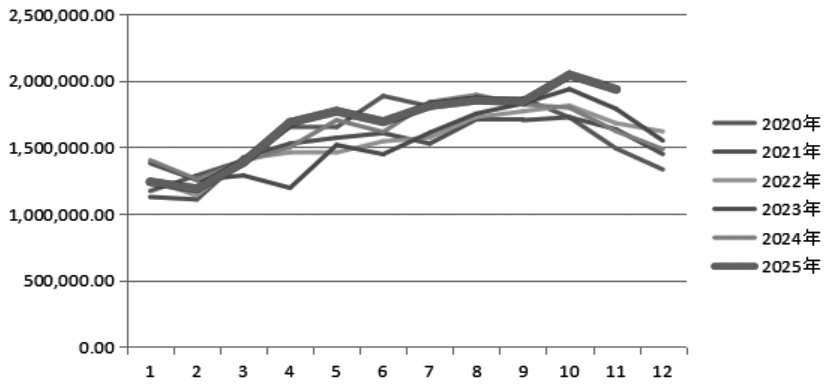
Group 1: Report Overview - Report period: October 27 - 31, 2025 [1] - Report title: Weekly Report on Soybean Meal and Soybean Oil Futures [2] - Reported futures varieties: Soybean meal and soybean oil [2] Group 2: Soybean Meal Futures 1. Mid - term Market Analysis - Mid - term trend: The main soybean meal contract is in a wide - range oscillation phase. The high inventory and high operation rate of oil mills continuously suppress the spot price, and the poor downstream breeding profit leads to cautious procurement by feed enterprises, resulting in weak demand - side support. However, the cost - effectiveness of soybean meal becomes apparent after the price drops to a low level, and the expected monthly decline in soybean arrivals in the fourth quarter provides bottom support. [6] - Trend judgment logic: In the 42nd week, the actual soybean crushing volume of oil mills was 2.1662 million tons, the operation rate was 59.59%, and the soybean meal inventory was 976,200 tons. [6] - Mid - term strategy suggestion: Pay attention to the progress of Sino - US trade negotiations. [6] 2. Variety Trading Strategy - Last week's strategy review: The overall trend of soybean meal futures prices was in a downward channel, and the capital was slightly bearish. In the short term, M2601 may continue the oscillation and consolidation pattern, with an expected operating range of 2,800 - 3,000. [9] - This week's strategy suggestion: The overall trend of soybean meal futures prices is in an upward channel, and the capital is relatively bullish. In the short term, M2601 may be in a slightly stronger oscillation phase, with an expected operating range of 2,880 - 3,050. [10] 3. Relevant Data - Data includes: Weekly soybean meal production, weekly soybean meal inventory, apparent consumption, weekly inventory days, soybean meal basis, and oil - meal ratio. [18][22][25] Group 3: Soybean Oil Futures 1. Mid - term Market Analysis - Mid - term trend: The main soybean oil contract is in a wide - range oscillation phase. The sufficient arrival of domestic soybeans, high operation of oil mills, and high commercial inventory (although it decreased slightly week - on - week) combined with weak demand, but strong exports and potential benefits from US biodiesel policies make soybean oil relatively strong among oils and fats. [30] - Trend judgment logic: In the 42nd week, the actual soybean oil production of 125 oil mills was 41,160 tons, and the commercial inventory of soybean oil in key regions was 1.224 million tons. [30] - Mid - term strategy suggestion: Pay attention to Sino - US trade trends, the progress of US biodiesel, and the promotion rhythm of Indonesia's B50 policy. [30] 2. Variety Trading Strategy - Last week's strategy review: The overall trend of soybean oil futures prices was in a sideways phase, and the capital was slightly bearish. In the short term, Y2601 may be in a range - bound oscillation pattern. [33] - This week's strategy suggestion: The overall trend of soybean oil futures prices is in a sideways phase, and the capital is relatively bearish. In the short term, Y2601 may continue the range - bound oscillation pattern. [33] 3. Relevant Data - Data includes: Weekly soybean oil production, weekly soybean oil inventory, soybean oil basis, soybean oil trading volume, weekly soybean arrival volume, weekly soybean inventory, weekly soybean crushing volume, weekly soybean operation rate, weekly port inventory, and Brazilian premium. [43][47][50][55][58]
【期货热点追踪】马棕油价格连续走高,美国生物柴油政策将如何影响市场?分析师指出,若后续数据持续利多,马棕油价格有望挑战这一区间!
news flash· 2025-07-09 00:59
Group 1 - Palm oil prices have been rising continuously, indicating a potential bullish trend in the market [1] - Analysts suggest that if subsequent data continues to be favorable, palm oil prices may challenge the current price range [1]