需求破坏

Search documents
Pricing in oil at $170 a barrel, could well go to $200: analyst
Youtube· 2026-03-30 09:18
Core Insights - The current energy crisis is characterized by unprecedented physical disruptions in oil and gas markets, with significant implications for pricing and demand [1][5][10] Oil Market Analysis - The total disruption amounts to approximately 20 million barrels per day of oil and products, with a shortfall of 9 to 10 million barrels expected [2] - If the crisis persists, demand destruction could necessitate a reduction of around 10 million barrels per day to stabilize the market [8] - Current high prices for products like jet fuel and gasoline are already leading to demand reductions, indicating a potential for further demand destruction [9][10] Gas Market Vulnerability - Gas markets are deemed more vulnerable than oil markets due to a lack of significant offsets to supply disruptions [3][4] - The crisis is expected to initially impact Asia more severely, as over 70% of Middle Eastern oil flows to Asia, leading to early demand reductions in that region [6][7] Long-term Market Changes - The resolution of the crisis may lead to permanent changes in demand forecasts, with a likelihood of sustained high prices prompting a shift towards alternative energy sources [13] - Countries may increase their strategic stockpiling of oil and gas to mitigate future crises, which could create bullish demand for these products [14] Price Projections - If the current disruptions continue, oil prices could potentially reach levels of $170 to $200 per barrel [14]


高盛闭门会-地缘政治与能源交汇-供应冲击-贸易流动与价格形成
Goldman Sachs· 2026-03-26 13:20
Investment Rating - The report suggests a bullish stance on core spreads to mitigate upside risks due to high volatility in the front end of the market [1][12]. Core Insights - The daily flow through the Strait of Hormuz has dropped from 20 million barrels to 1 million barrels, creating a supply gap of 19 million barrels per day, which can only be offset by policies managing 4-5 million barrels [1]. - The price of Dubai crude has surged to $130 per barrel due to Middle Eastern supply shortages and increased near-term procurement demand from Asian refineries [1]. - Qatar's LNG supply has been impacted, leading to a projected long-term capacity loss of 3% globally, with net supply losses expected to reach 26 million tons per year by 2026 [1][13]. - The TTF gas price forecast for Q2 has been raised to €72 per MWh, with extreme scenarios potentially reaching €100 [1][13]. - The U.S. government is managing expectations through social media to prevent speculative investments from exacerbating oil prices, with current speculative positions lower than during previous crises [1][10]. Summary by Sections Geopolitical Impact - The current Middle Eastern situation represents a fundamental change, introducing a permanent risk premium in the energy market due to underestimations of Iran's regime stability [3]. - Key signals to monitor include the internal stability of the Iranian regime and potential shifts in leadership dynamics, which could indicate changes in policy direction [4]. Energy Supply Dynamics - The report highlights that the ongoing supply shock is unprecedented, with the potential for significant demand destruction needed to rebalance the market [7][19]. - The report emphasizes that the current market is not adequately pricing the risks associated with energy infrastructure and the potential for prolonged supply losses [19][20]. Market Strategies - The recommended trading strategy is to go long on core spreads, as the volatility in the front end is high, and the risk-reward ratio is favorable [12]. - Producers are advised to sell call options in the back end starting from the second half of 2026 to capitalize on high volatility and time value [12]. Future Outlook - The report anticipates that energy security concerns may lead to a structural shift in energy production, with a potential move away from natural gas towards coal and renewable energy sources [2][18]. - Despite short-term supply disruptions, the long-term outlook for LNG remains bearish, with expectations of oversupply persisting beyond 2028-2029 [14][15].
能源危机加剧,多国被迫推行“4天工作制”,航班停飞
华尔街见闻· 2026-03-20 10:19
Group 1 - The core viewpoint of the article highlights the rapid escalation of energy crises in Asia, driven by a significant tightening of refined oil supplies, leading to emergency energy-saving measures across multiple economies [1] - In the past 10 days, the export volume of refined oil products from major Asian exporting countries has decreased by approximately 30% compared to a five-month baseline, with the latest data indicating a further decline to 35% [1] - Jet fuel prices have seen the most drastic drop, exceeding 40%, while gasoline and diesel have decreased by over 30% and 20% respectively [1] Group 2 - Diesel prices have surged sharply, becoming a critical economic bottleneck affecting transportation and logistics, prompting governments to implement administrative measures to curb demand [4] - Countries like the Philippines and Sri Lanka have adopted a four-day workweek to reduce diesel consumption, while Bangladesh has adjusted holiday schedules to save fuel [4] - Thailand and Vietnam have encouraged officials to minimize travel, and Myanmar has implemented vehicle restrictions to lower fuel demand [4] Group 3 - The price of jet fuel is nearing $200 per barrel, forcing airlines to shift from cost control to direct capacity reductions, rendering many routes economically unviable [5] - Several Asian airlines, including Qantas and Air India, have introduced phased fuel surcharges, with Air India charging up to $200 for long-haul tickets [6] - Scandinavian Airlines has announced the cancellation of approximately 1,000 flights in April due to soaring fuel costs [6] Group 4 - The energy crisis has extended from the demand side to the supply side, with many Asian petrochemical companies declaring force majeure due to raw material supply disruptions [7] - Over 50% of naphtha used by Asian petrochemical firms is sourced from the Middle East, and supply tightening has led to production halts or reductions [7] - In Japan, major chemical companies have cut ethylene production, while in South Korea, significant producers have also declared force majeure [8] Group 5 - Demand elasticity for oil is limited, with a projected shortfall of one million barrels per day potentially emerging in April [9] - The short-term price elasticity of global oil demand is estimated at -0.024, indicating that a 40% increase in oil prices would be required to reduce total consumption by 1% [9] - If Brent crude averages $100 per barrel in March, the price effect alone could lead to a demand reduction of approximately one million barrels per day in April, not accounting for additional impacts from flight cancellations and physical shortages [9]

高盛闭门会-我们的交通运输数据揭示中东局势扰动的影响
Goldman Sachs· 2026-03-13 04:46
Investment Rating - The report suggests a defensive investment strategy, favoring high-margin public and rail infrastructure, and light asset freight forwarding companies while shorting airport and container shipping stocks [1][6]. Core Insights - The Middle East situation has led to significant disruptions in energy flows, with low-sulfur fuel oil prices doubling and a 20% pricing pressure on airlines and shipping companies [1][2]. - The oil flow through the Strait of Hormuz, which typically averages around 21 million barrels per day, has nearly stopped, creating a substantial supply gap [1][2]. - European jet fuel inventories are critically low, sufficient for only two weeks of consumption, with 50%-66% of supply reliant on imports [1][2]. - The Asia-Europe air cargo routes are heavily impacted, with a potential 50% reduction in cargo capacity due to the loss of passenger bellyhold space, leading to a 15% global cargo impact [1][5]. - China's exports are projected to grow by 10% year-on-year in early 2026, driven by strong demand in semiconductors and data center equipment [1][5]. Summary by Sections Energy Flow Impact - The report highlights that the current geopolitical situation has caused a doubling in prices for low-sulfur fuel oil and significant increases in jet fuel crack spreads in Western Europe, leading to a 20% price increase pressure on airlines and shipping companies [1][2]. - The oil tanker transport activity through the Strait of Hormuz has nearly ceased, with Saudi Arabia's additional capacity only at 3 million barrels per day [1][2]. Global Air Travel Demand - Outside the Middle East, global air travel demand remains stable, with no significant changes observed in flight schedules on transatlantic routes [3]. - The number of flights in the Middle East has decreased significantly, with a peak drop of about 80%, although it has since recovered to about half of the previous levels [3]. Freight and Trade Demand - The report indicates that the disruption in passenger capacity has led to a significant reduction in air cargo capacity, particularly affecting Asia-Europe routes, with a potential 50% decrease in capacity [5]. - The report anticipates a seasonal rebound in demand post-Chinese New Year, supported by strong demand in specific sectors like semiconductors [5][6]. Investment Strategy - The report advocates for a defensive investment strategy, emphasizing high-margin infrastructure assets and light asset freight forwarding companies, while advising against investments in airport stocks and container shipping [6][7]. - The report expresses a bearish outlook on container shipping companies due to limited supply impacts and direct negative demand effects from reduced Middle Eastern shipping routes [6][7].
大摩闭门会-市场观点-2000万桶原油难题解析
2026-03-13 04:46
Summary of Key Points from Conference Call Industry Overview - The discussion centers around the oil market, specifically the critical role of the Strait of Hormuz, which has a daily transport volume of approximately 20 million barrels, accounting for one-third of global maritime oil supply [1][2]. Core Insights and Arguments - The potential disruption in the Strait of Hormuz could exceed historical extremes, being 6.7 times greater than the expected production cuts during the 2022 Russia-Ukraine conflict [1]. - The oil market is highly sensitive to supply-demand imbalances, with a daily shortfall of 1 million barrels causing noticeable price fluctuations. A gap of 2-3 million barrels per day, as seen in 2022, previously drove Brent crude prices to $130 per barrel [1][2]. - Current global alternative production capacity is only about 7 million barrels per day, including 4 million from Saudi pipelines, 500,000 from UAE pipelines, and 500,000 from potential Russian increases, leaving a shortfall of 13 million barrels per day [1][4]. - To balance the market through demand destruction, oil prices would need to exceed the normal range and enter an inflation-adjusted high price state of $130-$140 per barrel [1][5]. Alternative Supply Solutions - The primary alternative supply source is Saudi Arabia's southwest pipeline, which can deliver an additional 400,000 barrels per day, while the UAE pipeline can provide about 50,000 barrels per day. If sanctions on Russian oil are eased, an additional 50,000 barrels per day could be available [4]. - The fastest historical release of strategic petroleum reserves (SPR) was 1.3 million barrels per day, and even if increased to 2 million barrels per day, the total alternative supply would still fall short by 1.3 million barrels per day [4]. Supply Chain Recovery - If the shipping disruption lasts only a few days, logistics issues could be resolved within 4-6 weeks. However, if the disruption continues for several weeks, existing inventory adjustment capabilities would fail, leading to systemic impacts on the global economy [1][6][7]. - The need for re-routing and utilizing local inventories could keep commodity prices tense in the short term, but stock markets might overlook these fluctuations [6]. Additional Considerations - Historical data indicates that significant demand destruction is linked to oil prices reaching critical levels, which can have severe implications for overall economic activity due to the integral role of oil products in various sectors [5].
刚刚!巨震!霍尔木兹海峡突发大消息!
天天基金网· 2026-03-10 23:57
Group 1 - The core viewpoint of the article highlights the significant volatility in the international oil market, with WTI crude oil prices experiencing a drop of nearly 19% and Brent crude oil falling by approximately 18% during a trading session [2][3] - The primary drivers behind this price drop are policy statements from the Trump administration indicating a potential de-escalation of tensions with Iran and discussions among the G7 to release 300 to 400 million barrels of oil reserves [5][6] - The U.S. military's recent actions in the Strait of Hormuz, including strikes on Iranian mines, and the request for Israel to halt attacks on Iranian oil facilities, have further influenced market sentiment [6][5] Group 2 - The article notes that the International Energy Agency (IEA) is convening a special meeting to assess the current oil supply security situation, which reflects the urgency of the market's response to geopolitical developments [5] - There is a significant decline in oil tanker traffic through the Strait of Hormuz, dropping from about 50 vessels per day in February to just 1 to 2 vessels currently, indicating a critical situation for oil supply routes [9] - Analysts suggest that if disruptions in transportation persist, oil prices could surge significantly, potentially exceeding historical peaks seen in 2008 and 2022, depending on the duration of the supply interruptions [9]

中东地缘风险溢价重塑欧洲货币政策预期?
第一财经· 2026-03-04 09:59
Core Viewpoint - The ongoing tensions in the Middle East have disrupted the energy supply chain, particularly through the Strait of Hormuz, leading to significant price increases in energy products, with WTI crude oil prices rising over 13% to $76 and European natural gas futures surging by over 40% [3][4]. Group 1: Energy Price Impact - The shipping through the Strait of Hormuz is effectively stalled due to increased insurance premiums and withdrawal of coverage for vessels, indicating that the main barrier is psychological rather than physical, expected to last for several days [6]. - If the conflict escalates into a regional war, oil prices are likely to continue rising, posing significant economic challenges for net oil-importing countries due to increased energy costs affecting real income and trade balances [8]. - The rise in energy prices is expected to lead to uncertainty and instability, which will translate into higher energy prices, lower economic growth expectations, and volatility in financial markets [7][10]. Group 2: Central Bank Policy Considerations - The European Central Bank (ECB) is currently in a wait-and-see mode regarding monetary policy adjustments, with potential changes depending on the duration of the energy price surge [4]. - If energy prices remain elevated for an extended period, the risk of a second-round effect could trigger adjustments in interest rates, complicating the ECB's plans for potential rate cuts [4][8]. - The current energy price fluctuations are critical in determining the ECB's monetary policy trajectory, especially if broader inflation rates rise above 2% due to oil price shocks [7][10]. Group 3: Geopolitical Risk and Market Sentiment - Geopolitical risks are becoming structural factors influencing investment cycles, with energy price volatility and inflation uncertainty expected to dominate market trends [10][11]. - Historical patterns suggest that even if conflicts resolve quickly, market perceptions of risk will persist for some time, indicating a sustained geopolitical premium in the market [11]. - The U.S. political landscape may influence military actions in the Middle East, with potential implications for market stability and investor sentiment as the midterm elections approach [11][12].
贵金属的风险在哪里?
Sou Hu Cai Jing· 2026-01-09 11:17
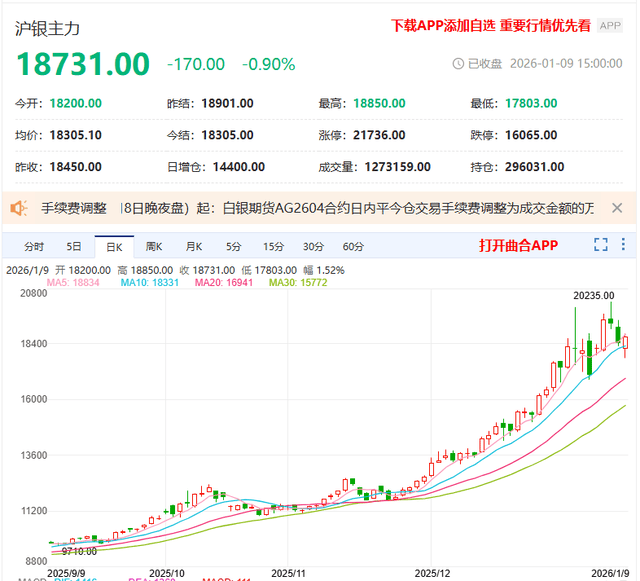
Group 1 - The current price increase of white metals (silver, platinum group metals) is primarily driven by ongoing supply tightness and reduced market liquidity during the year-end holiday season, with increased trading activity in China also playing a significant role [1][2] - There is a growing belief that silver and platinum group metals have room for price appreciation, especially after breaking key technical levels and reaching new highs, attracting more investor interest [1] - The sustainability of this upward momentum into next year is uncertain, as excessive price increases could lead to reduced industrial demand, potentially alleviating market tightness and decreasing investor appeal [1] Group 2 - China's historically low interest rates have led investors to seek profitable assets, increasing the popularity of precious metals, with silver demand expected to rise in the coming years [2] - The trading volume of silver futures has rebounded, and new futures and options for platinum and palladium have been introduced, enhancing investment channels for precious metals [2] - Silver inventory has been declining since 2020, and if industrial demand improves alongside high investment enthusiasm, companies may replenish their inventories, further driving price increases [2] Group 3 - In the silver market, bullish funds are significantly increasing their holdings through ETFs and physical delivery, which is driving prices higher, although high prices may suppress industrial demand [4] - The potential for a "non-rational" price increase may end as exchanges like CME adjust margin requirements, leading to a possible reduction in volatility [4] - In a high volatility environment, it is advised to maintain a light long position above $70 [4]