软件和服务

Search documents
AI冲击之下“铁索连环”,美国杠杆贷款遭重创,高达1500亿美元CLO证券面临冲击
Hua Er Jie Jian Wen· 2026-02-28 01:30
Core Insights - The disruptive potential of artificial intelligence (AI) is rapidly impacting the credit market, leading to significant adjustments in the U.S. leveraged loan market and posing systemic threats to the large collateralized loan obligation (CLO) market [1][2] Group 1: Market Impact - The U.S. leveraged loan market has experienced its most severe monthly sell-off in over three years, primarily affecting borrowers in the software and services sector [1][2] - The Bloomberg U.S. Leveraged Loan Index fell by 1.34% in February, marking the largest monthly decline since September 2022, driven by concerns over AI's potential to disrupt traditional business models [2] Group 2: CLO Market Risks - Estimates suggest that between $40 billion and $150 billion of assets packaged into U.S. CLOs may face disruptive impacts from the AI boom, as highlighted by JPMorgan strategists [3] - CLO managers are currently assessing their portfolios to determine which loans are most sensitive to AI impacts, following significant sell-offs triggered by the release of advanced AI tools like the Claude chatbot [3] Group 3: Refinancing Pressures - The upcoming debt maturity wave raises refinancing risks, with approximately $51 billion of software debt rated B- or lower maturing by 2028, and another $50 billion by 2029 [4] - The private credit market's exposure in the software sector limits its ability to refinance syndicated assets, complicating the previously common "public-to-private" acquisition model [4] - Despite expectations of a gradual integration of AI into the real economy, there are warnings about the potential for a "displeasing reset" in financial markets due to leveraged speculation on AI [4]
印度科技行业协会表示,印度科技行业在2026财年将增长6.1%
Xin Lang Cai Jing· 2026-02-24 08:26
Core Insights - The Indian technology industry is projected to grow by 6.1% in the current fiscal year, driven by AI-driven services and global capability centers [1] - The National Association of Software and Service Companies (Nasscom) anticipates that the industry's revenue will exceed $300 billion by the fiscal year 2026 [1]
全球大公司要闻 | 苹果推迟新版Siri上线,Meta百亿押注AI基建
Wind万得· 2026-02-12 00:54
Group 1 - Meta plans to invest over $10 billion in building a data center park in Indiana, providing 1 GW of power capacity to support AI projects and core social media operations, while hedge fund Pershing Square disclosed a stake in Meta representing 10% of its capital, believing the market underestimates AI's long-term potential [2][3] - Apple faces delays in upgrading its Siri virtual assistant, with multiple new features potentially postponed until iOS 26.5 or iOS 27 due to issues with query handling, response times, and accuracy [2] - ByteDance is reportedly developing an AI chip and negotiating with Samsung for production, aiming to produce at least 100,000 chips this year and gradually increase output to 350,000, although a spokesperson claimed the information is inaccurate [3] Group 2 - NetEase's Q4 2025 revenue reached 27.5 billion yuan, a 3% year-on-year increase, but net profit attributable to shareholders fell nearly 30% to 6.2 billion yuan, missing expectations due to increased sales expenses and investment losses [5] - Zhiyuan Technology launched its new flagship model GLM-5, integrating DeepSeek sparse attention mechanism, targeting programming and intelligent agent capabilities, with internal evaluations indicating performance close to Claude Opus 4.5 [5] - Huazhu Group is under scrutiny from the Beijing Consumer Association for potentially unfair terms in its membership service agreement, prompting the company to initiate a self-examination and commit to improving the consumer environment [6] Group 3 - Amazon received approval from the US FCC to deploy an additional 4,500 low-Earth orbit satellites, expanding its constellation to 7,700 to enhance space internet competition [8] - Cisco reported Q2 revenue of $15.3 billion, exceeding analyst expectations, with product revenue of $11.64 billion, driven by a surge in orders from AI hyperscalers [8] - Ford anticipates achieving a record revenue of $187.3 billion in 2025, but expects a net loss of $8.182 billion, a 239.17% year-on-year decline, primarily due to rising supply chain costs and increased R&D investments [9] Group 4 - Samsung Electronics announced the Galaxy S26 series launch on February 26, featuring the 2nm Exynos 2600 chip and a 200-megapixel camera in the Ultra model, with continued strong demand for memory chips expected until 2027 [12] - Toyota is set to launch a pure electric version of the Highlander for the North American market, targeting a range of 320 miles, with plans to guide users of fuel/mixed models to the Grand Highlander series [12] - LG Energy Solution announced the acquisition of a 49% stake in a Canadian energy storage battery factory from Stellantis to strengthen its energy storage business [13]





华尔街年初热门交易 全军覆没
Sou Hu Cai Jing· 2026-02-11 16:49
Market Sentiment Shift - The recent market turmoil is not caused by a single factor, indicating a significant shift in sentiment on Wall Street compared to the panic sell-off triggered by tariff policies last April [1] - Earlier predictions suggested that the U.S. stock market would experience its longest rally in nearly two decades, driven by expectations of sustained AI momentum, unexpectedly strong economic resilience, and gradual interest rate cuts by the Federal Reserve [1][6] AI Disruption Concerns - Concerns about AI potentially disrupting or reshaping certain U.S. industries and companies have emerged as investors worry about the transition of AI investments into commercial products [1][2] - The launch of a new tool by startup Altruist aimed at helping financial advisors has sparked fears of automation threatening the wealth management sector, leading to significant stock declines for firms like Raymond James Financial Inc. (down 8.8%) and Charles Schwab Corp. (down 7.4%) [2] Broader Market Impact - The sell-off affected not only tech stocks but also other previously popular trades on Wall Street, with the S&P 500 software and services index losing nearly 8% over the week, marking its worst weekly performance since March 2020 [6] - The S&P 500 insurance index dropped 3.9%, the largest single-day decline since October of the previous year, reflecting the broader impact of AI-related concerns on various sectors [2] Investment Strategy Shift - Analysts suggest a shift in investment focus from "AI enablers" to "AI beneficiaries," indicating a potential change in which companies will benefit from AI advancements [3][4] - Despite the recent volatility, some analysts believe the market's reaction may be an overreaction, with the fundamentals still supporting a stable growth outlook [8][9] Economic Indicators - The ISM manufacturing PMI showed better-than-expected performance, indicating potential for stable growth and avoidance of inflationary pressures, which is crucial for the stock market and the Federal Reserve [8] - Recent strong earnings reports from various companies have reinforced the initial positive expectations, although concerns about the sustainability of high valuations in tech and other sectors remain [7]
纽约时报:美国可以从亚洲学到什么
美股IPO· 2026-02-08 07:13
Core Insights - The article highlights the rapid economic growth and transformation in Asia, particularly in countries like Vietnam, where per capita income has risen from approximately $100 in the 1980s to around $5,000 today, alongside an 8% economic growth rate and a 37% increase in the stock market last year [3][4] - It emphasizes the importance of education as a driving force behind this growth, noting that Asian cultures, particularly those influenced by Confucianism, place a high value on learning and academic achievement [5][7] Economic Growth - Emerging Asian economies, including China, India, Indonesia, and Vietnam, contributed more to global economic growth than all other regions combined last year, a trend expected to continue into 2026 [3][4] - The article notes that some Asian countries have doubled their economic size in less than a decade, showcasing the region's dynamic economic landscape [4] Education System - The article discusses the cultural emphasis on education in East Asia, where countries like Singapore, South Korea, Taiwan, Hong Kong, and Japan have some of the best-performing schools globally [7] - It contrasts the investment in education in Taiwan, which mandates at least 15% of the national budget for education, culture, and science, with the U.S., where education spending is only about 2% of the federal budget [7] Individual Stories - The article shares the story of Tran Ha Hoang Chau, a determined student in Vietnam who balances full-time work and studies, highlighting the sacrifices made for education [6] - Another example is Phan Thi My Duyen, a university student who prioritizes her studies over social activities, reflecting the cultural values surrounding education in the region [8] Cultural Reflection - The article questions whether a similar culture of valuing education can be established in the U.S., suggesting that there is room for improvement in addressing educational inequities and the overall perception of education [9][10] - It calls for a shift in how human capital is respected in society, advocating for a greater appreciation of educational achievements [10]

“若GPU管够,增速早超40%!”微软电话会回应市场担忧:我们缺产能,不缺订单
硬AI· 2026-01-29 08:10
Core Viewpoint - Microsoft reported a record capital expenditure of $37.5 billion, leading to a market panic and a post-market drop of over 6% in stock price, despite exceeding Wall Street expectations in revenue ($81.3 billion) and earnings per share ($4.14) [5][6][54]. Group 1: Financial Performance - Microsoft’s capital expenditure surged approximately 66% year-over-year to a record $37.5 billion, while Azure cloud revenue grew by 39% (38% at constant currency) [6][54]. - The company’s cloud revenue surpassed $50 billion for the first time, reflecting a 26% year-over-year increase [35]. - Operating income grew by 21%, and earnings per share increased by 24%, adjusted for OpenAI investment impacts [54][56]. Group 2: Supply and Demand Dynamics - CFO Amy Hood stated that the growth limitation is not demand but supply, emphasizing that if all newly launched GPUs were allocated to Azure, growth would exceed 40% [10][12]. - Approximately two-thirds of the capital expenditure is directed towards short-term assets like servers (GPU/CPU), indicating a tight supply-demand relationship [11][56]. Group 3: AI Monetization and Growth - Microsoft 365 Copilot paid seats increased by 160% year-over-year, reaching 15 million users, with daily active users growing tenfold [15][45]. - GitHub Copilot paid subscriptions reached 4.7 million, marking a 75% year-over-year increase, showcasing accelerated penetration in productivity tools [18][46]. Group 4: Strategic Investments - The launch of the in-house chip Maya 200 is expected to reduce total cost of ownership by over 30%, aimed at controlling AI infrastructure costs [21][37]. - Microsoft Fabric's annual revenue run rate exceeded $2 billion, with a 60% year-over-year growth, driven by the need for data management in the AI era [23][39]. Group 5: Long-term Outlook - Microsoft expressed strong confidence in AI demand through 2027 and beyond, framing the current situation as a "arms race" for computing power [24][25]. - The company aims to build an optimal long-term customer lifetime value (LTV) portfolio rather than focusing solely on short-term growth in any single business [12][13]. Group 6: Market Reactions and Analyst Concerns - Analysts raised concerns about the rapid growth of capital expenditures compared to Azure's growth, questioning the return on investment (ROI) [9][72]. - CFO Hood reassured that most GPU purchases are contractually locked for their entire lifespan, mitigating risks of underutilization [14][56].


微软推出新举措,严控数据中心电力成本与水资源消耗
Xin Lang Cai Jing· 2026-01-13 16:44
Core Viewpoint - Microsoft has announced a new initiative aimed at reducing water consumption in its U.S. data centers and mitigating the potential impact of rising electricity costs on the public [1][3]. Group 1: Initiative Details - The company will pay electricity costs sufficient to cover its own usage and will collaborate with local utility companies to expand power supply based on data center demand [1][3]. - Microsoft has committed to achieving "net replenishment" of water resources, meaning that the amount of water replenished will exceed the amount consumed [1][3]. - The company plans to disclose details about water usage and replenishment progress for its U.S. data centers in the future [1][3]. Group 2: Political Context - U.S. political leaders are calling for rapid expansion of data center capacity and new power generation facilities to maintain competitiveness in the AI sector, while local communities express concerns about the high energy consumption of these facilities [1][3]. - President Donald Trump stated that large tech companies must bear the costs of building these facilities, emphasizing the importance of data centers for the growth of the U.S. AI industry [4]. - Microsoft is assisting in developing a new pricing mechanism in Wisconsin to prevent the transfer of data center electricity costs to consumers [4]. Group 3: Community Engagement - Microsoft will provide training for local residents to prepare them for jobs in the construction and operation of data centers, as well as conduct AI knowledge dissemination training in the community [4].
道指、标普创新高,甲骨文暴跌拖累纳指,金银齐涨
Di Yi Cai Jing Zi Xun· 2025-12-11 23:39
Market Overview - The U.S. stock market showed mixed performance, with the Dow Jones Industrial Average and S&P 500 reaching new highs driven by cyclical stocks, while the tech sector faced pressure due to Oracle's significant drop [2] - The Dow closed up 646.26 points, or 1.34%, at 48,704.01, marking a record high [2] - The S&P 500 rose 0.21% to 6,901.00, also setting a new closing record, while the Nasdaq Composite fell 0.26% to 23,593.86, with tech stocks underperforming [2] Sector Performance - Small-cap stocks performed particularly well, with the Russell 2000 index rising 1.21% to 2,590.61, also reaching a historical high [2] - Oracle's stock plummeted 10.83% after reporting cloud revenue below expectations and announcing an additional $15 billion investment in data centers, raising concerns about "AI capital expenditure overheating" [2] Federal Reserve Actions - The Federal Reserve lowered the policy interest rate to a range of 3.5% to 3.75%, indicating a more moderate easing phase, with future rate cuts expected to be slower than in the current year [3] - Fed Chair Jerome Powell suggested that the current economic conditions remain resilient, and future inflation may stabilize due to the one-time upward pressure from tariffs implemented during the Trump administration [3] Economic Data - Initial jobless claims rose to 236,000, significantly above the expected 220,000, marking the largest weekly increase since 2020, indicating a cooling labor market [4] - The U.S. trade deficit narrowed to $52.8 billion in September, the lowest level in five years, supported by a 3% increase in exports [4] Market Predictions - Analysts predict that the S&P 500 may have a chance to reach 7,000 points in the short term, as investors digest potential uncertainties in the AI sector [4] - However, there are warnings of higher risks in the coming year, with expectations that the S&P 500 could decline to 6,500 points by the end of 2026 due to pressures from AI capital expenditures and potential policy uncertainties with a new Fed chair [4] Bond Market - The yield on the 10-year U.S. Treasury note fell by 2.3 basis points to 4.141%, while the two-year yield decreased by 3.9 basis points to 3.526% [4] Commodity Market - Following the interest rate cut, the U.S. dollar weakened, leading to a strong performance in precious metals, with gold prices rising by 2.1% to $4,313 per ounce, a one-month high [5] - Crude oil prices fell, with light crude futures for January 2026 dropping by $0.86 to $57.60 per barrel, a decline of 1.47% [5]

千亿巨头IBM突然官宣:裁员!或影响全球数千名员工
Mei Ri Jing Ji Xin Wen· 2025-11-06 00:49
Group 1: Workforce Changes - IBM plans to conduct a new round of layoffs in Q4 2025, affecting a "low single-digit" percentage of its global workforce, which translates to at least 2,700 employees based on an estimated total of 270,000 employees by the end of 2024 [1] - This is not the first large-scale layoff for IBM; previous layoffs included 6,000 to 8,000 employees in 2013 and additional cuts in marketing and public relations last year [1] - The company has been reallocating resources by automating repetitive tasks, which has led to the replacement of around 200 HR employees with AI systems, while hiring more sales and software development personnel to drive business growth [1] Group 2: Financial Performance - IBM reported third-quarter revenue of $16.3 billion, representing a year-over-year increase of 9.1%, and net profit of $1.74 billion, marking a return to profitability [2] - Executives emphasized that accelerating innovation remains a key focus for IBM, with ongoing strategic execution aimed at driving revenue growth and enhancing profitability [3] Group 3: New Product Launch - IBM has announced the launch of "IBM Digital Asset Haven," a full-stack blockchain service aimed at government, financial institutions, and regulated enterprises, positioning itself as a "shovel seller" in the crypto asset industry [4] - The service will support over 40 blockchains and will automate transaction processing, state monitoring, and fund settlement, while integrating compliance services [7] - The "IBM Digital Asset Haven" is set to be offered as a SaaS solution in Q4 2025, with a local deployment version expected in Q2 2026 [8] Group 4: Market Performance - As of November 6, IBM's stock closed at $306.77, up 1.97%, with a total market capitalization of $286.7 billion [9]
IBM将启动新一轮全球裁员,或影响数千名员工
Zhong Guo Ji Jin Bao· 2025-11-05 11:02
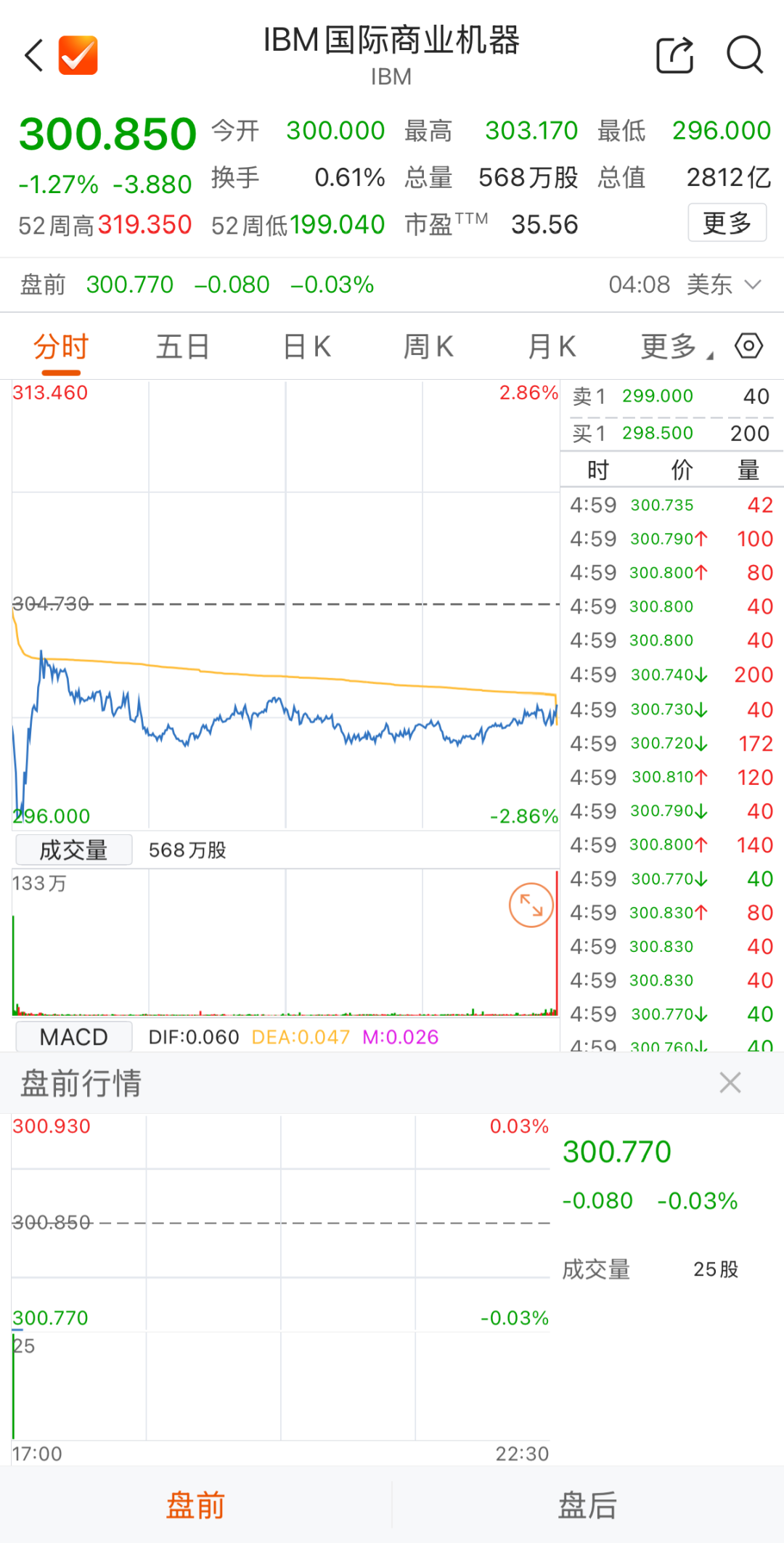
Group 1 - IBM plans to initiate a new round of global layoffs in Q4, potentially affecting thousands of employees, while shifting focus towards high-growth software and services [1] - The layoffs will impact a "low single-digit percentage" of the total workforce, with the company expecting overall employment in the U.S. to remain stable compared to the previous year [1] - As of the end of 2024, IBM's total global workforce is projected to be 270,000 [1] Group 2 - IBM reported Q3 revenue of $16.3 billion, a year-over-year increase of 9.1%, and a net profit of $1.74 billion, marking a return to profitability [2] - Company executives emphasized that accelerating innovation remains a priority, with ongoing strategic execution aimed at boosting revenue growth and enhancing profitability [2] - As of November 5, IBM's pre-market stock price was $300.77, reflecting a slight decrease of 0.03% [2]