贵金属

Search documents
黄金遭遇40年来最大下跌,XBIT美联储颠覆市场宽松预期波及贵金属与加密金融
Sou Hu Cai Jing· 2026-01-31 14:32
Core Viewpoint - The global financial market experienced significant turbulence, with gold prices witnessing the largest single-day drop since 1983, primarily driven by a shift in Federal Reserve policy expectations [1][3]. Group 1: Gold Market Impact - Gold prices fell from a historical high of $5598 per ounce to $4880 per ounce, marking a drop of nearly $670 within 30 hours, with a maximum intraday decline exceeding 12% [1][3]. - The Federal Reserve's decision to maintain the federal funds rate between 3.50% and 3.75% and the indication that interest rate cuts are not imminent led to a sharp decline in market expectations for rate cuts, with the probability for a March cut dropping from 30% to 13.5% [3][5]. - The significant sell-off in gold was exacerbated by algorithmic stop-loss orders being triggered as prices fell below key support levels, alongside increased margin requirements from major exchanges [5][6]. Group 2: Cryptocurrency Market Response - The cryptocurrency market, while not experiencing the same level of volatility, faced adjustments due to macro liquidity expectations, with a total market capitalization of approximately $2.98 trillion [6][8]. - XBIT, a leading compliant crypto financial service provider, highlighted that the shift in Federal Reserve policy would accelerate the filtering of less practical altcoins from the market, while Ethereum's Layer-2 upgrades and the tokenization of real-world assets (RWA) are expected to drive future growth [6][8]. - The market showed a divergence in asset preferences, with some institutions reducing Bitcoin holdings in favor of gold, reflecting differing views on the two asset classes [8]. Group 3: Future Outlook - XBIT anticipates that the recent drop in gold prices is a correction following excessive optimism, with ongoing geopolitical risks and central bank gold purchases providing long-term support for gold [8]. - The cryptocurrency sector may continue to experience short-term panic, but the long-term outlook remains positive due to regulatory advancements and technological iterations [8]. - The recent market turbulence underscores the profound impact of macroeconomic factors, with compliance and technology emerging as key competitive advantages for the crypto industry [8].


九卦 | 黄金“史诗级”大跌,提名“鹰派”惹的祸?
Sou Hu Cai Jing· 2026-01-31 14:14
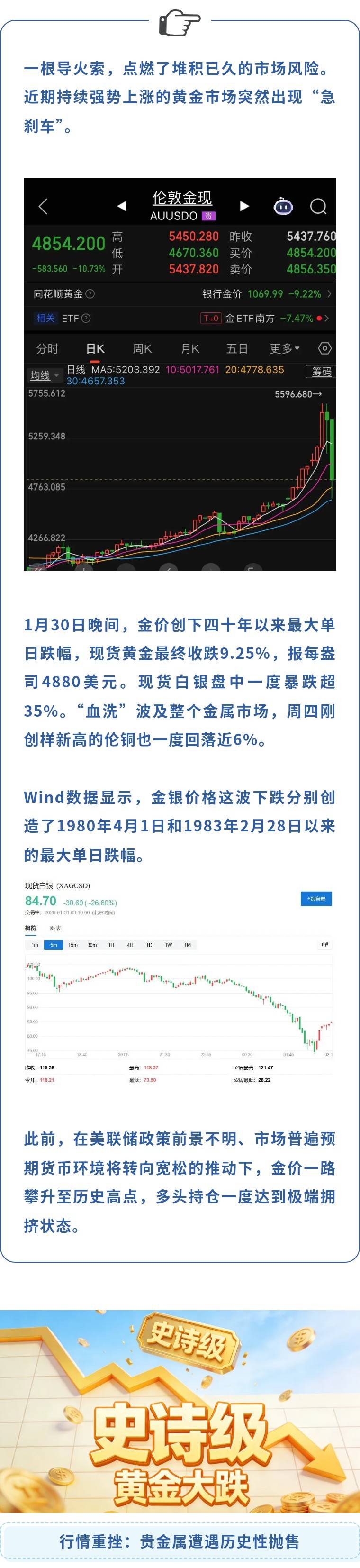
Core Viewpoint - The global precious metals market experienced a historic sell-off on January 30, with gold and silver prices plummeting significantly, marking the largest single-day declines in decades. This volatility was triggered by the nomination of Kevin Warsh as the next Federal Reserve Chairman, which raised concerns about future monetary policy tightening [6][7][10]. Group 1: Market Reaction - On January 30, gold prices fell by 9.25%, closing at $4,880 per ounce, while silver saw a drop of over 35% during trading [3][6]. - The sell-off was characterized by a rapid decline in prices, with gold losing nearly $500 in a single day, reflecting a shift in market sentiment from optimism to panic [13][15]. - The market had previously seen a sharp increase in gold prices, rising over 27% in January, which created a fragile market structure susceptible to sudden downturns [6][15]. Group 2: Causes of the Sell-off - The immediate catalyst for the market's reaction was the announcement of Kevin Warsh's nomination, which was interpreted as a signal that the Federal Reserve's monetary policy might not remain accommodative [10][12]. - Warsh's historical stance as a hawk raised fears of potential interest rate hikes, leading to a stronger dollar and reduced attractiveness of gold as an investment [10][12]. - The market's structure was already under strain due to rapid price increases, leading to a situation where leveraged positions were forced to liquidate, exacerbating the downward spiral [15][16]. Group 3: Market Dynamics - The sell-off highlighted the risks associated with speculative trading in precious metals, particularly in silver, which is more volatile and faced potential delivery risks in the futures market [19]. - The Chicago Mercantile Exchange announced increased margin requirements for gold and silver futures following the price drop, which could further impact trading dynamics [16]. - The overall market sentiment shifted from a focus on buying the dip to a rush to sell, indicating a rapid change in investor psychology [15][21]. Group 4: Long-term Outlook - Despite the short-term volatility, the fundamental drivers supporting gold—such as geopolitical risks, economic uncertainty, and inflation—remain intact, suggesting a potential recovery in the long run [19][20]. - Analysts suggest that the recent sell-off may provide an opportunity for investors who missed earlier gains to re-enter the market [20]. - A balanced approach to gold investment is recommended, emphasizing its role in risk diversification rather than speculative trading [21][22].
史诗级崩盘!有人爆仓有人想退货,黄金还香吗?
Feng Huang Wang Cai Jing· 2026-01-31 13:46
来源丨凤凰网《风暴眼》 历史上有两次黄金白银的暴涨,结局都异常惨烈。 第一次是1979-1980年,黄金一年内从200美元狂飙至850美元,白银从6美元冲上50美元。然而,狂欢转瞬即逝。触顶后短短两个月,黄金价格腰斩,白银 暴跌三分之二,随后市场进入长达二十年的"冰封期"。 第二次是2010-2011年,黄金从1000美元涨至1921美元,白银再次摸高50美元。暴涨之后,黄金回撤45%,白银跌去70%,随后又是多年的阴跌横盘,漫长 而磨人。 每一次,市场都以为"这次不一样"。但历史的剧本,似乎总在重复。 然而,历史经验一再表明,当一种资产蜕变为"无需思考"的全民共识时,它往往也就离阶段性的顶部不远了。 01 当"避险之王"成了最大风险 一觉醒来,市场再次上演惊魂一幕。黄金白银的暴跌,让无数人措手不及。 1月31日,黄金上演史诗级崩盘,盘中最大跌幅突破12%,最终收跌9.25%。白银更惨烈,单日最大跌幅达到36%,最终收跌26.4%,超过四分之一的市值 瞬间蒸发。 这不仅是数字的游戏,贵金属交易大多带着杠杆,如此断崖式下跌,意味着无数账户一夜爆仓,财富顷刻归零。 前两次暴涨,背后要么是石油危机与恶性通胀,要么是 ...
金银创纪录暴跌背后核心推手 分析称贵金属市场抛售或难以持续
Sou Hu Cai Jing· 2026-01-31 12:39
【#金银创纪录暴跌背后核心推手# #分析称贵金属市场抛售或难以持续#】本周,国际贵金属价格遭 遇"过山车"行情。[话筒]市场分析认为,美国总统特朗普30日提名美国联邦储备委员会前理事凯文·沃什 为下任美联储主席,加剧此次贵金属价格大跌。沃什曾公开批评量化宽松政策的副作用,认为美联储需 要与美国财政部在政策上更紧密地协作。[话筒]美国劳工部30日公布,2025年12月份和全年核心生产者 价格指数(PPI)均高于经济学家此前预期,显示通胀逐渐融入整体经济。生产者价格上涨可能迫使美 联储维持"中性"货币政策的时间长于预期,利空金价。[话筒]分析人士认为,经历近一个月来金银价格 暴涨,此次市场抛售在所难免。总部位于伦敦的布里坦尼亚全球市场公司资产经纪公司分析师表示,考 虑到1月份贵金属上涨的速度和幅度,此次回调并不出乎意料。[话筒]英国研究机构金属聚焦公司分析 师认为,近来贵金属上涨行情呈现非理性,但鉴于投资者面临持续的地缘政治风险和经济不确定性,市 场抛售或难以持续。#金价银价暴跌三大原因# 来源:@央视财经微博 ...
分析师:获利了结与对冲行为可能也助推了贵金属抛售
Xin Lang Cai Jing· 2026-01-31 12:17
格隆汇1月31日|周五金银的暴跌始于特朗普将提名沃什为美联储新任主席的报道。SLC管理公司董事 总经理德克·马拉基表示,沃什的履历带有鹰派色彩,这降低了美元全面贬值的风险。市场正在回归有 序的货币政策轨道。此外分析师们还提到,月末快速获利了结的交易员,或为防范突然下跌影响而进行 对冲操作的银行,也可能助推了这次贵金属抛售。BullionVault研究主管阿德里安·阿什表示,他已经参 与贵金属市场20年了,从没见过像现在这样的情况。但他淡化了散户投资者突然在周五撤出资金的可能 性,并指出了铜等基本金属市场的类似异常走势,例如铜期货周五下跌了4.5%。阿什还表示,只看金 银,很容易说这是散户的狂热,但基本金属市场没有散户参与。 ...
和讯投顾高璐明:黄金、白银历史大跌!下周会跳水吗?
Sou Hu Cai Jing· 2026-01-31 12:07
Core Viewpoint - The recent significant drop in gold and silver prices has raised concerns about the potential impact on the market in the coming week, particularly for the precious metals and non-ferrous sectors [1][2]. Group 1: Market Impact - Spot gold experienced a drop of over 10 points, closing at $4,884, marking the largest single-day decline in nearly 40 years [1]. - Spot silver also saw a substantial decline of over 27%, closing at $85, which is the largest single-day drop in history [1]. - The recent sell-off in precious metals is expected to create short-term risks for the gold concept and the non-ferrous sector in the upcoming week [1]. Group 2: Factors Influencing Recovery - The potential for recovery in gold and silver prices depends on three key factors: 1. The escalation of external geopolitical tensions, as gold and silver are often viewed as safe-haven assets [1]. 2. The ongoing purchasing activities of central banks, with domestic and many foreign central banks continuing to buy gold and silver, which supports long-term price expectations [2]. 3. The alleviation of external inflation and the Federal Reserve's ability to maintain a dovish stance on interest rates, with indications that rate cuts are likely in the future [2]. Group 3: Short-term Market Sentiment - The recent sell-off has put downward pressure on the overall index, which is expected to continue into the next week, indicating further potential declines [2]. - Despite the short-term risks, there is an expectation that once the market stabilizes, there could be a subsequent upward movement in prices, although this may take additional time [2].
金价银价暴跌,原因何在?
Sou Hu Cai Jing· 2026-01-31 10:48
美国劳工部30日公布2025年12月份和全年核心生产者价格指数(PPI)均高于经济学家此前预期,显示 通胀逐渐融入整体经济。PPI上涨可能迫使美联储维持"中性"货币政策的时间长于预期,利空金价。 分析人士认为,经历近一个月来金银价格暴涨,此次市场抛售在所难免。总部位于伦敦的布里坦尼亚全 球市场公司资产经纪公司分析师表示,考虑到1月份贵金属上涨的速度和幅度,此次回调并不出乎意 料。 美东时间1月30日,国际市场黄金、白银价格继续大幅下跌,均创下数十年来最大单日跌幅。纽约商品 交易所4月黄金期价一度跌破每盎司4800美元关口,跌幅超过10%;3月白银期价一度跌破每盎司80美元 关口,跌幅超过30%。 市场分析认为,美国总统特朗普30日提名美国联邦储备委员会前理事凯文·沃什为下任美联储主席,加 剧此次贵金属价格大跌。沃什曾公开批评量化宽松政策的副作用,认为美联储需要与美国财政部在政策 上更紧密地协作。 英国研究机构金属聚焦公司分析师认为,近来贵金属上涨行情呈现非理性,但鉴于投资者面临持续的地 缘政治风险和经济不确定性,市场抛售或难以持续。 ...
贵金属遭遇重挫,原因几何前景如何?|国际
清华金融评论· 2026-01-31 10:34
文/《清华金融评论》 王茅 但是 沃什 的主张在现实层面将面临重重阻力。一是来自特朗普的。特朗普提名 沃什 担任下一届美联储主席,两人很可能在某些方面达成了 "共识"。如 果未来 沃什 的政策主张,妨碍了特朗普的行动,那 沃什 无疑会面临比现任鲍威尔更大的压力。二是来自美联储内部的,倘若 沃什 真的推动缩表,那他 在美联储内部将面临其他两股力量的制衡,不支持降息支持扩表的,降息扩表并举的。 更重要的是,大规模缩表,美联储能做到吗,美联储扩表购买的主要是美国国债,如果缩表,谁来承接美国政府的债务? 获利盘集中抛售 。 2026年 1月 , 黄金 价格 累计涨幅 已超 30%,白银涨超 达 60%,短期投机盘获利了结 , 这 引发 了市场的 抛售潮。 相比之下, 白银 因流动性 相对较 差、杠杆更高, 导致 跌幅 更为显著 。 杠杆资金踩踏效应 。 一些 交易所提高保证金比例,触发程序化止损 交易 ,形成 "抛售→下跌→强制平仓"恶性循环,这放大了 市场的 波动程度。 贵金属前景展望 未来 1至3个月,贵金属价格可能以 震荡调整为主 , 市场需消化政策不确定性,白银因波动剧烈或弱反弹后延续震荡,黄金支撑位在 47 ...

和讯投顾朱健飞:大科技卷土重来,黄金静候2波?
Sou Hu Cai Jing· 2026-01-31 09:52
Group 1 - The core viewpoint suggests that the recent performance of technology stocks, particularly in the ChiNext index, indicates a potential shift in market dynamics, moving away from precious metals and resource stocks [1][3] - The technology sector's recent surge is characterized as either a rotation or an offensive move, with the CPU sector showing strong performance after a prolonged adjustment period, indicating investor confidence [2][3] - The adjustment in precious metals, particularly gold and silver, is viewed as a first-time correction, with expectations that the cycle of rotation among various resource sectors is not yet over [3] Group 2 - The rise in technology stocks, especially in AI applications, would signify a market offensive, but the current gains are primarily attributed to the CPU sector, which has been consolidating at high levels [2] - The market's rotation is evident as funds shift from declining resource stocks to lower-valued sectors, indicating a broader strategy of capital reallocation [1][2] - The ongoing strength in the CPU sector suggests a complex investment landscape, where long-term expectations are clear, but short-term volatility remains a concern [2]
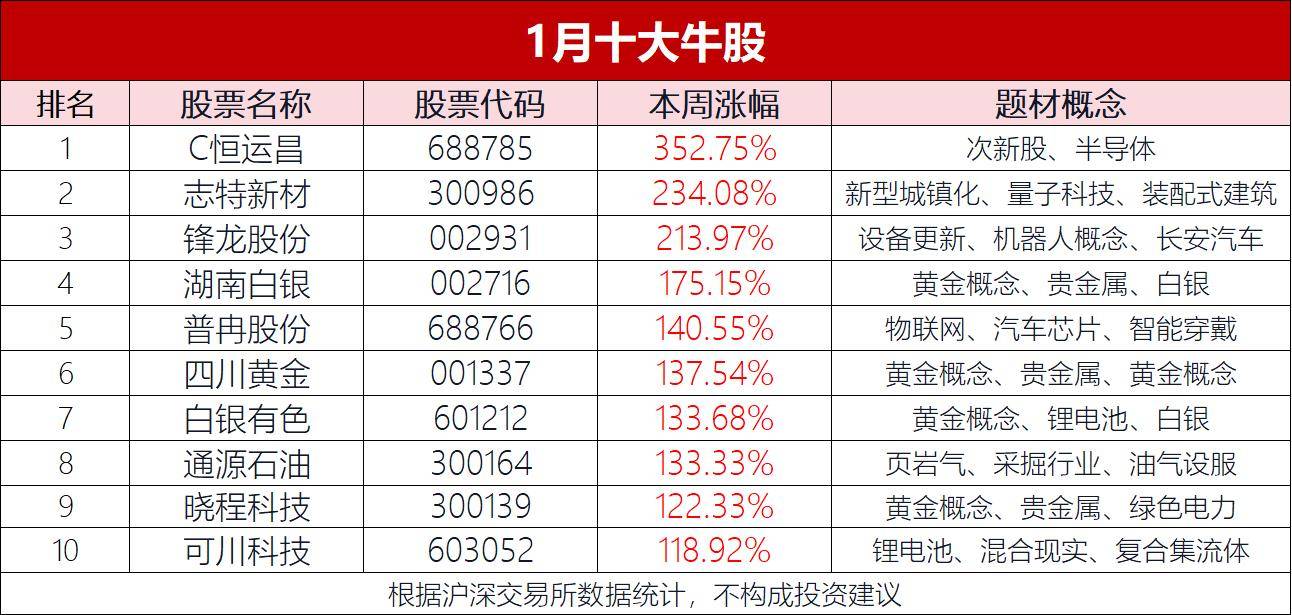
1月十大牛股:最牛恒运昌暴涨352%,志特新材连续20cm涨停,18连板“妖王”锋龙股份屈居第三,湖南白银、四川黄金、白银有色等霸榜
Sou Hu Cai Jing· 2026-01-31 09:46
Market Overview - In January 2026, the A-share market opened strong with the Shanghai Composite Index rising by 3.76%, the Shenzhen Component Index increasing by 5.03%, the ChiNext Index up by 4.47%, and the STAR Market 50 Index soaring by 12.29% [1] - Various sectors such as gold, silver, non-ferrous metals, AI applications, and domestic chips showed strong performance, indicating high market sentiment [1] Top Performing Stocks - The top ten performing stocks in January include: 1. C Hengyun Chang (688785) - 352.75% increase, focusing on semiconductor equipment [2] 2. Zhi Te New Materials (300986) - 234.08% increase, involved in new urbanization and quantum technology [2] 3. Fenglong Co. (002931) - 213.97% increase, related to equipment updates and robotics [2] 4. Hunan Silver (002716) - 175.15% increase, linked to gold concepts and precious metals [2] 5. Pushe Co. (688766) - 140.55% increase, focusing on IoT and automotive chips [2] 6. Sichuan Gold (001337) - 137.54% increase, associated with gold concepts and precious metals [2] 7. Silver Nonferrous (601212) - 133.68% increase, involved in gold concepts and lithium batteries [2] 8. Tongyuan Petroleum (300164) - 133.33% increase, related to shale gas and the extraction industry [2] 9. Xiaocheng Technology (300139) - 122.33% increase, focused on gold concepts and precious metals [2] 10. Kecuan Technology (603052) - 118.92% increase, involved in lithium batteries and mixed reality [2] Sector Insights - C Hengyun Chang's significant rise is attributed to its position as a leading supplier of core components for semiconductor equipment, marking a new investment opportunity in the market [2] - Zhi Te New Materials has transitioned from traditional construction aluminum mold services to new materials, leveraging AI and robotics for development [2] - Fenglong Co.'s stock surge is linked to a strategic acquisition that connects it with a leading humanoid robotics company, altering its ownership structure [3] - Hunan Silver benefits from favorable macroeconomic conditions, including geopolitical risk and interest rate cuts, enhancing its market position as a leading silver processing company [3] - Sichuan Gold's stock performance is closely tied to historical highs in global gold prices, driven by geopolitical tensions and trade friction, benefiting from increased sales and prices of gold concentrates [3] - Silver Nonferrous plans to invest 1.5 billion yuan to establish a gold company, indicating a strategic move to extend its operations into the entire gold industry chain [3] - Xiaocheng Technology's stock fluctuations are primarily due to its dominant gold business, which constitutes over 86% of its revenue, making it a direct beneficiary of rising gold prices [4] - Pushe Co. is strategically positioned in the storage industry, which is experiencing a "super cycle" driven by rapid AI infrastructure development [4] - Tongyuan Petroleum is benefiting from a cyclical recovery in the oil and gas service sector, supported by geopolitical tensions and rising international energy demand [4] - Kecuan Technology is expanding into the silicon photonics sector, aligning with current market trends in computing hardware [4]