
公用事业

Search documents
基金研究周报:全球权益共振,黄金续创新高(9.8-9.12)
Sou Hu Cai Jing· 2025-09-14 13:31
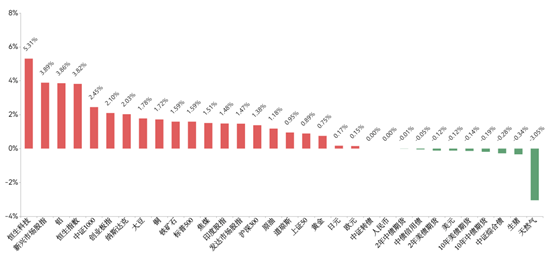
Market Overview - The A-share market showed structural activity driven by policy expectations and technology themes, with the Wind All A index rising by 2.12% from September 8 to September 12, and the Sci-Tech 50 leading with a 5.48% increase, indicating strong market preference for technology growth sectors [1] - The Shanghai Composite Index increased by 1.52%, the Shenzhen Index by 2.65%, and the ChiNext Index by 2.10% during the same period [1] - The communication sector performed notably due to increased demand for optical devices and higher capital expenditures from operators, while the pharmaceutical and biotechnology sector declined by 0.64%, reflecting market concerns over deepening centralized procurement policies and risks in innovative drug development [1] Industry Performance - The average increase of Wind's first-level industry indices was 2.05%, with 90% of the Wind Top 100 concept indices rising [1][12] - All sectors except for biomedicine saw positive performance, with communication, agriculture, forestry, animal husbandry, and fishery, and electronics sectors rising by 5.24%, 5.00%, and 4.93% respectively [1][12] - The real estate, machinery, and construction materials sectors experienced slight increases, while the oil, petrochemical, and coal sectors lagged, with increases of only 0.30% and 0.16% respectively [1][12] Fund Issuance - A total of 39 funds were issued last week, including 18 equity funds, 13 mixed funds, 5 bond funds, and 3 FOF funds, with a total issuance of 21.794 billion units [2][14] Fund Performance - The Wind All Fund Index rose by 1.17%, with the ordinary equity fund index increasing by 2.13% and the mixed equity fund index by 2.40%, while the bond fund index fell by 0.06% [2][8]

政策定调,储能迎来产业空间和盈利空间双提升
Guotou Securities· 2025-09-14 02:02
Investment Rating - The industry investment rating is maintained at "Outperform the Market - A" [6] Core Insights - The report highlights a significant increase in domestic and international energy storage system bidding and shipment volumes, with domestic bidding capacity reaching 47.2 GWh in August 2025, a year-on-year increase of 2158% and a month-on-month increase of 1142% [1][19] - The new energy storage construction plan for 2025-2027 aims for an annual installed capacity of at least 85 GWh, driving direct project investments of approximately 250 billion yuan [2][32] - The establishment of energy storage as an independent market entity is expected to enhance its role in electricity balancing and pricing [35] Summary by Sections 1. Industry Overview - Domestic energy storage system bidding has rapidly increased, with a cumulative bidding volume of 144.1 GWh from January to August 2025, reflecting a year-on-year growth of about 216% [1][19] - Internationally, Chinese companies secured 199 overseas energy storage orders in the first half of 2025, totaling over 160 GWh, marking a year-on-year increase of 220.28% [24][27] 2. Market Information Tracking - In September 2025, the average transaction price for electricity in Jiangsu was 319.48 yuan/MWh, down 18.29% from the benchmark price [51] - The average price of thermal coal in the Bohai Rim region was reported at 675 yuan/ton as of September 10, 2025, reflecting a slight increase [53] 3. Investment Recommendations - The report suggests focusing on new energy storage-related companies such as Xizi Clean Energy, Lin Yang Energy, and Tongli Risen [2] - In the renewable energy sector, companies like Fuhua Energy and Zhongmin Energy are recommended due to improved cash flow from renewable energy subsidies [13] - For gas companies, China Gas is highlighted as a key player due to its significant residential gas consumption [13] 4. Industry Dynamics - The new energy storage construction plan aims for a cumulative installed capacity of over 180 million kW by 2027, with a focus on lithium-ion battery storage technology [32] - The report emphasizes the importance of establishing a reliable capacity compensation mechanism for energy storage to ensure its profitability [35]
埃利奥特押注日本核电 关西电力成“新猎物”
智通财经网· 2025-09-11 13:52
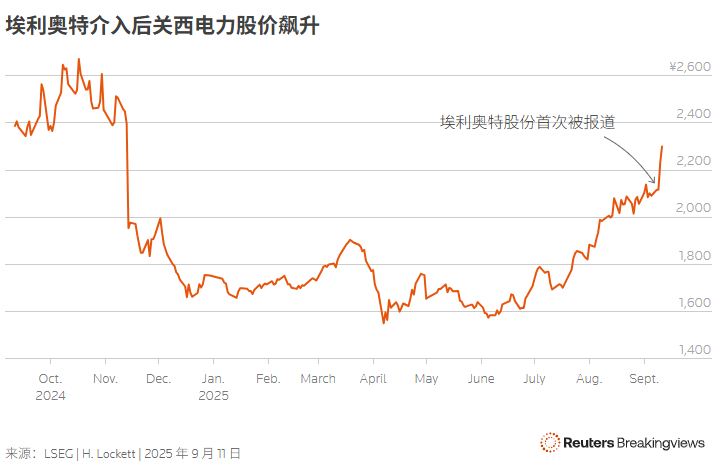
Core Insights - Elliott Management has acquired nearly 5% of Kansai Electric Power, a major Japanese utility company valued at $17 billion, prompting discussions on enhancing investor returns and divesting non-core assets valued over ¥2 trillion (approximately $13.6 billion) [1][4] - The company's price-to-book ratio is only 0.7, significantly below the Tokyo Stock Exchange's standard of 1:1, indicating potential undervaluation [4] - Elliott's proposed strategy includes raising large customer electricity prices, increasing dividends from ¥60 to approximately ¥100 per share (about 30% of earnings), selling around ¥150 billion in non-core assets annually, and using proceeds for stock buybacks and capital expenditures in core energy operations [4] Company Overview - Kansai Electric Power is a key player in Japan's energy security, operating half of the 24 nuclear reactors that have restarted since the Fukushima disaster in 2011 [4] - The company attempted to raise ¥500 billion through the stock market in November but faced a significant drop in stock price, raising only about ¥400 billion [4] - The Japanese government is increasing investments in nuclear power to reduce reliance on imported fossil fuels and liquefied natural gas [4] Market Implications - Elliott's strategy for Kansai Electric mirrors its previous successful investment in Tokyo Gas, where the stock price surged by 50% since the acquisition [5] - This move may prompt a reevaluation of investment opportunities in the energy sector and other sensitive industries that have not yet been fully explored [5]
Best Moves For Income Investors As Rate Cuts Loom
Investors· 2025-09-11 11:00
Core Insights - The Federal Reserve is likely to begin lowering interest rates due to weak job growth, with Wall Street predicting a high probability of rate cuts in upcoming meetings [1][4][5] - Current borrowing costs are at 4.25% to 4.5%, and a significant reduction in rates could occur by next year, potentially lowering them to a range of 2.75% to 3% [2][5] - The implications of rate cuts will affect savers, retirees, and bond investors, leading to lower yields on savings accounts and CDs [6][7][10] Impact on Savers - Rate cuts will lead to immediate reductions in interest earned on savings accounts and CDs, with current yields potentially dropping from around 4% to 3.25% by year-end [8][11] - Savers are advised to lock in higher rates by purchasing CDs before the Fed cuts rates further [10][11] Impact on Bond Investors - Bond prices are expected to rise as interest rates fall, allowing investors to lock in higher yields and benefit from capital appreciation [13][16] - Investors are encouraged to diversify into intermediate-term bonds and consider investment-grade bonds or bond funds with durations of six to seven years [15][16] Impact on Borrowers - Fed rate cuts will lower rates on variable debt like HELOCs, but fixed-rate mortgages may not see significant reductions due to their ties to the 10-year Treasury note [22][24] - Homeowners are advised to wait for more substantial rate cuts before refinancing or taking out new loans [27][28] Impact on Stock Investors - While the S&P 500 yields about 1.25%, investors seeking income may consider higher-paying dividend stocks, particularly in the utilities sector, which is expected to benefit from structural growth [30][31]
中泰国际每日晨讯-20250911
ZHONGTAI INTERNATIONAL SECURITIES· 2025-09-11 01:49
Market Performance - On September 10, the Hang Seng Index rose by 262 points or 1.01%, closing at 26,200 points, stabilizing above the 26,000 mark[1] - The Hang Seng Tech Index increased by 1.3%, closing at 5,902 points, with total market turnover exceeding HKD 288.2 billion[1] - Net inflow from the Hong Kong Stock Connect was HKD 7.567 billion[1] Sector Performance - Key sectors such as banking, insurance, telecommunications, internet, real estate, and transportation showed significant gains, with major stocks like Tencent and Alibaba rising by 1.0% and 0.6% respectively[1] - AI-related stocks like WanGuo Data and Kingsoft Cloud surged over 6.0%[1] - The four major domestic banks saw increases between 1.9% and 3.5%, with Agricultural Bank of China leading the performance[1] Macroeconomic Indicators - China's August CPI decreased by 0.4% year-on-year, the lowest since February, primarily due to falling food prices[2] - Core CPI rose by 0.9% year-on-year, marking the highest since June 2022, indicating a positive signal[2] - August PPI fell by 2.9% year-on-year, with a narrowing decline compared to July, while durable goods PPI dropped by 3.7%, the largest decline in five months[2] Real Estate Market - New home sales in 30 major cities reached 1.29 million square meters, up 3.7% year-on-year, but down 30.3% month-on-month[5] - The sales-to-inventory ratio for major cities was 101.2, higher than last year but lower than the previous week[7] - Land transaction volume in 100 major cities fell by 43.5% year-on-year, indicating a significant decline in market activity[8] Policy Adjustments - Shenzhen has optimized housing purchase and credit policies, allowing families to buy unlimited properties in certain districts[9] - Continuous policy adjustments in various cities are expected to support the real estate market, particularly during the "Golden September and Silver October" period[11]
震荡市安全边际凸显 红利资产成资金配置焦点
Zheng Quan Shi Bao· 2025-09-10 22:42
Core Viewpoint - The A-share market has experienced fluctuations and adjustments since September, with an increase in risk aversion, leading some funds to shift towards dividend assets characterized by low valuations and high dividends [1] Market Overview - Since September, the Shanghai Composite Index has declined by 1.18%, indicating a volatile market with structural characteristics becoming more pronounced [2] - Industries such as defense, computer, and electronics have seen significant pullbacks, with the defense industry index dropping over 10% [2] - Conversely, cyclical industries like electric equipment, non-ferrous metals, and public utilities have strengthened, with electric equipment industry rising over 5% [2] Stock Performance - Over 3,000 stocks have declined since September, with over 450 stocks falling more than 10%, while over 400 stocks have increased by more than 10% [3] - Stocks that have risen by at least 10% exhibit notable high dividend characteristics, with the average market capitalization of these "big gainers" being below 15 billion, compared to nearly 19 billion for "big losers" [4] Dividend Assets - High dividends are a significant feature of the stocks that have surged in September, with dividend assets attracting considerable capital [5] - As of September 9, the overall stock market saw a net outflow of over 8 billion in stock ETFs, while dividend-themed ETFs experienced a net inflow of over 800 million [5] - Financing balances in industries like electric equipment and non-ferrous metals have increased, with electric equipment seeing a rise of over 15% [5] Stability and Risk Buffer - Dividend assets have shown significant anti-drawdown characteristics during market downturns, outperforming the Shanghai Composite Index in several instances since 2020 [6][7] - The dividend index has a lower price-to-earnings ratio compared to other indices, indicating a more attractive valuation for risk-averse investors [8] Investment Strategy - The dividend sector, characterized by low valuations and high dividend yields, serves as a strong defensive choice in a volatile market [9] - The consumer sector, while undervalued, offers stable dividend returns and growth potential, suitable for long-term investors [9] - The technology sector, despite its high growth potential, presents certain investment risks due to lower dividend yields and relatively high valuations [9]
震荡市安全边际凸显红利资产成资金配置焦点
Zheng Quan Shi Bao· 2025-09-10 18:09
Market Overview - Since September, the A-share market has experienced fluctuations and adjustments, with increased risk aversion leading some funds to shift towards dividend assets characterized by low valuations and high dividends [1] - The Shanghai Composite Index has dropped by 1.18% since September, indicating a structural divergence in the market [2] Sector Performance - The defense, computer, and electronics sectors, which previously led the market, have seen significant corrections, with the defense sector index declining over 10% [2] - Conversely, cyclical sectors such as electric equipment, non-ferrous metals, and public utilities have strengthened, with the electric equipment sector rising over 5% [2] - The strong performance of cyclical sectors is attributed to steady demand recovery and the appeal of high dividend yields in the current market environment [2] Stock Characteristics - Over 3,000 stocks have declined since September, with more than 450 stocks falling over 10%, while over 400 stocks have risen more than 10% [3] - Stocks that have increased by at least 10% exhibit significant high dividend characteristics, with their average market capitalization below 15 billion and average P/E ratios lower than those of declining stocks [4] Fund Flows - Dividend assets have attracted significant capital, with dividend-themed ETFs seeing a net inflow of over 800 million, while other sectors like technology and AI have experienced substantial outflows [5] - Financing balances in sectors such as electric equipment and non-ferrous metals have increased, while sectors like defense and computing have seen declines [5] Stability and Risk Buffer - Dividend assets have shown notable resilience during market downturns, outperforming the Shanghai Composite Index in several instances since 2020 [6][7] - The dividend index has a lower P/E ratio compared to consumer and technology indices, indicating a more attractive valuation for risk-averse investors [8] Investment Strategy - The dividend sector is seen as a strong defensive choice in a volatile market, while the consumer sector offers stable returns and growth potential for long-term investors [9] - The technology sector, despite its high growth potential, carries investment risks due to lower dividend yields and higher valuations [9]
涉多只热门股!两大指数,正式发布!
Zheng Quan Shi Bao· 2025-09-10 11:50
Core Viewpoint - The launch of the CSI A500 Growth Index and CSI A500 Value Index provides diversified investment options for the market, reflecting the performance of representative listed companies in various industries in China [2][5]. Group 1: Index Launch Details - The CSI A500 Growth Index and CSI A500 Value Index were officially launched on September 10, 2025, by the China Securities Index Co., Ltd. [2][6]. - Both indices consist of 100 securities selected from the CSI A500 Index sample, which is considered the Chinese equivalent of the S&P 500 [2][3]. - The CSI A500 Growth Index is based on growth factor scores, while the CSI A500 Value Index is based on value factor scores, both using a base date of December 31, 2014, and a base point of 1000 [4][5]. Group 2: Index Composition and Characteristics - The CSI A500 Growth Index focuses on companies with high growth characteristics, using metrics such as average revenue growth rate, average net profit growth rate, and quarterly ROE year-on-year [2][4]. - As of September 9, 2025, the top sectors in the CSI A500 Growth Index include Industrial and Information Technology, each with weights exceeding 20%, while Communication Services, Materials, and Consumer Discretionary exceed 10% [3][5]. - The top ten weighted stocks in the CSI A500 Growth Index include Ningde Times, Zijin Mining, and BYD, with several being recent high-performing stocks [3][5]. Group 3: Value Index Characteristics - The CSI A500 Value Index selects securities based on value factor scores, utilizing metrics such as dividend yield, price-to-book ratio, cash flow to price ratio, and earnings to price ratio [4][5]. - The leading sectors in the CSI A500 Value Index are Financials and Industrials, each with weights over 20%, while Consumer Discretionary and Materials exceed 10% [4][5]. - The top ten weighted stocks in the CSI A500 Value Index include Gree Electric Appliances, China Ping An, and China Construction, indicating a focus on established companies with strong value characteristics [4][5]. Group 4: Upcoming Indices - In addition to the two indices launched, four more indices will be released on September 11, 2025, including the CSI A500 Relative Growth Index, CSI A500 Relative Value Index, CSI A500 Pure Growth Index, and CSI A500 Pure Value Index [6][7]. - The upcoming indices will assess both growth and value characteristics, with specific methodologies for selecting securities based on their respective styles [7].
大众公用上半年净利增173%,董事长杨国平年近七旬、三年来薪酬翻倍
Sou Hu Cai Jing· 2025-09-10 10:41
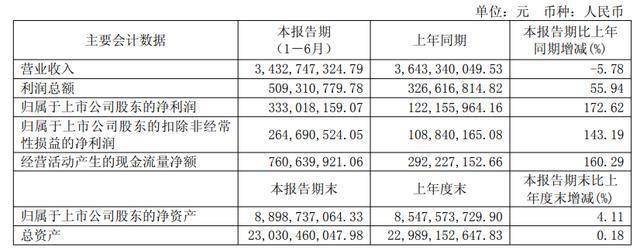
Core Insights - The company reported a decline in revenue but a significant increase in net profit for the first half of 2025, indicating improved profitability despite lower sales [1][2] Financial Performance - Revenue for the first half of 2025 was CNY 3.43 billion, a decrease of 5.78% compared to the same period last year [1] - Total profit reached CNY 509.31 million, reflecting a year-on-year increase of 55.94% [1] - Net profit attributable to shareholders was CNY 333.02 million, up 172.62% year-on-year [1] - The net profit excluding non-recurring gains and losses was CNY 264.69 million, an increase of 143.19% compared to the previous year [1] - Basic earnings per share stood at CNY 0.11 [1] Profitability Metrics - Gross margin for the first half of 2025 was 19.21%, an increase of 2.49 percentage points year-on-year [2] - Net profit margin improved to 12.42%, up 6.15 percentage points from the previous year [2] Expense Management - Total operating expenses for the first half were CNY 393 million, a reduction of CNY 27.46 million compared to the same period last year [2] - The expense ratio was 11.44%, a slight decrease of 0.09 percentage points year-on-year [2] - Sales expenses increased by 7.06%, while management expenses decreased by 14.31% [2] Shareholder Equity - As of the end of the reporting period, net assets attributable to shareholders were CNY 8.90 billion, a 4.11% increase from the end of the previous year [1] - Total assets amounted to CNY 23.03 billion, reflecting a marginal increase of 0.18% [1]

美国8月非农:美国就业市场持续弱化,降息在即
LIANCHU SECURITIES· 2025-09-10 07:53
Employment Data - In August, the U.S. non-farm payrolls increased by only 22,000, significantly below the expected 75,000 and the previous value of 79,000[3] - The unemployment rate rose slightly to 4.3%, matching expectations but up from 4.2%[3] - The Labor Department revised the non-farm employment data for June and July, resulting in a total downward adjustment of 21,000 jobs[3] Sector Performance - The goods-producing sector saw a job loss of 25,000, continuing a downward trend, while the service sector added 63,000 jobs, down from 85,000 in the previous month[4] - Notably, the manufacturing sector lost 12,000 jobs, and government employment decreased by 16,000[11] Market Implications - Following the employment data release, the market anticipates a 25 basis points rate cut by the Federal Reserve in September and October, with some speculation about a potential 50 basis points cut in September[3] - The short-term U.S. Treasury yields have declined rapidly, while long-term yields have remained relatively stable[5] Economic Outlook - The labor market is showing signs of weakness, but the unemployment rate has not increased significantly, suggesting that the Federal Reserve may not act too quickly on rate cuts[4] - The market is closely monitoring the upcoming CPI data on September 11, which will provide further insights into inflation trends[5] Risks - There are risks associated with the U.S. economy potentially declining more than expected, as well as uncertainties surrounding monetary and fiscal policies[51]