
外卖

Search documents
每经热评︱阿里的双重突围
Mei Ri Jing Ji Xin Wen· 2025-09-01 13:14
Core Viewpoint - Alibaba's stock surged nearly 18.5% following the release of its Q1 FY2026 earnings report, driven by strong revenue and profit growth, and a strategic focus on "AI + Cloud" and "Human Consumption" [1][6] Financial Performance - Total revenue for the quarter reached 247.65 billion yuan, a year-on-year increase of 2% [1] - Net profit was 42.38 billion yuan, showing a significant year-on-year growth of 76% [1] Strategic Direction - Alibaba's strategy is characterized by a dual focus on "AI + Cloud" for technological advancement and "Human Consumption" to meet consumer needs [2][6] - The company has committed over 1 billion yuan in AI infrastructure and product development over the past four quarters, with plans to invest more than 380 billion yuan in the next three years [3] Cloud Business Growth - Alibaba Cloud's revenue grew by 26% year-on-year to 33.40 billion yuan, marking a three-year high [3] - AI revenue from Alibaba Cloud now accounts for over 20% of external commercial revenue [3] E-commerce Strategy - The e-commerce landscape is highly competitive, with players like Pinduoduo and Douyin reshaping consumer habits [4] - Alibaba has integrated Ele.me with Taobao Flash Sale and invested heavily in subsidies to enhance its market position [4][5] Market Position and User Engagement - Ele.me's market share in the food delivery sector increased from 13% to 28%, making it a leading player in the ongoing delivery battle [4] - Taobao Flash Sale's monthly active users surpassed 300 million, reflecting a 200% increase since April [4][5] Synergistic Growth - The integration of high-frequency local services with e-commerce creates a "virtuous growth cycle," enhancing user experience and driving core e-commerce growth [5] - The dual strategy of "AI + Cloud" and "Human Consumption" supports each other, providing a solid foundation for Alibaba's long-term development [6]

外卖“三国杀”,阿里成最大赢家?
财富FORTUNE· 2025-09-01 13:06
Core Insights - The article discusses the unprecedented competition in China's food delivery market among Meituan, Alibaba (Ele.me), and JD.com, leading to a significant reshaping of the market landscape and varying financial impacts on the companies involved [2][3]. Market Dynamics - The market share has shifted from "741" (Meituan 74%, Ele.me 13%, others 7%) to "631" (Meituan 65%, Ele.me 28%, JD.com 7%) [2]. - The overlapping user base among the three companies reached 388 million, a year-on-year increase of 22.8%, indicating a trend towards multi-platform usage [2]. Financial Performance - Meituan's Q2 2025 revenue was approximately 91.84 billion yuan, a year-on-year increase of 11.7%, but its adjusted net profit fell by 89% to about 1.493 billion yuan, with a significant drop in operating profit margin from 25.1% to 5.7% [2]. - Alibaba reported Q2 revenue of 247.6 billion yuan, a 2% year-on-year increase, but its Non-GAAP net profit decreased by 18% due to substantial investments in the food delivery sector [3]. - JD.com experienced a nearly halved net profit despite exceeding 350 billion yuan in total revenue for Q2, with a 35% increase in cross-selling from new users acquired through food delivery [4]. Strategic Moves - Alibaba's launch of "Taobao Flash Purchase" has rapidly increased its user base and order volume, with monthly active users surpassing 300 million and peak daily orders reaching 12 million [3]. - Meituan announced a support plan for small and medium-sized merchants, indicating an increase in operational costs and continued pressure on short-term performance [2]. Investment and Future Outlook - Alibaba's capital expenditure on cloud computing and AI reached 38.6 billion yuan in Q2, a 220% year-on-year increase, with significant returns seen in cloud revenue growth [5]. - The competition is expected to evolve towards service differentiation and operational efficiency, with all three companies committing to avoid malicious competition and regulate promotional behaviors [6]. Market Reactions - Following Alibaba's earnings report, its stock surged by 13%, while JD.com and Meituan saw declines of approximately 10% and 32% respectively, indicating investor confidence in Alibaba's strategic direction [5].




百亿基金经理隐形重仓股曝光!张坤、葛兰、傅鹏博这样操作
证券时报· 2025-09-01 11:40
Group 1: Core Views - The article highlights the recent movements of prominent fund managers in the public fund sector, focusing on their investment strategies and stock adjustments in response to market conditions [1][4][5]. Group 2: Zhang Kun's Strategy - Zhang Kun has reduced his holdings in Meituan by 46.43% while increasing his position in Beike, indicating a shift towards domestic demand logic [1][3]. - The E Fund Blue Chip Select Fund, managed by Zhang Kun, has a current size of 34.943 billion and a year-to-date return of 12.85% [3]. - The fund's hidden heavyweights include Focus Media and Meituan, with Focus Media's holdings increasing by 13.76% [3]. - Zhang Kun believes that the current pessimism regarding domestic demand is unfounded and anticipates a positive feedback loop in domestic consumption [4]. Group 3: Ge Lan's Focus - Ge Lan's China Europe Medical Health Fund has achieved a year-to-date return of 28.82%, with significant investments in the innovative drug sector [5][6]. - The fund's hidden heavyweights include Huadong Medicine and Zai Lab, with a notable increase of 2627.32% in holdings of Ailis [6]. - Ge Lan emphasizes that innovation, consumption recovery, and domestic substitution will drive the pharmaceutical industry in the second half of 2025 [6]. Group 4: Fu Pengbo's Approach - Fu Pengbo's Ruiyuan Growth Value Fund has a year-to-date return of 48.50%, focusing on high-growth companies [7][8]. - The fund has significantly increased its holdings in Alibaba and BYD by 161.10% and 184.78%, respectively [8][9]. - Fu Pengbo plans to continue focusing on sectors such as electronics, internet technology, and precision manufacturing, while also adapting to market volatility [9].

某外卖厂两大高管离职另有隐情;某社区电商公司撒钱式挖人;上海某游戏中厂可能裁员百人丨大厂情报局Vol.4
雷峰网· 2025-09-01 10:21
Group 1: Executive Departures at Company A - Two executives from Company A recently left, with rumors suggesting a fallout with the founder, but insiders indicate different reasons for their departures [2][3] - Executive A was found to have violated anti-corruption rules by secretly investing in a hotel while signing a contract, leading to a three-month "cooling-off" period before leaving [2] - Executive B's aggressive spending strategy on community group buying led to significant cash burn without profitability, resulting in a strategic halt and subsequent resignation [3] Group 2: Challenges in Company B's Game Development - Company B's shooting game, developed over five to six years with costs in the hundreds of millions, is facing potential layoffs of 100 out of 400 team members due to underperformance [4] - The game has struggled to retain players, with its core gameplay not meeting current market standards, amidst a highly competitive landscape dominated by major players [4] Group 3: Changes in Company C's Leadership Style - Executive C, known for a decisive and results-oriented approach, has adopted a more low-profile style after transitioning to oversee overseas operations, indicating a strategic shift rather than a demotion [5] - The new role involves building a team tailored to the overseas market, showcasing adaptability and a focus on business needs [5] Group 4: Company D's Live Streaming Business Dynamics - Company D's live streaming segment has seen a rise in group broadcasts, which are highly effective for monetization, but there are concerns about the long-term impact on community engagement [7] - The current strategy may yield short-term financial benefits but risks altering the community's character if overemphasized [7] Group 5: Executive E's Ascension in Company E - Executive E is viewed as a "prince" within Company E, rapidly promoted and consistently securing key resources, though opinions on his contributions vary [8] - While some credit him with significant business development, others suggest his role was more about managing expectations and securing resources rather than direct involvement in early-stage growth [8] Group 6: Company F's Aggressive Hiring Strategy - Company F has been actively recruiting employees from major firms like ByteDance and Xiaohongshu, offering cash-only compensation packages, indicating strong cash flow and profitability [9][10] - This approach contrasts with typical compensation structures in the industry, which often include stock options and bonuses, highlighting F's financial strength [10] Group 7: Company G's Short Drama Success - Company G's short drama app has implemented a "blind box" script selection mechanism, resulting in an increase in hit rates from 30% to 50%, with some top-tier dramas achieving over 1 billion views [11] - This innovative approach aims to mitigate risks associated with high production costs while encouraging quality content creation [11] Group 8: Company H's Delivery Challenges - Company H's delivery capabilities are under pressure due to competitor I's aggressive recruitment of H's service providers and riders, leading to a decline in delivery performance metrics [12] - The delivery rate has dropped from 95%-96% to around 93% in some areas, with significant impacts in cities like Wuhan and Qingdao, raising concerns about H's competitive edge [12]

二季度利润暴跌89%,但这样的美团才可怕?
Hu Xiu· 2025-09-01 10:05
Group 1 - The core viewpoint of the article highlights a significant decline in Meituan's net profit, which plummeted by 89%, raising concerns about the sustainability of free delivery services in the food delivery market [1] - The article questions who the ultimate winner will be in the competitive food delivery industry, suggesting that the current financial performance of major players like Meituan may influence future market dynamics [1] Group 2 - The article emphasizes the impact of Meituan's financial results on the broader food delivery landscape, indicating that such drastic profit drops could lead to changes in pricing strategies and service offerings [1] - It suggests that the fierce competition in the food delivery sector may result in a shake-up, with potential implications for market share among existing players [1]
YA0001!广州核发首张“电鸡”专用号牌,归属邮政企业
Nan Fang Du Shi Bao· 2025-09-01 06:36
Group 1 - The new regulations for electric bicycles in Guangzhou, including the registration and management of special license plates, officially took effect on September 1, 2023, with a validity period of five years [1][4] - Special license plates are issued specifically for electric bicycles used by service industry units, categorized into four segments: "Guangzhou W" for delivery services, "Guangzhou X" for public utility repair units, "Guangzhou Y" for postal and courier services, and "Guangzhou Z" for healthcare and emergency services [2][3] - The application process for obtaining special license plates requires confirmation from the relevant administrative department and submission of vehicle information through the Guangzhou traffic police's WeChat account [3] Group 2 - Existing electric bicycles with blue license plates must be replaced with the new yellow license plates within six months, by March 1, 2026, or they will be considered unregistered [4] - Delivery companies are required to upload data regarding their electric bicycles, delivery personnel, and delivery routes to the market supervision department, which will conduct regular inspections to ensure compliance with safety responsibilities [3]
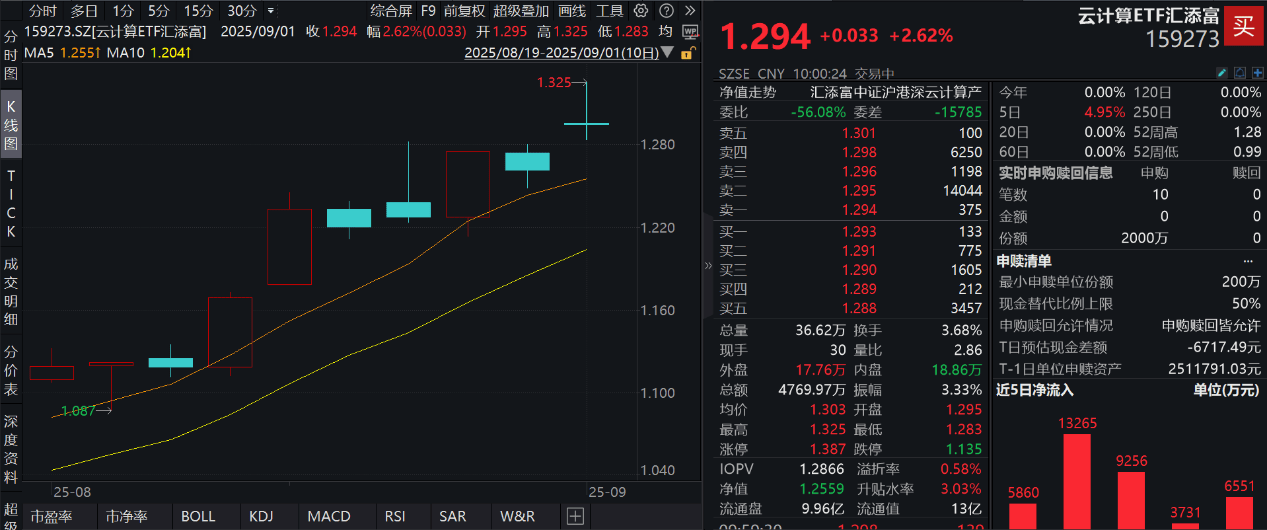
云业务增速及capex超预期,阿里巴巴暴涨17%!云计算ETF汇添富(159273)大涨超3%,连续13日大举吸金!
Sou Hu Cai Jing· 2025-09-01 02:19
Group 1 - Alibaba's Q1 FY2026 financial report shows a record high Capex investment of 38.6 billion yuan in AI and cloud, with cloud revenue growth accelerating to 26%, marking a three-year high [3][5] - The cloud computing ETF, Huatai-PineBridge (159273), surged over 3% following Alibaba's performance, with net inflows exceeding 260 million yuan, marking 13 consecutive days of significant capital inflow [1][3] - The majority of the index component stocks for the cloud computing ETF saw gains, with Alibaba rising by 17% and other stocks like Runhe Software and Zhongji Xuchuang also performing well [3][4] Group 2 - Alibaba's e-commerce segment reported a revenue of 140.07 billion yuan, growing by 10%, driven by improved monetization rates and increased customer management revenue [5] - The instant retail segment, particularly Taobao Flash Sale, has shown rapid growth, achieving a peak of 120 million daily orders, significantly boosting the overall platform's daily active users [6] - The cloud and AI segment's revenue reached 33.4 billion yuan, exceeding expectations, with AI revenue now accounting for over 20% of external commercial income [6][7] Group 3 - The increase in Alibaba's capital expenditure is expected to benefit domestic computing power, as demand for local cloud services may rise due to geopolitical tensions and supply chain risks [7] - The cloud computing ETF is positioned to capture opportunities in AI-driven cloud computing, with a diverse index covering hardware, cloud services, and IT services [8]
为什么女骑手越来越吃香?
吴晓波频道· 2025-09-01 00:30
Core Viewpoint - The article highlights the rapid growth of female delivery riders in China, indicating a significant shift in the labor market dynamics, particularly for middle-aged women facing economic challenges and traditional job market constraints [5][34]. Group 1: Growth of Female Riders - From 2022 to 2024, the number of female delivery riders increased from 517,000 to 701,000, representing a growth of 35.6% [8][3]. - In 2024, the number of female ride-hailing drivers is expected to exceed 1.05 million, up from 600,000 in 2023, marking a 75% year-on-year increase [9][8]. - The overall number of delivery riders on Meituan grew from 6.24 million in 2022 to 7.45 million in 2024, with female riders outpacing the overall growth rate [8][9]. Group 2: Demographics and Background of Female Riders - A significant portion of female riders are middle-aged, married, and have children, with 85% being married and 96.6% having children [14][20]. - The average age of female riders is 37, which is notably higher than their male counterparts [14]. - Many female riders have transitioned from traditional service industries, with 50.8% previously working in service sectors before entering the gig economy [22][23]. Group 3: Economic Pressures and Job Market Dynamics - Economic pressures, such as debt and job loss, have driven many women into the delivery sector, with 31.6% of riders citing unemployment as a reason for their choice [17][18]. - The article notes that over 80% of riders in one team carry debt, with many having previously faced business failures or financial struggles [18][20]. - The shrinking job market in traditional sectors like retail and hospitality has forced women into the gig economy, where they often find more flexible work options [22][23]. Group 4: Market Dynamics and Labor Quality - The influx of female riders reflects a broader market shift towards quality labor, as platforms seek to enhance service standards [26][31]. - Female riders are noted for their higher customer satisfaction ratings, indicating a potential competitive advantage in service-oriented roles [31][30]. - The article discusses the emotional labor aspect, where women’s skills in communication and empathy are increasingly valued in the gig economy [28][30]. Group 5: Conclusion and Future Implications - The rise of female riders represents a rebalancing of the labor market in the digital economy, creating new opportunities for women who have been marginalized in traditional employment [33][34]. - The article suggests that this trend may lead to a restructuring of social roles and labor dynamics, particularly for middle-aged women [33][34].

蒋凡豪赌“规模论”,阿里蒸发百亿利润继续“大战外卖”
阿尔法工场研究院· 2025-09-01 00:05
Core Viewpoint - Alibaba's significant investment in food delivery subsidies has led to a surge in orders but a substantial decline in profits, highlighting the intense competition in the food delivery market [2][3]. Financial Performance - For the quarter ending June 2025, Alibaba reported total revenue of approximately 2476.52 billion RMB, a year-on-year increase of 2%. Excluding disposed businesses, the revenue growth would be 10% [3]. - The profit for Alibaba's China e-commerce group shrank over 100 billion RMB to 383.89 billion RMB, a decline of about 21% compared to 487.53 billion RMB in the same period last year [3][13]. - The sales and marketing expenses for the quarter were approximately 531.78 billion RMB, an increase of 204.82 billion RMB or 62.64% year-on-year [7]. Investment in Food Delivery - Alibaba announced a plan to invest 500 billion RMB in food delivery subsidies over the next 12 months, raising concerns about further profit declines [3][11]. - The major areas of expenditure include direct consumer subsidies, logistics infrastructure, merchant incentives, and technology investments [8]. Order Growth and Market Position - Following the launch of the "Taobao Flash Sale" service, the monthly active users of Taobao Flash Sale and Ele.me riders increased by 181%, with part-time riders growing by 236% [8]. - Daily orders for Taobao Flash Sale exceeded 60 million, and during promotional events, daily orders reached over 100 million, marking a significant milestone in the competitive landscape [8][9]. Profitability Challenges - Despite the increase in order volume, the profitability issue remains a significant challenge for Alibaba, with an average loss of 4.4 RMB per order during the initial months of Taobao Flash Sale [15]. - Alibaba's free cash flow showed a net outflow of 188.15 billion RMB, compared to a net inflow of 173.72 billion RMB in the previous year, primarily due to investments in Taobao Flash Sale [16]. Strategic Outlook - Alibaba's e-commerce group CEO, Jiang Fan, outlined a plan to improve operational efficiency and reduce losses through user optimization, increasing high-value orders, and lowering logistics costs [17]. - The company anticipates that the integration of offline brand stores into Taobao Flash Sale will generate significant new business opportunities, projecting an additional 1 trillion RMB in transactions over the next three years [18].

深读100:谁能接住《黑神话》下一波红利?
Mei Ri Jing Ji Xin Wen· 2025-08-31 13:56
Group 1 - The core viewpoint is that the cultural tourism in Lingbi County is leveraging the announcement of "Black Myth: Zhong Kui" to enhance its visibility, drawing inspiration from the success of "Black Myth: Wukong" in promoting Shanxi's cultural tourism [1] - Lingbi County is recognized as a hub for Zhong Kui culture, indicating a strategic focus on cultural heritage to attract tourism [1] - The challenge lies in improving accommodation and other supporting facilities to meet the increased demand from tourism [1] Group 2 - From January to July, there has been a strengthening of counter-cyclical fiscal adjustments, but the demand for real economy financing remains weak, leading to a shift of deposits towards wealth management and equity markets due to interest rate cuts and a recovering capital market [2] - The sustainability of this trend depends on economic expectations and the effectiveness of policies implemented [2] Group 3 - The Chinese AI pharmaceutical industry is reaching a critical point, with generative AI transforming the drug development paradigm from a broad search to precise design, thereby accelerating research and activating difficult drug targets [3] - The core competitiveness in this sector is centered around models and data, which may reshape the innovative drug industry chain in the future [3] Group 4 - The food delivery industry has experienced several months of intense competition, shifting from a duopoly to a multi-player market, where leading players maintain revenue growth but face profit pressures [4] - The focus of competition has transitioned from price subsidies to value competition, indicating a need for the industry to move beyond internal competition and return to the essence of service [4]