
非银金融

Search documents
“重估牛”系列之港股资金面:9月港股资金复盘:南向流入互联网,外资加码硬件科技
Changjiang Securities· 2025-10-09 02:43
Core Insights - The report highlights a net inflow of 145.4 billion HKD from southbound funds during September 2025, primarily directed towards sectors such as consumer discretionary retail, software services, non-ferrous metals, biopharmaceuticals, and non-bank financials [2][5][14] - The top five sectors receiving the most inflow were: consumer discretionary retail (77.3 billion HKD), software services (11.5 billion HKD), non-ferrous metals (9.3 billion HKD), biopharmaceuticals (8.6 billion HKD), and non-bank financials (8.5 billion HKD) [2][5][14] - Conversely, sectors experiencing the largest outflows included telecommunications services (-3.7 billion HKD), durable consumer goods (-3.7 billion HKD), hardware equipment (-2.8 billion HKD), daily consumer retail (-0.9 billion HKD), and semiconductors (-0.9 billion HKD) [2][5][14] Southbound Fund Inflows - From September 1 to 30, 2025, the net inflow of southbound funds totaled 145.4 billion HKD, with significant contributions from consumer discretionary retail, software services, non-ferrous metals, biopharmaceuticals, and non-bank financials [2][5][14] - The report indicates that the total net inflow for the top five sectors was 115.2 billion HKD, showcasing a strong preference for these industries [2][5][14] Foreign Institutional Fund Flows - During the same period, foreign institutional funds saw a net outflow of 77.1 billion HKD, with notable inflows into hardware equipment, consumer services, media, biopharmaceuticals, and durable consumer goods, totaling 35.6 billion HKD [6][25] - The sectors with the highest inflows from foreign institutions included hardware equipment (16.7 billion HKD), consumer services (12.1 billion HKD), and media (2.8 billion HKD) [6][25] Comparative Analysis - The report also compares the inflow trends of southbound funds and foreign institutional funds, indicating a divergence in sector preferences, with southbound funds favoring consumer discretionary sectors while foreign institutions leaned towards hardware and automotive sectors [6][25][45] - The analysis of the changes in the proportion of holdings in the market capitalization reveals significant shifts in sectors such as media, consumer services, and hardware equipment, indicating evolving investment strategies [25][30]
美股飘红,热门中概股走强,极氪涨超3%,网易、蔚来涨超2%
21世纪经济报道· 2025-10-08 14:46
Core Viewpoint - The article discusses the recent performance of the U.S. stock market, the rise in gold prices, and notable movements in specific companies, particularly in the tech sector, while also analyzing the historical performance of the Chinese stock market post-holidays. Group 1: U.S. Stock Market Performance - The three major U.S. stock indices opened higher and showed slight gains as of 22:05 [1] - Gold stocks experienced a rise, with companies like Hecla Mining and Harmony Gold increasing over 3% as spot gold surpassed $4040 and New York futures crossed $4070 per ounce, marking a daily increase of 1.66% [3] Group 2: Gold Investment Insights - Renowned investor Ray Dalio recommended an overweight position in gold, suggesting that investors should allocate 15% of their portfolios to gold due to its superior safe-haven attributes compared to the U.S. dollar [5] Group 3: Tech Sector Developments - NVIDIA's CEO confirmed an investment in Elon Musk's startup xAI, expressing excitement about the deal [6] - AMD shares surged nearly 5% following a Morgan Stanley report indicating a partnership with OpenAI, with AMD expected to deploy 6GW of AI computing capacity over several years, involving an investment exceeding $100 billion [6] Group 4: Chinese Stock Market Trends - The Nasdaq Golden Dragon China Index rose by 0.16%, with several Chinese concept stocks, including Zeekr and NIO, showing gains of over 2% [8] - Historical data indicates that the Shanghai Composite Index and Shenzhen Component Index have a 70% probability of rising on the first trading day after the National Day holiday, with overall positive performance in the following five trading days [9][10] Group 5: Sector Performance Post-Holidays - Over the past decade, sectors such as computer, communication, and electronics have shown over 50% probability of rising in the week following the National Day holiday, with banking and automotive sectors also demonstrating strong performance [12]


科技板块出现分化
GOLDEN SUN SECURITIES· 2025-10-08 12:38
- The report mentions the construction of the **A-share prosperity index**, which is based on the Nowcasting target of the year-on-year growth rate of the net profit attributable to the parent company of the Shanghai Composite Index. The index is designed to observe the high-frequency prosperity of A-shares. The current prosperity index is 21.28, which has increased by 15.85 compared to the end of 2023, indicating an upward cycle[29][33][34] - The **A-share sentiment index** is constructed using market volatility and transaction volume changes, divided into four quadrants. Among these quadrants, only the "volatility up - transaction down" quadrant shows significant negative returns, while the others show significant positive returns. The sentiment index includes bottoming and peaking warning signals. Currently, the bottoming signal indicates bearishness, and the peaking signal also points to bearishness, leading to an overall bearish outlook for the market[36][39][40] - The **theme mining algorithm** is used to identify investment opportunities in thematic stocks. This algorithm processes news and research report texts, extracts theme keywords, explores relationships between themes and individual stocks, constructs theme active cycles, and builds theme influence factors. Recently, the algorithm has identified semiconductor concept stocks as having high concept heat anomalies, driven by the event of the China Semiconductor Industry Association's announcement regarding chip origin designation[46][47][48] - The **index enhancement portfolios** for CSI 500 and CSI 300 are mentioned. The CSI 500 enhancement portfolio achieved a return of 1.99% but underperformed the benchmark by 0.38%. Since 2020, the portfolio has generated an excess return of 51.20% relative to the CSI 500 index, with a maximum drawdown of -5.73%. The CSI 300 enhancement portfolio achieved a return of 2.15%, outperforming the benchmark by 0.16%. Since 2020, the portfolio has generated an excess return of 38.68% relative to the CSI 300 index, with a maximum drawdown of -5.86%[46][53][54] - The report utilizes the **BARRA factor model** to construct ten major style factors for the A-share market, including size (SIZE), beta (BETA), momentum (MOM), residual volatility (RESVOL), non-linear size (NLSIZE), valuation (BTOP), liquidity (LIQUIDITY), earnings yield (EARNINGS_YIELD), growth (GROWTH), and leverage (LVRG). Recent market style analysis shows that liquidity factors are positively correlated with beta, momentum, and residual volatility, while value factors are negatively correlated with beta, residual volatility, and liquidity. From pure factor returns, size factors have high excess returns, while residual volatility shows significant negative excess returns. High beta and high growth stocks performed well recently, while residual volatility and value factors performed poorly[58][59][60] - The report applies **factor models for performance attribution analysis** of major indices. It highlights that indices like the Shanghai Composite Index, SSE 50, and CSI 300 have significant exposure to size factors due to the market's preference for large-cap stocks, resulting in good performance in style factors. In contrast, indices like CSI 500 and Wind All A have lower exposure to size factors and performed poorly in style factors during the week[66][67][69]
假期外围市场太热闹!A股明天怎么走?分析来了
天天基金网· 2025-10-08 05:24
牛市来了还没上车?上天天基金APP搜索777注册即可领500元券包,优选基金10元起投!限 量发放!先到先得! 长假将尽,对股民——尤其只做A股的朋友们来说,好消息是: 终于要开盘了,不用看外围市场的热闹了! 但久违的忐忑也随之而来,比如不少人担心: 节前红盘作收的A股市场, 节后首日 会不会"复刻 " 去年的走法? | F9 不复权 超级叠加 画线 工具 ② | 广山十信零 | | 000001 | | | --- | --- | --- | --- | --- | | | | | +20.25 +0.52% | दों | | 2025/04/11-2025/09/30(119日) | | | | | | | | 15:00:09 交易中 | | 沪深市场核心指数 / ● + | | | | | | 9732.75亿 | | | | | | 569.73亿 | | | | | | 3869.70 ( 0.19%) | | 3800.00 | | | | 3887.57 ( 0.65%) | | | | | | 3866.28 ( 0.10%) | | | | | 16.6 市海率 | 1.50 | | | ...

港股吸睛!韩国股民持续“扫货”
Zhong Guo Zheng Quan Bao· 2025-10-08 05:15
Group 1 - The core viewpoint of the articles indicates that the Hong Kong stock market is experiencing a significant inflow of southbound funds, particularly favoring the consumer sector and defensive styles ahead of the National Day holiday [1][3][4] - Southbound funds recorded a net purchase of over 40.3 billion yuan in the week leading up to the holiday, with a notable single-day net purchase of nearly 14.2 billion yuan on September 30 [3][4] - The attractiveness of the Hong Kong stock market is attributed to the acceleration of profit recovery and valuation repair, with expectations for a positive fourth quarter driven by improved profit expectations and supportive liquidity conditions [3][4][5] Group 2 - During the holiday period, southbound trading was paused, yet overseas funds, particularly from South Korea, continued to engage in the market, with a total trading volume of approximately 150 million USD from October 1 to 6 [1][5] - The Hang Seng Index showed a slight increase of 0.38% during the period from October 2 to 6, with significant performance in gold stocks and a 1.31% rise in the Hang Seng Tech Index, indicating a diverse market structure [5] - Analysts suggest that the fourth quarter will be a critical phase for the Hong Kong stock market, with a shift in investment logic towards new productive forces and high-quality development, recommending investors to adopt a balanced approach and focus on sectors like technology, high-end manufacturing, and biomedicine [4][5]
创新药很坚挺~
Sou Hu Cai Jing· 2025-10-06 20:31
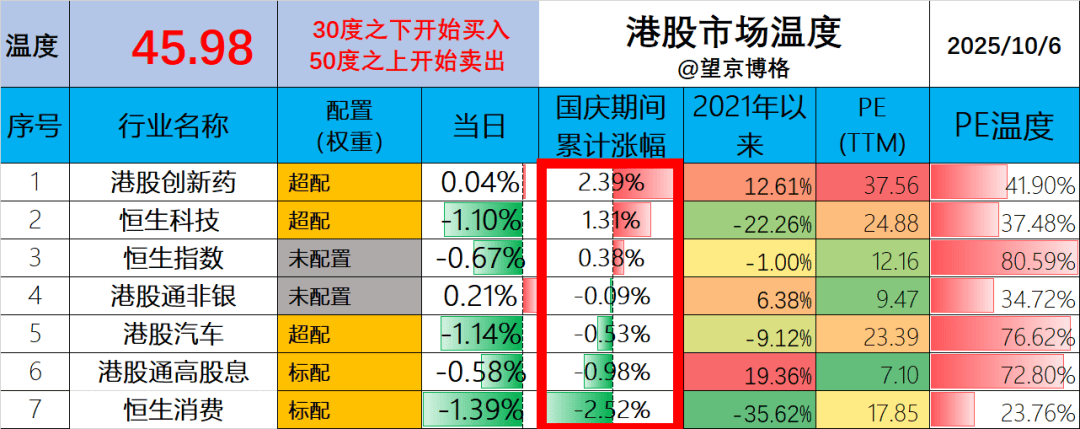
Core Viewpoint - The Hong Kong stock market is experiencing mixed performance during the National Day holiday, with the innovative pharmaceutical sector showing resilience while other sectors face declines [2][3]. Group 1: Market Performance - The Hong Kong stock market remains open on the day of the Mid-Autumn Festival but will close the following day [1]. - The innovative pharmaceutical sector in Hong Kong has shown a slight increase of 0.04% today, with a cumulative gain of 2.39% during the National Day holiday [2]. - The Hang Seng Technology index has experienced a decline of 1.10% today, with a cumulative gain of 1.31% during the holiday, indicating a weaker performance [3]. - Other sectors, including non-bank financials, automotive, and consumer sectors, have all seen declines during the holiday, with the consumer sector dropping by 2.52% [3]. Group 2: Commodity Prices - Gold and copper prices have reached new highs during the holiday, with London gold surpassing $3,940 per ounce, indicating strong demand [3]. - The rise in commodity prices is expected to lead to significant gains in gold and non-ferrous metal stocks post-holiday [3].
招商证券:长假后计算机、通信、电子、银行等上涨概率较高
Sou Hu Cai Jing· 2025-10-05 09:52
招商证券张夏团队在9月26日发布的研报中表示,从近十年国庆节后行业表现来看,国庆后一周一级行 业上涨概率多数在50%以上,其中上涨概率靠前的行业集中在计算机、通信、电子、银行等行业,其中 银行、非银金融、汽车在国庆后两周和国庆后一个月上涨概率仍然较高。 另据Choice数据,近十年,节后第一个交易日,上证指数上涨概率达70%。 ...


从贵州茅台到宁德时代,一文速览A股“含科量”五年巨变
Zhong Guo Zheng Quan Bao· 2025-10-04 09:20
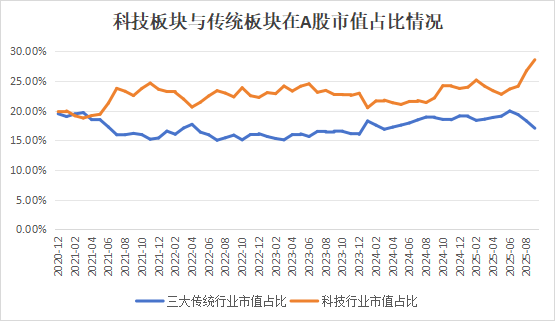
Group 1 - The core viewpoint of the article highlights the shift in market capitalization from traditional sectors to the technology sector, reflecting China's economic transition from factor-driven to innovation-driven growth [1][6] - During the "14th Five-Year Plan" period, the market capitalization of the technology sector increased significantly, with its share rising from 19.86% at the end of the "13th Five-Year Plan" to 28.60% [1][4] - The total number of listed companies in the A-share market reached 5,436, with a total market capitalization of 105.85 trillion yuan as of September 30, marking an increase of 1,443 companies and 27.26 trillion yuan compared to the end of the "13th Five-Year Plan" [1][6] Group 2 - Within the technology sector, the electronic industry leads with a total market capitalization of 13.47 trillion yuan, followed by the power equipment industry at 8.23 trillion yuan, and the computer and communication industries at 5.10 trillion yuan and 3.47 trillion yuan, respectively [2][4] - The traditional sectors, including banking, non-bank financials, and real estate, have a combined market capitalization of 18.06 trillion yuan, which is significantly lower than the technology sector's 30.27 trillion yuan [2][4] - The number of technology companies with a market capitalization exceeding 100 billion yuan increased from 28 at the end of the "13th Five-Year Plan" to 44, indicating a growing dominance of technology firms in the market [8][7] Group 3 - The revenue of many technology companies has seen substantial growth, with CATL reporting a total revenue of 178.9 billion yuan in the first half of 2025, a year-on-year increase of 7.3%, and a net profit of 30.5 billion yuan, up 33.3% [9] - The number of technology companies among the top 50 listed companies increased from 5 at the end of the "13th Five-Year Plan" to 13, showcasing the rising prominence of technology firms in the market [8] - The capital market has accelerated its support for technology innovation, with over 90% of newly listed companies being technology-related or having high technological content [6]


从贵州茅台到宁德时代 一文速览A股“含科量”五年巨变
Zhong Guo Zheng Quan Bao· 2025-10-04 09:18
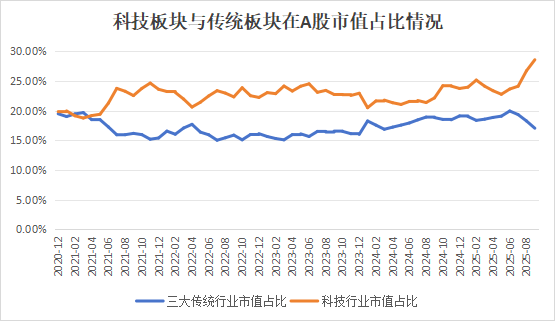
Group 1 - The core viewpoint is that the market capitalization of CATL has surpassed that of Kweichow Moutai, reflecting a shift in the capital market and the transition of the Chinese economy from factor-driven to innovation-driven [1] - During the "14th Five-Year Plan" period, the market capitalization structure of A-shares has undergone significant changes, with the technology sector's market capitalization share rising from 19.86% at the end of the "13th Five-Year Plan" to 28.60% [1][6] - The number of technology companies in the top 50 by market capitalization has increased significantly, with the number of technology companies with a market capitalization of over 100 billion rising from 28 to 44 [1][8] Group 2 - As of September 30, the total number of A-share listed companies reached 5,436, with a total market capitalization of 105.85 trillion yuan, an increase of 1,443 companies and 27.26 trillion yuan compared to the end of the "13th Five-Year Plan" [2][4] - The technology sector's total market capitalization is 30.27 trillion yuan, significantly exceeding the combined market capitalization of traditional sectors such as banking, non-bank financials, and real estate, which totals 18.06 trillion yuan [2][4] - The electronic industry leads the technology sector with a market capitalization of 13.47 trillion yuan, followed by the power equipment industry at 8.23 trillion yuan [2][4] Group 3 - The number of companies in the technology sector with a market capitalization exceeding 100 billion has increased from 28 at the end of the "13th Five-Year Plan" to 44, indicating robust growth in the sector [7][8] - The revenue of many technology companies has seen significant increases, with CATL reporting a total revenue of 178.9 billion yuan in the first half of 2025, a year-on-year increase of 7.3% [9]
社保基金2024年年度报告点评:长期投资,复利增长
Guoxin Securities· 2025-09-30 12:54
Investment Rating - The investment rating for the non-bank financial industry is "Outperform the Market" [2][25]. Core Insights - In 2024, the National Social Security Fund (NSSF) achieved an investment income of 218.418 billion yuan, with an investment return rate of 8.10%. The average annual investment return rate since its establishment is 7.39%, with cumulative investment income exceeding 1.9009 trillion yuan [3][19]. - The NSSF maintained a stable equity risk exposure amidst fluctuations in the domestic stock market, benefiting from the rebound in the A-share market. The fund's long-term investment strategy and patience capital have allowed it to seize long-term allocation opportunities [3][19]. - The total assets of the NSSF reached 3.322462 trillion yuan by the end of 2024, marking a year-on-year increase of 10.2% [4]. Summary by Sections Investment Performance - The NSSF's investment income for 2024 was 218.418 billion yuan, with a realized income of 43.651 billion yuan and a fair value change of trading assets amounting to 174.767 billion yuan. The fund's long-term returns significantly exceed its long-term liabilities cost [3][15][19]. Fund Structure - By the end of 2024, the NSSF's total liabilities were 409.66 billion yuan, while the total equity amounted to 2.912802 trillion yuan, with cumulative fiscal net allocations of 1.211651 trillion yuan and cumulative investment appreciation of 1.701151 trillion yuan [7][10]. Investment Strategy - The NSSF employs a combination of direct and entrusted investments. By the end of 2024, entrusted investments accounted for 71.45% of total assets, reflecting a 5.27 percentage point increase since 2021. The fund has also increased its equity investment and optimized its overseas investment layout [10][12][19].