
银行等

Search documents
主力资金动向 64.25亿元潜入电子业
Zheng Quan Shi Bao Wang· 2025-08-12 13:40
| 建筑材 | 19.87 | -17.85 | 2.67 | -0.46 | -7.89 | | --- | --- | --- | --- | --- | --- | | 料 | | | | | | | 食品饮 | 14.33 | -12.92 | 1.56 | -0.42 | -9.75 | | 料 | | | | | | | 传媒 | 45.73 | 0.49 | 3.12 | 0.06 | -12.22 | | 建筑装 饰 | 40.69 | -14.35 | 1.45 | -0.14 | -13.03 | | 基础化 | | | | | | | 工 | 63.96 | -6.05 | 2.37 | -0.01 | -23.48 | | 汽车 | 53.09 | 0.88 | 2.41 | 0.38 | -24.66 | | 医药生 | 82.46 | 0.76 | 3.02 | -0.23 | -48.54 | | 物 | | | | | | | 机械设 | 94.78 | -8.98 | 3.50 | 0.10 | -50.53 | | 备 | | | | | | | 电力设 | 78.71 | ...
美股再创佳绩?高盛拆解市场韧性密码,下半年布局看这几点
Zhi Tong Cai Jing· 2025-08-11 13:49
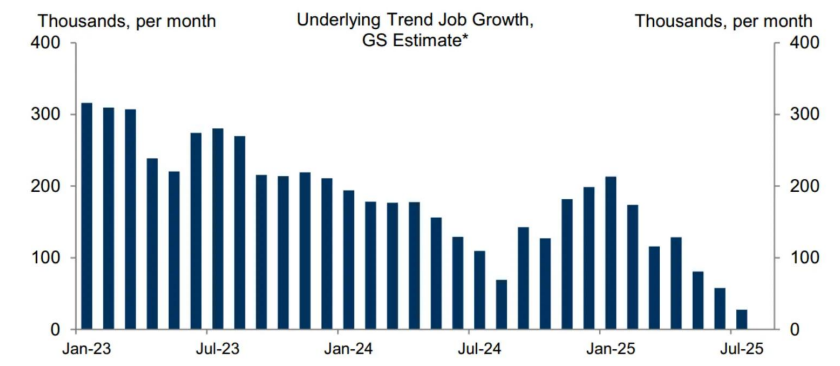
Group 1: U.S. Stock Market Narrative - The U.S. stock market showed resilience despite signs of weakness in the labor market, with the S&P 500 recovering losses and the Nasdaq 100 reaching a new all-time high [4][3] - Three hypotheses were proposed to explain this resilience: new AI stimuli, healthy capital flows despite reduced speculative demand, and the notion that stock markets do not directly reflect the economy [5][6][7] Group 2: Market Framework - The overall market sentiment remains positive, but increased risk asset holdings may complicate future trading [8] - AI spending has exceeded expectations, while employment growth has significantly declined since Q1, leading to a volatile market environment [8] - Short-term risk balance is uncertain, with expectations of consolidation in August and a challenging technical situation in September, but a bullish trend is anticipated for the second half of 2025 [8] Group 3: Key Points and Data Analysis - The U.S. labor market's health is under scrutiny, with mixed initial jobless claims and a disappointing ISM services index, leading to a GDP tracking expectation of 1.2% for Q3 [12] - Systematic trading institutions have largely completed their buying of global index futures, and discretionary investors have increased long positions, while retail investor demand has weakened [12] - The impact of tariffs is seen as destructive but not catastrophic, with the market no longer viewing it as a significant variable [13] Group 4: U.S. Technology Sector - Major U.S. tech companies reported strong Q2 earnings, with growth acceleration across various sectors, including cloud computing and AI [14] - The Nasdaq 100 index's P/E ratio is approaching historical highs, suggesting a need for consolidation, but potential earnings growth justifies a positive outlook on tech valuations [14] - Concerns about AI's impact on employment are noted, with a significant rise in unemployment rates among tech workers aged 20-30 since early 2024 [14] Group 5: Global Market Insights - The Japanese stock market has shown resilience, with the Nikkei index reaching new highs, while India's market faces challenges despite strong fundamentals [15] - Market depth and risk transfer ease are deteriorating, indicating a sensitive trading environment with increased price volatility [15] Group 6: Credit Market Dynamics - The surge in new corporate bond issuances suggests ample credit supply in the U.S. financial system, supported by ongoing demand and rising coupon rates [16] - A favorable policy environment for large corporations is noted, with pressures on consumers due to rising prices and stagnant real wage growth [16] Group 7: Investment Strategy - The recommended investment strategy includes going long on U.S. stocks (particularly tech), value storage assets (gold, silver, Bitcoin), shorting the dollar, and steepening yield curve trades [16] - This strategy is viewed as a preferred defensive measure for 2025, despite potential short-term underperformance in certain components [16]

发掘格局优化与盈利修复的机会:反内卷政策下的行业比较
Guohai Securities· 2025-08-11 07:18
Investment Rating - The report focuses on identifying investment opportunities in industries that are expected to benefit from the "anti-involution" policy, particularly in coal, steel, and building materials sectors, which are characterized by high levels of internal competition and effective policy execution [7][19]. Core Insights - The report addresses key questions regarding the existence of a clear investment theme in the market, the establishment of a systematic and quantifiable analysis framework for industry selection, and the roadmap and timeline for investments [7]. - The macroeconomic context highlights that industrial profits are under pressure, with the Producer Price Index (PPI) experiencing negative growth for 33 consecutive months as of June 2025, leading to intensified competition within industries [7][14]. - The "anti-involution" policy has emerged as a national agenda aimed at optimizing industry structures and restoring profitability, driven by strong policy guidance [7][19]. - A dual-dimensional analysis model was constructed to evaluate the impact of the "anti-involution" policy on various industries, focusing on execution efficiency and the degree of internal competition [7]. - The investment conclusion emphasizes a focus on supply-side clearing, with coal, steel, and building materials industries expected to achieve rapid supply-side clearing and a V-shaped recovery in profitability due to their characteristics of high internal competition and high execution efficiency [7][19]. Summary by Sections Current Macroeconomic Background - Industrial enterprises are facing profit pressures, with the PPI continuing to contract, indicating a challenging environment for profitability [9][14]. - The report notes a significant correlation between PPI and industrial profits, suggesting that a recovery in prices is essential for profit recovery [14]. Model and Methodology - A quantitative model was developed to screen industries that would benefit from the "anti-involution" policy, focusing on execution efficiency and internal competition levels [7]. Conclusions and Strategies - The report suggests that industries such as coal, steel, and building materials are likely to be the first to experience supply-side clearing and profitability recovery, making them core areas of focus for investment [7][19].
收评:沪指涨0.34% 能源金属板块全天领涨
Zhong Guo Jing Ji Wang· 2025-08-11 07:17
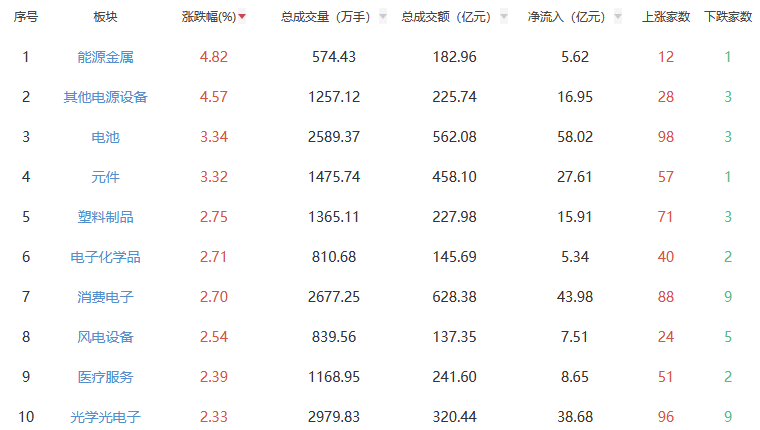
Market Overview - The A-share market saw all three major indices rise, with the Shanghai Composite Index closing at 3647.55 points, up 0.34%, and a trading volume of 751.33 billion yuan [1] - The Shenzhen Component Index closed at 11291.43 points, up 1.46%, with a trading volume of 1075.64 billion yuan [1] - The ChiNext Index closed at 2379.82 points, up 1.96%, with a trading volume of 530.90 billion yuan [1] Sector Performance - The top-performing sectors included Energy Metals (up 4.82%), Other Power Equipment (up 4.57%), and Batteries (up 3.34%) [2] - Energy Metals had a total trading volume of 574.43 million hands and a net inflow of 182.96 billion yuan, with 12 stocks rising and 1 falling [2] - Other Power Equipment recorded a trading volume of 1257.12 million hands, a net inflow of 225.74 billion yuan, with 28 stocks rising [2] - The sectors with the largest declines included Needs (down 2.99%), Banks (down 0.97%), and Road and Railway Transportation (down 0.27%) [2] - The Banking sector had a trading volume of 3759.01 million hands, a net outflow of 38.92 billion yuan, with 2 stocks rising and 37 falling [2]
午评:沪指涨0.51% 能源金属板块涨幅居前
Zhong Guo Jing Ji Wang· 2025-08-11 03:47
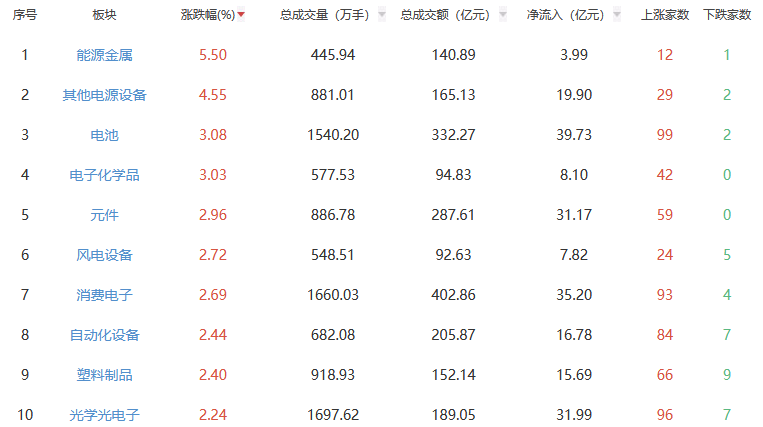
| 序号 | 板块 | 涨跌幅(%)▼ | | 总成交量(万手) = 总成交额(亿元)▼ | 净流入 (亿元) ▼ | 上涨家数 | 下跌家数 | | --- | --- | --- | --- | --- | --- | --- | --- | | 1 | 能源金属 | 5.50 | 445.94 | 140.89 | 3.99 | 12 | 1 | | 2 | 其他电源设备 | 4.55 | 881.01 | 165.13 | 19.90 | 29 | വ | | 3 | 电池 | 3.08 | 1540.20 | 332.27 | 39.73 | ਰੇਰੇ | 2 | | 4 | 电子化学品 | 3.03 | 577.53 | 94.83 | 8.10 | 42 | 0 | | 5 | 元件 | 2.96 | 886.78 | 287.61 | 31.17 | ਦਰ | 0 | | 6 | 风电设备 | 2.72 | 548.51 | 92.63 | 7.82 | 24 | ട | | 7 | 消费电子 | 2.69 | 1660.03 | 402.86 | 35.20 | 03 | র্ব | | 8 ...
超720亿!46家A股公司官宣中期分红
Di Yi Cai Jing Zi Xun· 2025-08-10 12:20
Core Viewpoint - The mid-year dividend distribution among A-share companies is gaining momentum, with many companies announcing substantial dividend payouts, reflecting their financial performance and shareholder returns [2][3][9]. Group 1: Dividend Announcements - Nearly 50 A-share companies have disclosed mid-year dividend proposals, with a total proposed dividend amount exceeding 720 billion yuan [3][4]. - China Mobile plans to distribute a mid-year dividend of 594.32 billion Hong Kong dollars (approximately 540 billion yuan), with a per-share dividend of 2.75 Hong Kong dollars (about 2.5 yuan) [3][5]. - Other notable companies like Ningde Times and WuXi AppTec are also planning significant dividends, with amounts exceeding 10 billion yuan [4][5]. Group 2: Performance and Support for Dividends - Many companies proposing high dividends have reported revenue and profit growth in the first half of the year, indicating strong financial performance [6][7]. - For instance, Dongpeng Beverage achieved a revenue of 10.737 billion yuan and a net profit of 2.375 billion yuan, both showing over 30% year-on-year growth [7]. - However, some companies like China Mobile and Cangge Mining experienced slight revenue declines, raising questions about the sustainability of their high dividend payouts [7]. Group 3: Upcoming Dividend Distributions - Three A-share companies are set to implement mid-year dividends next week, including Sujiao Technology and Zhongchong Co., with total payouts of approximately 0.25 billion yuan and 0.61 billion yuan, respectively [8]. - Changshu Bank is also set to distribute its first mid-year dividend since its listing, proposing a payout of 1.5 yuan per 10 shares, totaling 4.97 billion yuan [8]. Group 4: Market Trends and Investor Insights - The trend of increased dividend frequency and the emergence of special dividends are becoming more common among listed companies, reflecting a shift towards shareholder-friendly policies [9]. - Investors are advised to analyze dividend yield, payout ratios, and sustainability when selecting dividend-paying stocks, considering the company's fundamentals and market conditions [9].





从最新PB-ROE框架下来看,红利三兄弟ETF“成长—价值”风格凸显
Sou Hu Cai Jing· 2025-08-08 06:02
Group 1 - The market is returning to a "growth-value" barbell effect, with high ROE in growth sectors and high PB percentiles over the past five years [1] - Value sectors show lower PB percentiles, indicating a safety margin and a demand for catch-up in annualized returns over the past year [1] - Reasonable valuation percentiles and relatively high ROE are observed in sectors like non-ferrous metals, non-bank financials, and banks [1] Group 2 - The Free Cash Flow ETF (159233) is the only dividend value fund that excludes financials and real estate [1] - The Ping An SSE Dividend Low Volatility Index A (020456) has significantly outperformed other dividend low volatility and CSI dividend funds, with monthly dividends and low volatility factors to control drawdowns [1] - The State-Owned Enterprises Win-Win ETF (159719) includes 15% Hong Kong stocks, with stable holdings, slow rotation, and high concentration in pure state-owned enterprises [1] Group 3 - The table presents various sectors with their respective PB (LF), 5-year PB analysis, ROE, and recent annualized returns, highlighting significant differences across sectors [2] - For instance, the telecommunications sector has a PB of 3.29 and an ROE of 17.57%, while the real estate sector has a low PB of 0.77 and a negative ROE of -21.29% [2] - The machinery equipment sector shows an exceptionally high ROE of 1298%, indicating strong performance despite a PB of 2.76 [2]
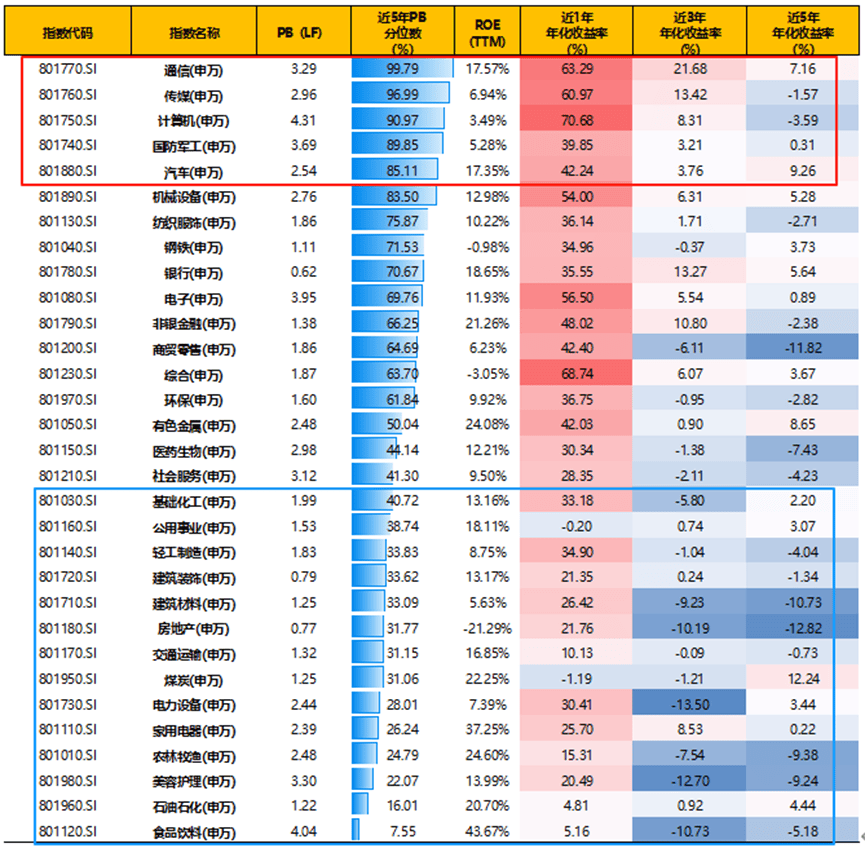
半年报盘点|151家上市公司披露 14家公司净利润超10亿元
Di Yi Cai Jing· 2025-08-08 00:25
截至8月8日,A股已累计有151家上市公司披露2025年半年报,其中135家盈利,16家亏损。从净利润来 看,14家公司净利润超10亿元,中国移动、宁德时代、华能国际排名居前,上半年净利润分别为842.35 亿元、304.85亿元、92.62亿元。从净利润增幅来看,43家公司净利润增幅超50%,智明达、容知日新、 仕佳光子排名居前,上半年净利润增幅分别为2147.93%、2063.42%、1712.00%。 8月8日,A股共38家上市公司披露2025年半年报,其中35家盈利,3家亏损。从营收来看,当日披露半 年报公司中,6家营收超50亿元,中国移动、新洋丰、爱旭股份排名居前,上半年营收分别为5437.69亿 元、93.98亿元、84.46亿元。从净利润来看,当日披露半年报公司中,2家净利润超10亿元。中国移动、 常熟银行、新洋丰排名居前,上半年净利润分别为842.35亿元、19.69亿元、9.51亿元。 ...
智通港股沽空统计|8月7日
Zhi Tong Cai Jing· 2025-08-07 00:24
Core Insights - The top short-selling ratios for the last trading day were recorded at 100% for New World Development Co. Ltd. (80016), Anta Sports Products Ltd. (82020), and Li Ning Company Limited (82331) [1][2] - The highest short-selling amounts were for Tencent Holdings Ltd. (00700) at 2.284 billion, Alibaba Group Holding Ltd. (09988) at 1.855 billion, and Meituan (03690) at 1.779 billion [1][2] - The highest deviation values were for New World Development Co. Ltd. (80016) at 47.23%, Hang Seng Bank Ltd. (80011) at 43.60%, and China International Marine Containers (Group) Co., Ltd. (02039) at 39.58% [1][3] Short-Selling Ratios - New World Development Co. Ltd. (80016) had a short-selling amount of 170,500 with a 100% short-selling ratio and a deviation of 47.23% [2] - Anta Sports Products Ltd. (82020) reported a short-selling amount of 131,200 with a 100% short-selling ratio and a deviation of 32.87% [2] - Li Ning Company Limited (82331) had a short-selling amount of 91,300 with a 100% short-selling ratio and a deviation of 32.41% [2] Short-Selling Amounts - Tencent Holdings Ltd. (00700) led with a short-selling amount of 2.284 billion and a short-selling ratio of 19.43% [2] - Alibaba Group Holding Ltd. (09988) followed with a short-selling amount of 1.855 billion and a short-selling ratio of 21.48% [2] - Meituan (03690) had a short-selling amount of 1.779 billion with a short-selling ratio of 32.58% [2] Deviation Values - New World Development Co. Ltd. (80016) had a deviation value of 47.23% with a short-selling amount of 170,500 and a short-selling ratio of 100% [3] - Hang Seng Bank Ltd. (80011) reported a deviation value of 43.60% with a short-selling amount of 612,100 and a short-selling ratio of 89.42% [3] - China International Marine Containers (Group) Co., Ltd. (02039) had a deviation value of 39.58% with a short-selling amount of 16.5625 million and a short-selling ratio of 55.28% [3]



8月6日主力资金流向日报
Zheng Quan Shi Bao Wang· 2025-08-06 11:52
资金面上,今日主力资金全天净流出96.52亿元。其中,创业板主力资金净流出10.21亿元;科创板主力 资金净流出15.16亿元;沪深300成份股主力资金净流出43.97亿元。 (文章来源:证券时报网) 主力资金净流出的行业有24个,医药生物行业主力资金净流出规模居首,今日下跌0.65%,全天净流出 资金90.49亿元,其次是通信行业,今日涨幅为0.49%,净流出资金为29.49亿元,净流出资金较多的还 有银行、建筑材料、建筑装饰等行业。 今日各行业资金流向 | 行业 | 日涨跌幅(%) | 资金流向(亿元) | 行业 | 日涨跌幅(%) | 资金流向(亿元) | | --- | --- | --- | --- | --- | --- | | 机械设备 | 1.98 | 43.67 | 食品饮料 | -0.08 | -4.00 | | 国防军工 | 3.07 | 42.83 | 传媒 | 0.48 | -4.79 | | 汽车 | 1.18 | 21.31 | 公用事业 | 0.01 | -5.10 | | 计算机 | 1.30 | 10.54 | 农林牧渔 | 0.19 | -5.25 | | 家用电器 | ...