
化妆品

Search documents
网红减肥针,竟是“妆字号”?
FBeauty未来迹· 2025-12-04 14:23
Core Viewpoint - The article highlights the dangers of a viral weight loss injection that nearly caused a woman's death, revealing a black market for such products that misuses cosmetic regulations and poses serious health risks [3][4][5]. Group 1: Product Safety and Compliance Issues - The weight loss injection, costing around 900 yuan for a treatment of three injections, was found to have severe side effects, including vomiting and potential cardiac arrest [5][10]. - Many similar products, marketed under names like "Four Point Slimming King" and "Black Gold Transport Protein," have been sold online, with prices ranging from tens to hundreds of yuan, claiming rapid weight loss effects [7][10]. - The products often lack proper labeling and compliance, with some packaging showing only a counterfeit anti-counterfeiting mark and no Chinese labels [12][13]. Group 2: Regulatory Violations and Legal Consequences - The article discusses how these products are often labeled as cosmetic but contain prescription drug ingredients like Semaglutide, which is strictly regulated and should only be used under medical supervision [16][18]. - Investigations revealed that the production of these injections involved illegal procurement of raw materials and misleading labeling, leading to significant legal repercussions for those involved [19][24]. - The article emphasizes that cosmetic products are not permitted for injection, and only medical devices or drugs can be used for such purposes, highlighting the serious legal implications of mislabeling [23][24]. Group 3: Industry Implications and Warnings - The exposure of this black market for weight loss injections serves as a warning for beauty companies attempting to cross into medical aesthetics, stressing the importance of compliance with regulatory standards [21][26]. - Companies are urged to establish robust compliance mechanisms and professional capabilities if they wish to enter the medical device market, as the regulatory requirements are significantly higher than for cosmetic products [25][26]. - The article concludes that the beauty industry must prioritize compliance and professional integrity to avoid legal issues and maintain consumer trust [26].


第三届广州国际美妆周开幕,千亿产业集群加速全球化布局
2 1 Shi Ji Jing Ji Bao Dao· 2025-12-04 14:08
Core Insights - The third Guangzhou International Beauty Week, themed "Tide Rising in the Bay, Glamour Shining Globally," commenced on December 4, showcasing Guangzhou's ambition to build a world-class cosmetics industry cluster [1] Group 1: Industry Development - Guangzhou's cosmetics industry continues to expand, maintaining its position as a "trillion-yuan industry cluster" with 1,857 production enterprises, accounting for 60% of the province's total [1] - The city has a total of 7,237 registered entities and over 1.2 million circulating products, creating a complete ecosystem from raw material research and development to brand marketing [1] - By October 2025, Guangzhou is expected to have 14,900 invention patent applications in cosmetics and 40 new raw material registrations, indicating a shift from "formula application" to "raw material definition" [2] Group 2: Globalization and Export - Guangzhou is positioned as a "cross-border e-commerce international hub," with beauty and personal care exports projected to reach nearly 10 billion yuan in 2024, making it the top city for such exports in China [2] - Local brands like Feimei and Perfect Diary have successfully penetrated international markets, establishing a strong presence in Southeast Asia and beyond [2] - Over 15 Guangzhou manufacturing enterprises have set up factories overseas in countries such as France, Australia, and Indonesia, enhancing their global footprint [2] Group 3: Investment and Project Launches - The conference highlighted 31 new high-quality cosmetics industry projects with a total investment of nearly 10 billion yuan, focusing on key industry segments such as smart manufacturing and R&D [3] - Notable projects include the AI Smart Headquarters of Kangaroo Mom and the R&D production base of Youcon Technology, which are expected to drive high-quality development in Guangzhou's beauty industry [3] Group 4: Innovation and Market Trends - The event emphasized the importance of technological innovation and globalization, with industry leaders advocating for regulatory frameworks to guide high-quality development [4] - Unilever's plans to introduce a direct-to-consumer logistics model in Guangzhou aim to leverage the city's logistical advantages for broader market reach [4] - Local brands are leveraging AI and digital tools to enhance efficiency and reduce costs, with data indicating strong competitive positioning in the online market [4]
广州美妆稳居“千亿俱乐部”:技术驱动、全球布局双线领跑
Zhong Guo Xin Wen Wang· 2025-12-04 13:28
来源:中国新闻网 中新网广州12月4日电 (记者 许青青)记者从4日举行的第三届广州国际美妆周化妆品高质量发展大会了 解到,广州市化妆品产业年产值超1000亿元(人民币,下同),持续坐稳"中国美妆第一城"。当前,该市 化妆品产业已从规模扩张迈入以技术驱动为核心的高质量发展新阶段。 据了解,广州市化妆品产业市场主体高度集聚,截至2025年10月底,广州市注册备案主体数量达到7237 家,约占广东省总量的68%、全国30%。形成从原料研发、生产制造到品牌营销的全链条生态。产品覆 盖护肤、彩妆、特殊用途等全品类。 技术创新正成为产业发展的核心引擎。截至2025年10月底,广州市化妆品产业的发明专利申请总量达到 1.49万件,其中在技术含量最高的化妆品原料领域突破11774件,位居中国第一。 目前,广州美妆制造企业在海外建立工厂超过15家,遍布法国、澳大利亚、越南、印尼等国。 大会现场还展示了近期落地的31个优质化妆品产业项目,总投资额近百亿元。(完) 广州美妆稳居"千亿俱乐部":技术驱动、全球布局双线领跑 编辑:张嘉怡 广告等商务合作,请点击这里 本文为转载内容,授权事宜请联系原著作权人 中新经纬版权所有,未经书面 ...
巨子生物(02367.HK):拟回购股份彰显信心 26年产品矩阵拓展可期
Ge Long Hui· 2025-12-04 11:56
Company Overview - The company announced a share buyback plan of up to 104 million shares, representing 10% of the total issued shares, which reflects management's confidence in long-term growth [1] - The buyback is expected to enhance earnings per share and improve shareholder returns [1] Strategic Planning - The company has a clear product matrix and channel expansion plan for 2026, with a rich pipeline of new products, including four key new products in the collagen repair and focus series [2] - The company plans to strengthen its online influencer matrix and self-operated team while expanding offline channels, including clinics and OTC markets, as well as its own store layout [2] - The company is successfully advancing its second curve in the medical beauty sector, with a growing team and strong commercialization preparations [2] Financial Forecast and Valuation - Due to short-term pressure on cosmetics sales, the company has lowered its net profit forecasts for 2025 and 2026 by 25% and 33% to 1.91 billion and 2.14 billion yuan, respectively [2] - The current stock price corresponds to a P/E ratio of 20x for 2025 and 18x for 2026, with a target price adjustment down by 20% to 56 HKD, indicating a potential upside of 41% [2]
巨子生物(2367.HK):短期业绩承压 回购彰显信心
Ge Long Hui· 2025-12-04 11:56
Core Viewpoint - The company faced sales pressure during the "Double Eleven" period primarily due to underperformance in live streaming sales, reflecting both strategic channel adjustments and overall industry competition [1][2] Group 1: Sales Performance - The company's online GMV during the Double Eleven period declined approximately 30% year-on-year, with Tmall GMV down about 20% as the company opted out of aggressive price wars in top-tier live streaming [2] - Douyin GMV saw a significant decrease of around 50%, attributed to weak performance in live streaming, with a more than 50% reduction in the number of collaborations with influencers in October [2] - Despite the overall decline, the self-operated channels and mid-tier influencers showed resilience, indicating a solid brand presence and user loyalty [2] Group 2: Strategic Adjustments - The management is focusing on maintaining price stability and enhancing consumer experience, which is expected to lay a foundation for long-term growth and profit margin stability [2] - The company plans to launch several key new products in 2026, which are anticipated to drive a new growth phase [1][3] - The company has been approved to repurchase up to 104 million shares, representing 10% of its total share capital, reflecting confidence in long-term development [1] Group 3: Product Development - The company is actively cultivating a second product tier to optimize its product structure, with expectations for significant revenue growth from new products [3] - In 2026, the company will introduce four major new products across various series, aiming to reduce reliance on single blockbuster products and enhance brand resilience [3] - The medical beauty product line is set to expand, with the first injectable recombinant collagen product approved and planned for rapid market penetration in 2026 [3] Group 4: Financial Outlook - The company has adjusted its revenue growth forecasts for 2025 and 2026 to -3.5% and 13.6%, respectively, reflecting short-term pressures [3] - The target price has been revised to HKD 53.89, maintaining a "Buy" rating based on a DCF model [3]
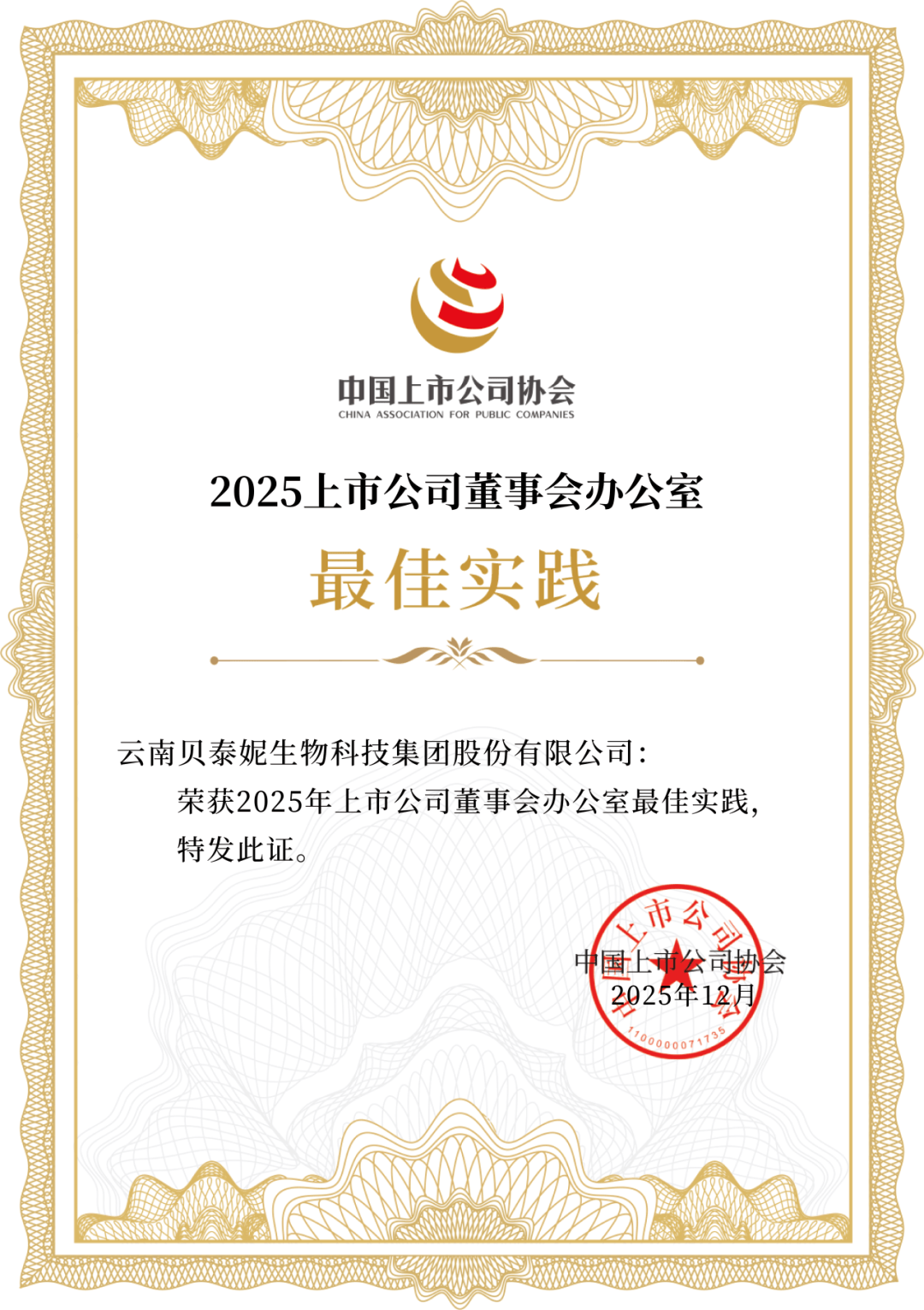
喜报!贝泰妮集团荣获“2025 年上市公司董事会办公室最佳实践”称号
Sou Hu Cai Jing· 2025-12-04 11:29
Core Viewpoint - The Beitain Group's Board Office has been awarded the "2025 Best Practice for Listed Company Board Offices" for its systematic innovation and excellence in corporate governance, highlighting its role in modernizing governance and driving long-term value growth through innovation [1][3][4]. Group 1: Recognition and Achievement - The Beitain Group's Board Office received the "2025 Best Practice for Listed Company Board Offices" award, reflecting the team's professional capabilities and its benchmark role in corporate governance [1][2]. - This recognition signifies the continuous improvement of the company's governance capabilities [4]. Group 2: Governance Innovation - In the context of deepening registration system reforms and the widespread adoption of ESG investment concepts, corporate governance is transitioning from "compliance baseline" to "value creation" [3]. - The Board Office team focuses on "empowering governance modernization" through a problem-oriented, innovation-driven, and value-sharing approach, establishing a new governance ecosystem characterized by diverse structures, professional decision-making, transparent execution, and shared value [3]. Group 3: ESG and Risk Management - The team has developed a three-tier ESG governance system that integrates ESG into corporate strategy and operations, transitioning ESG from a "soft constraint" to a "hard strategy" [3]. - The risk management system has been transformed from a "cost center" to a "value creation center," effectively strengthening the company's development foundation [3]. Group 4: Future Directions - The Board will continue to explore new directions to provide measurable, verifiable, and replicable practices for upgrading corporate governance in China [4]. - The Board Office aims to be a core enabler of value creation, helping the Board become an engine of value creation and guiding the company towards sustainable, resilient, and high-quality development [4].
红星观察| 国债被“抛售”,债市遭暴击,日本恐面临3年前英国类似的金融风暴
Sou Hu Cai Jing· 2025-12-04 11:18
Group 1 - The yield on Japan's 10-year government bonds has surpassed 1.94%, indicating a significant decline in market prices for fixed-income securities [1][3] - Japan's GDP has contracted for the first time in six quarters, with a year-on-year decline of 1.8% in the third quarter of 2025, leading to substantial drops in the stock market [3] - The depreciation of the yen against the dollar is nearing the psychological threshold of 160, contributing to investor concerns [3] Group 2 - Japan's export-dependent economy has been severely impacted by high tariffs from the U.S., with a 1.2% decline in goods and services exports in the third quarter of 2025, and a 10.2% year-on-year drop in exports to the U.S. during the first half of the fiscal year [4] - The automotive sector has faced significant losses, with major companies reporting a combined net profit drop of 30%, exceeding 1.5 trillion yen [4] - The tourism industry has also suffered, with over 540,000 flight cancellations from Chinese tourists, leading to potential losses in the sector amounting to trillions of yen [4] Group 3 - A supplementary budget of 21.3 trillion yen for the fiscal year 2025 has been approved, significantly higher than the previous year's budget, raising concerns among bondholders [5] - The budget primarily focuses on direct financial aid, including subsidies for gas and electricity, and rice vouchers for local governments, which has drawn criticism for its lack of sustainable funding [5] Group 4 - The current fiscal strategy of tax cuts and subsidies has drawn parallels to the financial crisis in the UK in 2022, where similar measures led to a loss of market confidence and significant economic turmoil [7] - The UK experience serves as a cautionary tale for Japan, highlighting the potential risks associated with unbacked fiscal policies and the rapid rise in bond yields [7]

国内功效护肤品牌hfp获颁2025年度SIA100科盟两项大奖
Jiang Nan Shi Bao· 2025-12-04 06:21
Core Insights - The SIA2025 Scientific Skincare Innovation Alliance Annual Conference was held in Shanghai, attracting over a thousand participants from the skin health industry, including leaders and experts from various sectors [1] - The "SIA100 Scientific Product and Technology Achievement Collection" results were announced, showcasing significant improvements in the scale and quality of selected products compared to the previous year [1] - The brand hfp (HomeFacialPro) received recognition for its two products, the AHA Pore Purifying Essence and the Dual-Phase Moisturizing Oil Cream, highlighting its strength in efficacy skincare [1] Company Overview - hfp, established in 2014, focuses on ingredient-driven skincare solutions tailored for young consumers, promoting ingredient education in the domestic skincare market [2] - The company operates a large R&D center, hfp lab, which has invested over 100 million in resources, collaborating with various research institutions to advance the understanding of new ingredients [2] - hfp lab features 13 functional laboratories and meets international CNAS certification standards, ensuring that every product's efficacy is measurable and perceivable [2] Product Innovations - The AHA Pore Purifying Essence targets oily skin issues, utilizing a three-generation AHA formula to effectively clear pores and improve skin conditions like blackheads and acne [3] - The product incorporates innovative ingredients such as bifida ferment and centella asiatica extract, ensuring a gentle yet effective experience for users [3] - The Dual-Phase Moisturizing Oil Cream combines nourishing oils and a repairing cream to address dry and sensitive skin, featuring a blend of nine plant oils and a five-dimensional moisturizing combination [3] Market Position - The AHA Pore Purifying Essence has sold over 4 million bottles, maintaining the top sales position in the national AHA skincare e-commerce market for three consecutive years, reflecting its strong market presence [3] - hfp continues to adapt to changing consumer needs by launching products like the "Dual-Phase Bubble Cream" to provide targeted solutions for seasonal skincare challenges [3][4] Future Directions - The recognition of hfp's products underscores the brand's commitment to its philosophy of "Letting Ingredients Touch the Skin" and its ongoing exploration of ingredient boundaries [4] - The company aims to further promote ingredient education in the domestic skincare market, embedding this concept into more consumers' minds [4]
湖南凌语护肤品有限公司成立 注册资本200万人民币
Sou Hu Cai Jing· 2025-12-04 05:48
天眼查App显示,近日,湖南凌语护肤品有限公司成立,法定代表人为刘垚,注册资本200万人民币, 经营范围为许可项目:互联网信息服务(依法须经批准的项目,经相关部门批准后方可开展经营活动, 具体经营项目以批准文件或许可证件为准)一般项目:互联网销售(除销售需要许可的商品);化妆品 零售;咨询策划服务;市场营销策划;日用杂品制造;化妆品批发;日用品销售;个人卫生用品销售;技术服务、 技术开发、技术咨询、技术交流、技术转让、技术推广;食品销售(仅销售预包装食品);保健食品(预 包装)销售;食品互联网销售(仅销售预包装食品);服装服饰零售;针纺织品销售;文化娱乐经纪人服务; 广告设计、代理;广告发布(除依法须经批准的项目外,自主开展法律法规未禁止、未限制的经营活 动)。 ...
青岛彩跳糖化妆品有限公司成立 注册资本10万人民币
Sou Hu Cai Jing· 2025-12-04 04:20
天眼查App显示,近日,青岛彩跳糖化妆品有限公司成立,法定代表人为史爱聪,注册资本10万人民 币,经营范围为一般项目:化妆品零售;货物进出口;技术进出口;工艺美术品及收藏品批发(象牙及 其制品除外);工艺美术品及礼仪用品销售(象牙及其制品除外);工艺美术品及收藏品零售(象牙及 其制品除外);工艺美术品及礼仪用品制造(象牙及其制品除外)【分支机构经营】;化妆品批发;日 用杂品销售;个人卫生用品销售;互联网销售(除销售需要许可的商品);市场营销策划;商业综合体 管理服务;技术服务、技术开发、技术咨询、技术交流、技术转让、技术推广;网络技术服务;信息技 术咨询服务;商务代理代办服务;个人商务服务;信息咨询服务(不含许可类信息咨询服务)。(除依 法须经批准的项目外,凭营业执照依法自主开展经营活动)。 ...