食品饮料

Search documents
数说公募纯债与混合资产策略基金2025年四季报:固收+规模再创新高,含权敞口小幅下降
SINOLINK SECURITIES· 2026-01-26 15:04
Report Title - "Counting the Public Offering Pure Bond and Hybrid Asset Strategy Funds' 2025 Q4 Reports - The Scale of 'Fixed Income +' Reaches a New High, and the Exposure to Equity Slightly Declines" [1] Report Date - January 26, 2026 [2] Market Overview General Fixed - Income Fund Scale in 2025 Q4 - Among the top 20 fund companies in terms of general fixed - income fund scale, the scale of some companies increased while others decreased. For example, the scale of China Merchants Fund increased by 9.88% to 3512.27 billion yuan, while the scale of E Fund decreased by 4.71% to 3627.05 billion yuan [8]. Hybrid Asset Strategy Fund Scale in 2025 Q4 - In the hybrid asset strategy fund scale ranking, the scale changes also varied. For instance, the scale of Invesco Great Wall Fund increased by 32.11% to 2263.68 billion yuan, while the scale of Fullgoal Fund decreased by 5.85% to 1281.73 billion yuan [8]. Performance Return - Different types of funds had different average returns in 2025 Q4, year - to - date, and in the past 1 - year, 3 - year, and 5 - year annualized periods. For example, the average return of convertible bond funds in 2025 Q4 was 0.84%, and the year - to - date return was 23.10% [15]. Maximum Drawdown - The average maximum drawdowns of various fund types also differed. For example, the average maximum drawdown of convertible bond funds in 2025 Q4 was - 5.26%, and the year - to - date maximum drawdown was - 8.90% [15]. Annualized Sharpe Ratio - The annualized Sharpe ratios of different fund types were distinct. For example, the annualized Sharpe ratio of short - term pure bond funds in 2025 Q4 was 4.28 [15]. Asset Allocation Leverage Ratio - In 2025 Q4, different types of funds had different leverage ratios and their changes compared to Q3. For example, the leverage ratio of short - term pure bond funds was 111.89% in Q4, an increase of 0.40% compared to Q3 [40]. Holding Characteristics Stock Holdings - From 2025 Q1 to Q4, the industry and stock holding ratios of funds changed. For example, the proportion of non - ferrous metals in the stock market value increased from 11.27% in Q1 to 14.65% in Q4 [54][57]. Bond Holdings - The industry and bond holding ratios of funds also changed over the four quarters of 2025. For example, the proportion of bank bonds in the bond market value decreased from 20.75% in Q1 to 14.45% in Q4 [67][68]. Fund Managers' Views Pure Bond Market Views - Different fund managers had different views on the pure bond market in 2026 Q1. For example, Huang Yingjie of Bank of Communications Yulong Pure Bond A believed that the bond market might be in a range - bound market with a steeper curve [74]. Bond and Stock Market Views - Some fund managers had comprehensive views on the bond and stock markets. For example, Deng Xinyu and Zhao Yucheng of China Europe Dingli A were optimistic about the stock market's structural opportunities and adjusted their convertible bond positions [75]. Convertible Bond and Stock Market Views - Fund managers also had different views on the convertible bond and stock markets. For example, Huang Bo of Everbright Tianyi A planned to select high - cost - effective convertible bonds for the fund's fixed - income part [79].
2026年全国“老字号嘉年华”启幕
Jin Rong Jie· 2026-01-26 14:49
Core Viewpoint - The "National Old Brand Carnival" and Greater Bay Area Consumption Season aims to enhance consumer experiences and cultural festivities through a series of 35 themed activities throughout the year, focusing on revitalizing traditional Chinese brands and products [1] Group 1: Event Overview - The event was launched on January 26 in Guangzhou, themed "National Goods Trend Revitalization" [1] - The carnival will feature four main themes: "Old Brand Creative Market," "Old Brand Public Appreciation," "Old Brand Famous Products Expo," and "Old Brand Craftsmanship Going Global" [1] - A total of 35 key activities will be organized across various regions to expand the supply of quality goods and services [1] Group 2: Upcoming Activities - Eight national thematic activities will be launched in conjunction with the upcoming Year of the Horse Spring Festival, creating a "one-stop" shopping platform and consumer experience [1] - The Greater Bay Area Consumption Season activities will run until January 28 [1] Group 3: Product Highlights - The Guangdong Provincial Department of Commerce announced the second batch of "Yue Hand Gifts," which includes three categories: technological cultural creations, intangible cultural heritage health products, and specialty flavors [1] - Guangzhou will promote a selection of new "national trend" products from old brands, showcasing new business models and scenarios [1] - Featured products include Wanglaoji International Canned Drink, Zhujiang Beer Tea Beer, and commemorative balls for the 15th National Games [1]
食品饮料行业深度报告:2025Q4基金食品饮料持仓分析:持仓继续下降,结构向大众品倾斜
Soochow Securities· 2026-01-26 12:24
Investment Rating - The report maintains an "Increase" rating for the food and beverage industry [1] Core Insights - The food and beverage sector continues to see a decline in holdings, with a shift towards mass-market products. The proportion of active equity funds in the food and beverage sector decreased to 4.04% in Q4 2025, down from 4.18% in Q3 2025, reflecting a 0.14 percentage point decline [9][15] - The report highlights a continued reduction in allocations to alcoholic beverages, while holdings in mass-market products have shown signs of recovery. The proportion of holdings in white liquor decreased by 0.29 percentage points to 2.92% in Q4 2025 [14][17] - Major consumer funds have reduced their allocations to alcoholic beverages, with a notable decrease of 2.22 percentage points in white liquor holdings, while overall food and beverage allocations have increased [17][21] Summary by Sections 1. Food and Beverage Holdings Continue to Decline, Structure Shifts Towards Mass-Market Products - As of Q4 2025, the total scale of active equity fund heavy holdings is approximately 19.4 trillion yuan, with food and beverage holdings at 78.4 billion yuan, reflecting a 9.01% decline [9][10] - The decline in alcoholic beverage holdings is evident, with white liquor allocations decreasing to 2.92% and beer and pre-mixed drinks also seeing slight reductions [14][15] 2. Holdings Become More Diversified, Capturing Marginal Recovery Themes - The number of heavy holdings in the food and beverage sector has become more diversified, with only Kweichow Moutai remaining in the top 20 heavy holdings [24] - The report notes that the top five stocks with the largest increase in heavy holdings include Baba Foods, Yingjia Gongjiu, Youran Dairy, Ximai Foods, and Modern Animal Husbandry [28][29] 3. Investment Recommendations - The report suggests five key directions for investment: focusing on functional health foods, improving supply chains and product/channel resonance in leading snack companies, expanding quality retail formats, investing in long-lifecycle beverage leaders, and tracking sectors with potential recovery such as dairy and large-scale dining [10][29]




2025Q4基金食品饮料持仓分析:持仓继续下降,结构向大众品倾斜
Soochow Securities· 2026-01-26 12:12
Investment Rating - The report maintains an "Increase" rating for the food and beverage industry [1] Core Insights - The food and beverage sector continues to see a decline in holdings, with a shift towards mass-market products. The proportion of active equity funds in the food and beverage sector decreased to 4.04% in Q4 2025, down 0.14 percentage points from the previous quarter [9][15] - The report highlights a continued reduction in allocations to alcoholic beverages, while holdings in mass-market products have shown signs of recovery. The proportion of holdings in white liquor decreased by 0.29 percentage points to 2.92% in Q4 2025 [14][17] - The report emphasizes the importance of capturing valuation switching opportunities in five key areas: health food and supplements, leading snack brands, quality retail chains, beverage leaders with long life cycles, and sectors expected to recover from downturns, particularly dairy [29][30] Summary by Sections 1. Holdings Decline and Shift Towards Mass-Market Products - Active equity funds' holdings in the food and beverage sector decreased by 9.01% to 784 billion yuan in Q4 2025, with a total market value of approximately 1.94 trillion yuan [9][10] - The decline in holdings is attributed to a preference for technology and other sectors, while the alcoholic beverage sector continues to face downward pressure [10][14] 2. Increased Diversification in Holdings - The number of heavily held stocks in the food and beverage sector has become more diversified, with only Kweichow Moutai remaining in the top 20 heavy holdings [24][28] - The report notes that the top five stocks with the largest increase in heavy holdings include Baba Foods, Yingjia Gongjiu, Youran Dairy, Ximai Foods, and Modern Dairy [28][29] 3. Investment Recommendations - The report suggests focusing on five areas for investment: innovative health food, leading snack brands, quality retail chains, beverage leaders, and sectors expected to recover from downturns [29][30] - It emphasizes the need to pay attention to the health food sector, which is expected to benefit from an expanding consumer base and product innovation [29][30]
2026年债券信用风险展望
Si Lu Hai Yang· 2026-01-26 11:35
Group 1: Report Industry Investment Rating - No information provided in the given content. Group 2: Core Viewpoints of the Report - In 2026, focus on provinces with large maturity scales of industrial bonds, such as Inner Mongolia, Heilongjiang, and Jilin, and avoid entities with industry downturns, weakened profitability, and financing channels, or those with non - bond debt risks [2]. - The broad private real estate developers still face challenges, and other industries have a low probability of concentrated risks, but entities with weak competitiveness, significant profit decline, cash - flow pressure, and concentrated debt maturities should be focused on [2]. - For convertible bonds, weak - quality entities with low - priced underlying stocks and high conversion premiums may face difficulties in exiting through conversion, and potential losses should be watched out for [2]. Group 3: Summary by Relevant Catalogs 1. Overall Bond Market Situation - As of January 6, 2026, the national credit bond balance was 36.18 trillion yuan, with urban investment bonds at 17.73 trillion yuan (49.00%) and industrial bonds at 18.45 trillion yuan (51.00%, down from 54.57% last year) [5]. - Beijing has the largest bond balance, followed by Jiangsu, Guangdong, Zhejiang, and Shandong. Inner Mongolia has the highest short - term bond maturity ratio at 81.09%, followed by Heilongjiang at 40.39% [5]. 2. Urban Investment Bonds - Since 2023, with a series of policies and measures, the debt pressure of urban investment platforms has been relieved, the issuance cost and credit spread of urban investment bonds have decreased, the financing cost is generally below 3%, and the debt term has been significantly extended [10]. 3. Industrial Bonds Provincial - level Analysis - Excluding urban investment bonds, Beijing has the largest industrial bond scale at over 7 trillion yuan, mainly central - enterprise bonds. Inner Mongolia has the highest short - term industrial bond maturity ratio at 82.64%, followed by Tibet, Heilongjiang, Tianjin, and Jilin [11]. - Inner Mongolia, Heilongjiang, and Jilin have a bond issuance coverage ratio of less than 1 for the next - year's maturity scale, indicating weak refinancing ability [14]. Industry - level Analysis - In 2025, default industries included 12 sectors such as automobile services and real estate development. The industrial holding and power industries have the largest bond balances, over 2 trillion yuan each [15]. - The paper - making, automobile services, medical devices, medical services, and publishing media industries have a short - term debt ratio of over 50%, with poor debt term structures [15]. - Industries with large short - term debt repayment pressures include rail transit, packaging, heating, furniture and home appliances, textiles, automobile services, and information technology [15]. 4. Real Estate Industry - In 2025, the default rate of real estate development entities remained high, with Vanke and Zhengxinglong defaulting. As of January 6, 2026, the real estate development enterprise bond balance was 11,528.76 billion yuan, mainly held by local and central state - owned enterprises [18]. - The short - term bond maturity pressure of public, Sino - foreign joint - venture, and private enterprises is over 40%. The broad private enterprises still face pressure, with an issuance amount of only 234.38 billion yuan in the past year, 76.93% of the next - year's maturity amount [20]. - In 2026, private real estate enterprises to focus on are Longfor and Yida Development [23]. 5. Loss - making Industrial Entities - Large - loss entities (losses over 10 billion yuan in 2024 and still in losses in the first three quarters of 2025) are mainly in the real estate development industry, including state - owned enterprises such as Overseas Chinese Town Group and financial street - related companies, as well as steel giant Ansteel Group [24]. - Entities with losses between 5 and 10 billion yuan involve industries such as electrical equipment, chemical, steel, and airport [26]. 6. ABS Market - From 2023 - 2025, the default rate of CSRC - regulated ABS was 1.10%, 0.77%, and 0.88% respectively. As of January 6, 2026, the ABS balance was 25,021.96 billion yuan, with a one - year maturity amount of 3,541.59 billion yuan (14.15%). The 2025 issuance amount covered the next - year's maturity amount 3.97 times, with good continuation [32]. 7. Convertible Bond Market - Since 2024, the convertible bond repayment risk has increased. As of January 6, 2026, the convertible bond balance was 5553.51 billion yuan, a 22.89% year - on - year decrease. The broad private enterprises accounted for 64.73%, with a relatively large proportion [33]. - Entities such as Anhui Honglu Steel Structure, Shenzhen Huayang International Engineering Design, and Shanghai Kehua Bio - Engineering face large convertible bond repayment pressures, but the conversion mechanism can reduce credit risks to some extent [35]. - Entities such as Dongfang Fashion Driving School, Hainan Pulili Pharmaceutical, and Jiangsu Fumiao Technology, although not facing immediate repayment pressures, have negative information such as business fluctuations, financial fraud, and equity freezes, and their dynamic changes should be continuously monitored [36].



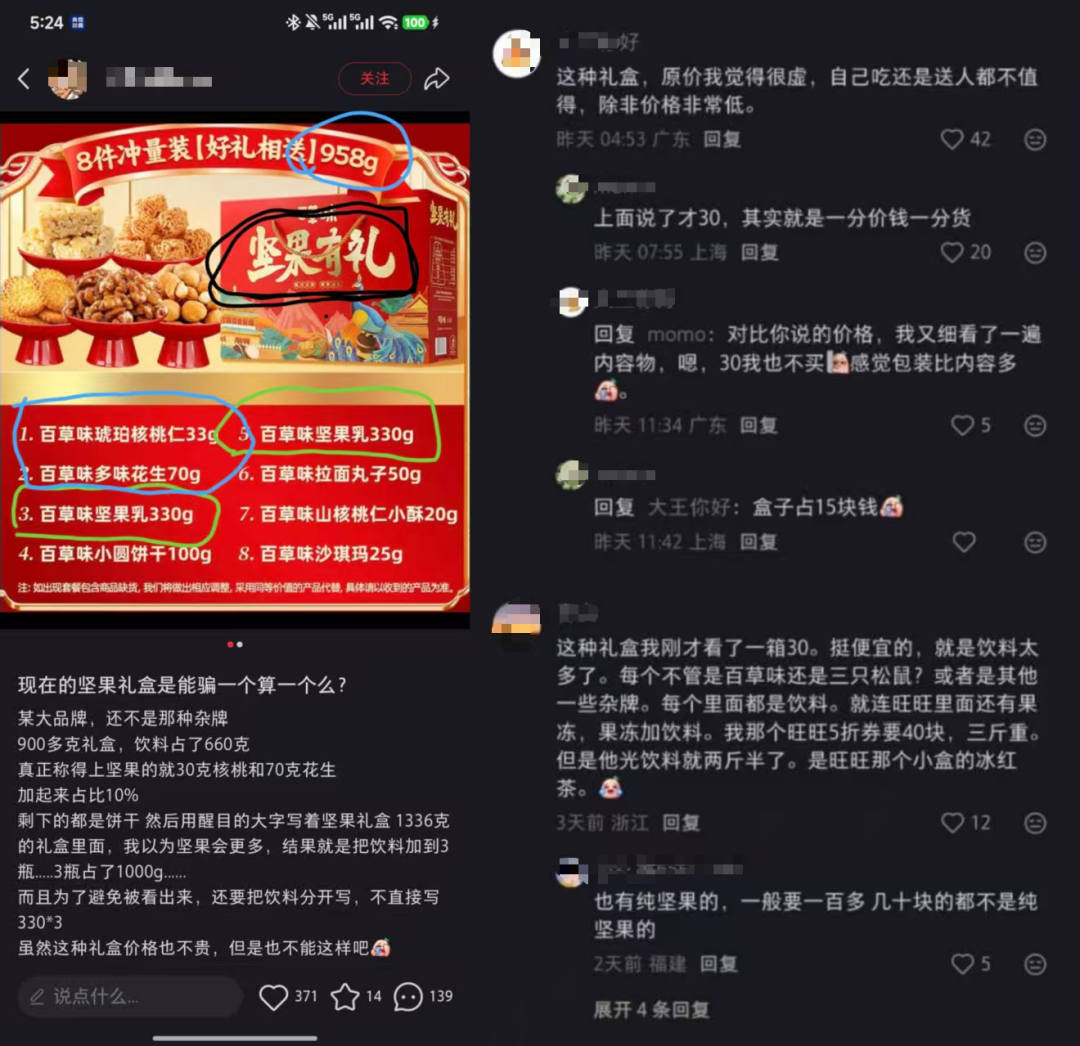
百草味958克的坚果礼盒,两盒饮料就占660克,实际坚果仅33克?
Mei Ri Jing Ji Xin Wen· 2026-01-26 11:06
Core Viewpoint - The article discusses consumer concerns regarding misleading advertising practices related to a nut gift box sold by Baicaowei, highlighting the discrepancy between the product's advertised contents and its actual composition [1][5]. Group 1: Product Composition and Consumer Reactions - A nut gift box labeled as weighing 958 grams contains only 33 grams of actual nuts, with the majority being beverages and snacks, leading to consumer skepticism about the product's labeling [1][3]. - Some consumers defend the product's price of around 30 yuan, suggesting it is reasonable for the value offered, while others question the legitimacy of calling it a "nut gift box" when nuts are not the primary component [3]. Group 2: Legal and Ethical Implications - Legal experts indicate that the marketing strategy employed by Baicaowei may violate the Anti-Unfair Competition Law of the People's Republic of China due to misleading advertising practices [5][6]. - The lack of transparency regarding the actual composition of the product infringes on consumer rights, particularly the right to be informed about product contents, which could lead to legal repercussions for the company [6].

张坤四季报:困难只是暂时的,中国消费“有鱼可钓”!
市值风云· 2026-01-26 10:15
Core Viewpoint - The current market pricing for some high-quality companies is very low, making them attractive even for privatization [1][12]. Group 1: Fund Performance - In Q4 2025, the assets under management by Zhang Kun decreased to 48.3 billion, with a quarterly shrinkage of over 8 billion [4]. - The performance of Zhang Kun's four funds showed significant structural differentiation, with the largest fund, E Fund Blue Chip Select Mixed Fund, losing nearly 9% in Q4, underperforming its benchmark by over 6% [4][5]. - In contrast, the E Fund Asia Select Stock Fund achieved a positive return of 4.5% in Q4, outperforming its benchmark by over 2%, and had an annual increase of nearly 42% for 2025 [4][5]. Group 2: Sector Adjustments - Zhang Kun continued to reduce holdings in the liquor sector, albeit at a slower pace compared to Q3 2025, maintaining a near 10% position in leading liquor stocks like Kweichow Moutai and Wuliangye [6]. - Significant reductions were also observed in pharmaceutical and media stocks, with JD Health seeing its holdings cut by about half [8]. Group 3: Consumer Market Outlook - Zhang Kun expressed optimism about the future of domestic consumption, citing that the current weak consumption data is not a long-term trend [10]. - He believes that the Chinese government's goal of reaching a middle-income level by 2035 indicates substantial growth potential for income, which will enhance consumer spending [11]. - The stabilization of housing prices, which have been a barrier to consumer confidence, is expected to further boost spending as wealth perception improves [11]. Group 4: Technology and Innovation - A strong domestic consumer market is viewed as a crucial driver for technological innovation, with examples from leading AI models abroad demonstrating the revenue potential from consumer subscriptions [12]. - Zhang Kun emphasized that with a stronger consumer environment, domestic tech companies could generate more income to support research and development, accelerating their growth to catch up with global leaders [12]. Group 5: Long-term Investment Perspective - Despite short-term pressures, Zhang Kun maintains a long-term positive outlook on China's consumption potential and economic development, positioning for investments in quality companies that will grow alongside rising living standards [13].

黑芝麻:向银行申请不超过1.1亿元流动资金借款
Xin Lang Cai Jing· 2026-01-26 09:37
黑芝麻公告,公司在工行容县支行的流动资金借款将陆续到期,现根据经营业务发展需要,拟继续向该 行申请总额度不超过11,000万元、期限为1年期的借款用于流动资金周转。公司本次申请流动资金借 款,有利于开展经营业务,进一步促使公司持续健康发展,符合公司及全体股东的整体利益,对公司不 存在不利影响。截至目前,公司资产负债结构合理,经营情况正常,具备相应的偿债能力,本次申请借 款不会对公司带来重大财务风险。 ...

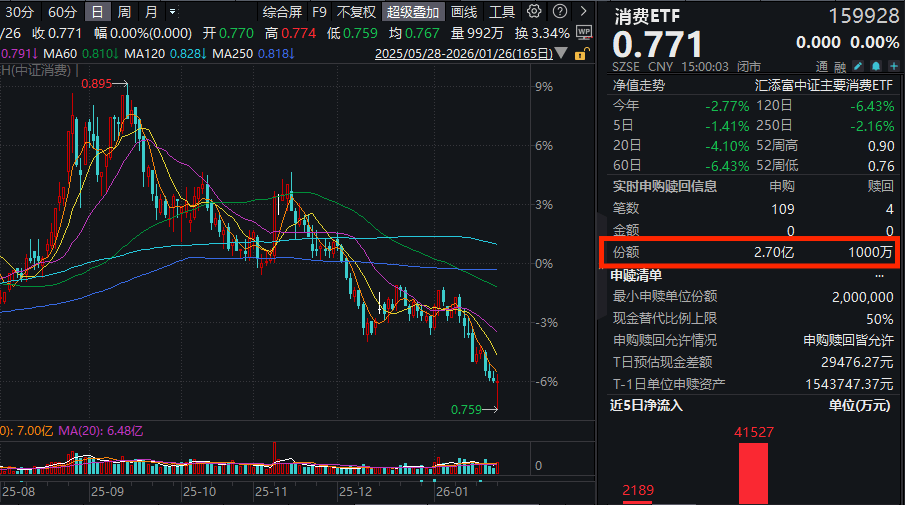
国际黄金突破5000美元,老铺黄金“逆势打折”大涨超7%!消费ETF(159928)金针探底,全天大举揽金2.6亿份!
Sou Hu Cai Jing· 2026-01-26 09:20
Group 1: Market Overview - A-shares experienced fluctuations with the consumer sector showing narrow movements, while the leading consumption ETF (159928) saw a significant increase in trading volume, reaching nearly 800 million yuan, a 102% increase compared to the previous period [1] - The consumption ETF has attracted substantial capital inflow, with a net inflow exceeding 1.6 billion yuan over the past ten days, bringing its total scale to over 22.8 billion yuan, leading its peers [1] Group 2: Alcohol Industry Insights - Yanghe Distillery projected a significant decline in its net profit for 2025, estimating between 2.116 billion to 2.524 billion yuan, representing a year-on-year drop of 62%-68%, marking the largest annual decline since its listing [3] - The company has also retracted its previous commitment to a cash dividend of no less than 7 billion yuan, leading to investor dissatisfaction and a stock price drop of 9.85%, nearing the limit for a trading halt [3] Group 3: Gold Market Dynamics - The price of spot gold surpassed 5,000 USD per ounce, reaching a new historical high, which has led to increased consumer interest in gold purchases, particularly during the upcoming Spring Festival [4] - Old Puhuang's sales have surged due to promotional activities, with a notable increase in foot traffic at their stores, indicating a strong consumer response to the rising gold prices [4] - The jewelry market remains robust, with consumers showing a preference for gold and jewelry products as investments, despite rising prices [5] Group 4: Policy and Consumer Trends - Recent government initiatives aim to enhance consumer spending, particularly in durable goods and service sectors, with new policies expected to be introduced soon [3][10] - The upcoming long holiday period, including the Spring Festival, is anticipated to boost consumer spending across various sectors, including travel, dining, and retail [11] - The focus on service consumption is expected to accelerate, supported by government policies aimed at improving service quality and expanding consumer options [10]
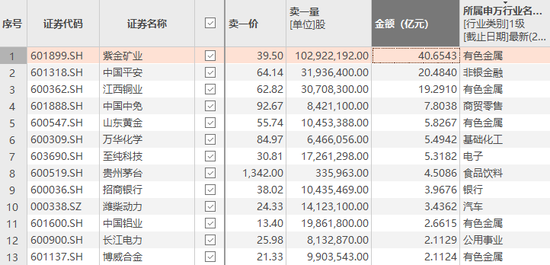
601899,尾盘突现超40亿元压单
Xin Lang Cai Jing· 2026-01-26 09:12
Core Viewpoint - The A-share market experienced significant selling pressure from major stocks during the closing auction phase, indicating potential market volatility and regulatory responses to manage risks [1][4][10]. Market Performance - On January 26, the main A-share indices adjusted, with the Shanghai Composite Index down 0.09%, the Shenzhen Component down 0.85%, and the ChiNext Index down 0.91% [1][6]. - The total trading volume in the Shanghai, Shenzhen, and Beijing markets reached 32,806 billion CNY, an increase of 1,625 billion CNY from the previous trading day, marking the second consecutive day of trading volume exceeding 30 trillion CNY [1][6]. Selling Pressure - During the closing auction from 14:57 to 15:00, several core stocks experienced substantial sell orders, with Zijin Mining (601899) having a sell order amount exceeding 4 billion CNY, and other leading stocks like China Ping An, Jiangxi Copper, and China Duty Free also showing significant sell orders [1][7]. - Specific sell order amounts included 40.7 billion CNY for Zijin Mining, 20.5 billion CNY for China Ping An, and 19.3 billion CNY for Jiangxi Copper [1][7]. Historical Context - This incident is not the first occurrence of large sell orders from major stocks; a similar event happened on January 14, 2026, where stocks like China Merchants Bank and Zijin Mining also showed significant sell orders exceeding 10 billion CNY [4][10]. - The previous sell order from China Merchants Bank reached as high as 6.5 billion CNY, indicating a pattern of pressure on key financial and resource stocks during active market periods [4][10]. Regulatory Environment - The frequent occurrence of sell orders may correlate with recent regulatory measures aimed at strengthening risk management, including an increase in the minimum margin requirement for margin trading from 80% to 100%, effective January 19, 2026 [4][10]. - Following these regulatory changes, the A-share market has shown signs of consolidation and structural differentiation, with the Shanghai Composite Index fluctuating around the 4,100-point mark after reaching a peak of 4,190.87 points on January 14 [10].