
银行业

Search documents
澳洲联储“二把手”放鹰:通胀依然“过高” 不能任其持续
智通财经网· 2026-02-11 08:45
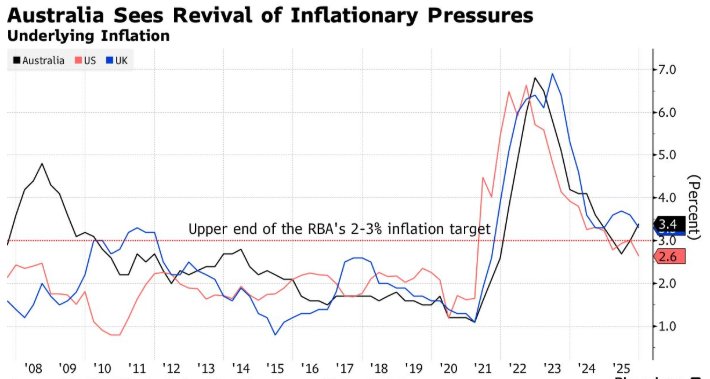
Group 1 - The core viewpoint is that inflation in Australia remains "too high," posing a significant challenge for the Reserve Bank of Australia (RBA), which cannot allow this situation to persist for too long [1] - The RBA has become the first major central bank globally to raise interest rates this year, with indications that at least one more rate hike is expected in the coming months [1] - Current forecasts suggest that both overall and core inflation rates in Australia will exceed the RBA's target range of 2-3% this year [1] Group 2 - Part of the inflation increase in Australia is attributed to the RBA's measures aimed at achieving an economic soft landing, avoiding excessive rate hikes in the post-pandemic era [2] - The RBA has lowered the potential growth rate of the economy to approximately 2% due to long-term weak productivity growth [2] - Recent data shows a decline in consumer confidence following the RBA's rate hike, and a survey indicates a deterioration in the business environment, with consumer confidence remaining below long-term averages [2] Group 3 - The next RBA meeting is scheduled for mid-March, where decision-makers will review January's employment and inflation reports, as well as fourth-quarter GDP data [2] - Most economists expect the RBA to raise the cash rate from the current 3.85% to 4.1% in May after analyzing the first-quarter inflation data [2] - The RBA's Deputy Governor, Andrew Hauser, refrained from directly criticizing government spending, which is seen as a contributor to rising inflation [6]

广东金融“惠”企业!去年新发放企业贷款平均利率创新低
Nan Fang Du Shi Bao· 2026-02-11 08:12
Core Insights - Guangdong's banking sector continues to lead nationally in key metrics such as assets, liabilities, and loans, with total loan balance reaching 19.64 trillion yuan, a year-on-year growth of 6.23% [2] - The sector has achieved both quantitative growth and qualitative improvements, particularly in manufacturing, strategic emerging industries, and infrastructure loans, which have outpaced average loan growth rates [2] Group 1: Financial Performance - By the end of 2025, Guangdong's banking sector reported a total loan balance of 19.64 trillion yuan, with an increase of 1.15 trillion yuan in new loans, representing a year-on-year increase of 179.4 billion yuan [2] - Loans to manufacturing, strategic emerging industries, and infrastructure reached 3.04 trillion yuan, 2.07 trillion yuan, and 3.15 trillion yuan respectively, with growth rates of 7.89%, 16.06%, and 7.42% [2] Group 2: Sectoral Developments - The sector has seen significant growth in technology loans, inclusive loans, green loans, digital economy loans, and elderly care loans, with respective balances of 3.64 trillion yuan, 2.97 trillion yuan, 3.14 trillion yuan, 876.4 billion yuan, and 9.2 billion yuan, reflecting year-on-year growth rates of 11.12%, 8.65%, 15.45%, 4.2%, and 53.2% [2] - Over 200 technology branches have been established, with loans to tech enterprises reaching 276.3 billion yuan, a year-on-year increase of 24.9% [3] Group 3: Digital and Green Finance - Guangdong is advancing its digital finance initiatives, with a focus on integrating digital technology into financial services and enhancing service quality in key areas [4] - Green finance initiatives have led to significant growth in loans for energy transition, infrastructure upgrades, and green consumption, with year-on-year increases of 10.79%, 14.55%, and 19.13% respectively [3] Group 4: Inclusive Finance - The county-level loan balance reached 1.83 trillion yuan, with a loan-to-deposit ratio of 78.22%, an increase of 4.29 percentage points year-on-year [5] - Loans to small and micro enterprises totaled 6.12 trillion yuan, while loans to private enterprises reached 6.8 trillion yuan [5] Group 5: Economic Support Measures - The average interest rate for newly issued corporate loans has decreased by 48 basis points, marking the lowest level on record [6] - Measures to support foreign trade have been implemented, with loans to foreign trade enterprises exceeding 1.8 trillion yuan, a year-on-year increase of 12.43% [6] Group 6: Regulatory and Safety Measures - The Guangdong Financial Regulatory Bureau has imposed penalties on 354 institutions, with fines increasing by 15.5% year-on-year [7] - The bureau has implemented a comprehensive risk prevention framework, particularly in the real estate sector, with significant credit support for "white list" projects [7] Group 7: Industry Restructuring - The province is actively promoting the consolidation of small financial institutions, with 15 village banks either dissolved or entering merger processes [8] - Efforts to curb "involution" competition in the banking sector have been initiated, focusing on self-regulation and market order [8]

个人消费类贷款证券化
Zhong Cheng Xin Guo Ji· 2026-02-11 08:01
1. Report Industry Investment Rating - No information provided in the report 2. Core Viewpoints of the Report - In 2025, China's economy showed strong resilience, with per capita disposable income of residents increasing, but personal consumption willingness remaining weak. The credit card asset quality was under pressure, and the state introduced policies to reduce residents' financing costs and boost consumption [7][47]. - The issuance and secondary trading of personal consumer loan ABS increased, but the issuance of consumer finance companies has been suspended since the fourth quarter. The issuance interest rate remained low, and the cumulative default rates of products from different institutions were differentiated [6]. - In 2026, China is expected to implement more proactive macro - policies, and consumer finance companies need to clarify their positioning and optimize their business capabilities [47]. 3. Summary by Directory 3.1 Policy - In 2025, the state introduced policies to reduce residents' financing costs, boost consumption, and regulate the consumer credit market. These policies included increasing consumer finance supply, standardizing financial business fees, strengthening risk management, and improving credit management [6][9][10] 3.2 Issuance - In 2025, 18 personal consumer loan ABS products were issued in the inter - bank credit asset securitization market, with a total issuance scale of 32.77 billion yuan, a year - on - year increase of 5.88% in the number of products and 32.70% in the scale. The issuance of consumer finance companies has been suspended since the fourth quarter [6][14][16] 3.3 Issuance Interest Rate - The issuance interest rate range of the priority (AAAsf) and sub - priority (AA + sf) securities of personal consumer loan ABS products narrowed. The AAAsf - level spread range of products initiated by commercial banks was 0.44 - 11.47BP, and that of consumer finance companies was - 1.53 - 21.58BP. The overall issuance cost remained low [6][22] 3.4 Secondary Market - In 2025, the trading volume of personal consumer loan ABS products was 9.625 billion yuan, with a turnover rate of 28.06%, indicating an increase in secondary market activity [6][25] 3.5 Asset Pool Characteristics - The asset pool interest rate of personal consumer loan ABS products issued in 2025 increased, and the remaining term remained stable. The average single - household loan unpaid principal balance was small, and the asset pool had a high degree of dispersion. The weighted average contract interest rate of consumer finance companies was higher than that of commercial banks [27][28][29] 3.6 Performance of Existing Products - The cumulative default rate of personal consumer loan ABS products decreased in 2025 compared with 2024, but there were differences among different institutions. The 31 - 60 - day and 61 - 90 - day overdue rates of the underlying assets fluctuated less, but the asset quality was still under pressure. The prepayment rate continued to rise due to interest rate decline and residents' de - leveraging [6][30][44]
央行重要发布,最新解读来了!
Sou Hu Cai Jing· 2026-02-11 07:35
Core Viewpoint - The People's Bank of China (PBOC) continues to implement a moderately accommodative monetary policy to create a suitable monetary and financial environment for the high-quality development of the real economy [1]. Group 1: Monetary Policy Effects - The effects of the moderately accommodative monetary policy in 2025 are gradually becoming evident, with social financing scale and broad money supply (M2) growing by 8.3% and 8.5% year-on-year, respectively, significantly outpacing nominal GDP growth [4]. - The interest rates for newly issued corporate loans and personal housing loans were approximately 3.1% in December 2025, indicating a sustained low financing cost [4]. - Key areas such as technology loans, green loans, inclusive loans, elderly care industry loans, and digital economy loans saw year-on-year growth rates of 11.5%, 20.2%, 10.9%, 50.5%, and 14.1%, respectively, with all key area loans maintaining double-digit growth [4]. Group 2: Coordination of Fiscal and Monetary Policies - The PBOC will continue to strengthen the coordination between monetary and fiscal policies, as highlighted in a recent State Council meeting, to enhance policy effectiveness and guide social capital in promoting consumption and investment [5]. - Three main models for enhancing coordination include maintaining market liquidity through open market operations, optimizing financial resource allocation via "re-lending + fiscal subsidies," and using guarantees to share risk costs [5]. Group 3: Diversification of Financing Channels - In 2025, there was a notable increase in government bond financing, corporate bond financing, and non-financial corporate domestic stock financing, with over 1.5 trillion yuan in technology innovation bonds issued, accelerating the formation of a new capital market investment ecosystem [6]. - The ongoing innovation in the capital market has led to a richer and more diverse range of products and services, improving the alignment between financial market supply and the financing needs of new growth areas [7]. Group 4: Adjustments in Resident Asset Allocation - In the third quarter of 2025, the growth rate of household deposits showed a high-level decline, prompting discussions about potential "loss" of bank deposits [8]. - Experts suggest that this shift in asset allocation towards bank wealth management and asset management products does not significantly impact overall liquidity, as most funds are redirected back into the banking system [9]. Group 5: Future Monetary Policy Directions - The PBOC aims to enhance the consistency of macroeconomic policy orientation and improve counter-cyclical and cross-cyclical adjustments to support a stable economic environment [11]. - Key strategies include maintaining reasonable growth in financial totals, optimizing financial services for high-quality development, and ensuring effective implementation of financial support policies for consumption and innovation [11][12].
2025Q4货币政策执行报告学习体会:如何解读2025年四季度货币政策执行报告?
EBSCN· 2026-02-11 07:31
Economic Outlook - The central bank is optimistic about domestic economic growth in 2026, indicating conditions for sustained improvement[2] - The report highlights positive changes in price levels, with a focus on supporting reasonable price recovery[3] - The domestic economy is described as maintaining a steady and progressive trend, with major development goals achieved in 2025[3] Monetary Policy - The central bank aims to stabilize short-term interest rates and may introduce corresponding policy tools[2] - Interest rate cuts will require careful timing, with attention to the impact of the continuously appreciating exchange rate on monetary policy adjustments[2] - The report emphasizes the need for coordination between monetary and fiscal policies, addressing liquidity concerns in the "big asset management" sector[2][6] Market Implications - Overall liquidity is expected to remain sufficient, which is favorable for domestic equity and bond markets[6] - The report suggests that liquidity friction within the asset management industry is recognized and will be managed through monetary policy[7] - The central bank's cautious approach to using total monetary policy tools reflects a balance between supporting growth and managing risks[5]
【广发宏观钟林楠】2025年四季度货政报告的四个关注点
郭磊宏观茶座· 2026-02-11 06:58
Core Viewpoint - The central theme of the article revolves around the People's Bank of China's (PBOC) monetary policy adjustments and their implications for the economy, focusing on stabilizing short-term interest rates, promoting low financing costs, and leveraging exchange rates as automatic stabilizers for macroeconomic balance [5][6][10]. Group 1: Short-term Interest Rates - The PBOC aims to guide short-term money market rates to operate smoothly around the central bank's policy rates, specifically targeting DR001 and DR007, with a stable operation range defined as 20 basis points below and 50 basis points above the 7-day reverse repo rate [1][6]. - The report indicates that the key interest rates like DR001 and DR007 are expected to operate within a corridor of 70 basis points, which is considered acceptable by the central bank [1][6]. Group 2: Financing Costs - The PBOC emphasizes the need to maintain low comprehensive financing costs for society, suggesting that current financing costs are already at a relatively acceptable low level, making further rate cuts less likely without stronger triggers [2][8]. - The focus remains on stabilizing and expanding bank interest margins while ensuring sufficient liquidity for the banking system, indicating a low probability of significant increases in short-term rates like interbank certificates of deposit [2][8]. Group 3: Exchange Rate Stabilization - The PBOC calls for the exchange rate to function as an automatic stabilizer for the macroeconomy and international balance of payments, highlighting its role in adjusting trade conditions and absorbing external policy impacts [3][10]. - Emphasizing the need for exchange rate flexibility, the PBOC aims to maintain a balance between internal and external economic conditions, which requires a certain degree of exchange rate elasticity [3][10]. Group 4: Response to Deposit Migration - The PBOC addresses the issue of "deposit migration," noting that as direct financing develops and financing channels diversify, the allocation of household savings between bank deposits and other financial assets will become more varied [4][11]. - The central bank emphasizes that while this diversification may affect the structure of bank liabilities, it does not necessarily lead to significant changes in the overall liquidity of the financial system [4][11].

ETO Markets 出入金:美国12月零售零增长,降息预期升温
Sou Hu Cai Jing· 2026-02-11 06:46
Core Insights - The December 2025 retail sales data in the U.S. indicates a significant slowdown in consumer spending momentum at year-end, with retail sales showing a month-on-month growth of 0%, a sharp decline from the previous month's 0.6% increase, and below the market expectation of 0.4% growth [1][3] Group 1: Retail Sales Performance - Retail sales showed a month-on-month stagnation, raising concerns about the sustainability of consumer spending, a key driver of U.S. economic growth [1][3] - Year-on-year retail sales growth was recorded at 2.4%, which is lower than the consumer price index's year-on-year increase of 2.7%, suggesting that real consumption growth may have stalled [3][4] Group 2: Sectoral Analysis - There is a divergence in consumer spending, with categories such as automobiles, furniture, electronics, and clothing experiencing month-on-month declines, while categories like building materials, gasoline, and food and beverages saw growth [3][4] - High-income households may be supported by rising stock markets, but low-income groups, reliant on wage growth, are showing weaker spending performance [3] Group 3: Market Reactions - Following the retail sales data release, U.S. Treasury yields fell across the board, with the 10-year yield dropping by 6 basis points to 4.14% and the 30-year yield down by 7 basis points to 4.78%, reflecting heightened expectations of economic slowdown and speculation about potential early interest rate cuts by the Federal Reserve [3][4] Group 4: Federal Reserve's Stance - Federal Reserve officials have indicated that a shift in monetary policy is not imminent, with concerns about persistent high inflation and cautious optimism regarding the current policy rate's ability to bring inflation back to the 2% target [4] - Future economic data will be crucial in determining the appropriateness of current policy positions, with potential rate cuts being considered only if inflation decreases alongside a significant weakening in the labor market [4] Group 5: Economic Outlook - The weak December retail data highlights the fragile foundation of the U.S. consumer recovery, particularly among middle and low-income groups [4] - The combination of high inflation and a labor market that has not yet shown significant cooling will keep the Federal Reserve's policy path highly dependent on subsequent economic data [4]
助贷新规出台在即 规范三大助贷模式 要求银行加强自主风控
2 1 Shi Ji Jing Ji Bao Dao· 2026-02-11 06:33
Core Viewpoint - The upcoming "Loan Assistance Regulations" aim to enhance banks' risk control capabilities and standardize three main loan assistance models, while encouraging banks to diversify their risk sources through third-party guarantee institutions [1][2]. Group 1: Loan Assistance Models - The three main models for internet loans through commercial banks include: Joint Loan Model, Financing Guarantee Model, and Profit Sharing Model [2]. - In the Joint Loan Model, the lending bank and the platform's licensed institutions jointly provide loans, with the bank's contribution not exceeding 70% [2]. - The Financing Guarantee Model involves the assistance platform providing guarantees for borrowers, with the platform conducting initial risk assessments and recommending clients to banks [2]. - The Profit Sharing Model allows the assistance platform to provide customer acquisition and data analysis services, with banks handling funding and risk control independently, thus being referred to as a "light asset model" [2]. Group 2: Regulatory Context - The introduction of the Loan Assistance Regulations reflects a broader trend of stringent regulation in the internet loan sector [5]. - Since the 2020 issuance of the "Interim Measures for the Management of Internet Loans by Commercial Banks," a series of regulatory documents have been released to standardize the roles of all parties involved in internet loans [6]. - These regulations aim to enhance the self-capacity of banks and other financial institutions, thereby reducing risks associated with collaborative entities [6]. Group 3: Market Dynamics - The regulatory changes are expected to increase the operational costs for third-party platforms and push down financing rates [6]. - The industry is witnessing a growing divide, with weaker banks facing consolidation pressures, as evidenced by nearly 200 small banks ceasing operations in 2024 [7]. - The number of small loan companies has decreased from 5,500 at the end of 2023 to 5,385 by September 2024, indicating a trend of market exit among non-compliant entities [7].

中国人民银行副行长邹澜:继续实施好适度宽松的货币政策
Zhong Guo Ji Jin Bao· 2026-02-11 06:33
Core Viewpoint - The People's Bank of China (PBOC) will continue to implement a moderately accommodative monetary policy to support economic growth and stabilize market expectations, with a focus on the effectiveness of previously implemented policies [4][5]. Group 1: Monetary Policy Implementation - In the first half of 2025, the total social financing increased by 22.83 trillion yuan, which is 4.74 trillion yuan more than the same period last year [1]. - The PBOC has reduced the reserve requirement ratio (RRR) 12 times and policy interest rates 9 times since 2020, leading to a decrease of 115 basis points for the 1-year Loan Prime Rate (LPR) and 130 basis points for the 5-year LPR [2]. - The average interest rate for newly issued corporate loans in the first half of 2025 was approximately 3.3%, down about 45 basis points from the previous year [3]. Group 2: Financial Market Developments - The bond market in China issued various bonds totaling 44.3 trillion yuan in the first half of 2025, a year-on-year increase of 16% [7]. - The balance of loans in the "Five Major Financial Articles" reached 103.3 trillion yuan, with a year-on-year growth of 14% [6]. - The average issuance rate for corporate credit bonds was 2.08%, which is a decrease of 32 basis points compared to the same period last year [7]. Group 3: Structural Policies and Support - The PBOC has established a 500 billion yuan re-lending facility for service consumption and elderly care to stimulate demand in these sectors [9]. - Structural monetary policy tools will continue to focus on supporting technological innovation and boosting consumption, enhancing the effectiveness of economic restructuring [14]. - A total of 288 entities issued technology innovation bonds amounting to approximately 600 billion yuan, promoting the development of emerging industries [12].
固收-四季度货政报告有哪些关注点
2026-02-11 05:58
Summary of Key Points from the Conference Call Industry Overview - The conference call primarily discusses the bond market and monetary policy in the context of the central bank's actions and strategies for stabilizing the financial environment. Core Insights and Arguments - The central bank is utilizing net bond issuance and reverse repos to stabilize market liquidity, indicating a protective stance towards the market [1][2] - Short-term interest rate cuts are unlikely, but long-term rates have room for growth, with expectations for the 10-year government bond yield to potentially drop to 1.75% and the 30-year yield to exceed 2.15% in the first quarter [1][2] - The resumption of government bond trading aims to maintain the yield curve within a reasonable range, supporting the healthy development of the bond market, suggesting that interest rates should not rise excessively [3] - The report indicates that the peak for short-term market interest rates may have occurred in early January, with a subsequent downward trend expected [4] - The phrase "orderly expansion of the coverage of comprehensive financing costs for corporate loans" refers to reducing unnecessary fees in the loan process and increasing transparency to lower corporate financing costs, implying that interest rate cuts are not anticipated in the short term [5] - Short-term market interest rates are expected to fluctuate within the range of temporary reverse repo operation rates, indicating that funding costs will not significantly increase [6] - The normalization of government bond trading tools will serve as an indicator of the central bank's protective intentions towards the market, with a recent trading volume reaching a trillion level indicating strong protective intent [7] Additional Important Content - Macro-prudential management (MPA) focuses on supporting the execution and transmission of monetary policy, ensuring overall financial stability and enhancing investor confidence through range management of various financial products [8][9] - Concerns regarding deposit outflows are deemed unwarranted, as current conditions are better than expected, with new asset allocations primarily directed towards unified deposits and certificates of deposit, which will eventually return to the banking system [10] - The implementation of a one-time credit repair policy targets small consumer loans (below 10,000 yuan) and reflects ongoing pressure on banks' non-performing loans, necessitating continued monitoring and measures to alleviate this pressure [11] - Investment strategy recommendations suggest a gradual shift from coupon strategies to duration strategies, with expectations for continued low volatility in the bond market over the next three years, emphasizing the importance of capturing small trading opportunities [12]