医药生物

Search documents
医药生物行业双周报(2025、10、24-2025、11、6)-20251107
Dongguan Securities· 2025-11-07 09:22
Investment Rating - The report maintains a "Market Weight" rating for the pharmaceutical and biotechnology industry, indicating that the industry is expected to perform within ±10% of the market index over the next six months [3][29]. Core Insights - The SW pharmaceutical and biotechnology industry underperformed the CSI 300 index, declining by 0.61% from October 24 to November 6, 2025, which is approximately 2.50 percentage points lower than the index [10][23]. - Most sub-sectors within the industry recorded negative returns during the same period, with the vaccine and pharmaceutical distribution sectors showing the highest gains of 2.87% and 2.33%, respectively, while offline pharmacies and medical research outsourcing experienced declines of 3.95% and 3.11% [11][12]. - Approximately 57% of stocks in the industry recorded positive returns, with notable performers including Hezhong China, which saw a weekly increase of 115.96% [15][12]. Summary by Sections 1. Market Review - The SW pharmaceutical and biotechnology industry lagged behind the CSI 300 index, with a decline of 0.61% from October 24 to November 6, 2025 [10]. - Most sub-sectors recorded negative returns, with vaccines and pharmaceutical distribution leading in gains [11]. - About 57% of stocks in the industry had positive returns, with significant fluctuations among individual stocks [15]. 2. Industry News - The 11th batch of national drug centralized procurement results was announced, involving 55 varieties and 445 companies, with a selection rate of 57% [21]. - The new procurement rules emphasize clinical stability, quality assurance, and higher standards for bidding companies [21]. 3. Company Announcements - Yekang Pharmaceutical announced that its subsidiary received approval for clinical trials of YKYY013 injection for chronic hepatitis B treatment [22]. 4. Industry Outlook - The report suggests focusing on investment opportunities in innovative drugs and sectors with expected business development catalysts, including medical devices and traditional Chinese medicine [25]. - Key companies to watch include Mindray Medical, Yifeng Pharmacy, and Aier Eye Hospital, among others [26].
A股平均股价13.95元 25股股价不足2元
Zheng Quan Shi Bao Wang· 2025-11-07 09:11
Core Insights - The average stock price in the A-share market is 13.95 yuan, with 25 stocks priced below 2 yuan, the lowest being *ST Gao Hong at 0.38 yuan [1][2] - Among the low-priced stocks, 10 are ST stocks, accounting for 40% of the total [1] Market Performance - As of November 7, the Shanghai Composite Index closed at 3997.56 points [1] - In the low-priced stock category, 8 stocks increased in price, with *ST Hui Feng leading at a rise of 3.53%, followed by ST Jing Lan at 1.71% and HNA Holding at 1.67% [1] - Conversely, 10 stocks experienced declines, with *ST Yuan Cheng dropping 4.69%, *ST Su Wu down 2.00%, and ST Zhong Zhu falling 1.51% [1] Low-Priced Stock Rankings - The table lists various low-priced stocks, including their latest closing prices, daily price changes, turnover rates, price-to-book ratios, and industries [1][2] - Notable low-priced stocks include *ST Gao Hong (0.38 yuan), *ST Yuan Cheng (0.61 yuan), and *ST Su Wu (0.98 yuan) [1]


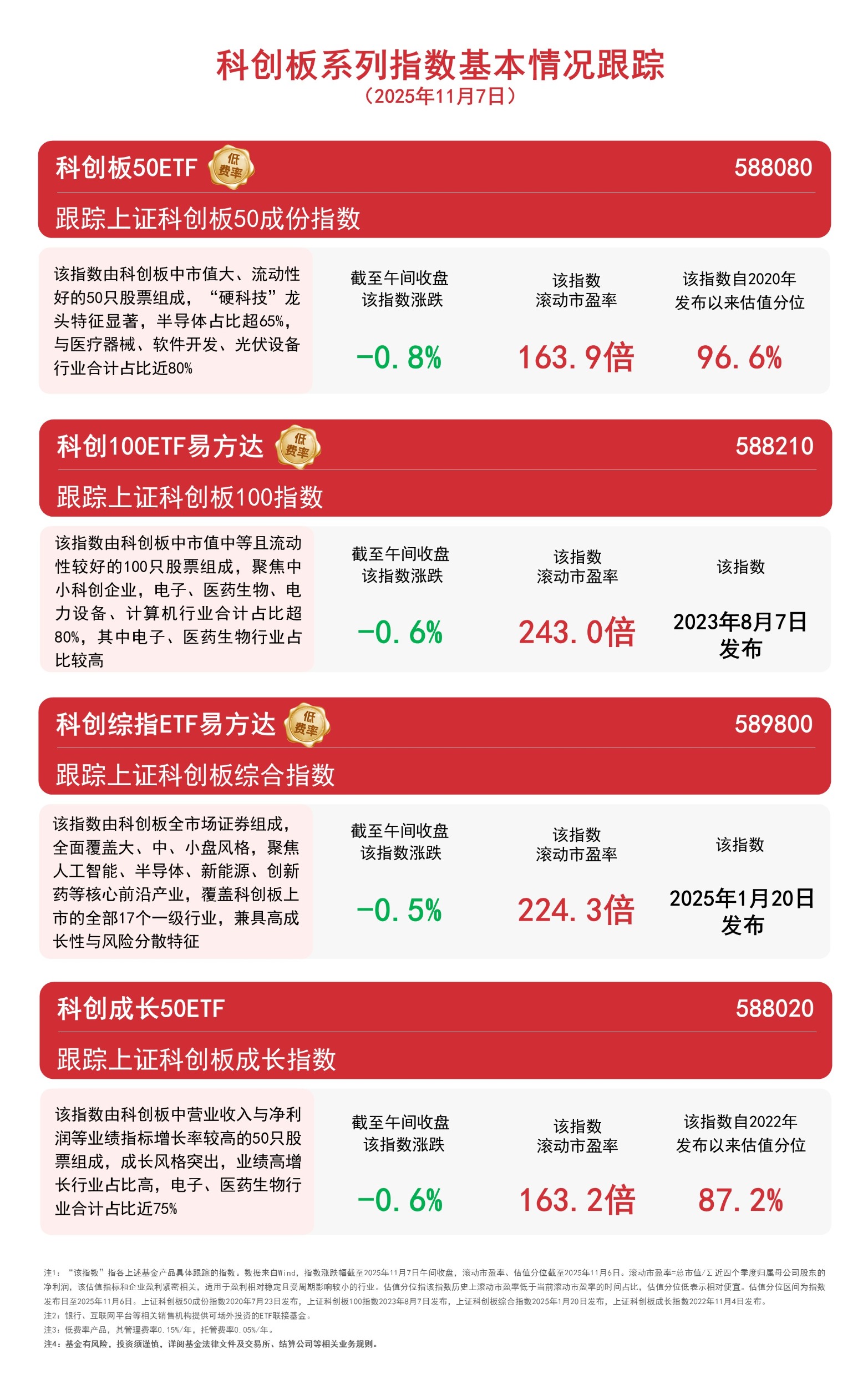
半导体硬件股震荡调整,关注科创板50ETF(588080)等产品投资机会
Mei Ri Jing Ji Xin Wen· 2025-11-07 05:45
Group 1 - The core viewpoint of the article highlights the performance and characteristics of various STAR Market ETFs, focusing on their underlying indices and sector allocations [2][3][5] - The STAR 50 ETF tracks the STAR 50 Index, consisting of 50 large-cap stocks with significant liquidity, predominantly in the "hard technology" sector, with semiconductors accounting for over 65% and combined with medical devices, software development, and photovoltaic equipment making up nearly 80% [2] - As of the midday close, the STAR 50 Index had a rolling P/E ratio of 110 and experienced a price change of +0.8% [2] Group 2 - The E Fund STAR 100 ETF tracks the STAR 100 Index, which includes 100 medium-cap stocks with good liquidity, focusing on small and medium-sized innovative enterprises, with over 80% of its composition in electronics, pharmaceuticals, and power equipment [3] - The STAR 100 Index had a rolling P/E ratio of 243 and saw a price change of -0.6% as of the midday close [3] - The E Fund STAR Comprehensive Index ETF tracks the STAR Comprehensive Index, which encompasses all market securities in the STAR Market, providing a broad coverage of various stock styles [3]

弱者恒弱or困境反转?
Tianfeng Securities· 2025-11-07 05:43
Group 1 - The core conclusion of the report is to explore which industries that have underperformed for three consecutive years have a higher probability of reversal in the coming year. It highlights that industries like beauty care, basic chemicals, and social services are currently close to their historical longest periods of underperformance [2][3][10] - The report identifies that defensive industries such as environmental protection, public utilities, and transportation are more likely to exhibit prolonged underperformance due to their weak cyclical nature and low beta characteristics. These industries tend to show a "prolonged decline" feature [2][3][10] - The report indicates that the trend of negative excess returns in public utility sectors is attributed to the small-cap stocks within these sectors, which lack both offensive characteristics during bull markets and stable dividend attributes. The divergence between industry leaders and small-cap stocks has become more pronounced since 2017 [3][24] Group 2 - The report provides statistical analysis from 2007 to 2025, showing that the probability of an industry that has underperformed for three consecutive years winning in the fourth year is inversely related to its historical performance. This suggests that industries with a long history of weak performance are likely to continue this trend [3][10] - The report notes that the current industries that have underperformed for three years and are close to their historical longest underperformance periods include beauty care, basic chemicals, and social services. It also mentions that the food and beverage, agriculture, forestry, animal husbandry, fishery, social services, and pharmaceutical biotechnology sectors have a higher probability of winning in the fourth year [4][38] - The report emphasizes that the monthly trading volume of public utilities, environmental protection, and transportation has been decreasing as a proportion of total A-share trading volume, indicating a long-term downward trend in liquidity for these sectors [4][24][37]
瑞银全球金融市场部中国主管房东明:期待2026年成为配置型国际投资者投资中国的大年
Zheng Quan Ri Bao Wang· 2025-11-07 04:04
Core Insights - China's capital market has significantly opened up, with approximately 90% to 95% of the foreign investment access goals achieved, indicating a mature and complete foreign institutional access mechanism [1] - The focus should now be on improving risk management tools, expanding interconnectivity targets, and enhancing capital utilization efficiency to further increase the international appeal of the Chinese market [1] - The provision of predictable macro policies and robust growth fundamentals of listed companies are crucial for attracting long-term international investors [1] Group 1: International Investor Trends - International investors are increasingly active in China, with a notable rise in trading-type investors contributing significantly to market liquidity since September of the previous year [1] - In contrast, allocation-type investors are extending their research efforts and closely monitoring developments in Chinese listed companies, policies, and technological innovations [1] - As of November 7, 2023, foreign institutions have conducted 8,406 research sessions involving 770 A-share companies, focusing on sectors such as telecommunications, pharmaceuticals, semiconductors, and robotics [2] Group 2: Investment Preferences and Growth Sectors - International investors show a preference for large-cap blue-chip stocks with good liquidity and attractive valuations, while also focusing on high-growth sectors like technology, AI, innovative pharmaceuticals, and new consumption [4] - The attractiveness of growth sector companies is often linked to specific events and timing, with recent developments enhancing international recognition of China's technological innovation capabilities [4] - Companies with strong fundamentals, favorable industry policies, and global competitiveness are more appealing to overseas investors, who prioritize long-term strategies over short-term performance [4] Group 3: Globalization and Future Outlook - As Chinese companies expand internationally, sectors like new consumption and innovative pharmaceuticals are gaining increased attention from international investors [5] - Companies must focus on continuous product or model innovation to maintain competitiveness in overseas markets, emphasizing the importance of talent acquisition and local partnerships [5] - The attractiveness of Chinese assets to international investors is expected to rise further by 2026, despite potential market volatility in late 2025, with expectations of sector rotation enhancing overall asset valuations [5]
万联晨会-20251107
Wanlian Securities· 2025-11-07 02:18
Core Insights - The A-share market showed a strong upward trend, with the Shanghai Composite Index rising by 0.97% to 4007.76 points, and the Shenzhen Component Index increasing by 1.73% [2][8] - The total trading volume in the A-share market reached approximately 2.05 trillion RMB, with over 2800 stocks experiencing gains [2][8] - The leading sectors included non-ferrous metals, electronics, and telecommunications, while the media sector lagged behind [2][8] - In the Hong Kong market, the Hang Seng Index closed up by 2.12%, and the Hang Seng Tech Index rose by 2.74% [2][8] - In contrast, all three major US stock indices closed lower, with the Dow Jones down by 0.84%, the S&P 500 down by 1.12%, and the Nasdaq down by 1.9% [2][8] Important News - President Xi Jinping emphasized the high-standard construction of the Hainan Free Trade Port, marking it as a significant step towards expanding high-level opening-up and promoting an open world economy [3][9] - The strategic goal of the Hainan Free Trade Port is to become a key gateway for China's new era of opening-up, focusing on high-quality development and integrating with major economic regions [3][9] Fund Allocation Insights - As of Q3 2025, the total net value of all funds in the market reached 35.16 trillion RMB, with equity and mixed funds accounting for 24.33% of the total [10] - The overall fund position increased to 80.03%, with equity mixed funds at 74.77% and ordinary equity funds at 82.14% [10] - The performance of various fund types varied significantly, with equity funds achieving a return of 24.14% and mixed funds at 20.87% for the quarter [11] Beauty and Personal Care Sector - In Q3 2025, the fund allocation ratio for the beauty and personal care sector decreased to 0.20%, indicating a low allocation level [14][15] - The medical beauty sub-sector remains in an overweight position, while personal care and cosmetics are underweighted [15][16] - The top three stocks in the beauty and personal care sector by fund allocation are Jinbo Biological, Aimeike, and Baiya Shares, although their allocation ratios have declined [16] Precision Reducer Industry - The precision reducer is a core component in the transmission field, crucial for humanoid robots, with significant market potential expected by 2030 [18][21] - The market for precision reducers is projected to grow substantially, with the domestic market for harmonic reducers expected to reach 24.9 billion RMB in 2023, growing at a CAGR of 16.54% from 2019 to 2023 [20] - The domestic production of precision reducers is increasing, with local manufacturers gradually closing the gap with international standards, indicating a strong trend towards domestic substitution [22]
A股开盘速递 | A股弱势震荡!海南板块再度走高 煤炭概念反复活跃
智通财经网· 2025-11-07 01:54
Core Viewpoint - The A-share market is experiencing weak fluctuations, with notable movements in specific sectors such as Hainan Free Trade and technology growth trends becoming clearer [1][2]. Group 1: Market Performance - As of November 7, the Shanghai Composite Index fell by 0.16%, the Shenzhen Component Index decreased by 0.72%, and the ChiNext Index dropped by 1.07% [1]. - The Hainan Free Trade concept is gaining traction, with Haima Automobile hitting the daily limit up for six consecutive days, and Hainan Development also reaching the limit up [1][3]. Group 2: Sector Highlights - The Hainan sector is performing well, driven by high-level discussions on the construction of the Hainan Free Trade Port, aiming for high-quality development and a modern industrial system [3]. - In the downtrend, sectors such as storage chips and semiconductors are experiencing corrections [1]. Group 3: Institutional Perspectives - Huajin Securities suggests a slow bull market and recommends accumulating positions in communication and electronics sectors, as recent factors causing adjustments may gradually dissipate [4]. - Dongguan Securities notes that the market style is expected to be more balanced than in the third quarter, with a focus on technology growth and high-end manufacturing [5]. - Zhongyuan Securities anticipates a continuation of structural volatility in the market, advising to consider increasing allocations in the technology sector if price-performance ratios improve [6].

36只北交所股票融资余额增加超百万元
Zheng Quan Shi Bao Wang· 2025-11-07 01:37
Core Insights - As of November 6, the total margin financing and securities lending balance on the Beijing Stock Exchange (BSE) is 7.958 billion yuan, a decrease of 16.7738 million yuan from the previous trading day [1] - The stocks with the highest margin financing balances include Jinbo Biological, Shuguang Digital Innovation, and Betterray, with balances of 406 million yuan, 332 million yuan, and 264 million yuan respectively [1] - A total of 131 stocks on the BSE received net margin purchases, with 36 stocks having net purchases exceeding 1 million yuan, led by Kaifa Technology with a net purchase of 16.6739 million yuan [1][2] Margin Financing Overview - The margin financing balance on November 6 is 7.957 billion yuan, down by 16.7451 million yuan, marking a decrease for three consecutive trading days [1] - The securities lending balance is 442,700 yuan, a decrease of 28,700 yuan from the previous trading day [1] Sector Performance - The sectors with the most stocks receiving net margin purchases over 1 million yuan are electric power equipment, machinery, and pharmaceutical biology, with 9, 6, and 5 stocks respectively [2] - On November 6, the average decline for stocks with net margin purchases exceeding 1 million yuan was 1.90%, with Lingge Technology, Tianming Technology, and Audiwei showing increases of 2.87%, 0.88%, and 0.70% respectively [2] Trading Activity - The weighted average turnover rate for stocks with net margin purchases over 1 million yuan on November 6 was 5.92%, with the highest turnover rates seen in Caneng Electric, Kerun Zhikong, and Deer Chemical at 49.67%, 21.24%, and 20.75% respectively [2] - The average daily turnover rate for BSE stocks on the same day was 3.71% [2] Notable Stocks - The stocks with the largest increases in margin financing on November 6 include Kaifa Technology (increase of 16.6739 million yuan), Tianming Technology (increase of 7.9101 million yuan), and Qiaoguan Cable (increase of 6.7871 million yuan) [2][3] - Stocks with the largest net margin sales include Betterray, Shuguang Digital Innovation, and Danna Biological, with net sales of 20.1779 million yuan, 13.0228 million yuan, and 11.6394 million yuan respectively [1][2]
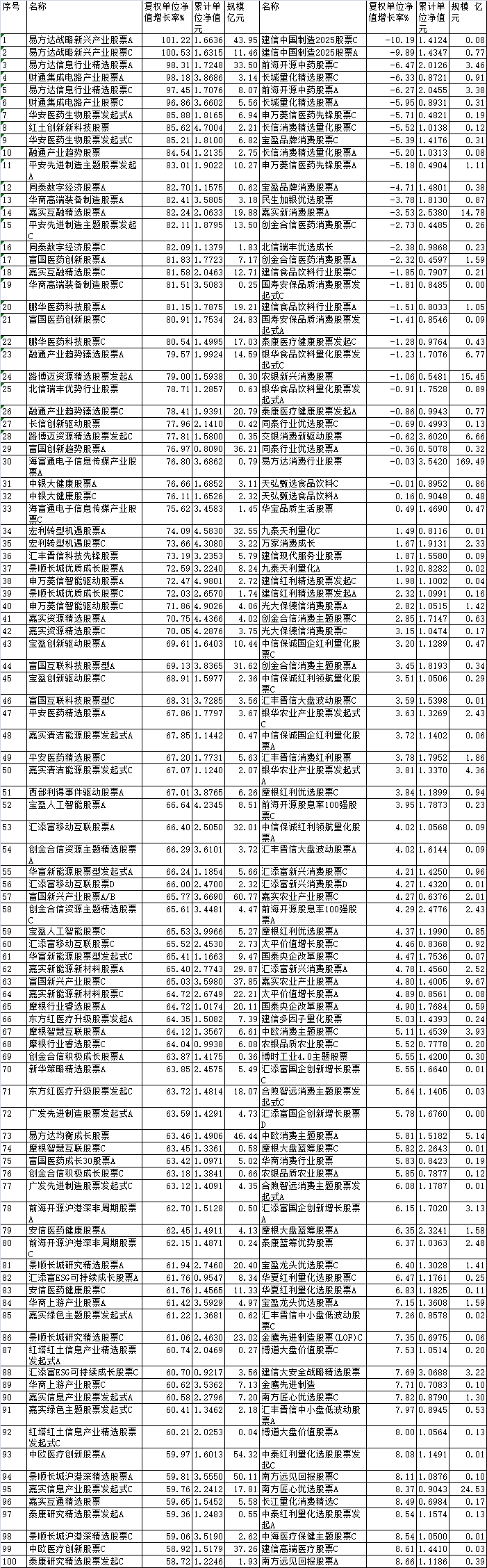
前十月97%普通股基上涨 易方达战略新兴产业股票翻倍
Zhong Guo Jing Ji Wang· 2025-11-06 23:01
Group 1 - In the first ten months of the year, 943 out of 974 comparable ordinary equity funds achieved positive performance, representing a 97% success rate, with only 31 funds declining [1][3] - The top-performing funds include E Fund Strategic Emerging Industries Stock A and C, with returns of 101.22% and 100.53% respectively, benefiting from the surge in sectors like semiconductors and computing [1][2] - The E Fund Information Industry Selected Stock A and C, managed by veteran Zheng Xi, also performed well, with increases of 98.31% and 97.45%, focusing on semiconductor stocks [2][3] Group 2 - The healthcare-themed funds, such as Huaan Pharmaceutical Biotechnology Stock A and C, saw significant gains of 85.88% and 85.21%, respectively, indicating strong performance in the pharmaceutical sector [3][4] - Despite the overall market rise, only 31 ordinary equity funds reported negative returns, with the largest decline being less than 7% for funds heavily invested in traditional sectors like medicine and liquor [3][4] - The Baoying Brand Consumption Stock A and C experienced declines of 4.71% and 5.39%, attributed to a shift in management and a focus on consumer stocks [4][5] Group 3 - The data from Tonghuashun indicates that the performance of various funds is closely tied to their sector focus, with technology and healthcare leading the gains [1][3] - The report highlights the importance of fund management experience, as seen with managers like Zheng Xi and Ouyang Liangqi, who have extensive backgrounds in industry research [2][3] - The overall trend in the A-share market suggests a strong recovery, with a majority of funds benefiting from sector-specific booms, particularly in technology and healthcare [1][3]
港股私有化热潮背后:跳出流动性困境 推动战略转型
Zheng Quan Shi Bao· 2025-11-06 17:56
Core Insights - The Hong Kong stock market is experiencing an unprecedented wave of privatizations, with over 20 companies delisted due to privatization as of November 6, surpassing the total of 15 for the entire year of 2024 [1] - Privatization has become a mainstream method for delisting in the Hong Kong market, accounting for 42.31% of all delisted companies this year, compared to 30.61% in 2024 [2] Summary by Category Market Trends - A total of 52 companies have been delisted from the Hong Kong stock market this year, with 28 due to cancellation of listing status and 22 due to privatization [2] - The privatization trend spans various sectors, including finance, real estate, consumer goods, and technology [2] Reasons for Privatization - Companies are primarily driven to privatize due to low valuations that do not reflect their true value, hindering further financing potential [2] - Low trading volumes have rendered public trading meaningless, prompting companies to seek privatization [3] Strategic Considerations - Strategic transformation needs are also a significant factor driving privatization, as seen with Dongfeng Group's plan to spin off its electric vehicle subsidiary, Lantu Motors, and privatize itself to focus on new energy vehicles [4] - Companies like Fosun Tourism Culture have cited long-term low stock prices and liquidity issues as reasons for their privatization decisions [4] Market Implications - Privatization allows companies to avoid stock price volatility, reduce listing costs, and focus on long-term strategic transformations and mergers [5] - The concentration of privatized companies in traditional industries may temporarily suppress market activity but is expected to attract new capital into emerging sectors in the long run [5] Resource Optimization - Privatization can enhance resource allocation and operational efficiency, as demonstrated by HSBC's plan to privatize Hang Seng Bank while maintaining customer interactions [6] - The process of privatization is seen as a way to eliminate public shareholder constraints, integrate resources, and improve management efficiency [6]