
债券

Search documents
10月28日中午,利率债部分回吐,基金单日爆蛋81个
Sou Hu Cai Jing· 2025-10-29 03:51
Core Viewpoint - The bond market is experiencing significant volatility, with a notable divergence between interest rate bonds and credit bonds, driven by recent central bank actions and market sentiment [3][5][10]. Group 1: Market Reactions - A pure bond fund heavily invested in 30-year government bonds is projected to face a loss of 53-81 basis points, a stark contrast to typical daily fluctuations [1]. - The 10-year government bond yield saw a slight recovery of 1 basis point after a drop, but overall, it has decreased by 3 basis points over two days, raising questions about the market's optimistic sentiment despite some pullback [3][5]. - The central bank's announcement on October 27 to restart government bond trading has altered market dynamics significantly, likened to turning on a water faucet for a thirsty person [3][7]. Group 2: Institutional Divergence - There is a clear divide in institutional strategies, with fund companies favoring long-duration interest rate bonds while banks and insurance firms focus on credit bonds for yield [9][15]. - The bond market has seen a substantial increase in trading volume, with both interest rate and credit bonds experiencing a rise in transaction numbers, indicating a flow of capital into the bond market [9][17]. Group 3: Central Bank Operations - The central bank's dual approach of restarting government bond trading and conducting a 900 billion yuan MLF operation is reminiscent of quantitative easing strategies used by foreign central banks [7][10]. - Market participants are closely monitoring the central bank's actions, with a strong expectation of continued monetary easing reflected in the performance of long-duration interest rate bonds [10][15]. Group 4: Market Sentiment and Liquidity - The bond market's volatility has decreased post-lunch, transitioning from excitement to a more rational outlook, with discussions around potential pricing distortions due to ongoing central bank purchases [12][15]. - There is a noticeable liquidity stratification in the bond market, where large institutions can access funds easily, while smaller non-bank entities face higher financing costs, creating a structural imbalance [15].


511030:心泊公司债,财享更稳健
Sou Hu Cai Jing· 2025-10-29 02:03
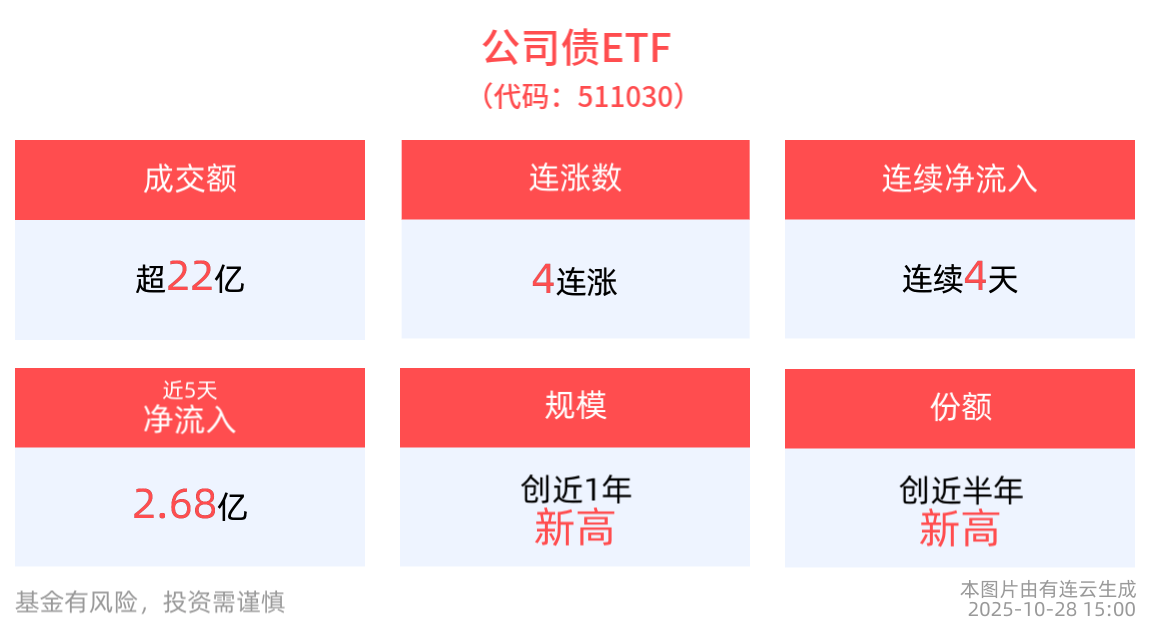
Group 1: Treasury Auctions - The U.S. Treasury auctioned $44 billion in seven-year bonds with a winning yield of 3.790%, marking a new low since September 2024, and a bid-to-cover ratio of 2.46 [1] - The auction of six-month bonds had a winning yield of 3.445% with a bid-to-cover ratio of 3.21 [1] - The auction of 52-week bonds yielded 3.880% with a bid-to-cover ratio of 2.87 [1] Group 2: Credit Bond ETF Performance - The total scale of credit bond ETFs reached 486.2 billion yuan, increasing by 4.4 billion yuan in a single day, with the benchmark market-making ETF rising by 120 million yuan and the Sci-Tech bond ETF increasing by 401 million yuan [4] - The median weighted duration of these ETFs is 3.2 years, with an average transaction amount of 5.01 million yuan and a median turnover rate of 50.6% [4] - The median yield is 1.87%, with a median discount rate of -13.8 basis points [4] Group 3: Company Bond ETF Insights - The company bond ETF (511030) saw a counter-trend growth of 102 million yuan, attributed to its short duration (1.94 years), static high yield (currently 1.95%), and minimal discount [4] - As of October 28, 2025, the company bond ETF has increased by 0.06%, achieving four consecutive days of gains, with a year-to-date increase of 1.26% [4] - The latest scale of the company bond ETF reached 23.346 billion yuan, a new high in nearly a year, with a total of 2.19 billion shares, also a six-month high [6] Group 4: Fund Flows and Leverage - The company bond ETF experienced continuous net inflows over the past four days, with a maximum single-day net inflow of 14.6 million yuan, totaling 26.8 million yuan and an average daily net inflow of 6.7 million yuan [7] - Leverage funds are actively positioning in the company bond ETF, with a net financing purchase of 1.4457 million yuan on the previous trading day and a latest financing balance of 4.2489 million yuan [8] Group 5: Performance Metrics - Over the past five years, the net value of the company bond ETF has increased by 13.23%, with a maximum monthly return of 1.22% and the longest consecutive monthly gain of 9 months [8] - The maximum drawdown in the last six months was 0.28%, with a relative benchmark drawdown of 0.06% [9] - The management fee for the company bond ETF is 0.15%, and the custody fee is 0.05%, with a tracking error of 0.013% over the past year [10]
欧债收益率多数上涨,法国10年期国债收益率涨0.3个基点
Mei Ri Jing Ji Xin Wen· 2025-10-28 22:04
Core Viewpoint - European bond yields mostly increased, indicating a shift in market sentiment towards higher interest rates and potential inflation concerns [1] Group 1: Bond Yield Changes - The UK 10-year government bond yield decreased by 0.1 basis points to 4.398% [1] - The French 10-year government bond yield increased by 0.3 basis points to 3.417% [1] - The German 10-year government bond yield rose by 0.8 basis points to 2.622% [1] - The Italian 10-year government bond yield increased by 0.2 basis points to 3.392% [1] - The Spanish 10-year government bond yield rose by 0.5 basis points to 3.142% [1]
债务人财务造假债券违约 农商行起诉五家中介机构 法院判决:赔偿1800万元
Mei Ri Jing Ji Xin Wen· 2025-10-28 17:54
Core Viewpoint - The Shanghai Financial Court ruled on a case involving false statements in bond issuance by Shanghai Huaxin International Group, ordering five intermediary institutions to bear joint liability for the investment losses of over 128 million yuan incurred by the plaintiff [1][5]. Group 1: Case Details - This case marks the first instance of a securities false statement liability dispute in the interbank bond market, involving a total bond issuance amount exceeding 40 billion yuan from 2014 to 2017 [1][3]. - The plaintiff, a rural commercial bank, claimed that there were false statements during the bond issuance process, leading to significant financial losses [1][3]. - The court found that the issuance documents contained significant omissions and misrepresentations regarding corporate governance, actual control, and financial transactions, constituting false statements [3][5]. Group 2: Financial Implications - The court determined that the plaintiff's losses due to false statements amounted to over 128 million yuan after accounting for non-false statement-related losses [5][7]. - The five intermediary institutions were ordered to bear joint liability for the losses, with compensation responsibilities ranging from 0.5% to 5% [1][7]. - The introduction of third-party professional institutions to assess losses related to non-false statements represents a significant breakthrough in the judicial process for such cases [5].

赵伟:长端利率突破2%后的市场运行规律——基于跨国比较的经验研究(《债券》9月刊)
申万宏源宏观· 2025-10-28 16:04
Core Viewpoint - The article discusses the market dynamics following the long-end interest rates breaking through the 2% threshold, emphasizing the need for a revised analytical framework in the bond market to address potential long-term oscillations rather than a continuous decline [5][6]. Group 1: Long-End Interest Rate Downward Path - Historical data shows that the downward path of long-end interest rates in developed economies exhibits significant asymmetry, with the time taken to drop from 3% to 2% being shorter than from 2% to 1% [6][8]. - The Japanese case during the 1998 Asian financial crisis illustrates this pattern, where the 10-year government bond yield quickly fell below 2% and 1%, followed by a prolonged oscillation between 1% and 2% for seven years [7][8]. - Factors triggering rebounds in interest rates during oscillation periods include marginal tightening of monetary policy, better-than-expected economic data, and the siphoning effect from equity markets [8][9]. Group 2: Conditions for Breaking the 1% Threshold - Long-term interest rates face strong resistance when approaching the 1% level, often requiring specific catalysts such as major economic or financial crises, policy rates nearing theoretical lower limits, or significant external shocks [9][10]. - Historical instances of developed economies effectively breaking the 1% threshold typically coincide with their policy rates being at or near zero [9][10]. Group 3: Mechanisms of Constraints - The lower bound of policy interest rates acts as a constraint, as nominal rates cannot fall below zero, limiting the effectiveness of monetary policy transmission [11][14]. - The rigidity of term premiums, which compensates for risks associated with long-term bonds, restricts further declines in long-end interest rates, as it is influenced by structural factors and market expectations [15][16]. - Institutional asset allocation behavior shifts when long-term bond yields drop below 2%, leading to increased risk asset allocations or cross-border investments, thereby reducing domestic long-term bond demand [17][20]. Group 4: Insights for Bond Market Analysis - The traditional analytical framework for bond markets may become ineffective as the 10-year government bond yield approaches the 1% to 2% range, necessitating a focus on new structural dynamics [21][22]. - The pressure for asset-liability matching among financial institutions has emerged as a key structural force influencing long-term interest rates, particularly in low-yield environments [22][23]. - Central banks' balance sheet operations have evolved into core tools for interest rate control, significantly impacting long-end rates through both flow and stock effects [23][24]. Group 5: Implications for China's Bond Market - The bond market in China may enter a prolonged oscillation phase following the 10-year government bond yield breaking the 2% threshold, necessitating a reassessment of investment strategies from a cross-asset allocation perspective [25][26]. - Current asset allocation behaviors indicate extreme states, with bond assets in public funds significantly exceeding equity allocations, suggesting ongoing rebalancing processes [25][26].

低利差环境下的信用债投资策略 - 中金固收2025债市宝典系列
中金· 2025-10-28 15:31
Investment Rating - The report indicates a focus on high-quality corporate long-duration bonds and suggests a flexible investment strategy to adapt to market conditions. Core Insights - The Chinese credit bond market has formed with non-financial credit bonds accounting for approximately 32 trillion RMB, presenting potential arbitrage opportunities, particularly in medium-term notes and corporate bonds [1][2] - Historical asset shortages have occurred during periods of loose monetary policy and insufficient real financing demand, with the current environment requiring close attention to policy changes [1][5] - Key investment strategies include focusing on high-quality long-duration products, exploiting regulatory arbitrage opportunities, and increasing allocations to high-grade products for stable returns [1][9] Summary by Sections Current Market Changes - The credit bond market has seen significant changes, with credit spreads remaining low amid an asset shortage and a decrease in default events, limiting trading opportunities based on spread fluctuations [2][11] Major Categories and Characteristics - Credit bonds are categorized into financial and non-financial types, with non-financial bonds primarily comprising short-term financing, medium-term notes, and corporate bonds, which may present arbitrage strategies [3][4] Rating Agency Impact - Rating agencies operate under issuer-paid and investor-paid models, with the latter primarily covering certain bonds in the interbank market. The actual practice still favors rated bonds despite regulatory changes allowing for the cancellation of mandatory ratings [4] Historical Asset Shortages - Four historical phases of asset shortages are identified, characterized by loose monetary policy and insufficient real financing demand, with varying influences from demand and supply factors [5] Feasible Investment Strategies - Current feasible investment strategies include focusing on high-quality long-duration bonds, utilizing arbitrage opportunities between different regulatory systems, and considering undervalued assets during severe asset shortages [7][9] Indicators of Rate Downturn Reversal - Key indicators for potential reversals during rate downturns include changes in fundamentals, stringent financial regulations, and institutional behaviors [8] Credit Spread Volatility - Credit spread volatility is influenced by central bank monetary policy, fundamental changes, and institutional behaviors, with historical events illustrating these impacts [10][12] Future Influencing Factors - Future factors affecting the credit bond market include central bank monetary policy changes, actual or expected fundamental changes, and institutional behaviors such as potential redemption waves [12] Risk Preference Influences - In adverse market conditions, risk preferences for credit bonds are influenced by default events, investor characteristics, liquidity compensation, and leverage operation convenience [13][14] Supply Pressure Impact - Credit bond supply pressure is influenced by corporate financing willingness, cost advantages of financing channels, and regulatory policies, with recent trends indicating a shift towards bond financing due to cost advantages [19][20] Common Investment Strategies - Common investment strategies in the credit bond market include regional and industry rotation, product selection based on market volatility, duration selection based on interest rate trends, and monitoring changes in wealth management product behaviors [21][22]
票息资产热度图谱:2.4%的中短债哪里找?
SINOLINK SECURITIES· 2025-10-28 15:25
Group 1: Report Industry Investment Rating - No relevant content found Group 2: Report's Core View - As of October 27, 2025, private enterprise industrial bonds and real estate bonds in the outstanding credit bonds have higher overall valuation yields and spreads compared to other varieties. Yields of most varieties in non - financial and non - real estate industrial bonds and financial bonds have declined compared to last week [2][3][8] Group 3: Summary by Related Catalogs 3.1 Overall Outstanding Credit Bonds - The valuation yields and spreads of private enterprise industrial bonds and real estate bonds are higher. Yields of most varieties in non - financial non - real estate industrial bonds have declined, with the 2 - 5 - year state - owned enterprise private perpetual bonds having a larger decline (over 6BP on average). Yields of real estate bonds over 2 years have declined, and the 2 - 3 - year private enterprise public non - perpetual real estate bonds' yield has declined by 6.6BP. In financial bonds, varieties with high valuation yields and spreads include leasing company bonds, urban and rural commercial bank capital supplementary tools, and securities sub - bonds, and most varieties' yields have declined [2][3][8] 3.2 Urban Investment Bonds 3.2.1 Public Urban Investment Bonds - The weighted average valuation yields in Jiangsu and Zhejiang are below 2.7%. Yields over 4.5% are in Guizhou's district - level bonds. Guangxi, Yunnan, Gansu have high spreads. Yields have generally declined, with 3 - 5 - year varieties having a larger decline, such as 3 - 5 - year Shandong district - level perpetual bonds [2][15] 3.2.2 Private Urban Investment Bonds - Coastal provinces like Shanghai, Zhejiang, Guangdong, and Fujian have weighted average valuation yields below 3%. Yields above 4% are in Guizhou's prefecture - level bonds. Gansu, Guangxi, Yunnan have high spreads. Medium - and long - term private urban investment bonds' yields have a larger decline, such as 1 - 2 - year Shaanxi district - level perpetual bonds [2][23] 3.3 Non - financial Non - real estate Industrial Bonds - For state - owned enterprise bonds, private bonds' yields have declined, with 2 - 5 - year private perpetual bonds having a larger decline. For private enterprise bonds, yields of most varieties have declined, but there are some fluctuations [3][8] 3.4 Real Estate Bonds - Yields of real estate bonds over 2 years have declined, and the 2 - 3 - year private enterprise public non - perpetual real estate bonds' yield has declined by 6.6BP [3][8] 3.5 Financial Bonds - Leasing company bonds, urban and rural commercial bank capital supplementary tools, and securities sub - bonds have high valuation yields and spreads. Most varieties' yields have declined, such as 1 - 3 - year leasing bonds with a decline of about 5BP [4][8]
华信债虚假陈述一审宣判 五中介被判赔1800余万
Di Yi Cai Jing· 2025-10-28 10:42
Group 1 - The Shanghai Financial Court issued a first-instance judgment on October 28 regarding the false statements made during the bond issuance by Shanghai Huaxin International Group [1] - Five intermediary institutions were ordered to bear joint liability for the investment losses incurred by the plaintiffs, amounting to over 128 million yuan, with liability percentages ranging from 5% to 0.5% [1]
债券指数“上新”提速 较2024年同期翻倍
Zheng Quan Ri Bao· 2025-10-28 00:35
Core Insights - FTSE Russell announced significant revisions to its flagship index, the FTSE China Renminbi Onshore Bond Index, effective from November, which will enhance the global representation of Chinese bonds [1] - The revisions include lowering the minimum issuance amount from 3 billion to 1.5 billion yuan, removing the 30-year maturity limit for corporate bonds, and allowing callable/redeemable bonds and zero-coupon bonds to be included [1] - An estimated 3,482 securities with a total market value of 11.21 trillion yuan will be included, representing 12.5% of the index weight [1] Group 1: Market Dynamics - The acceleration of new bond indices reflects the expansion of market scale and plays a crucial role in activating market vitality, serving the real economy, and facilitating investor allocation [2] - The coverage of indices has extended to equity-linked and target maturity bonds, effectively attracting new capital and improving liquidity in the bond market [2] - The emergence of thematic indices such as green and technology innovation bonds aligns with national strategies, guiding social capital towards key areas like green development and high-end manufacturing [2] Group 2: Dual Development Trends - The bond index market in China is advancing in both "internationalization" and "localization," enhancing international processes while shifting domestic markets from scale expansion to quality improvement [3] - Domestic index providers are collaborating with international index firms to align with global standards, improving the recognition and adaptability of domestic bonds in the global market [3] - The recent revisions to the FTSE China Renminbi Onshore Bond Index will also be reflected in other indices, enhancing the overall index ecosystem [3] Group 3: Index Expansion - The number of bond indices in China has significantly increased, with 987 new indices launched this year, a 100.6% increase compared to the same period last year [4] - The structure of indices is optimizing to focus on national strategic directions, with thematic indices emerging to meet financing needs in green development and high-end manufacturing [4] - New indices such as the Shenzhen AAA State-Owned Enterprise Credit Bond Index and the Shenzhen AAA Private Enterprise Credit Bond Index reflect the market's demand for high-grade credit bonds [4] Group 4: Market Functionality - The acceleration of new bond indices enhances market functionality and overall efficiency, guiding funds towards popular targets and improving market liquidity [5] - The introduction of indices that reflect regional credit differences aids investors in identifying credit risks, thereby refining pricing mechanisms [5] - High-yield bond indices serve as key indicators of market sentiment, enhancing risk monitoring capabilities [5] Group 5: Driving Factors - The active performance of the bond index market is a result of policy guidance and sustained market demand [6] - Regulatory bodies view bond indices as essential tools for directing capital flows and improving market systems, creating a favorable policy environment for index development [7] - A significant portion of new indices (27.46%) focuses on technology innovation bonds, indicating a shift towards supporting the tech sector [7] Group 6: Future Outlook - Market demand is a core driver for the acceleration of new bond indices, with institutions like banks and insurance companies increasingly utilizing bond ETFs to access quality assets [8] - The bond ETF market has seen substantial growth, with assets reaching 684.29 billion yuan, a 293.32% increase since the beginning of the year [8] - Future developments may include implementing an "index registration system" and encouraging standardized thematic indices to reduce fragmentation [8]
国际化与本土化双向发力 债券指数“上新”提速
Zheng Quan Ri Bao· 2025-10-27 17:05
Core Viewpoint - FTSE Russell announced significant revisions to its flagship index, the FTSE China Renminbi Onshore Bond Index, effective from November, which will enhance the global representation of Chinese bonds [1] Group 1: Index Revisions and Market Impact - The minimum issuance balance for bonds has been reduced from 3 billion to 1.5 billion yuan, and the longest maturity limit for corporate bonds has been removed, allowing for the inclusion of callable/redeemable bonds and zero-coupon bonds [1] - An estimated 3,482 securities with a total market value of 11.21 trillion yuan will be included, representing 12.5% of the index weight, significantly increasing the global representation of Chinese bonds [1] - The acceleration of new bond indices since 2025 reflects a doubling in issuance, covering various sectors and forming a multi-layered bond index system [1] Group 2: Market Dynamics and Investor Engagement - The rapid increase in bond indices is a direct reflection of market expansion, enhancing market vitality, serving the real economy, and facilitating investor allocation [2] - The extension of index coverage to equity-linked and target maturity bonds is expected to attract new capital and improve liquidity in the bond market [2] - The emergence of thematic indices, such as green and technology innovation bonds, aligns with national strategies and directs social capital towards key sectors [2] Group 3: Internationalization and Domestic Growth - The dual development of the bond index market is evident in both internationalization and localization efforts, enhancing the quality of the domestic market [3] - Domestic index providers are collaborating with international index firms to align with global standards, improving the recognition and adaptability of Chinese bonds in the global market [3] - The recent revisions to the FTSE China Renminbi Onshore Bond Index will also be reflected in other indices, enhancing the overall index ecosystem [3] Group 4: Policy Support and Market Demand - The active performance of the bond index market is driven by policy guidance and sustained market demand [6] - Regulatory bodies have emphasized the importance of bond indices in directing capital flows and optimizing market structures, creating a favorable policy environment for new index launches [6] - Data shows that 271 of the new bond indices focus on technology innovation bonds, indicating a significant expansion in this area [6] Group 5: Future Directions - Future bond index releases should align more closely with deep market demands and policy directions, potentially implementing an "index registration system" to ensure quality [8] - Encouragement for standardized thematic index creation and optimization of mature parent indices is suggested to reduce fragmentation [8] - Establishing a "liquidity monitoring pool" is recommended to ensure the tradability of indices through specific thresholds for transaction volumes and market maker participation [8]