新能源

Search documents
市场化电价冲击波下,中国风光年新增装机仍创新高
Xin Lang Cai Jing· 2026-01-29 05:14
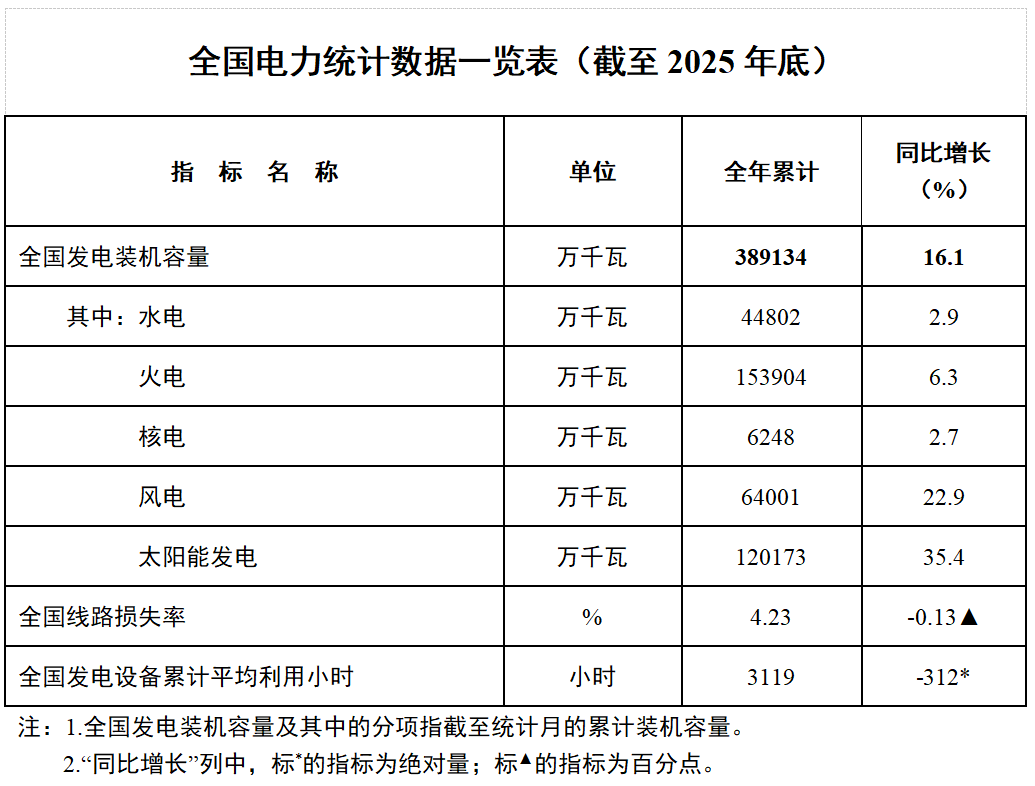
Core Insights - The renewable energy sector in China has achieved record-high installed capacity despite market fluctuations in electricity pricing [1][2] Group 1: Installed Capacity Growth - As of the end of 2025, China's total installed power generation capacity reached 389.134 million kilowatts, marking a year-on-year increase of 16.1% [2][3] - Solar power capacity reached 120.173 million kilowatts, with a year-on-year growth of 35.4%, while wind power capacity reached 64.001 million kilowatts, growing by 22.9% [2][3] - For the first time, the cumulative installed capacity of solar and wind power exceeded 180 million kilowatts, accounting for 47.3% of the total installed capacity, surpassing thermal power [2][3] Group 2: Yearly Additions and Trends - In 2025, the annual addition of installed capacity for solar power is projected to be 31.5 million kilowatts, a year-on-year increase of approximately 13%, while wind power is expected to add 11.9 million kilowatts, a significant year-on-year increase of about 49% [2][4] - The annual addition of wind and solar capacity has consistently surpassed 10 million, 20 million, 30 million, and 40 million kilowatts over the past four years [2] Group 3: Market Dynamics and Future Projections - The introduction of market-based pricing for renewable energy projects has led to more stable bidding results for wind power compared to solar, making wind a focal point for market investment [4] - The China Photovoltaic Industry Association has revised its forecast for new solar installations in 2025 from 21.5-25.5 million kilowatts to 27-30 million kilowatts, indicating stronger-than-expected growth [4] - Long-term projections suggest a slowdown in solar installation growth, with Bloomberg New Energy Finance predicting a compound annual growth rate of 3% for global solar installations from 2025 to 2035, and a decline in China's growth rate to -5% [7]

中智咨询:中央企A股上市公司战新产业布局和模式路径比较研究报告
Sou Hu Cai Jing· 2026-01-29 04:44
Core Insights - The report by Zhongzhi Consulting focuses on the strategic layout and development models of central enterprises controlling A-share listed companies in emerging industries, providing a systematic analysis of the layout logic and development paths of strategic emerging industries [1][12]. Group 1: Overview of Central Enterprises in Emerging Industries - Among 402 central enterprises controlling A-share listed companies, 64% can be classified as emerging industry enterprises, with nearly 80% concentrated in five key areas: new generation information technology, new materials, high-end equipment manufacturing, new energy, and biotechnology [1][18]. - The report highlights a significant underinvestment in critical areas such as industrial mother machines and chips, indicating a need for increased focus and resources in these sectors [1][18]. Group 2: Industry-Specific Analysis - The report emphasizes that over 40% of manufacturing emerging enterprises are transitioning towards new materials and high-end equipment manufacturing, showcasing significant industrial synergy effects [1][20]. - In terms of profitability, emerging industry enterprises contribute 26% of total operating revenue and 31.27% of total profit, with new generation information technology, new energy, and new materials showing particularly strong profitability [1][23]. Group 3: Strategic Positioning and Implementation Paths - The report identifies four business layout models: core business extension, establishment of emerging platforms, equity cooperation, and fund investment, which enterprises can combine based on their specific circumstances [2]. - It suggests a systematic cultivation framework of "assessment-layout-empowerment," advocating for a full-cycle evaluation mechanism and a tailored approach for each enterprise to optimize resource allocation and enhance competitiveness in emerging industries [2].


特变电工(600089):多业务板块景气共振开启价值重估
HTSC· 2026-01-29 04:07
Investment Rating - The report initiates coverage on TBEA Co., Ltd. with a "Buy" rating and sets a target price of 33.31 RMB, corresponding to a 2026 PE of 22X [1][7]. Core Views - The report highlights that TBEA's multiple business segments are entering a phase of upward momentum, with the power transmission and transformation business expected to benefit from global high-pressure equipment shortages, leading to accelerated international expansion [1][17]. - The gold business is experiencing simultaneous increases in both volume and price, while coal and polysilicon sectors are also showing signs of recovery, indicating strong upward profit elasticity for the company in 2026-2027 [1][17]. - The report emphasizes that TBEA is a leading player in the energy equipment sector, with a diversified portfolio that includes power transmission, energy, new energy, and new materials, positioning the company for robust growth [23]. Summary by Sections Power Transmission and Transformation - TBEA is a leading private transformer manufacturer in China, with integrated capabilities in high-voltage cables, accessories, and construction services. The company is witnessing rapid growth in overseas orders, with international market product contracts exceeding 7 billion USD in 2023 and 12 billion USD in 2024, reflecting a year-on-year growth of 65.9% in the first half of 2025 [2][18]. - The domestic market is also expected to see a significant increase in grid investment during the 14th Five-Year Plan, with TBEA's market share in main grid tenders continuing to rise, providing a solid foundation for future growth [2][18]. Resource Products - The gold mining segment is currently in a rapid capacity release phase, with projected production increasing from 2.2 tons in 2024 to 3.6 tons in 2027, potentially generating revenues of 19.8 billion RMB to 46.4 billion RMB during this period, with year-on-year growth rates of 65.9% to 29.2% [3][19]. - TBEA's coal business benefits from low-cost open-pit mining resources, with a production cost of only 177 RMB per ton in the first half of 2025. The company is also developing a coal-to-gas project that is expected to enhance profitability [3][20]. - The polysilicon segment is anticipated to achieve significant cost reductions, with cash costs expected to decrease by approximately 18% in the first half of 2025, allowing the company to return to cash flow breakeven [4][21]. Market Perspective - The report notes a divergence from market perceptions, indicating that TBEA's diverse business segments are now in an upward cycle, contrary to the prevailing view that the company is being dragged down by its renewable energy and coal businesses [5][22]. - The company is positioned to leverage its strengths in various sectors, including power transmission, coal-to-gas, gold production, and polysilicon, to drive future growth and profitability [5][22].

中国实践引领“电力时代”能源转型
Ren Min Ri Bao· 2026-01-29 03:29
Core Insights - China has been recognized as the world's first significant "power nation," highlighting its pivotal role in the global energy transition and the increasing importance of electricity in national energy systems [1][2][3] Group 1: Electricity Consumption and Production - By the end of 2025, China's cumulative installed capacity of wind and solar power is expected to exceed 1.8 billion kilowatts, equivalent to approximately 82 Three Gorges power stations [1] - China's electricity consumption is projected to surpass 10 trillion kilowatt-hours by 2025, setting a record for the highest annual electricity consumption by a single country [1][2] - In the past decade, China's electricity consumption has nearly doubled from about 5.5 trillion kilowatt-hours in 2015, now exceeding that of the United States by more than two times [2] Group 2: Energy Transition and Environmental Impact - Over 95% of China's coal-fired power plants have ultra-low emissions, and more than 50% can perform deep peak regulation, establishing the world's largest clean coal power supply system [3] - China is actively promoting the replacement of fossil fuels with electricity across various sectors, including transportation, industry, and construction, with a steady increase in electrification expected to reach around 35% by 2030 [3] Group 3: Global Influence and Technological Contributions - China supplies 70% of the world's wind power equipment and 80% of solar photovoltaic components, with its renewable energy products being exported to over 200 countries and regions [4] - The country is playing a significant role in global energy transition by establishing international standards and facilitating technology sharing, thereby providing affordable energy transition options for developing nations [4] - China's initiatives are reshaping not only its own energy landscape but also influencing the energy frameworks of other countries, as noted by international media [4]
中广核:“十四五”期间境内新能源在运装机容量较“十三五”末增长近三倍
Zheng Quan Ri Bao Zhi Sheng· 2026-01-29 03:10
在深耕国内市场的同时,中广核海外绿色足迹同样亮眼,境外新能源控股装机规模超过1300万千 瓦。"十四五"期间,新增在建、在运装机约580万千瓦,已累计为18个国家和地区提供清洁电力超3700 亿千瓦时,点亮"一带一路"万家灯火。 "我们深耕'一带一路'共建国家,积极融入能源领域国际合作,并在此过程中持续拓宽清洁能源合作'新 路径、新场景、新模式'。"在中国广核能源国际控股有限公司党委副书记、总经理欧阳孜看来,中广核 境外新能源发展正从电站投资者,向为合作国提供深度本地化能源解决方案的伙伴转型。 记者从中广核获悉,截至目前,其核电在运机组28台,在建机组20台,总装机容量超5600万千瓦。其 中,目前,有18台在建核电机组采用"华龙一号"。 作为我国核电走向世界的"国家名片","华龙一号"12项主要技术指标达国际最优水平,成功通过欧洲用 户要求认证和英国通用设计审查,是目前唯一无审查重大问题、无审查重大遗留问题的堆型。中广核工 程有限公司党委书记、董事长宁小平介绍,中广核"华龙一号"示范工程——广西防城港核电3、4号机组 于2024年高质量投产,全面验证了该技术的安全性、先进性和可靠性。随着"华龙一号"技术持续 ...

人民日报权威发布:两个万亿元,标注国资央企创新刻度
Ren Min Ri Bao· 2026-01-29 02:22
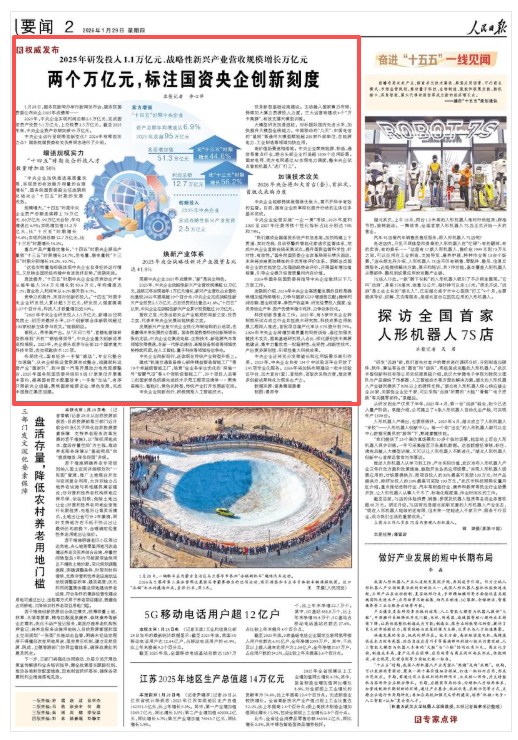
Core Insights - The central enterprises in China are projected to achieve significant financial milestones by 2025, including a total profit of 2.5 trillion yuan, fixed asset investments of 5.1 trillion yuan, and tax contributions of 2.5 trillion yuan, with total assets exceeding 95 trillion yuan by the end of 2025 [5][19]. Group 1: Financial Performance - By 2025, central enterprises are expected to realize a total profit of 2.5 trillion yuan and complete fixed asset investments of 5.1 trillion yuan [5][19]. - The total assets of central enterprises are projected to surpass 95 trillion yuan by the end of 2025 [5][19]. - The average annual growth rate of total assets during the 14th Five-Year Plan period is 6.9%, with a total value added of 51.3 trillion yuan, marking a 44.6% increase compared to the previous five-year period [6][20]. Group 2: R&D and Innovation - Central enterprises are set to invest 1.1 trillion yuan in R&D by 2025, with a notable increase in the number of scientific and technological talents by nearly 50% [8][22]. - The cumulative R&D investment during the 14th Five-Year Plan period exceeded 5 trillion yuan, with a 0.27 percentage point increase in R&D intensity [6][20]. - Central enterprises led or participated in all 22 national major science and technology projects in 2025, achieving breakthroughs in 121 leading technologies [8][22]. Group 3: Strategic Emerging Industries - Revenue from strategic emerging industries is expected to exceed 12 trillion yuan by 2025, with an annual growth of 1 trillion yuan for three consecutive years [9][23]. - Investment in strategic emerging industries will account for 41.8% of total investments, with cumulative investments exceeding 10 trillion yuan since the beginning of the 14th Five-Year Plan [9][23]. Group 4: Transformation and Upgrading - Central enterprises are focusing on the transformation and upgrading of traditional industries, establishing 70 advanced intelligent factories and 39 projects recognized as national green low-carbon advanced technology demonstration projects [11][25]. - The integration of artificial intelligence technologies is being actively pursued, with significant investments in new infrastructure and the development of over 1,000 application scenarios in key industries [12][26]. Group 5: Regulatory and Governance Enhancements - The central enterprises are implementing a personalized assessment system, with 76% of individual indicators for the 2025 assessment and 79% for the 2025-2027 term being customized [13][27]. - A nationwide state-owned assets system property information database has been established to enhance the scientific and effective regulation of state-owned enterprises [14][28]. Group 6: Future Directions - In 2026, the focus will be on ensuring continuous growth in value added, aligning with national GDP growth, and enhancing the quality of technological supply through increased investment in key technologies [15][29]. - Central enterprises will accelerate the establishment of pilot platforms for testing and validation, aiming to convert more innovative results into productive forces [15][29].
碳酸锂期价冲高回落,“强现实”已兑现?
Qi Huo Ri Bao· 2026-01-29 02:03
Core Viewpoint - Lithium carbonate futures prices have recently experienced a pullback after reaching a peak, indicating a market return to fundamental trading as previous bullish news has been digested [1] Group 1: Price Movements and Market Dynamics - On January 28, the main contract for lithium carbonate futures closed at 166,280 yuan/ton, down 3.9% [1] - The price drop is attributed to a decline in lithium ore prices, with the average price of Australian 6% spodumene reported at $2,355/ton, down $100/ton [1] - Analysts suggest that the rapid price increase lacked further supportive news, leading to a reduction in upward momentum and subsequent price correction [1][2] Group 2: Supply and Demand Factors - The lithium carbonate market remains stable, with supply at a high level but limited incremental growth, maintaining a weekly production of approximately 22,000 tons [1] - Demand is characterized by a "not-so-dull off-season," with energy storage batteries operating at full capacity and a "rush for exports" in the power battery sector due to export tax rebate policies [1] - Current weekly inventory reduction of lithium carbonate is around 800 tons, indicating a shift back to a destocking phase after a slight accumulation [1] Group 3: Market Sentiment and Future Outlook - The overall inventory level in the industry is low, with lithium salt plants and downstream industries showing low inventory levels, while futures traders hold higher inventories [2] - Strong demand may trigger replenishment needs, providing support for spot prices despite a cooling market sentiment and limited upward price movement [2] - Analysts express caution regarding potential price corrections, suggesting that while there is support for prices due to strong demand, the market is entering a phase of uncertainty regarding future supply-demand balance [3]
国泰君安期货商品研究晨报:绿色金融与新能源-20260129
Guo Tai Jun An Qi Huo· 2026-01-29 01:48
2026年01月29日 国泰君安期货商品研究晨报-绿色金融与新能源 | 观点与策略 | | --- | | 镍:印尼事件悬而未决,套保与投机盘博弈 | 2 | | --- | --- | | 不锈钢:印尼加剧镍矿担忧,镍铁跟涨支撑重心 | 2 | | 碳酸锂:下游低位采买意愿增强,宽幅震荡延续 | 4 | | 工业硅:上游减产,盘面亦有支撑 | 6 | | 多晶硅:会议情绪偏好 | 6 | 国 泰 君 安 期 货 研 究 所 请务必阅读正文之后的免责条款部分 1 期货研究 商 品 研 究 2026 年 1 月 29 日 商 品 研 究 镍:印尼事件悬而未决,套保与投机盘博弈 不锈钢:印尼加剧镍矿担忧,镍铁跟涨支撑重心 张再宇 投资咨询从业资格号:Z0021479 zhangzaiyu@gtht.com 【基本面跟踪】 镍基本面数据 | | | 指标名称 | T | T-1 | T-5 | T-10 | T-22 | T-66 | | --- | --- | --- | --- | --- | --- | --- | --- | --- | | | | 沪镍主力(收盘价) | 144,370 | -1,740 ...
成都新津:“智”造引领 “立园满园”擘画千亿级工业新图景
Mei Ri Jing Ji Xin Wen· 2026-01-29 01:17
Core Viewpoint - The New Jin District in Chengdu is advancing its strategy of becoming an industrial and manufacturing powerhouse, focusing on high-quality development in advanced manufacturing and aiming to establish a billion-level economic development zone [3][4]. Group 1: Industrial Development Strategy - The New Jin District is committed to deepening its industrial strength and enhancing service efficiency, accelerating the new industrialization process through the development of advanced manufacturing industries and a structured enterprise development matrix [3][4]. - The district aims to achieve an industrial output value exceeding 60 billion yuan by 2025, with key sectors including green food, new energy, and rail transportation [6]. Group 2: Manufacturing Sector Growth - The health food industry in New Jin is projected to exceed 20 billion yuan, becoming the leading sector in the city, supported by major enterprises like COFCO [6]. - The establishment of a fully integrated supply chain in the health food sector has led to the clustering of over 100 upstream and downstream enterprises, enhancing competitiveness through quality and technology [6][7]. Group 3: Industrial Structure Optimization - New Jin currently hosts over 800 industrial enterprises, with 255 above-scale industrial firms and 160 high-tech enterprises, fostering a clear and structured market participant landscape [9]. - The district is focusing on optimizing spatial organization to enhance industrial capabilities, promoting a cluster-based and specialized development approach [10]. Group 4: Infrastructure and Project Development - New Jin is implementing a "project-driven" mechanism to streamline the approval and construction processes, significantly reducing project timelines from 90 days to 10 days [12]. - Over 30 industrial projects with investments exceeding 100 million yuan have been introduced in the past year, contributing to the growth of the manufacturing sector [12]. Group 5: Future-Oriented Competitiveness - The district is prioritizing long-term and forward-looking industrial development, with initiatives like the establishment of a national data labeling base to integrate into the digital economy and artificial intelligence sectors [13]. - Collaboration with universities and research institutions is being strengthened to enhance innovation and translate research outcomes into productive capabilities [13][15]. Group 6: Service Industry Integration - The integration of productive services into manufacturing is accelerating, with improvements in R&D design, smart logistics, and testing services, enhancing the resilience and flexibility of the industrial system [15]. - The "Li Yuan Man Yuan" initiative aims to create a sustainable industrial ecosystem that balances efficiency, scale, innovation capacity, and industrial ecology [15].

首期零碳园区建设重点培训班3月举行 | 系列培训
中国能源报· 2026-01-29 01:07
Group 1 - The article highlights the launch of the first batch of 52 national-level zero-carbon park construction lists, marking the beginning of a significant trend in zero-carbon park development [2] - Various parks are actively exploring transformation but face challenges such as insufficient systemic capabilities, incomplete standard systems, and a shortage of professional talent in top-level planning, technology integration, operational management, and business models [2] - A training program is scheduled for March 5-6, 2026, in Beijing, organized by the China Energy News and the Carbon Neutrality Professional Committee of the China Development Zone Association, aimed at addressing the bottlenecks in zero-carbon park development [2] Group 2 - The training program will cover a comprehensive lifecycle solution for zero-carbon parks, focusing on strategic planning, implementation, operation, and risk control [3] - The curriculum includes modules on national and local policy integration, top-level design and planning, construction guidelines, implementation paths, investment and financing, commercial operation logic, and construction acceptance [5] - Target participants include government officials, employees from state-owned enterprises, energy companies, consulting and construction firms, and financial institutions involved in energy and carbon management [5] Group 3 - The training fee is set at 3,900 yuan per person, which includes training materials, meals, and taxes [6] - Registration details are provided, including a contact email for sending the application form [8][11]