
汽车制造业

Search documents
长城汽车涨超6% 10月汽车销量同比增长22.5% 坦克500Hi4-T在澳洲上市
Zhi Tong Cai Jing· 2025-11-10 02:12
Core Viewpoint - Great Wall Motors (601633)(02333) has seen a significant increase in stock price, rising over 6% and currently trading at 16.27 HKD, with a transaction volume of 172 million HKD [1] Sales and Production Performance - In October 2025, the total vehicle sales reached approximately 143,100 units, representing a year-on-year increase of 22.5%, while production was about 140,500 units, up 22.01% year-on-year [1] - From January to October, total vehicle sales amounted to approximately 1,066,400 units, reflecting a year-on-year growth of 9.87%, and production totaled around 1,060,300 units, with a year-on-year increase of 9.7% [1] Tank Model Sales - The Tank model recorded wholesale sales of 22,000 units in October, showing a year-on-year increase of 16.6% and a month-on-month increase of 4.0% [1] - The new Tank 400 model officially started pre-sales on October 21, featuring the Hi4-Z variant optimized for urban conditions, enhancing off-road performance and improving the driving experience through smart technology, which is expected to drive brand premiumization and sales growth [1] Overseas Market Performance - In October, the company's overseas wholesale sales reached 57,000 units, marking a year-on-year increase of 28.7% and a month-on-month increase of 13.7%; from January to October, overseas wholesale sales totaled 391,000 units, up 6.2% year-on-year [1] - The Tank 500 Hi4-T has been launched in Australia, and the Hi4 technology along with the off-road grading system has received positive recognition [1] - According to Minsheng Securities, as Great Wall Motors continues to localize its operations in Australia, overseas sales are expected to steadily increase [1]

国盛固收:黄金有色影响较大,物价有待继续观察
Ge Long Hui· 2025-11-10 01:40
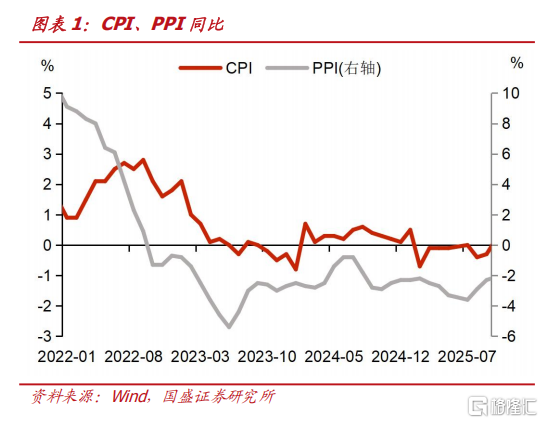
Core Insights - October inflation data shows a shift in CPI from decline to increase, with PPI's rate of decline narrowing, significantly influenced by prices of gold and non-ferrous metals [1][4][25] - October CPI increased by 0.2% year-on-year, reversing a 0.3% decline from the previous month, marking the highest value since February of this year [1][6] - PPI's year-on-year decline narrowed by 0.2 percentage points to -2.1%, marking the third consecutive month of narrowing [1][21] CPI Analysis - Food prices showed slight improvement, with a 2.9% decline, but the drop was less severe than the previous month, impacting CPI by approximately 0.54 percentage points [2][14] - Core CPI rose by 1.2% year-on-year, the highest since March 2024, with gold prices being a major driver [2][10] - Domestic gold futures prices increased by 52.8% year-on-year, significantly higher than the previous month's growth rate [2][10] PPI Analysis - PPI for October showed a year-on-year decline of 2.1%, with notable performance in the non-ferrous sector, particularly in mining and metal processing [3][21] - The prices in the non-ferrous mining and metal processing industries increased by 5.3% and 2.4% respectively, the highest among all sectors [3][21] - Life goods PPI decreased by 1.4% year-on-year, with a narrowing decline compared to the previous month [3][21] Market Outlook - The rise in prices is influenced by multiple factors, including the increase in gold prices and extreme weather affecting vegetable prices, leading to an unexpected overall price increase [4][25] - Future price trends remain uncertain, with a potential decline in gold prices in early November and weak terminal demand affecting price transmission from upstream to downstream sectors [4][26] - The bond market is entering a recovery phase, with a recommendation for a barbell strategy to manage risks and capitalize on potential interest rate declines [4][26]

CPI同比转正 PPI环比年内首涨
Jin Rong Shi Bao· 2025-11-10 01:37
Group 1: CPI Analysis - In October, the Consumer Price Index (CPI) increased by 0.2% month-on-month and year-on-year, driven by policies to expand domestic demand and the impact of the National Day and Mid-Autumn Festival holidays [1][2] - The core CPI, excluding food and energy prices, rose by 1.2% year-on-year, marking the sixth consecutive month of growth [1][2] - Significant rainfall and increased holiday demand led to a 4.3% month-on-month rise in vegetable prices, contributing to a narrowing of the year-on-year decline in food prices to -2.9% [2][3] Group 2: PPI Analysis - The Producer Price Index (PPI) saw a month-on-month increase of 0.1%, marking the first rise of the year, despite a year-on-year decline of 2.1% [1][4] - The improvement in supply-demand dynamics in various industries, particularly due to anti-involution policies, has supported price increases in sectors like coal and black metals [4][5] - Prices in the coal mining and washing industry rose by 1.6%, while prices for photovoltaic equipment and components increased by 0.6%, indicating a positive trend in certain high-tech manufacturing sectors [4][5] Group 3: Future Outlook - Analysts expect a gradual recovery in PPI year-on-year by 2026, while CPI is anticipated to remain at low levels, indicating a moderate inflationary trend [6]
10月份CPI同比涨幅转正,PPI环比年内首次上涨 扩内需等政策效应继续显现
Jing Ji Ri Bao· 2025-11-10 00:40
Group 1 - In October, the Consumer Price Index (CPI) increased by 0.2% month-on-month and year-on-year, indicating a recovery in consumer demand, particularly in the service sector [1][2][3] - The core CPI, excluding food and energy, rose by 1.2% year-on-year, marking the highest increase since March 2024 and reflecting a steady recovery in domestic consumption [2][3] - The Producer Price Index (PPI) saw a month-on-month increase of 0.1%, the first rise this year, driven by improved supply-demand relationships in certain industries [4][5] Group 2 - The increase in CPI was supported by higher service prices, particularly in accommodation, air travel, and tourism, which rose by 8.6%, 4.5%, and 2.5% respectively during the holiday season [2] - Food prices increased by 0.3%, with specific items like fresh vegetables and meat seeing price rises between 0.5% and 4.3% [2] - The PPI year-on-year decline narrowed to 2.1%, with significant improvements in sectors like coal mining and photovoltaic equipment manufacturing [5][6] Group 3 - Experts suggest that the overall improvement in price data reflects a comprehensive enhancement in the macroeconomic environment and consumer sentiment [6][7] - Future projections indicate a moderate rise in overall price levels, supported by continued macroeconomic policies and expanding domestic demand [7] - The construction of a modern industrial system and the ongoing recovery in market demand are expected to contribute to price stabilization in various sectors [7]
PPI环比年内首次上涨 扩内需等政策持续显效
Zhong Guo Jing Ji Wang· 2025-11-10 00:39
Group 1: CPI Analysis - In October, the Consumer Price Index (CPI) increased by 0.2% month-on-month and year-on-year, marking a shift from a decline of 0.3% in the previous month [2][3] - Service prices rose by 0.2%, driven by increased travel demand during the National Day and Mid-Autumn Festival, with hotel accommodation, flight tickets, and tourism prices rising by 8.6%, 4.5%, and 2.5% respectively [2][3] - Core CPI, excluding food and energy, rose by 1.2% year-on-year, marking the highest increase since March 2024 and reflecting a steady recovery in domestic consumption, particularly in services [2][3] Group 2: PPI Analysis - The Producer Price Index (PPI) saw a month-on-month increase of 0.1% in October, the first rise of the year, influenced by improved supply-demand relationships in certain industries [4][5] - Year-on-year, PPI decreased by 2.1%, but the decline narrowed by 0.2 percentage points compared to the previous month, indicating a gradual recovery in key industries [5][6] - Prices in the coal mining and washing industry, photovoltaic equipment manufacturing, and integrated circuit manufacturing have shown upward trends, while international commodity prices have created a mixed impact on domestic prices [4][5] Group 3: Economic Outlook - Experts suggest that the improvement in price data reflects a comprehensive enhancement in the economic cycle and internal momentum, indicating a balanced supply-demand relationship [6][7] - The overall price level is expected to rise moderately, supported by macroeconomic policies and a recovery in market confidence, with CPI anticipated to show a low but steady increase [7] - The construction of a modern industrial system and the expansion of market demand are expected to drive price increases in related industries, despite ongoing pressures from the real estate market [7]
10月份CPI同比由降转涨 PPI同比降幅收窄
Zheng Quan Ri Bao· 2025-11-09 16:24
Group 1: CPI Analysis - In October, the Consumer Price Index (CPI) increased by 0.2% month-on-month, which is an expansion of 0.1 percentage points compared to September and slightly above seasonal levels [2] - Service prices shifted from a 0.3% decline in September to a 0.2% increase in October, influenced by strong travel demand during the National Day and Mid-Autumn Festival, with hotel accommodation, airfare, and tourism prices rising by 8.6%, 4.5%, and 2.5% respectively [2] - Year-on-year, the CPI turned from a 0.3% decline in September to a 0.2% increase in October, with core CPI (excluding food and energy) rising by 1.2%, marking the highest increase since March 2024 [3] Group 2: PPI Analysis - The Producer Price Index (PPI) saw a month-on-month increase of 0.1% in October, marking the first increase of the year [4] - Year-on-year, the PPI decreased by 2.1%, but the decline narrowed by 0.2 percentage points compared to September, indicating a continuous improvement in price levels [5] - Factors contributing to the PPI increase include improved supply-demand relationships and the impact of input costs on the prices of non-ferrous metals and petroleum-related industries [4][7] Group 3: Economic Outlook - The overall price data indicates a steady enhancement of economic vitality and the release of domestic demand potential, supported by macro policies and market confidence [1] - The recovery in domestic demand is expected to continue to support industrial product prices, with ongoing policy measures aimed at stabilizing competition in various sectors [6][7] - The narrowing of PPI declines is attributed to improved order conditions and the implementation of consumption-boosting policies, which are expected to have a positive impact on related industries [5][7]
下周审核4家IPO,1家再融资。两家在审期间调减拟募资规模
Sou Hu Cai Jing· 2025-11-09 16:07
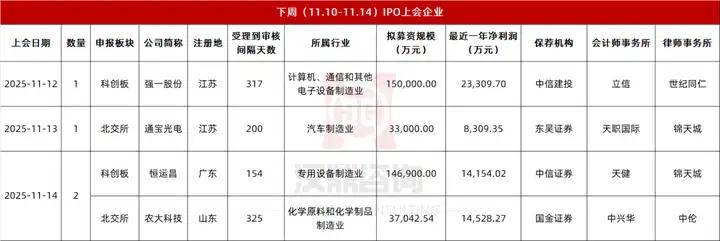
Summary of Key Points Core Viewpoint The upcoming week (November 10-14) will see the IPO review of four companies aiming to raise a total of 3.669 billion yuan, with some companies adjusting their fundraising targets downward. IPO Review - Four companies are scheduled for IPO review, with a total fundraising target of 3.669 billion yuan [1] - Companies include: - Qiangyi Semiconductor, aiming to raise 1.5 billion yuan [2] - Tongbao Optoelectronics, aiming to raise 330 million yuan [2] - Hengyun Crystal, aiming to raise 1.469 billion yuan after a reduction from 1.55 billion yuan [2][4] - Nongda Technology, aiming to raise 413 million yuan after a reduction from 552 million yuan [4] Fundraising Plans - Hengyun Crystal's fundraising plan includes projects such as: - Semiconductor RF power system industrialization project with a total investment of 1.657 billion yuan, using 1.4 billion yuan from the raised funds [20] - Core component production base for semiconductor and vacuum equipment with a total investment of 6.969 billion yuan, using 6.9 billion yuan from the raised funds [20] - Nongda Technology's projects include: - Production line for 150,000 tons of micro-ecological agents, which was removed from the revised plan [4][21] Company Performance - Qiangyi Semiconductor reported: - Total assets of 1.482 billion yuan as of June 30, 2025 [10] - Net profit of 137.884 million yuan for the first half of 2025 [10] - Revenue of 374.402 million yuan for the first half of 2025 [10] - Tongbao Optoelectronics reported: - Total assets of approximately 1.069 billion yuan as of June 30, 2025 [15] - Net profit of approximately 33.45 million yuan for the first half of 2025 [15] Upcoming Refinance - One company, Huafeng Measurement and Control, is set for a refinancing review, aiming to raise 1 billion yuan through a public convertible bond [6][26]
从单车净赚10万元到断崖式下跌!出口俄罗斯“退烧”,中国车商做了个大胆的决定
Mei Ri Jing Ji Xin Wen· 2025-11-09 15:41
Core Viewpoint - The export of Chinese automobiles to the Russian market is facing significant challenges, with a notable decline in sales and increasing operational costs due to new taxes and changing market dynamics [2][4][10]. Group 1: Market Dynamics - In the first nine months of 2025, China's automobile exports to Russia fell to 357,700 units, a decrease of 58% year-on-year, marking a significant shift in export destinations, with Mexico and the UAE surpassing Russia [4][10]. - Previously, Russia was the largest export market for Chinese automobiles, but it has now dropped to third place, reflecting a major change in the export landscape [4][10]. - The demand for Chinese electric vehicles in Russia has decreased, with many customers now hesitant to purchase due to rising costs and uncertainty about future taxes [2][5]. Group 2: Tax and Regulatory Impact - Starting October 1, 2024, the scrap tax for new imported vehicles in Russia will increase by 70% to 85%, significantly impacting the cost structure for Chinese exporters [8]. - The scrap tax for used cars with engine displacements of 2-3 liters and over three years old will rise from 1.3 million rubles (approximately 114,000 RMB) to 2.37 million rubles (approximately 208,000 RMB), an increase of nearly 83% [8]. - Additionally, from January 1, 2025, the import tariff for automobiles will be adjusted to 20% to 38%, further increasing the cost of doing business in Russia [8]. Group 3: Competitive Landscape - The Russian automotive market is experiencing a structural decline, with inflation at 10% and high interest rates on car loans, which are suppressing demand [10]. - Chinese brands still hold a significant presence in the Russian market, occupying six out of the top ten spots in sales, but overall sales are declining [10]. - Major Chinese automakers, such as Chery, are beginning to scale back their operations in Russia, indicating a shift in strategy as they reassess the market [10][15]. Group 4: Strategic Adjustments - Chinese automotive companies are shifting from a short-term profit focus to a long-term commitment in the Russian market, emphasizing the need for local production and service networks [19][20]. - Companies are encouraged to enhance localization efforts, improve product development for extreme weather conditions, and build robust after-sales service systems to better serve Russian consumers [20]. - The transition from a "quick profit" mindset to establishing a sustainable presence in Russia is seen as crucial for future success [15][19].

10月中国物价指数释放积极信号
Di Yi Cai Jing Zi Xun· 2025-11-09 15:13
Core Insights - The inflation data for October indicates a steady recovery in China's economic vitality and domestic demand, with the Consumer Price Index (CPI) showing a year-on-year increase of 0.2% and a core CPI increase of 1.2%, marking the highest level since March 2024 [2][5][14] CPI Analysis - The CPI turned from a decline of 0.3% in September to an increase of 0.2% in October, with food prices decreasing by 2.9%, but the decline has narrowed [3][6] - The core CPI's continuous rise suggests a robust recovery in domestic consumption, particularly in service consumption, indicating a solid foundation for overall prices [5][6] PPI Analysis - The Producer Price Index (PPI) saw a month-on-month increase of 0.1% in October, marking the first rise of the year, while the year-on-year decline narrowed to 2.1% [2][7] - Factors contributing to the narrowing decline in PPI include improved supply-demand relationships and ongoing capacity governance in key industries [9][10] Future Outlook - The outlook for inflation suggests a "strong food, weak energy, stable core" scenario, with potential for slight rebounds in food prices due to seasonal factors [6][10] - The government's focus on expanding domestic demand and enhancing consumer spending is expected to support economic growth and stabilize inflation levels [12][14]
宏观经济周度高频前瞻报告:经济周周看:本周经济景气度略有回落-20251109
ZHESHANG SECURITIES· 2025-11-09 13:53
Economic Indicators - The GDP weekly high-frequency prosperity index as of November 8 is 4.7%, slightly down from the revised value of 5.0% last week, indicating a slowdown in economic growth[10] - The service and industrial high-frequency indicators have both declined compared to last week[12] Production Sector - The industrial weekly prosperity index has decreased to 8.0% from 8.2%[11] - The service sector's weekly prosperity index has dropped to 2.9% from 3.4%[11] Demand Sector - Overall consumption and fixed asset investment have weakened, while exports have shown resilience, with container throughput rising to 671.8 thousand TEUs from 590.3 thousand TEUs last week, marking a significant increase[55] - The real estate market has seen a significant decline, with new home sales in 30 major cities dropping to 120.2 million square meters, a 43% decrease week-on-week and a 49% year-on-year decline[48] Price Trends - Consumer prices for agricultural products have shown a marginal increase, with the agricultural wholesale price index rising by 0.76% week-on-week[61] - The average price of pork has increased by 0.78% week-on-week, while the prices of key vegetables have risen by 2.16%[61]