科技

Search documents
今年以来南向资金累计净流入已超1.3万亿港元
Zhong Guo Zheng Quan Bao· 2025-11-11 20:09
Core Viewpoint - Southbound capital is increasingly becoming a key driver for the restructuring of liquidity and optimization of valuation in the Hong Kong stock market, with significant inflows recorded this year [1][3]. Group 1: Southbound Capital Inflows - As of November 11, 2023, southbound capital through the Stock Connect recorded a net inflow of 44.67 billion HKD, bringing the total net inflow for the year to over 1.3 trillion HKD, which is an increase of over 1.6 times compared to the same period in 2022 [1]. - The cumulative net inflow of southbound capital since the launch of the Stock Connect has surpassed 5 trillion HKD, setting a new record since the inception of the mutual market access mechanism [1]. Group 2: Holdings and Market Value - As of November 10, 2023, the number of shares held by southbound capital reached 5,573.90 billion shares, an increase of 908.52 billion shares from the beginning of 2023, with a total market value exceeding 6.3 trillion HKD, up 2.7 trillion HKD from early 2023 [2]. - The sectors with the highest market value held by southbound capital include Financials (15,762.36 billion HKD), Information Technology (13,100.89 billion HKD), and Consumer Discretionary (9,018.37 billion HKD) [2]. Group 3: Investment Opportunities - Analysts suggest focusing on three main investment directions in the Hong Kong stock market: cyclical stocks benefiting from rising commodity prices due to supply-demand changes, defensive dividend stocks as market risk appetite declines, and stocks positioned for overseas expansion benefiting from favorable policies [4]. - The investment style of southbound capital emphasizes quality and sustainability of earnings growth, favoring large-cap companies with moderate growth and high return on equity (ROE), while also showing an increased preference for high-dividend stocks [3].
Dow Gains More Than 300 Points; Energy Vault Holdings Shares Jump
Benzinga· 2025-11-11 17:17
Market Overview - U.S. stocks showed mixed performance with the Dow Jones index increasing by 0.64% to 47,673.48, while the NASDAQ decreased by 0.79% to 23,340.59 and the S&P 500 fell by 0.23% to 6,817.03 [1] - Energy shares experienced a rise of 1.2%, while information technology stocks saw a decline of 0.9% [1] Company Performance - RealReal Inc (NASDAQ:REAL) shares surged after reporting better-than-expected third-quarter results and providing fourth-quarter sales guidance above estimates, along with an increase in FY25 sales guidance [2] - enGene Holdings Inc (NASDAQ:ENGN) shares increased by 72% to $10.34 following positive Phase 2 LEGEND study data showing a 63% complete response rate [9] - Energy Vault Holdings Inc (NYSE:NRGV) shares rose by 30% to $4.62 after releasing third-quarter results [9] - Surmodics Inc (NASDAQ:SRDX) shares gained 49% to $40.80 after a court denied the FTC's attempt to block GTCR's acquisition [9] - Vor Biopharma Inc (NASDAQ:VOR) shares dropped by 50% to $9.32 due to the announcement of a $100 million public offering [9] - Salarius Pharmaceuticals Inc (NASDAQ:SLRX) shares fell by 50% to $1.00 after announcing a $7 million underwritten public offering [9] - Outset Medical Inc (NASDAQ:OM) shares decreased by 50% to $6.07 following worse-than-expected third-quarter results and a cut in FY25 sales guidance [9] Commodity Market - Oil prices increased by 1.5% to $61.00, while gold rose by 0.3% to $4,134.70 [5] - Silver traded up by 0.8% to $50.730, whereas copper fell by 0.4% to $5.0845 [5] European Market - European shares showed positive movement with the eurozone's STOXX 600 rising by 1.05%, Spain's IBEX 35 Index gaining 1.05%, and London's FTSE 100 increasing by 0.94% [6] Asian Market - Asian markets closed mixed, with Japan's Nikkei 225 down by 0.14%, Hong Kong's Hang Seng up by 0.18%, China's Shanghai Composite down by 0.39%, and India's BSE Sensex up by 0.40% [7]







美股异动丨苹果涨超1.7%,因AI支出敞口较低成为科技板块的“避风港”
Ge Long Hui· 2025-11-11 15:04
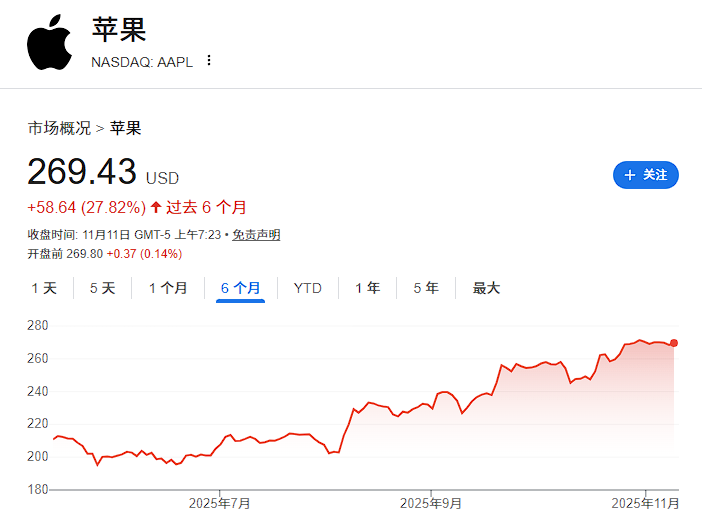
Core Viewpoint - Apple (AAPL.US) has shown resilience in the face of market pressures related to AI spending concerns, with its stock rising over 1.7% to $274, positioning itself as a "safe haven" due to low capital expenditures [1] Group 1: Market Performance - Apple's stock increased by more than 1.7%, reaching $274 [1] - The company demonstrated significant resistance during a period when technology stocks were under pressure due to AI spending worries [1] Group 2: Investment Perspective - According to Brian Mulberry from Zacks Investment Management, the hedge logic is that Apple remains a technology company but not an AI company [1] - Brian Pollak from Evercore noted that among the "seven giants," Apple has the lowest exposure and leverage in AI spending, suggesting it could benefit from AI without the need to invest heavily like its peers [1]

超6000亿元险资涌入科创赛道 能否开启科技与资本共赢新局?
Mei Ri Jing Ji Xin Wen· 2025-11-11 14:00
保险资金加速涌入科创赛道,耐心资本的价值愈发凸显。 在政策引导下,保险资金通过"直接+间接"方式覆盖科技企业投资。据国家金融监督管理总局(以下简 称金融监管总局)数据,截至2024年末,险资通过上市公司股票、直接股权投资、创业投资基金 (VC)和私募股权基金(PE)等方式,投向科技类企业的资金规模已超6000亿元,投资版图全面覆盖 先进制造、人工智能、半导体、新能源、生物医药等新质生产力核心赛道。 在业内看来,保险资金的"长钱"属性与科创产业的发展规律高度适配,成为保险资金赋能新质生产力的 核心优势。保险资金独特的"长坡厚雪"特质,也是支持科技创新的核心禀赋,有望成为推动金融动能高 效转化为科技势能、产业势能的重要力量。 政策引擎持续驱动 近年来,监管通过一系列政策组合拳,引导保险资金为科技创新、创业投资等产业发展提供支持,服务 新质生产力发展。 2023年9月,金融监管总局优化偿付能力监管标准,将保险资金投资战略性新兴产业未上市股权的风险 因子调整为0.4;投资科创板企业股票风险因子从0.45下调到0.4;科技保险适用财产险风险因子计量的 最低资本要求,按照90%计算偿付能力充足率。在不加大资金占用的情况下 ...
强势反攻,银行、科技双双反转,中概股、黄金大爆发
Ge Long Hui· 2025-11-11 13:23
高开低走后探底回升,截至收盘三大指数集体收涨,其中道指上涨0.81%,纳指上涨2.27%、标指上涨 1.54%。盘面上,银行、科技双双反转,中概股、黄金大爆发。 科技股强势反转,其中英伟达大涨5.79%,超威公司上涨4.47%,谷歌上涨4.04%,特斯拉上涨3.66%, 微软、亚马逊、奈飞、META等股涨幅均在1%上方。 中概股跳空高开后全天维持在高位盘整,截至收盘中国金龙上涨2.25%。其中小鹏汽车大涨16.15%,百 度上涨5.05%,贝壳上涨3.4%,爱奇艺上涨2.8%,腾讯控股上涨2.57%;蔚来逆势下跌2.19%,京东下跌 1.2%。 COMEX黄金低开高走后全天震荡上行,截至收盘大涨2.88%报4123.4美元/盎司,盘中最低报4004.2美 元/盎司,最高报4124美元/盎司。 理财就是一场修行,有人修有人度,结果就是看谁踩准了点,把握住了机会。 银行股企稳反转,其中摩根士丹利上涨1.66%,美国银行、花旗集团、高盛、摩根大通、齐昂银行等股 均小幅收涨;阿莱恩斯西部银行逆势下跌0.48%。 ...
人物|巴菲特“隐退”
2 1 Shi Ji Jing Ji Bao Dao· 2025-11-11 13:21
Core Insights - Warren Buffett, at 95 years old, announced his retirement from writing Berkshire Hathaway's annual reports and speaking at shareholder meetings, marking the end of an era for the company [2][5] Group 1: Performance Metrics - From 1964 to 2024, Berkshire Hathaway achieved an astonishing total return of 5,502,284%, compared to the S&P 500's return of 39,054% during the same period [2] - The annualized compound return for Berkshire from 1965 to 2024 is 19.9%, significantly higher than the S&P 500's 10.4% [2] Group 2: Leadership Transition - Buffett will continue as chairman but will step down as CEO, with Greg Abel set to take over the CEO position at the end of the year [5][6] - Buffett praised Abel's management style, stating it is more effective for Berkshire's subsidiaries and expressing confidence in his leadership capabilities [6] Group 3: Investment Philosophy - Buffett's investment strategy has evolved over the decades, moving from "cigar butt" investing to focusing on high-quality companies, influenced significantly by his partner Charlie Munger [4][9] - The investment approach can be categorized into three phases: 1. "Cigar butt" investing during the industrial era [9] 2. Transitioning to investments in companies with strong intangible assets in the 1980s [9] 3. Capitalizing on network effects in the new economy, exemplified by his investment in Apple [10] Group 4: Recent Financial Performance - In Q3, Berkshire Hathaway reported a strong operating profit of $13.49 billion, a 34% increase year-over-year, and a net profit of $30.8 billion, up 17% [5] - Despite a significant drop in stock price since its peak, Berkshire has not engaged in stock buybacks, maintaining a record cash reserve of $381.7 billion [5][6] Group 5: Market Conditions - The current market conditions have led Buffett to sell stocks, as he perceives U.S. equities to be "perfectly priced," which is contrary to his investment philosophy [6] - Berkshire Hathaway has faced a rare downgrade in its stock rating, reflecting concerns about various unfavorable factors impacting the company [6]

重返4000点!目前行情没有问题!周三,A股走势分析
Sou Hu Cai Jing· 2025-11-11 12:49
Group 1 - The technology sector is experiencing a downturn, with high-priced tech stocks showing little movement and declining trends, leading to emotional reactions among investors [1] - Market sentiment has cooled significantly, and without a boost from the securities and technology sectors, any pullback could result in a substantial decrease in trading volume [1] - Consumer spending appears to be recovering slightly, but overall consumption has not met expectations, particularly in sectors like liquor, beauty, and hospitality [3] Group 2 - The A-share market is likely to continue its upward trend, with a significant chance of returning to the 4000-point level, and there is no need for pessimism regarding the index [5] - The performance of the securities and technology sectors is crucial, as they will determine whether the market can return to 4000 points and if the current market cycle is nearing its end [5] - The real estate sector has shown positive trends, while the automotive sector is struggling, indicating mixed performance across key industries [3][5] Group 3 - The market is currently fluctuating around the 4000-point mark, and a significant rally is needed to move decisively away from this level [7] - Without major positive news to stimulate the market, there is little interest in aggressive buying, and any rapid increases will require compelling reasons to entice investors [7]
当同行陷入“AI烧钱竞赛”,苹果成了科技板块的对冲港湾
Hua Er Jie Jian Wen· 2025-11-11 12:46
上周科技股因AI支出担忧承压时,苹果展现出明显的抗跌性。当其他科技股深陷跌势时,苹果五个交 易日几乎持平。事实上,今年下半年以来苹果股价上涨31%,远超标普500指数、纳斯达克100指数及多 数科技巨头竞争对手。 这种分化在最新财报季表现得尤为明显。尽管苹果业绩喜忧参半且中国市场收入意外下滑,其股价在财 报发布次日仍上涨近3%。相比之下,Meta和微软等"七巨头"成员因巨额资本开支和令人失望的收入展 望遭到抛售,Meta股价在10月30日暴跌超11%,创三年来最大单日跌幅。 当华尔街开始质疑科技巨头在人工智能上的天文数字投入时,曾因AI投入不足而遭批评的苹果公司突 然成为投资者眼中的避风港。这家iPhone制造商凭借低资本开支和充裕现金,在科技板块剧烈波动中展 现出独特的防御价值。 11月11日,据报道,投资者正对OpenAI、Meta和微软等公司在AI领域的巨额支出展开审视,导致这些 年内最强势的科技股出现大幅波动。与此同时,苹果的战略定位正被重新评估——它既能通过接入其他 公司的模型向数百万用户提供AI功能,又无需承担开发自主能力所需的巨额投资。 表现分化凸显防御属性 这种战略差异直接反映在股价表现上。 ...
传言造成市场扰动,是警报还是机会?
Hu Xiu· 2025-11-11 12:43
如有疑问请以音频内容为准,添加妙投小虎哥微信miaotou515,入群有机会与董小姐进一步交流。 新闻解读评级说明:五星重磅,四星重要,三星级以下大家选择听。 1、美股科技反弹,带不动国内板块,透露什么信息? 今天中国科技板块的表现比预期更疲软。即便昨夜美股科技打了个"翻身仗",A股科技也未能借力上 行。早盘人工智能概念仅微幅高开便一路走低,收盘跌幅仍超2%,足见抛压之重。三季度它还是"带头 大哥",进入四季度、尤其11月后,"交接棒"行情愈发坚决,个人投资者对该方向宜保持谨慎。 本篇评级为★★★,主要围绕以下内容展开: 1、美股科技反弹,带不动国内板块,透露什么信息? 2、传言造成市场扰动,是警报还是机会?重点看哪些方向? 成交量也给出信号:沪深两市成交额跌破2万亿、报1.99万亿。绝对值不算低,但要撑起"高风险偏 好"的科技板块仍显不足——科技需要更活跃的冒险资金与更高的市场温度。而眼下资金注意力又被新 的政策讨论吸引,部分信心出现动摇,具体变化如下。 本文为妙投付费内容,上述仅为摘要,购买本专栏即可解锁完整内容。新用户可免费领本专栏7天阅读 体验机会,在妙投APP-我的-权益兑换 输入"妙投888"即可 ...
不要怕!大盘不仅稳,而且还会涨!
Sou Hu Cai Jing· 2025-11-11 10:39
Core Viewpoint - The Shanghai Composite Index is currently experiencing fluctuations around the 4000-point mark, with both bullish and bearish forces being evenly matched. The market is in a state of indecision, influenced by various economic and policy factors [1]. Group 1: Market Sentiment - Optimistic factors include supportive policies and some economic data, such as the recovery of core CPI and the focus on technological innovation in the 14th Five-Year Plan, indicating a potential "slow bull" trend in A-shares [1]. - Cautious factors highlight that economic recovery will take time, with ongoing downward pressure on the economy, particularly in exports, real estate, and consumer markets [1]. - Institutional investors are maintaining high positions, with stock private equity holding over 80% of their portfolios, indicating that they are not significantly withdrawing from the market but are adjusting their structures [1]. Group 2: Conditions for Bull Market - For the Shanghai Composite Index to effectively break through the 4000-point level and initiate a healthy upward trend, several conditions must align, including stable economic data, a shift from valuation recovery to profit-driven growth, clear policy expectations, improved capital market systems, foreign capital inflow, domestic capital accumulation, and the formation of a profit-making effect [1]. Group 3: Future Market Scenarios - Optimistic scenario: If economic data exceeds expectations and strong macro policies are implemented, the market may break through 4000 points and rapidly rise to 4200, 4500, 4800, or even 5000 points [1]. - Neutral scenario: A gradual increase is more likely, with the market slowly rising to digest selling pressure and accumulate strength over several months [1]. - Pessimistic scenario: If economic recovery falls short of expectations or international tensions arise, the market may oscillate between 3800 and 4000 points for an extended period [1]. Group 4: Valuation Insights - The historical PE ratio for the A-share market is around 12-15 times, with potential expansion to 18-20 times during optimistic market conditions. Future upward potential largely depends on corporate profit growth supporting higher valuation levels [1]. - Some optimistic brokerages suggest that if economic recovery is strong, A-shares could see a significant bull market, targeting the 4200-5000 point range, contingent on the strength and sustainability of economic, policy, and capital market dynamics [1].