
交通

Search documents
丹徒 2026 年 10 项民生实事清单出炉!交通、医疗、教育等领域全面发力
Yang Zi Wan Bao Wang· 2026-01-17 05:46
Core Viewpoint - In 2026, Danju District aims to enhance the quality of life for its residents by focusing on ten key livelihood projects that address the most pressing concerns of the community, including transportation, healthcare, social care for the elderly and children, and education [1] Group 1: Transportation and Infrastructure - Upgrade of urban and rural roadways, including the renovation of 10 rural roads and 12 kilometers of county roads, along with improvements to the Qiahu Road North Extension and the Zhangang Bridge connection project [1] - Implementation of a second phase of emergency governance for the Yangtze River embankment, focusing on reinforcement and construction of flood control roads in specific areas [4] Group 2: Healthcare Services - Expansion of emergency services at the district people's hospital, including upgrades to wastewater treatment, fire safety, electrical systems, and oxygen supply facilities [2] Group 3: Social Welfare - Establishment of 15 "Caring Summer Classes" and 15 "Dream Houses" for children, along with the enhancement of two rural elderly mutual assistance points [3] Group 4: Education - Construction of standardized psychological counseling rooms in 8 schools and implementation of safety hazard rectification in 7 schools [4] Group 5: Environmental Improvements - Implementation of sewage network remediation in natural villages along major waterways to enhance rural living conditions [5] - Improvement of urban aesthetics through the renovation of Huashan Street and Aimin Road, creating distinctive commercial districts [8] Group 6: Agricultural Development - Construction of 22,300 acres of high-standard farmland, including the establishment of 16,800 acres and the upgrading of 5,500 acres [9] Group 7: Emergency Services - Renovation of the Gaozi professional fire brigade's facilities, including the construction of living support areas and enhancements to water and electricity infrastructure [7] Group 8: Flood Management - Implementation of pipeline repairs and ecological governance of flood channels in urban areas to improve drainage systems [10]
广东湛江:加快打造现代化沿海经济带
Zhong Guo Jing Ji Wang· 2026-01-16 08:13
Core Viewpoint - The "14th Five-Year Plan" period is a significant phase for Zhanjiang, focusing on high-quality development and modernization as a key coastal economic zone and provincial sub-center city [1] Economic Development - Zhanjiang's GDP is expected to reach 400 billion yuan by 2025, with industrial added value surpassing 100 billion yuan and a double-digit growth rate for industrial added value [1] - A total of 2,367 major provincial and municipal projects have been implemented over five years, with a cumulative investment of 440 billion yuan, ranking first in the eastern and northwestern regions of Guangdong [1] - The total output value of agriculture, forestry, animal husbandry, and fishery has exceeded 100 billion yuan for five consecutive years, with annual R&D expenditure growing by 24.9% [1] Industrial Development - Zhanjiang has established a preliminary "Four Greens and One Blue" industrial system, with green petrochemicals and modern agriculture both achieving annual output values exceeding 100 billion yuan [2] - Key projects such as BASF's integrated base and Baosteel's hydrogen-based steel plant have been completed, while the region leads the province in onshore wind and solar power grid connection [2] - The Zhanjiang Lingang Economic Zone has been recognized as a national zero-carbon park, and the Zhanjiang Economic Development Zone has been designated as a national hydrogen energy pilot area, with industrial added value growing at an annual rate of 33.5% [2] Transportation and Infrastructure - Zhanjiang has enhanced its role as a national logistics hub, with its port becoming the first deep-water port in South China capable of accommodating 400,000-ton vessels [3] - The completion of the Zhanjiang Wuchuan International Airport has led to an annual passenger throughput exceeding 3.1 million, and the Guangzhan high-speed railway has improved connectivity with the Guangdong-Hong Kong-Macao Greater Bay Area [3] - A series of road and bridge projects have been completed, making Zhanjiang's total road mileage the highest in the province [3] Environmental and Ecological Initiatives - Zhanjiang maintains excellent air quality and water quality in coastal areas, with over 93% of nearshore waters rated as good [3] - The city has launched the first national "blue carbon" trading project and has been recognized for its ecological initiatives, including the promotion of zero-carbon islands [3] - Zhanjiang's ecological assets, such as mangroves and the Chinese white dolphin, have become key ecological symbols for the city [3] Trade and Tourism - The Zhanjiang Comprehensive Bonded Zone has commenced operations, with international trade covering 182 countries and regions [4] - The "Fresh Zhanjiang" tourism brand has driven total tourism revenue to exceed 110 billion yuan, attracting over 100 million visitors [4] - Zhanjiang has been recognized as a high-quality outdoor sports destination, successfully hosting major sports events [4] Future Outlook - Looking ahead to the "15th Five-Year Plan," Zhanjiang aims to accelerate its development as a key coastal economic zone and provincial sub-center city, striving for new advantages and breakthroughs [4]
商务部部长王文涛:我国将聚焦交通、家政、演出、体育赛事等重点和潜力领域,积极培育服务消费新增长点
Jing Ji Guan Cha Wang· 2026-01-16 02:10
Core Viewpoint - The Chinese government is focusing on enhancing service consumption alongside goods consumption as the economy develops and living standards improve [1] Group 1: Service Consumption Focus - The Ministry of Commerce will concentrate on key areas such as transportation, housekeeping, performances, and sports events to cultivate new growth points in service consumption [1] - A range of new business models and fast-growing service consumption sectors will be identified, with efforts to improve supportive policies and eliminate unreasonable restrictions [1] - Events like "Service Consumption Season" and "Chinese Food Festival" will be organized to guide localities in developing distinctive service consumption brands in sports, performing arts, tourism, and winter sports [1] Group 2: Consumption Policies - The government will optimize the implementation of the old-for-new policy for consumer goods, focusing on new tracks and offline entities [1] - By 2026, the old-for-new policy will support green and smart product consumption more vigorously, with requirements for home appliances to meet first-level energy efficiency or water efficiency standards [1] - New purchase subsidies will include smart devices such as smartwatches and smart glasses [1]
【环球财经】摆脱两年衰退 德国经济2025年实现小幅增长
Xin Hua Cai Jing· 2026-01-15 14:39
Economic Growth - After two consecutive years of recession, the German economy is projected to grow by 0.2% in 2025 according to preliminary calculations by the Federal Statistical Office of Germany [1] Consumption and Investment - Household consumption is expected to increase by 1.4%, while government consumption is projected to rise by 1.5% in 2025 [2] - Total asset investment in Germany is forecasted to decline by 0.5%, with construction investment decreasing by 0.9% for the fifth consecutive year [1][2] Export and Import Trends - German exports are anticipated to decrease by 0.3% in 2025, marking the third consecutive year of decline, while imports are expected to grow significantly by 3.6% after two years of decline [2] Sector Performance - The manufacturing sector is expected to see a continuous output decrease for the third year, with a year-on-year decline of 1.3%, particularly in the automotive and mechanical engineering industries [1] - The construction industry is projected to decline by 3.6% due to high construction costs, while the service sector shows mixed results with certain industries like sports and entertainment declining, but trade, transportation, accommodation, and food services growing by 1.2% [1]
摆脱两年衰退,德国经济2025年实现小幅增长
Xin Lang Cai Jing· 2026-01-15 13:17
Core Viewpoint - After two consecutive years of recession, the German economy is projected to grow by 0.2% in 2025, according to preliminary calculations by the Federal Statistical Office of Germany [1] Economic Growth Factors - The growth is primarily attributed to increased household and government consumption expenditures [1] Export and Investment Challenges - The export sector is facing significant challenges due to rising U.S. tariffs, the appreciation of the euro, and strong external competition, leading to a decline in exports [1] - Investment remains weak, continuing to be a concern for the economy [1] Sector Performance - The manufacturing sector has seen a continuous decline in output for the third consecutive year, with a year-on-year decrease of 1.3%, particularly in large industries such as automotive and mechanical engineering [1] - The construction industry has experienced a decline of 3.6%, influenced by persistently high construction costs [1] - The service sector shows mixed results, with declines in sports and entertainment industries, while trade, transportation, accommodation, and catering services grew by 1.2%, and public services, education, and health sectors increased by 1.4% [1]
湖南出台七大举措 推动2026年经济平稳起步
Xin Lang Cai Jing· 2026-01-15 13:17
Group 1: Economic Measures - Hunan Province government has announced measures to ensure a stable start for the economy in Q1 2026, focusing on consumption, project construction, and industry among other areas [1][3] - The government aims to boost consumer confidence and stabilize social expectations by implementing policies such as a trade-in program for consumer goods and distributing consumption vouchers [3] Group 2: Project Construction - Hunan has identified 4,345 major projects to be advanced in Q1, with plans to issue over 50 billion yuan in special bonds for project construction in February [3][4] - The government will also promote the development of the private economy and regularly introduce projects to private capital [3] Group 3: Industrial Focus - The industrial sector will be prioritized as a key economic stabilizer, with initiatives to support production increases and cost reductions for enterprises [3] - Specific policies will be tailored to support key industries and small and medium-sized enterprises, including measures like time-based electricity pricing and logistics cost reductions [3] Group 4: Service Sector Initiatives - Policies will target key areas in the service sector such as real estate, finance, and transportation, including the use of special bonds to convert existing housing into affordable housing [4] - Large financing events will be organized to support enterprise listings and enhance services for key foreign trade enterprises [4] Group 5: Agricultural Production - Hunan will focus on stabilizing grain and oil production, enhancing economic crops, and ensuring the supply of essential food products, aiming to complete 85% of early rice planting by the end of March [4] Group 6: Employment and Social Welfare - The government will address urgent public concerns by organizing over 2,000 recruitment events and ensuring energy supply and safety in key sectors during the winter [5]

通胀上行压力不大——12月美国通胀数据解读
陈兴宏观研究· 2026-01-14 03:10
Core CPI and Inflation Trends - The core CPI remained flat at 2.7% year-on-year in December, aligning with expectations; the core CPI was at 2.6%, below the expected 2.7%, marking the lowest level since April 2021 [2] - Month-on-month, the CPI increased by 0.2%, also below the expected 0.3%; energy inflation continued to decline, offsetting the rebound in food prices, with core goods and services remaining low [2] Energy Inflation - In December, the year-on-year growth rate of energy CPI dropped to 2.3%, down 1.9 percentage points from the previous month; gasoline prices fell to -4.3% year-on-year, while electricity prices remained high at 6.7% [5] - The average price of Brent crude oil in December was $62.94 per barrel, down from $63.87, indicating a steady decline towards $60 due to oversupply in the oil market [5] - EIA data suggests a global oil market surplus of 2.24 million barrels per day in 2025, increasing to 2.26 million barrels per day in 2026, indicating continued pressure on oil prices [5] Automotive Inflation - Core goods year-on-year growth was recorded at 1.4%, unchanged from the previous month; new and used car prices continued to decline to 0.3% and 1.6% respectively [6] - Leading indicators suggest a potential marginal recovery in automotive inflation by Q1 2026, indicating possible improvements in durable goods consumption post Fed rate cuts in late 2025 [6] Service Inflation - Core services year-on-year growth remained flat at 3%, with housing holding steady at 3.4% and a month-on-month increase of 0.3%; high mortgage rates continue to suppress housing inflation [8] - Medical services saw a rebound of 0.2 percentage points to 3.5%, countering the decline in transportation services, which have been affected by falling oil prices [8] Long-term Inflation Expectations - In January 2026, the one-year inflation expectation from Michigan consumers remained at 4.2%, while the five-year expectation increased to 3.4% from 3.2%, indicating ongoing consumer concerns about inflation risks [10] Interest Rate Expectations - Following the inflation data release, the dollar index fluctuated, and U.S. stock indices experienced slight declines; the two-year Treasury yield decreased by about 1 basis point to 3.53% [12] - Market expectations for a Fed rate cut in June increased to 70% from 68%, with the likelihood of a rate cut in January dropping to 2.8% [12] - Overall, the continued low inflation in December suggests further potential for Fed rate cuts in the future [12]

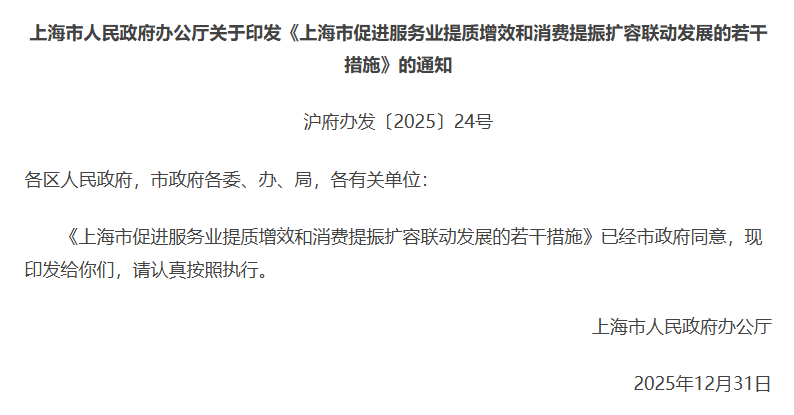
上海,利好来了!
Sou Hu Cai Jing· 2026-01-13 06:30
Core Viewpoint - The Shanghai Municipal Government has issued measures to promote the quality improvement and expansion of the service industry and consumption, focusing on optimizing supply and expanding demand to achieve mutual empowerment and progress [1][3]. Group 1: Financial Innovation and Support - Financial institutions are encouraged to innovate consumer finance products tailored to new consumption trends, such as holiday and night economies, and to implement personal consumption loan interest subsidy policies [3][4]. - Support for insurance product innovation includes enhancing coverage for specific groups and expanding commercial health insurance services [4]. - Financial support for service industry entities will be strengthened through various loan policies and innovative financing products based on expected revenue rights [4][5]. Group 2: Platform Economy Development - The development of platform economies will be regulated to ensure fair competition and prevent forced low-cost sales by platform operators [6][7]. - Platforms are encouraged to promote quality consumption through brand activities and support for quality merchants [7]. Group 3: Transportation and Connectivity - The government will enhance high-quality transportation services, including new international routes and improved travel experiences at transport hubs [8][9]. - Collaboration between airlines and travel agencies will be supported to create integrated travel products [9]. Group 4: Cultural and Entertainment Sector - Measures will be taken to enrich cultural and entertainment offerings, including support for high-quality exhibitions and performances [10][11]. - The gaming and esports industry will be promoted through the development of proprietary event systems and support for high-quality content creation [11][12]. Group 5: Improvement of Living Services - Initiatives to enhance the quality of domestic services and elder care will be implemented, including support for training and insurance for service personnel [13][14]. - The expansion of medical and health services will be encouraged, with a focus on high-end medical offerings and international medical tourism [15][16]. Group 6: Brand and Quality Standards - The establishment of a recognizable "Shanghai brand" will be promoted to enhance consumer trust and support for green product certifications [16][17]. - A comprehensive standard system will be developed to improve service quality across various sectors [17]. Group 7: Support and Talent Development - Financial support will be increased to enhance service quality and cultivate key consumption scenarios [19][20]. - Efforts will be made to attract talent in the service and consumption sectors, including support for international teams and skill evaluations [20][21].
集贤 民生领域投入占比86%
Xin Lang Cai Jing· 2026-01-12 22:06
Group 1 - The core idea of the articles emphasizes the commitment of Jixian County to enhance the well-being of its citizens by focusing on key areas such as employment, education, transportation, and healthcare, with 86% of fiscal spending directed towards these sectors in 2025 [1] Group 2 - In 2025, Jixian County achieved a cumulative increase of 3,303 jobs in urban areas, completing 134.81% of the annual employment target [2] - A total of 44.82 million yuan has been secured to improve educational conditions, with a total investment of approximately 77 million yuan for the fire safety enhancement project in the education system [2] - The county's "Transportation Strong Nation" pilot project for rural roads has been successfully completed with a total investment of 827 million yuan [2] - The project for the renovation of the Anbang River Bridge on Friendship Street has been fully opened to traffic [2] - 240 million yuan has been invested in the integration of urban and rural transportation, including the replacement of 60 new energy buses [2] - The drainage system of the Shuangfu Road Interchange, which has been in operation for 40 years, has been renovated [2] - 170 million yuan has been allocated for the construction and renovation of 23.31 kilometers of rain and sewage pipelines, along with upgrades to 16.8 kilometers of water supply, gas, and heating pipelines [2] - 90.3742 million yuan has been invested in implementing basic assistance programs [2] - The average price of drugs has decreased by 30% due to optimized centralized procurement, saving the public over 6 million yuan in medication costs [2] - A total of 9.2 million yuan has been distributed as childcare subsidies to alleviate the financial burden of families [2]

一票在手出行无忧住宿贴心
Xin Lang Cai Jing· 2026-01-11 17:16
Core Viewpoint - The 35th International Table Tennis Federation-Asian Table Tennis Union Asian Cup will be held in Haikou from February 4 to 8, marking a significant event for the global table tennis community and promoting Haikou as a vibrant tourist destination [1] Group 1: Event Details - The event will take place at the Wuyuanhe Sports Center, showcasing top-level table tennis matches [1] - Haikou is actively developing into an international tourism consumption center, enhancing its appeal to global visitors [1] Group 2: Fan Benefits - Tickets for the Haikou Asian Cup serve as a "Coconut City Welfare Card," offering fans various discounts on flights, hotels, and transportation [1] - The "City-wide Courtesy" initiative will involve over 100 businesses and merchants, providing more than 300 exclusive benefits across various sectors including food, accommodation, transportation, shopping, and entertainment [1]