冶金

Search documents
昆明对云南经济增长贡献率5年翻番 “逐步摆脱了房地产依赖”
Di Yi Cai Jing· 2025-11-10 09:32
Core Viewpoint - The "Strong Provincial Capital" strategy has significantly enhanced Kunming's role in driving Yunnan's economic growth, with its contribution rate rising from 13.3% in 2020 to 31.9% in 2024 [1][2]. Economic Growth and Industrial Development - Since the implementation of the "Strong Provincial Capital" strategy in 2022, Kunming's economic total has consistently surpassed 700 billion and 800 billion yuan, with growth rates improving from lagging behind the province by 3.6 percentage points in 2021 to surpassing it by 0.7 percentage points in 2024 [2]. - The industrial investment ratio in Kunming reached 39.5% in 2024, doubling from 16.2% in 2020, with industrial investment at its highest level in 25 years at 26.3% [2]. - The city's industrial added value grew by 7%, contributing 59.4% to the province's industrial output, an increase of nearly 50 percentage points since 2020 [2]. Economic Quality and Structural Changes - Kunming's economic development has not only accelerated but also improved in quality, with the industrial sector contributing 32.6% to the city's economic growth in 2024, and emerging industries accounting for 95% of industrial growth [3][4]. - The city's industrial added value as a percentage of GDP increased from 19.7% in 2020 to 22.2% in 2024, reflecting a structural shift away from reliance on real estate [4]. Challenges and Future Goals - Despite structural adjustments, Kunming's economic growth has been slower than expected due to the real estate market downturn and the impact of the COVID-19 pandemic, with a GDP target of over 1 trillion yuan by 2025 [5]. - The city's GDP was 827.52 billion yuan in 2024, with a slight decrease in its share of the provincial GDP from 26.61% in 2021 to 26.24% in 2024 [5]. Strategic Development and Regional Integration - Kunming is transitioning from a peripheral to a central role in regional development, supported by the China-Laos Railway and the establishment of an international port city model [6]. - The total import and export volume at the Mohan Port increased by 107.7% from 2020 to 2024, with the value rising by 186.1% during the same period [6]. Digital Economy and Infrastructure - The city is enhancing its digital economy, with significant investments from major tech companies and a focus on cross-border digital services, positioning itself as a hub for digital industries [7]. - The international communication business has been established, providing opportunities for the development of cross-border digital finance and logistics [7][8].
夸张!19100家企业破产,德国制造成“破落户”,向中国发出求救
Sou Hu Cai Jing· 2025-11-08 09:10
Economic Challenges in Germany - The number of bankruptcies among German companies reached 11,900 in the first half of 2025, marking a ten-year high, indicating unprecedented challenges for German manufacturing [1] - Germany's economy has been in recession for two consecutive years, with GDP declining by 0.3% in 2023 and an additional 0.2% in 2024, showcasing rare economic weakness since World War II [1] - The energy crisis, exacerbated by the Russia-Ukraine conflict, has led to electricity prices soaring to three to four times their previous levels, significantly impacting many businesses [1] Manufacturing Sector Struggles - The number of bankruptcies in the German automotive sector increased by 60% in 2024 compared to the previous year, highlighting severe pressures on this key industry [4] - Major companies like Bosch and ZF are implementing large-scale layoffs, with tens of thousands of job cuts announced [4] - The transition to electric vehicles is disrupting traditional manufacturing rhythms, with the current electric vehicle penetration rate in Germany at only 13%, far below the EU's target of 20% by 2025 [4] Structural Issues and Infrastructure Bottlenecks - Germany's reliance on traditional internal combustion engine technologies has hindered investment in new disruptive technologies like AI and semiconductors [6] - The country faces significant infrastructure challenges, with railway punctuality dropping to 62.5% and fiber optic coverage at only 17.7%, well below the EU average [6] - Administrative hurdles, such as the average 120 days required to register a new company, further complicate business operations [6] Government and Corporate Responses - The German government is expanding the coverage of bankruptcy prevention funds and has introduced loans to support digital transformation [8] - Local governments and universities are collaborating to create "Industry 4.0 Competence Centers" to assist SMEs in advancing technology applications [8] - Companies like Siemens are investing more resources into digital solutions, while SMEs are forming alliances for joint procurement and R&D, showing initial progress [9] International Cooperation and Future Outlook - In 2023, German investments in China increased to €11.9 billion, indicating that China remains a crucial market and technology partner for Germany [9] - The ongoing changes reflect the need for traditional industrial powers to dismantle path dependencies and embrace new challenges [9] - The potential for cooperation between Germany and China in areas like new energy and smart manufacturing could help Germany find breakthroughs and contribute to global growth [9]

山东:目标到2028年,突破前沿金属材料等领域100项以上关键技术
Sou Hu Cai Jing· 2025-11-07 16:37
Core Viewpoint - The "Shandong Province Modern Metallurgical Industry Technology Innovation Action Plan (2026-2028)" aims to enhance the competitive advantage of Shandong's modern metallurgical industry through technological innovation, promoting high-quality development of the manufacturing economy in Shandong [1] Group 1: Key Tasks - The plan focuses on four major actions: "High-end" product innovation, "Intelligent" manufacturing, "Green" process innovation, and "Scale" innovation in frontier materials [1] - It aims to achieve breakthroughs in over 100 key technologies and form more than 50 major innovative achievements by 2028 [1] Group 2: High-end Product Innovation - In steel, the focus is on developing high-performance special steels and advanced processing technologies for high-end steel materials [2] - For non-ferrous metals, the plan emphasizes breakthroughs in high-purity aluminum and copper alloys, supporting the development of high-performance aluminum and copper products [2][3] Group 3: Intelligent Manufacturing Innovation - The steel sector will develop smart manufacturing technologies, including real-time production information sensing and control systems [4] - Non-ferrous metal industries will focus on intelligent smelting technologies, integrating data management and process control [4] Group 4: Green Process Innovation - The steel industry will explore zero-carbon ironmaking processes and sustainable steel materials, aiming for low-carbon steelmaking models [5] - Non-ferrous metals will focus on energy-efficient and low-carbon technologies, including recycling and utilization of urban mining resources [6] Group 5: Scale Innovation in Frontier Materials - The plan targets the development of high-performance magnesium and titanium alloys for aerospace and deep-sea applications [7] - It also emphasizes the efficient use of rare earth materials and the development of advanced functional materials for various high-tech applications [7]
江苏神通:接受山西证券调研
Mei Ri Jing Ji Xin Wen· 2025-11-06 09:34
Group 1 - Jiangsu Shentong (SZ 002438) announced that on November 6, 2025, it will be receiving a research visit from Shanxi Securities, with Vice President Zhang Qiqiang participating in the reception and addressing investor inquiries [1] - For the first half of 2025, Jiangsu Shentong's revenue composition is as follows: Nuclear power industry accounts for 38.37%, energy-saving and environmental protection industry for 18.78%, metallurgy industry for 18.45%, energy equipment industry for 17.05%, and other businesses for 7.35% [1] - As of the report date, Jiangsu Shentong's market capitalization is 7.5 billion yuan [1]

港股异动 | 天工国际(00826)盘中涨近7% 公司有望成为核聚变结构供应链核心节点 正加快RAFM钢应用开发
智通财经网· 2025-11-06 03:47
Core Viewpoint - Tian Gong International (00826) has seen a significant stock price increase, attributed to its strategic positioning in the emerging nuclear fusion energy sector and advancements in powder metallurgy technology [1] Group 1: Company Developments - Tian Gong International's stock rose nearly 7% during trading, closing up 5.54% at HKD 3.05, with a trading volume of HKD 88.48 million [1] - The company has successfully developed core technology for a new neutron shielding material, high-boron steel (304B7), for nuclear fusion devices and has begun small-scale production of trial pieces [1] - The company is accelerating the application development of advanced low-activation steel (RAFM steel), which is crucial for nuclear fusion structural materials [1] Group 2: Industry Insights - The Central Committee of the Communist Party of China has proposed forward-looking layouts for future industries, emphasizing nuclear fusion energy as a new economic growth point [1] - Powder metallurgy technology is identified as a foundational capability platform for Tian Gong International to enter the strategic new materials and high-end manufacturing sectors, potentially enhancing both performance and valuation [1] - RAFM steel is recognized as the most mature and mainstream candidate structural material for the core component of magnetic confinement fusion devices, known as tokamaks, due to its excellent radiation swelling resistance, high-temperature strength, thermal conductivity, and inherent low activation properties [1]
“十五五”锚定现代化产业体系 固本育新打开增长新空间
Zheng Quan Shi Bao· 2025-11-05 18:35
Core Insights - The core viewpoint of the article emphasizes the importance of strengthening the real economy as a strategic priority in China's 15th Five-Year Plan, highlighting its critical role in national development and economic resilience [1][2]. Group 1: Strengthening the Real Economy - The real economy is identified as the foundation of a nation's economy, essential for wealth creation and national strength [2]. - The plan aims for industrial value-added growth from 31.3 trillion yuan to 40.5 trillion yuan between 2020 and 2024, providing robust support for economic, technological, and comprehensive national strength [2]. - The strategy includes building a modern industrial system focused on advanced manufacturing, quality, and green development, ensuring a balanced manufacturing sector [2][3]. Group 2: Upgrading Traditional Industries - The plan outlines four key areas for optimizing traditional industries: solidifying foundations, fostering innovation, expanding capacity, and enhancing efficiency [3]. - Key industries such as mining, metallurgy, chemicals, and machinery are targeted for quality upgrades to maintain global competitiveness [3][4]. - A collaborative approach involving policy, technology, and finance is necessary for the transformation of traditional industries [4]. Group 3: Cultivating Emerging and Future Industries - The plan emphasizes the cultivation of emerging and future industries, including new energy, new materials, and aerospace, to inject new momentum into economic growth [5][6]. - It proposes implementing industry innovation projects and exploring diverse technological routes and business models for future industries [5]. - Addressing challenges in emerging industries requires innovative mechanisms and a focus on application-oriented development [6]. Group 4: Enhancing the Service Sector - The plan recognizes significant potential for expanding and improving the service sector, aiming to enhance its integration with advanced manufacturing and modern agriculture [7]. - It calls for actions to elevate the quality and capacity of the service industry, promoting specialized and high-value production services [7].
专访黄群慧:发展新质生产力是“十五五”产业政策主线
21世纪经济报道· 2025-11-05 12:40
Core Viewpoint - The article discusses China's strategic direction for industrial development during the "15th Five-Year Plan" period, emphasizing the construction of a modern industrial system and the strengthening of the real economy as primary tasks [1][11]. Group 1: Traditional Industry Transformation - The "15th Five-Year Plan" aims to optimize and enhance the global competitiveness of traditional industries such as mining, metallurgy, and machinery, which are crucial for economic resilience [6][7]. - The transformation of traditional industries is expected to generate significant economic value, potentially reaching a value increase of 10 trillion yuan through technological upgrades and smart manufacturing [7]. Group 2: Emerging Industries - The plan highlights the importance of strategic emerging industries like new energy, new materials, and aerospace, which are anticipated to become major drivers of economic growth [8][9]. - Local governments are encouraged to develop emerging industries based on regional resources and capabilities, fostering suitable industrial clusters [9]. Group 3: Future Industries - The article identifies future industries such as quantum technology and hydrogen energy as critical for gaining competitive advantages in global markets [10][12]. - The development of these future industries requires careful consideration of technological maturity and market potential, as they involve high risks and long investment cycles [10]. Group 4: Modern Industrial System - A modern industrial system is deemed essential for China's modernization, with a focus on intelligent, green, and integrated development [11][12]. - The article stresses the need for a robust manufacturing sector as the backbone of the modern industrial system, which is vital for achieving national development goals [11]. Group 5: New Infrastructure and Services - The plan calls for the construction of new infrastructure, particularly in computing power, to support technological advancements and industrial upgrades [12][13]. - The expansion and enhancement of productive services are highlighted as key to supporting manufacturing transformation and achieving high-quality development [14].
21专访|黄群慧:发展新质生产力是“十五五”产业政策主线
2 1 Shi Ji Jing Ji Bao Dao· 2025-11-05 11:49
Core Viewpoint - The article discusses China's strategic plan for industrial development during the 15th Five-Year Plan period, emphasizing the construction of a modern industrial system and the strengthening of the real economy as primary tasks [1][2]. Group 1: Traditional Industry Optimization - The 15th Five-Year Plan aims to consolidate and enhance the global competitiveness of traditional industries such as mining, metallurgy, and machinery, which are crucial for economic resilience [3][4]. - The transformation and upgrading of these traditional industries through intelligent, green, and high-end development are expected to generate significant economic value, potentially reaching trillions in added value [4]. Group 2: Emerging Industries - The plan highlights the importance of emerging industries like new energy, new materials, and aerospace, which are anticipated to become major drivers of economic growth and have strong interconnections with various sectors [5][6]. - The development of strategic emerging industries should be tailored to local conditions, leveraging regional resources and capabilities to foster suitable industry clusters [5]. Group 3: Future Industries - The proposal includes promoting future industries such as quantum technology and hydrogen energy, which are seen as critical for gaining competitive advantages in global markets [6][7]. - These future industries are characterized by high dependence on original innovation and long investment cycles, necessitating careful planning and support for their development [6]. Group 4: Modern Industrial System - The modern industrial system is identified as the material and technical foundation for China's modernization, with a focus on maintaining a robust manufacturing sector [7][8]. - The integration of advanced manufacturing with new technologies is essential for driving high-quality development and achieving the goals of the 15th Five-Year Plan [8]. Group 5: New Infrastructure and Service Industry - The plan emphasizes the need for new infrastructure, particularly in computing power, to support technological advancements and industrial upgrades [9][10]. - The expansion and enhancement of the productive service industry are crucial for facilitating the transformation of manufacturing and achieving higher value chains [11].
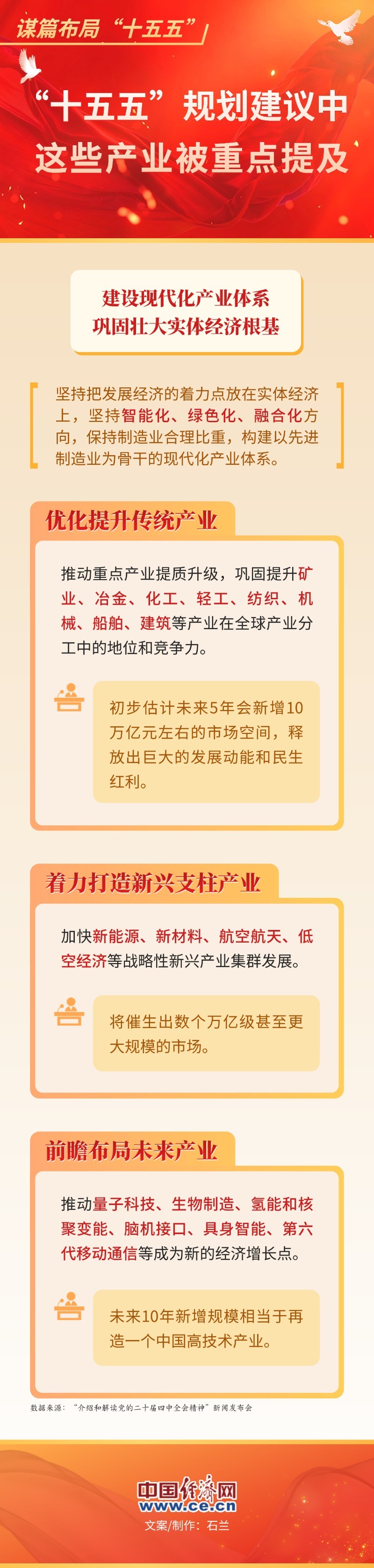
【图解】谋篇布局“十五五”|“十五五”规划建议中,这些产业被重点提及
Zhong Guo Jing Ji Wang· 2025-11-05 07:17
Core Viewpoint - The article emphasizes the importance of developing a modern industrial system focused on strengthening the real economy, with a commitment to intelligent, green, and integrated development, while maintaining a reasonable proportion of manufacturing [3][5]. Group 1: Modern Industrial System - The focus is on consolidating and expanding the foundation of the real economy by prioritizing the development of the real economy [3]. - There is a commitment to maintaining a reasonable proportion of manufacturing and constructing a modern industrial system centered on advanced manufacturing [3]. Group 2: Traditional Industry Optimization - The article discusses the need to enhance traditional industries such as mining, metallurgy, chemicals, light industry, textiles, machinery, shipping, and construction to improve their global competitiveness [5]. - An estimated market space of around 10 trillion yuan is expected to be added over the next five years, releasing significant development momentum and benefits for people's livelihoods [5]. Group 3: Emerging Pillar Industries - There is a push to accelerate the development of strategic emerging industries such as new energy, new materials, aerospace, and low-altitude economy [6]. - This initiative is expected to create several trillion-level markets or even larger scales [7]. Group 4: Future Industry Layout - The article highlights the importance of forward-looking layouts for future industries, promoting quantum technology, biomanufacturing, hydrogen energy, nuclear fusion energy, brain-computer interfaces, embodied intelligence, and sixth-generation mobile communication as new economic growth points [8]. - The anticipated scale of new high-tech industries over the next decade is comparable to recreating an entire high-tech industry in China [8].
月度前瞻 | 短期经济会否“超预期”?(申万宏观·赵伟团队)
申万宏源宏观· 2025-11-04 15:23
Economic Activity Changes - Economic activity has faced new pressures on both supply and demand sides since October, with a decrease in working days and high inventory levels constraining production [2][8] - The manufacturing PMI dropped by 0.8 percentage points to 49%, indicating a contraction in manufacturing activity, with production indices declining more than new orders [2][8] - Demand pressure is particularly evident in the manufacturing sector, as companies accelerate debt repayments, which negatively impacts fixed asset investment [2][19] Profitability and Cost Pressures - Excluding low base effects, industrial profits are weaker than in previous years, with the overall cost rate at a historical high of 85.4% [3][30] - In September, industrial profits increased by 2.6 percentage points to 22.5%, but the two-year compound growth rate fell by 5.3 percentage points to -5.9% [3][30] - The increase in profits is primarily driven by short-term indicators, while long-term cost pressures continue to rise, affecting profit sustainability [3][30] Policy Measures to Mitigate Growth Pressure - The introduction of new incremental policies aims to alleviate the investment squeeze caused by debt resolution efforts, with significant financial tools being deployed [4][38] - As of mid-October, nearly 300 billion yuan in new policy financial tools have been issued, focusing on infrastructure and emerging sectors [4][38] - The proportion of special refinancing bonds in new special bonds decreased from 56.9% to 16.7%, indicating a shift in funding allocation [4][38] Consumption Trends - The anticipation of the "Double Eleven" shopping festival is expected to temporarily boost retail sales, with a projected rebound of 3.4% in October [4][49] - Service consumption remains resilient, with holiday spending showing a year-on-year increase of 7.6%, surpassing goods consumption growth of 3.6% [4][49] - However, retail sales may weaken post-festival due to high base effects and consumer demand being "overdrawn" [4][49] Export Dynamics - The recent fluctuations in US-China tariffs have led to a "rush to export," potentially supporting October's export figures, which are expected to maintain resilience at 7% year-on-year [4][59] - The threat of a 100% tariff on all Chinese goods by the US has prompted increased export activity, with port freight volumes rising by 18% in the last week of October [4][59] - The recovery in processing trade imports also supports the outlook for exports, indicating ongoing demand for Chinese goods [4][59] Monthly Data Performance - The PPI is expected to recover slightly to around -2.1% in October, driven by rising prices in upstream commodities despite low capacity utilization in downstream sectors [5][73] - CPI is projected to rise above 0% due to low base effects and resilient service consumption, with an expected recovery to 0.4% year-on-year [5][81] - The actual GDP growth for October is estimated at 4.6%, indicating sustained high growth despite supply-side constraints and demand-side risks [6][94]