建材

Search documents
长城基金汪立:关注内需价值、新兴科技、大金融三大方向
Xin Lang Cai Jing· 2026-02-26 04:48
Core Viewpoint - The A-share market is expected to stabilize and rebound, supported by multiple positive factors including declining risk-free rates, comprehensive domestic demand policies, and improving export expectations [1][4]. Group 1: Market Conditions - The A-share market welcomed a "good start" with all three major indices opening higher on the first trading day after the holiday [1][4]. - Factors supporting the market include a decline in risk-free rates and ongoing capital market reforms, which create a favorable liquidity environment for A-shares [1][4]. - Domestic demand policies are being prioritized, with expectations for traditional domestic demand sectors to gradually improve, supported by both policy and fundamental factors [1][4]. Group 2: Economic Outlook - The outlook for China's economy in 2026 is expected to improve significantly, driven by breakthroughs in domestic new technology industries and accelerated globalization [1][4]. - The focus of economic work is shifting towards domestic demand, with expectations of recovery in consumption, rising prices, and stabilization in the real estate sector [1][4]. Group 3: Investment Strategies - Emerging technology is identified as a key investment theme, with value stocks also expected to see a resurgence [1][4]. - Specific sectors to focus on include consumer services, food and beverage, and building materials within the domestic demand space, as well as internet, media, computing, robotics, electronics, and military industries in the emerging technology sector [2][5]. - The financial sector, particularly brokerage and insurance, is highlighted as a stabilizing force in the market, benefiting from the ongoing growth in wealth management demand [2][6].
上海发布“沪七条”楼市新政,关注建材ETF(159745)投资机遇
Mei Ri Jing Ji Xin Wen· 2026-02-26 03:33
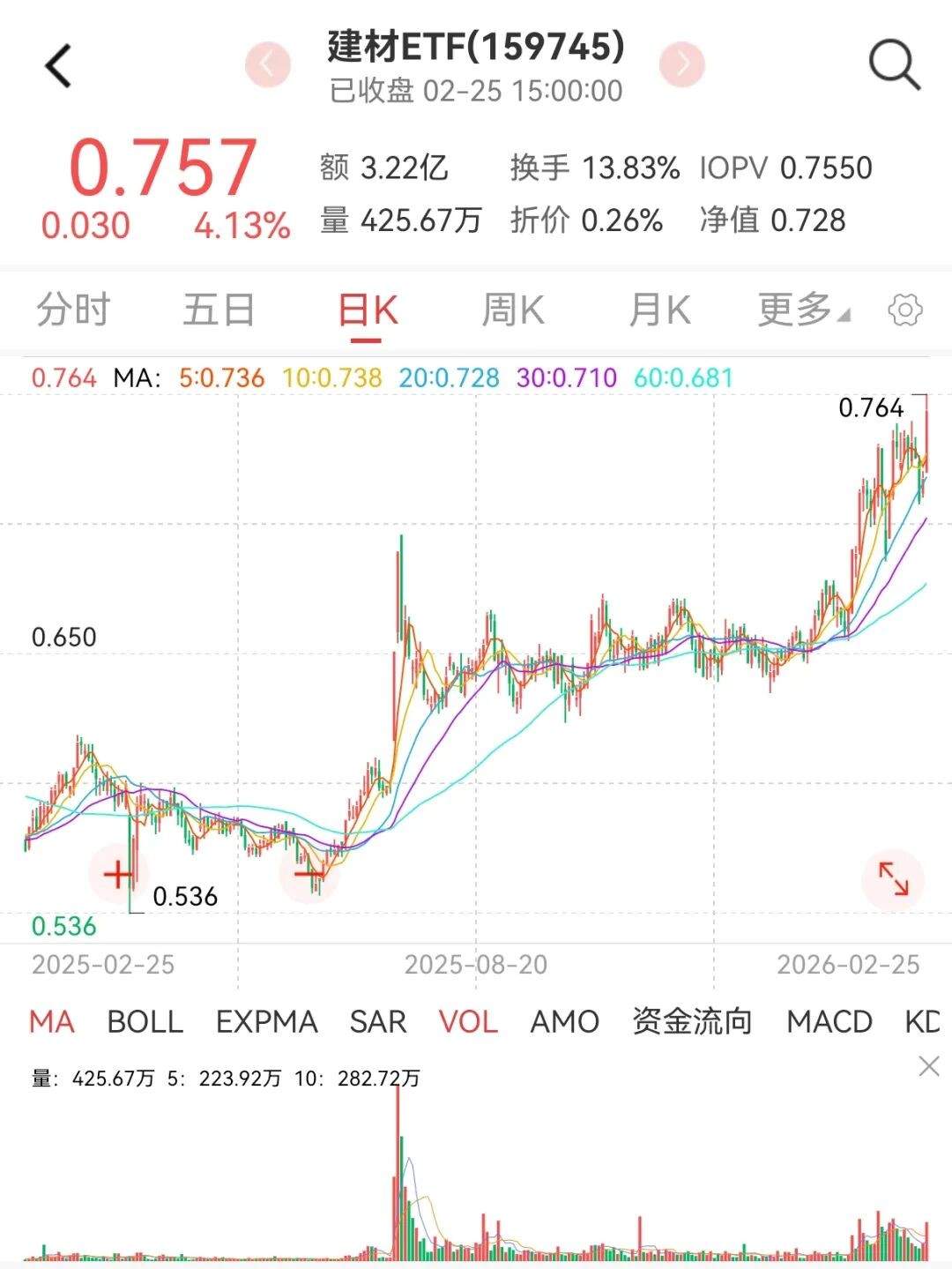
Core Viewpoint - The new housing policy "沪七条" released in Shanghai is expected to stabilize housing prices in the outer ring area by lowering purchase thresholds and increasing purchasing power for non-local families [1] Summary by Categories Policy Changes - Non-local families' social security requirement for purchasing homes in the outer ring is reduced from 3 years to 1 year [1] - Non-local families can purchase one additional property in the outer ring [1] - Families with a residence permit of 5 years can buy one property [1] - The first home provident fund loan limit is increased from 1.6 million to 2.4 million [1] - The provident fund policy shifts to "recognizing the house, not the loan" [1] Market Impact - The new policy is expected to improve the supply-demand relationship in the outer ring housing market [1] - There has been a steady decline in housing listings since Q4 2025, with high transaction volumes in the second-hand housing market [1] - New home transaction volumes during the recent Spring Festival showed significant growth compared to the same period in 2025 [1] Investor Sentiment - Market views suggest that the new policy aligns with expectations and may stimulate demand for first-time homebuyers [1] - The recovery in the housing market is anticipated to catalyze sectors such as building materials and real estate [1] - The building materials sector is expected to continue optimizing its supply-demand structure amid a trend against over-competition [1] - Investors are encouraged to consider the largest building materials ETF (159745) as a potential opportunity [1]

海螺创业早盘高开逾4% 拟获海螺集团收购额外股权
Xin Lang Cai Jing· 2026-02-26 01:36
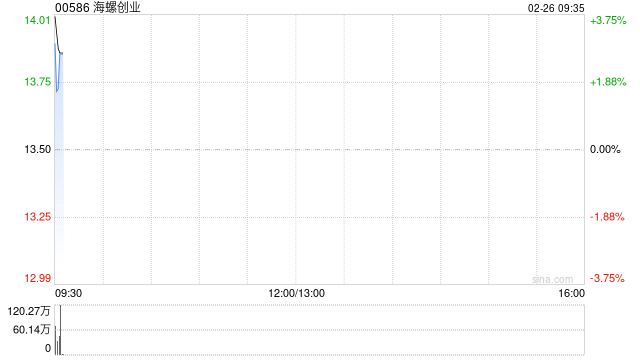
Core Viewpoint - Conch Venture (00586) is considering a potential acquisition of additional shares from Anhui Conch Group, which could lead to the group holding approximately 21% of the company's issued share capital after the acquisition is completed [2][5]. Group 1: Stock Performance - Conch Venture opened over 4% higher in early trading and, as of the report, the stock price increased by 2.67%, currently at HKD 13.86, with a trading volume of HKD 43.02 million [2][5]. Group 2: Acquisition Details - The potential acquisition is subject to approval from relevant government authorities and will be conducted in the open market at prevailing market prices, considering the company's market conditions at the time [2][5]. - Following the completion of the potential acquisition, Conch Group, along with its subsidiaries and concert parties, is expected to hold less than 30% of the voting rights of the company's total issued shares [2][5]. - Conch Group anticipates restructuring the board composition of Conch Venture, and the company will be regarded as a subsidiary of Conch Group, with its financial performance incorporated into Conch Group's consolidated financial statements [2][5].
海螺创业高开逾4% 拟获海螺集团收购额外股权
Zhi Tong Cai Jing· 2026-02-26 01:33
消息面上,2月25日,海螺创业发布公告,本公司从安徽海螺集团有限责任公司(海螺集团)获悉,其正 考虑可能收购本公司额外的股份(潜在收购事项),借此,海螺集团于紧随潜在收购事项完成后将直接及 间接持有本公司已发行股本约21%。 海螺创业(00586)高开逾4%,截至发稿,涨4.67%,报14.13港元,成交额516.45万港元。 潜在收购事项(受限于获得相关政府机构批准)将于公开市场按当时的市场价格,并在主要考虑本公司当 时的市场价格和当时市况后,在海螺集团认为适当的时间进行。紧随潜在收购事项完成后(如实现),海 螺集团,连同其附属公司和海螺集团之一致行动人士(定义见香港证券及期货事务监察委员会刊发的香 港公司收购及合并守则),将持有合计少于30%附于本公司全部已发行股份的投票权;海螺集团预期将 重构本公司董事会组成;及本公司将被视为海螺集团的附属公司,及本公司的财务业绩将并入海螺集团 合并财务报表中。 ...
地产新政出台,沪指冲?回落
Zhong Xin Qi Huo· 2026-02-26 00:45
Group 1: Report's Industry Investment Ratings - The outlook for stock index futures is "shockingly strong" [6] - The outlook for stock index options is "shock" [6] - The outlook for treasury bond futures is "shock" [7] Group 2: Report's Core Views - For stock index futures, the introduction of real - estate policies has scattered trading themes. The Shanghai Composite Index rose and then fell on Wednesday, with small and medium - cap stocks outperforming. After the Shanghai property market policy was released, there was sector rotation. With scattered themes, the upside may be limited, but with improved A - share trading volume after the holiday, it's still recommended to hold IM long - positions before the Two Sessions [1][6] - Regarding stock index options, short - term volatility expectations have decreased, and the focus can shift to medium - term moderate growth. The trading logic is moving from hedging and speculation to medium - term layout. The put - call ratio of small and medium - cap stocks provides some support, and a covered - call strategy can be the main medium - term approach [2][6] - For treasury bond futures, policies and risk preferences have disturbed the bond market, causing it to decline. The central bank's operations have loosened the money - market, but the bond market sentiment was weak due to the rise in the stock market and the new real - estate policy. In the short - term, the bond market is expected to continue to fluctuate [3][7] Group 3: Summaries Based on Related Catalogs 1. Stock Index Futures - **Market Situation**: The Shanghai Composite Index rose and fell on Wednesday, with small and medium - cap stocks performing better. After the Shanghai property market policy, sector rotation occurred, with cyclical sectors taking profits and real - estate related sectors being relatively resilient [1][6] - **Investment Strategy**: Hold IM long - positions as post - holiday A - share trading volume has recovered, and the policy call option before the Two Sessions is still valid [1][6] 2. Stock Index Options - **Market Situation**: The underlying market continued to rise, with small and medium - cap related varieties rising more. Option trading volume increased slightly, and implied volatility decreased, indicating a shift from short - term trading to medium - term layout [2][6] - **Investment Strategy**: Adopt a covered - call strategy as short - term volatility expectations decline and the market is suitable for medium - to long - term bullish strategies [2][6] 3. Treasury Bond Futures - **Market Situation**: Treasury bond futures' main contracts fell. The central bank's operations loosened the money - market, but the bond market was affected by the rise in the stock market and the new real - estate policy, leading to an increase in interest rates [3][7] - **Investment Strategy**: Be cautious in the bond market. For hedging, focus on short - hedging at low basis levels; for basis strategies, look for positive - arbitrage opportunities in ultra - long - term bonds; for curve strategies, focus on the narrowing of the 30Y - 10Y spread; and pay attention to the downward momentum of inter - delivery spreads and the change in the delivery window due to the Spring Festival [7]
优化内部链网 发力产业集群
Xin Lang Cai Jing· 2026-02-25 23:03
Group 1 - The core event was a supply-demand matching activity for the intelligent equipment industry chain held in the South Taihu New District, where representatives from 17 key equipment manufacturing enterprises engaged in practical cooperation discussions [1] - The city is exploring an intrinsic growth path driven by industrial chain collaboration to enhance international competitiveness, with 241 matching events held last year, involving over 7,400 enterprises, resulting in direct order matching worth 12.14 billion and financing exceeding 40 billion [1] - The city has identified the issue of information asymmetry and poor supply-demand connection as barriers to the development of the manufacturing sector, particularly for export-oriented enterprises, and is establishing efficient matching platforms to address these challenges [1] Group 2 - The city is implementing tailored market expansion strategies for different industries, particularly focusing on 322 key enterprises included in a "white list," providing integrated support in policies, credit, and customs [2] - The approach emphasizes collective international expansion of the entire industrial ecosystem rather than individual enterprises, enhancing bargaining power and risk resilience in the international market [2] - The city’s economic and information bureau aims to address pain points in the industrial chain and promote the manufacturing sector towards clustering and high-end development, which is a pragmatic response to the current complex foreign trade situation and a long-term strategy for building core competitiveness [2]
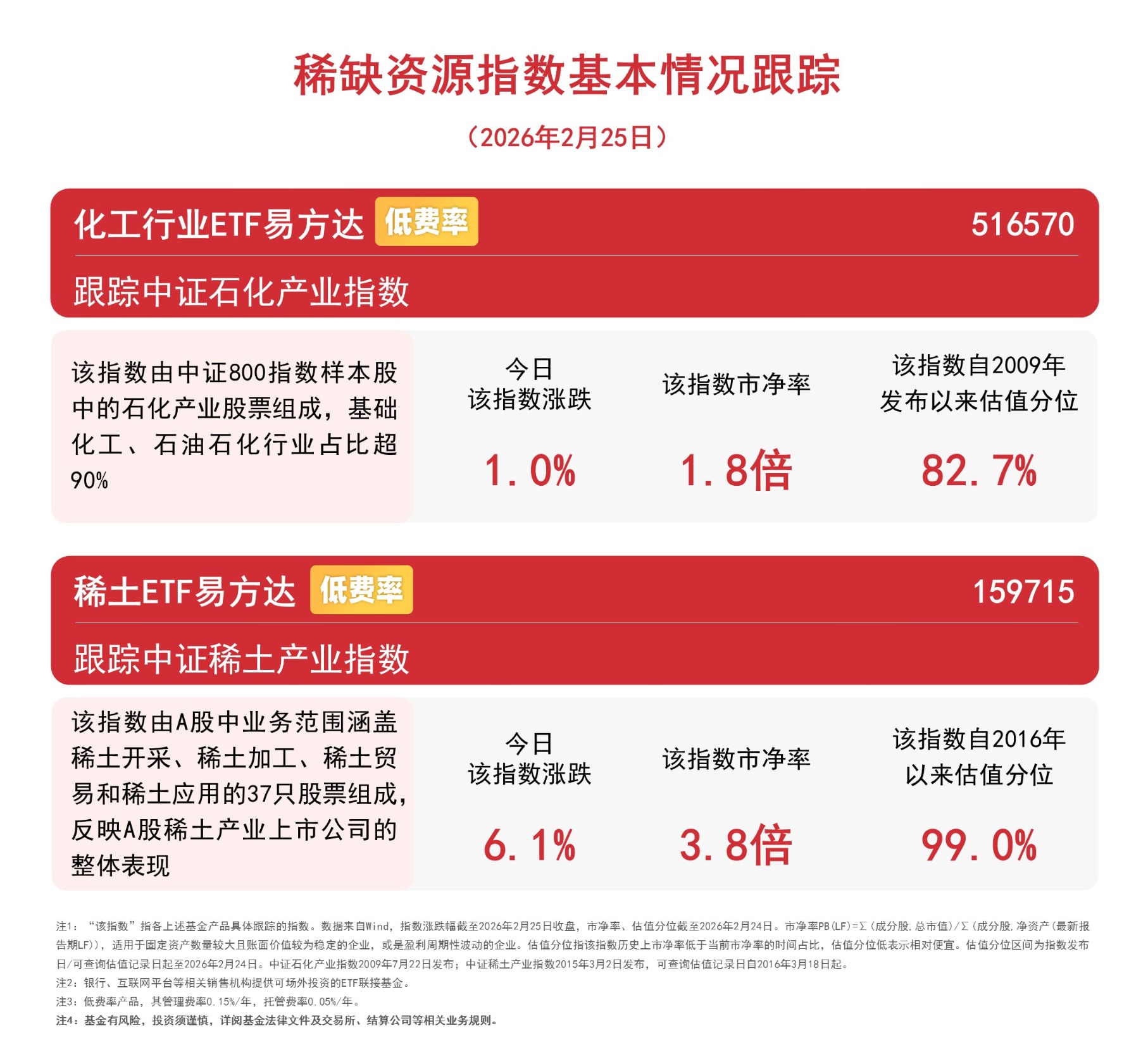
周期股延续强势,稀土板块领涨,稀土ETF易方达(159715)标的指数大涨超6%
Mei Ri Jing Ji Xin Wen· 2026-02-25 14:44
Group 1 - The article discusses the recent financial performance of a leading technology company, highlighting a revenue increase of 15% year-over-year, reaching $50 billion in the last quarter [5] - The company has successfully expanded its market share in the cloud computing sector, now holding a 25% share, which is a 5% increase from the previous year [5] - The report indicates that the company's net profit margin improved to 20%, up from 18% in the same quarter last year, reflecting better cost management and operational efficiency [5] Group 2 - The article notes that the company has launched several new products, contributing to a 10% increase in sales volume, with particular success in the AI-driven software segment [5] - It mentions the strategic partnerships formed with other tech firms, which are expected to enhance innovation and drive future growth [5] - The company is also focusing on sustainability initiatives, aiming to reduce carbon emissions by 30% over the next five years, aligning with global environmental standards [5]
ETF日报:当前钢铁板块或是弹性大且有预期差的底部板块,关注钢铁ETF
Xin Lang Cai Jing· 2026-02-25 12:30
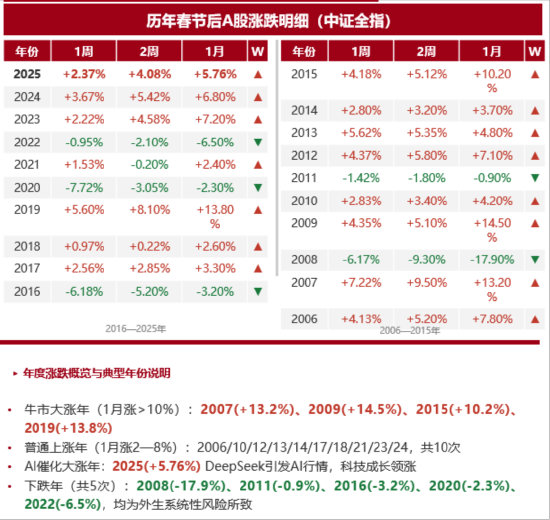
Market Overview - A-shares opened higher and closed with gains, with the Shanghai Composite Index rising by 0.72% to 4147.23 points, Shenzhen Component Index up 1.29%, and ChiNext Index up 1.41% [1][17] - The total trading volume for the day was 2.48 trillion yuan, compared to 2.22 trillion yuan the previous day, indicating a neutral to strong risk appetite in the market [1][17] - Over 3700 stocks in the market saw an increase, with small-cap stocks outperforming large-cap stocks, and growth stocks lagging behind value stocks [1][17] Spring Festival Market Trends - Historical data from 2006 to 2025 shows a consistent trend of gains in the A-share market following the Spring Festival, with an average increase of 1.6% in the first week, 2.5% in the second week, and 4.6% in the first month [3][19] - The success rate of the post-Spring Festival rally is notable, with a 76% win rate in the first two weeks and a 71% win rate in the first month, significantly higher than the annual average of about 52% [3][19] Semiconductor Equipment Sector - The Semiconductor Equipment ETF (159516) saw a significant increase of 4.56% after a volatile trading session [21] - Chinese top chip manufacturers plan to increase advanced chip production from less than 20,000 units currently to 100,000 units within 1-2 years, with a long-term goal of adding 500,000 units by 2030 [7][23] - The semiconductor equipment sector is expected to benefit from the expansion of advanced processes and storage, driven by global AI demand, making it a strong growth narrative [8][24] Real Estate Policy Impact - Shanghai's new real estate policy, "沪七条," aims to lower the threshold for home purchases, which is expected to stabilize housing prices in the outer ring of the city [8][9] - The policy includes reducing the social security requirement for non-local families from three years to one year and increasing the public housing loan limit from 1.6 million to 2.4 million yuan [8][9] - The new policy is anticipated to stimulate demand in the real estate market, benefiting related sectors such as building materials and real estate [9][25] Steel Sector Dynamics - The steel sector experienced a significant rise, with the Steel ETF (515210) increasing by 4.27%, driven by both demand and supply-side catalysts [11][27] - The Ministry of Industry and Information Technology released new guidelines for the steel industry, which are expected to lead to a phase of consolidation and resource allocation towards stronger companies [12][28] - Current low inventory levels and cautious market sentiment suggest potential upward price elasticity for steel if demand catalysts emerge [12][28]
恒指温和收涨 周期股领涨科技分化
2 1 Shi Ji Jing Ji Bao Dao· 2026-02-25 12:09
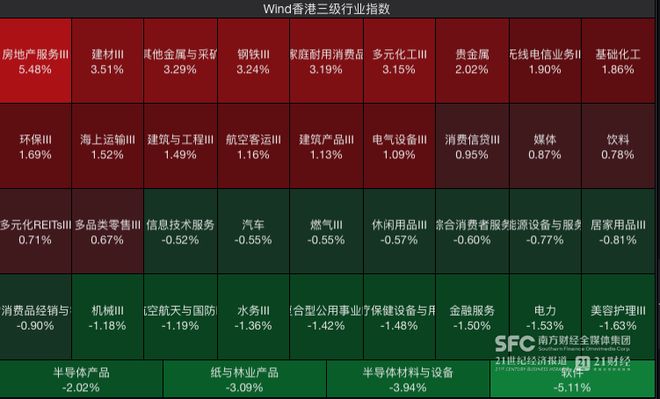
Market Overview - The Hong Kong stock market experienced a mixed performance with a structural characteristic of "strong cyclicals, weak technology" as policy support and rising commodity prices drove the market upward, while profit-taking affected the technology sector [1][2] - The Hang Seng Index rose by 0.66% to 26,765.72 points with a trading volume of 236.765 billion HKD, while the Hang Seng Tech Index slightly declined by 0.19% to 5,260.5 points with a trading volume of 51.908 billion HKD [1][2] Sector Performance - Cyclical sectors such as real estate services (+5.48%), building materials (+3.51%), and mining (+3.29%) led the gains, supported by favorable policies and rising commodity prices [2] - In contrast, technology sectors like software (-5.11%) and semiconductor materials and equipment (-3.94%) saw significant declines due to profit-taking from previously high-performing stocks [2] Individual Stocks - Notable gainers included Tianbao Energy (+69.49%) due to a projected profit increase of 84.5% year-on-year, and Semir Holdings (+60.53%) benefiting from active small-cap market sentiment [2] - Major decliners included Zhijing International Financial (-26.32%), Zhuoyue Holdings (-23.08%), and China National Pharmaceutical Group (-18.75%) [2] Trading Activity - The top three stocks by trading volume were Tencent Holdings (11.981 billion HKD), Alibaba-W (7.110 billion HKD), and HSBC Holdings (6.193 billion HKD) [2] Policy and Economic Developments - The Hong Kong budget proposed optimizing the listing system, including revising "same share, different rights" requirements and advancing T+1 settlement cycle consultations, aiming to enhance market efficiency [2] - New policies in Shanghai's real estate market, including shortening the social security period for non-local buyers and increasing public housing loan limits, stimulated the Hong Kong real estate sector [2] Future Outlook - Analysts suggest focusing on three sectors: precious metals and energy due to rising geopolitical risks, consumer sectors at relatively low valuations, and technology sectors expected to rebound as AI applications accelerate [3] - Concerns over potential VAT increases in service sectors may affect investor sentiment, but pre-meeting policy expectations could support the Hong Kong market [3] - The real estate sector showed overall gains during the Spring Festival, with a continued positive outlook for first-tier and select second-tier cities [3]




恒指温和收涨 周期股领涨科技分化丨港股复盘
2 1 Shi Ji Jing Ji Bao Dao· 2026-02-25 12:00
Core Viewpoint - The Hong Kong stock market experienced a mixed performance with a structural divergence, where cyclical sectors outperformed while technology stocks faced profit-taking pressures [1] Market Performance - The Hang Seng Index rose by 0.66% to 26,765.72 points with a trading volume of 236.765 billion HKD, while the Hang Seng Tech Index slightly declined by 0.19% to 5,260.5 points with a trading volume of 51.908 billion HKD [1] - Southbound capital recorded a net outflow of 3.569 billion HKD [1] Sector Performance - Cyclical sectors such as real estate services (+5.48%), building materials (+3.51%), and other metals and mining (+3.29%) led the gains, driven by favorable policies and rising commodity prices [1][2] - Technology sectors, including software (-5.11%) and semiconductor materials and equipment (-3.94%), showed significant declines due to profit-taking [1][2] Individual Stock Movements - Notable gainers included Tianbao Energy (+69.49%) due to a profit forecast increase of 84.5% year-on-year, and Semmy Holdings (+60.53%) benefiting from active small-cap market sentiment [2] - Major decliners included Zhijing International Finance (-26.32%), Chuangyue Holdings (-23.08%), and China National Pharmaceutical Group (-18.75%) [2] Major Transactions - The top three stocks by trading volume were Tencent Holdings (11.981 billion HKD), Alibaba-W (7.110 billion HKD), and HSBC Holdings (6.193 billion HKD) [3] - Conch Group plans to increase its stake in Conch Cement A-shares (7 to 14 billion HKD) and Conch Venture (10.61%), contributing to the rise in building materials stocks [3] Policy and Economic Factors - The Hong Kong budget proposed optimizing the listing system, including revising "same share different rights" requirements and advancing T+1 settlement cycle consultations [3] - New policies in Shanghai's real estate market aimed at stimulating demand, such as shortening social security requirements for non-local buyers and increasing public housing loan limits [3] Future Outlook - Analysts suggest focusing on three sectors: precious metals and energy due to rising geopolitical risks, consumer sectors at relatively low valuations, and technology sectors expected to rebound as AI applications accelerate [4]