
服务业

Search documents
国家统计局:1月份制造业采购经理指数(PMI)为49.3%
Xin Lang Cai Jing· 2026-01-31 01:56
Group 1: Manufacturing PMI Overview - In January, the Manufacturing Purchasing Managers' Index (PMI) was 49.3%, a decrease of 0.8 percentage points from the previous month, indicating a decline in manufacturing activity [1] - Large enterprises had a PMI of 50.3%, down 0.5 percentage points, while medium and small enterprises had PMIs of 48.7% and 47.4%, down 1.1 and 1.2 percentage points respectively, both below the critical point [1] - The production index was 50.6%, down 1.1 percentage points but still above the critical point, indicating continued expansion in manufacturing production [1] - The new orders index was 49.2%, down 1.6 percentage points, suggesting a slowdown in market demand for manufacturing [1] - The raw materials inventory index was 47.4%, down 0.4 percentage points, indicating a continued decrease in major raw material inventories [1] Group 2: Non-Manufacturing PMI Overview - In January, the Non-Manufacturing Business Activity Index was 49.4%, a decrease of 0.8 percentage points from the previous month [2] - The construction industry business activity index was 48.8%, down 4.0 percentage points, while the service industry business activity index was 49.5%, down 0.2 percentage points [2] - The new orders index for non-manufacturing was 46.1%, down 1.2 percentage points, indicating a decline in market demand [2] - The input prices index was 50.0%, down 0.2 percentage points, indicating stable input prices for non-manufacturing activities [3] - The sales prices index was 48.8%, up 0.8 percentage points, indicating a narrowing decline in overall sales prices [3] Group 3: Employment and Expectations - The employment index for manufacturing was 48.1%, down 0.1 percentage points, indicating a slight decline in employment conditions [2] - The employment index for non-manufacturing was 46.1%, stable compared to the previous month, indicating stable employment conditions [3] - The business activity expectation index for non-manufacturing was 56.0%, down 0.5 percentage points but still in a high optimism range [3] Group 4: Composite PMI Overview - The Composite PMI Output Index was 49.8% in January, down 0.9 percentage points, indicating a general slowdown in production and business activities compared to the previous month [5]
国家统计局:1月份非制造业商务活动指数为49.4%
Xin Lang Cai Jing· 2026-01-31 01:56
1月31日,国家统计局、中国物流与采购联合会发布2026年1月份中国采购经理指数。数据显示,1月 份,非制造业商务活动指数为49.4%,比上月下降0.8个百分点。 分行业看,建筑业商务活动指数为48.8%,比上月下降4.0个百分点;服务业商务活动指数为49.5%,比 上月下降0.2个百分点。从服务业行业看,货币金融服务、资本市场服务、保险等行业商务活动指数均 高于65.0%;批发、住宿、房地产等行业商务活动指数均低于临界点。 新订单指数为46.1%,比上月下降1.2个百分点,表明非制造业市场需求景气度下降。分行业看,建筑业 新订单指数为40.1%,比上月下降7.3个百分点;服务业新订单指数为47.1%,比上月下降0.2个百分点。 销售价格指数为48.8%,比上月上升0.8个百分点,表明非制造业销售价格总体水平降幅收窄。分行业 看,建筑业销售价格指数为48.2%,比上月上升0.8个百分点;服务业销售价格指数为48.9%,比上月上 升0.8个百分点。 从业人员指数为46.1%,与上月持平,表明非制造业企业用工景气度基本稳定。分行业看,建筑业从业 人员指数为41.1%,比上月上升0.1个百分点;服务业从业人员指数为 ...


国家统计局:1月份中国制造业采购经理指数为49.3%
Di Yi Cai Jing· 2026-01-31 01:45
Group 1: Manufacturing PMI - In January, the Manufacturing Purchasing Managers' Index (PMI) is at 49.3%, a decrease of 0.8 percentage points from the previous month, indicating a decline in manufacturing activity [3][6] - Large enterprises have a PMI of 50.3%, down 0.5 percentage points, remaining above the critical point; while medium and small enterprises have PMIs of 48.7% and 47.4%, down 1.1 and 1.2 percentage points respectively, both below the critical point [6] - The production index is at 50.6%, down 1.1 percentage points but still indicates expansion in manufacturing production [6] - The new orders index is at 49.2%, down 1.6 percentage points, suggesting a slowdown in market demand for manufacturing [6] - The raw materials inventory index is at 47.4%, down 0.4 percentage points, indicating a continued decrease in major raw material inventories [6] - The employment index is at 48.1%, down 0.1 percentage points, reflecting a slight decline in employment conditions in manufacturing [6][7] Group 2: Non-Manufacturing PMI - In January, the Non-Manufacturing Business Activity Index is at 49.4%, a decrease of 0.8 percentage points from the previous month [8] - The construction industry business activity index is at 48.8%, down 4.0 percentage points, while the service industry business activity index is at 49.5%, down 0.2 percentage points [8] - The new orders index for non-manufacturing is at 46.1%, down 1.2 percentage points, indicating a decline in market demand [8] - The input prices index is at 50.0%, down 0.2 percentage points, indicating stable input prices for non-manufacturing activities [8] - The sales prices index is at 48.8%, up 0.8 percentage points, indicating a narrowing decline in overall sales prices [9] - The employment index for non-manufacturing is at 46.1%, remaining stable, with the construction employment index at 41.1%, up 0.1 percentage points [10] Group 3: Composite PMI - The Composite PMI Output Index is at 49.8%, down 0.9 percentage points, indicating a general slowdown in production and business activities compared to the previous month [10]
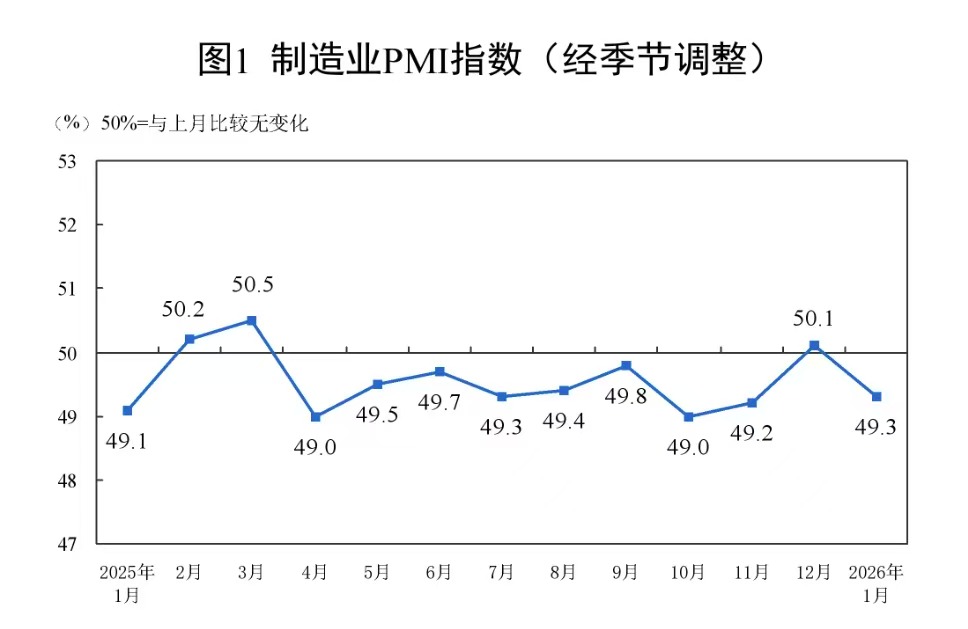
国家统计局:1月份中国采购经理指数有所回落
Yang Shi Wang· 2026-01-31 01:44
(五)企业预期保持乐观。生产经营活动预期指数为52.6%,继续高于临界点。从行业看,农副食品加 工、食品及酒饮料精制茶等行业生产经营活动预期指数连续两个月位于56.0%以上较高景气区间,相关 企业对近期行业发展信心较强。 央视网消息:据国家统计局网站消息,2026年1月31日国家统计局服务业调查中心和中国物流与采购联 合会发布了中国采购经理指数。对此,国家统计局服务业调查中心首席统计师霍丽慧进行了解读。 1月份,制造业采购经理指数、非制造业商务活动指数和综合PMI产出指数分别为49.3%、49.4%和 49.8%,比上月下降0.8个、0.8个和0.9个百分点,经济景气水平有所回落。 一、制造业采购经理指数有所下降,生产继续保持扩张 1月份,部分制造业行业进入传统淡季,加之市场有效需求仍显不足,制造业PMI为49.3%,景气水平较 上月下降。 (一)企业生产继续扩张。生产指数为50.6%,高于临界点,制造业生产保持扩张;新订单指数为 49.2%,市场需求有所回落。从行业看,农副食品加工、铁路船舶航空航天设备等行业生产指数和新订 单指数均高于56.0%,产需释放较快;石油煤炭及其他燃料加工、汽车等行业两个指数均低 ...
国家统计局:2026年1月份非制造业PMI为49.4%,比上月下降0.8个百分点
Guo Jia Tong Ji Ju· 2026-01-31 01:39
1月份,非制造业商务活动指数为49.4%,比上月下降0.8个百分点。分行业看,建筑业商务活动指数为 48.8%,比上月下降4.0个百分点;服务业商务活动指数为49.5%,比上月下降0.2个百分点。从服务业行 业看,货币金融服务、资本市场服务、保险等行业商务活动指数均高于65.0%;批发、住宿、房地产等 行业商务活动指数均低于临界点。 资讯编辑:费斐 021-26093397 资讯监督:乐卫扬 021-26093827 资讯投诉:陈跃进 021-26093100 免责声明:Mysteel发布的原创及转载内容,仅供客户参考,不作为决策建议。原创内容版权归Mysteel所有,转载需取得Mysteel书面授 权,且Mysteel保留对任何侵权行为和有悖原创内容原意的引用行为进行追究的权利。转载内容来源于网络,目的在于传递更多信息,方 便学习与交流,并不代表Mysteel赞同其观点及对其真实性、完整性负责。 ...
国家统计局服务业调查中心首席统计师霍丽慧解读2026年1月中国采购经理指数
Guo Jia Tong Ji Ju· 2026-01-31 01:35
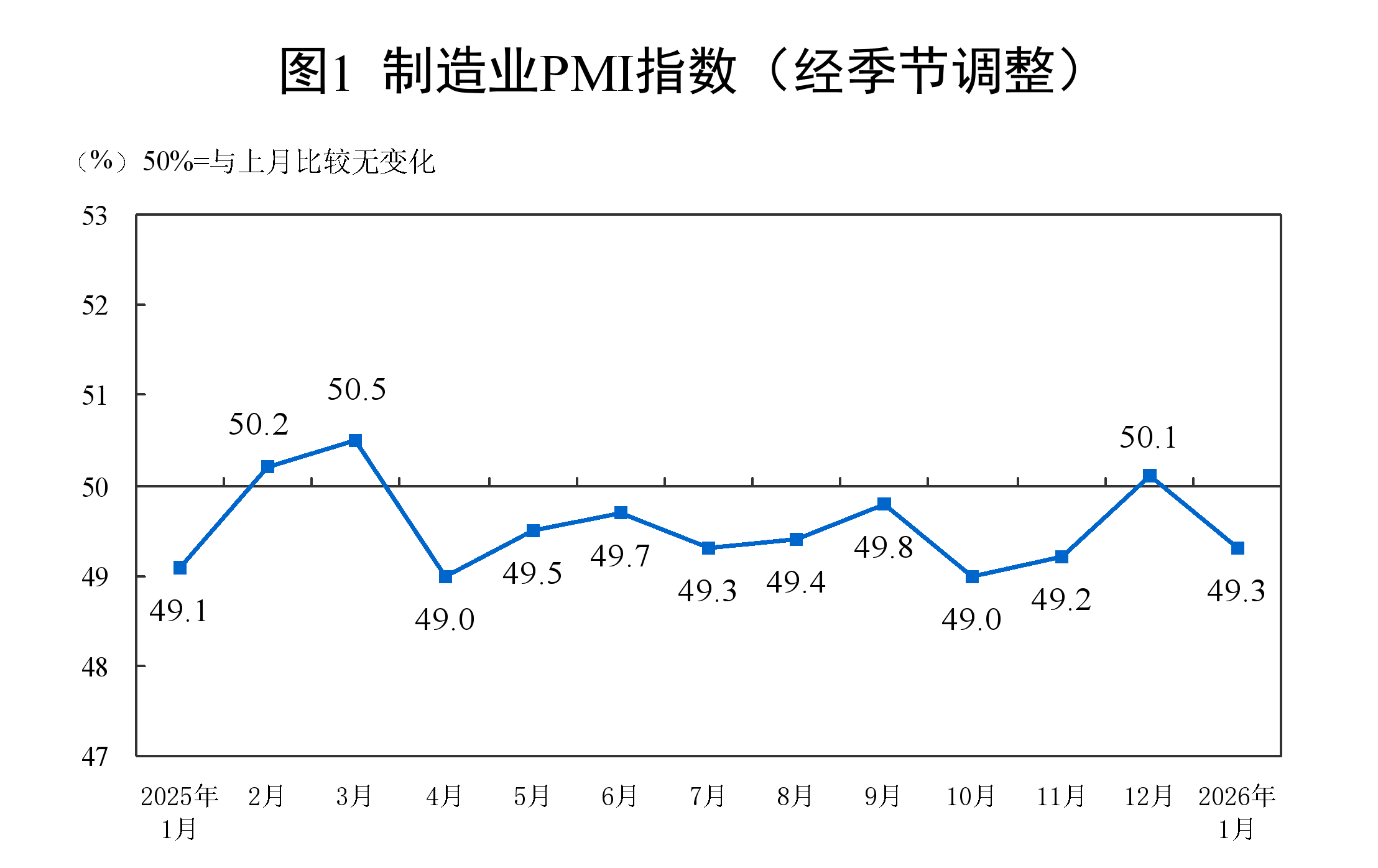
——国家统计局服务业调查中心首席统计师霍丽慧解读2026年1月中国采购经理指数 2026年1月31日国家统计局服务业调查中心和中国物流与采购联合会发布了中国采购经理指数。对此, 国家统计局服务业调查中心首席统计师霍丽慧进行了解读。 1月份,制造业采购经理指数、非制造业商务活动指数和综合PMI产出指数分别为49.3%、49.4%和 49.8%,比上月下降0.8个、0.8个和0.9个百分点,经济景气水平有所回落。 一、制造业采购经理指数有所下降,生产继续保持扩张 1月份,部分制造业行业进入传统淡季,加之市场有效需求仍显不足,制造业PMI为49.3%,景气水平较 上月下降。 (一)企业生产继续扩张。生产指数为50.6%,高于临界点,制造业生产保持扩张;新订单指数为49.2%, 市场需求有所回落。从行业看,农副食品加工、铁路船舶航空航天设备等行业生产指数和新订单指数均 高于56.0%,产需释放较快;石油煤炭及其他燃料加工、汽车等行业两个指数均低于临界点,相关行业 市场需求放缓,企业生产有所回落。 1月份中国采购经理指数有所回落 (四)高技术制造业持续领跑。高技术制造业PMI为52.0%,连续两个月位于52.0%及以上 ...
2026年1月中国采购经理指数运行情况
Guo Jia Tong Ji Ju· 2026-01-31 01:32
国家统计局服务业调查中心 中国物流与采购联合会 一、中国制造业采购经理指数运行情况 1月份,制造业采购经理指数(PMI)为49.3%,比上月下降0.8个百分点,制造业景气水平有所回落。 从企业规模看,大型企业PMI为50.3%,比上月下降0.5个百分点,仍高于临界点;中、小型企业PMI分别为48.7%和47.4%,比上月下降1.1个和1.2个百分 点,低于临界点。 从分类指数看,在构成制造业PMI的5个分类指数中,生产指数和供应商配送时间指数均高于临界点,新订单指数、原材料库存指数和从业人员指数均低于 临界点。 生产指数为50.6%,比上月下降1.1个百分点,仍高于临界点,表明制造业生产活动保持扩张。 新订单指数为49.2%,比上月下降1.6个百分点,表明制造业市场需求有所放缓。 原材料库存指数为47.4%,比上月下降0.4个百分点,表明制造业主要原材料库存量继续减少。 从业人员指数为48.1%,比上月下降0.1个百分点,表明制造业企业用工景气度略有回落。 供应商配送时间指数为50.1%,比上月下降0.1个百分点,仍高于临界点,表明制造业原材料供应商交货时间持续加快。 表1 中国制造业PMI及构成指数(经季节 ...
乌兹别克斯坦未观测经济规模降至400亿美元以下
Shang Wu Bu Wang Zhan· 2026-01-30 15:02
Core Insights - The unobserved economy in Uzbekistan is projected to decrease to 498.04 trillion soums (approximately 39.62 billion USD) in 2025, a reduction of 7.6 trillion soums (63 million USD) compared to 2024, with its GDP share dropping from 34.8% in 2024 to 26.9% in 2025 [1] Economic Composition - The unobserved economy consists of the informal economy and the shadow economy, with the informal economy accounting for 351.04 trillion soums (291.4 million USD), representing 19% of GDP (down from 26.4% in 2024) [1] - The shadow economy is valued at 147 trillion soums (122 million USD), making up 7.9% of GDP (a slight decrease from 8.4% in 2024) [1] Sector Distribution - The agricultural, forestry, and fishing sectors dominate the unobserved economy, comprising 62.6%, followed by the service sector at 26.9%, construction at 23.5%, and industry at 9.4% [1] - The most significant declines in the unobserved economy are concentrated in the service and construction sectors [1]
GDP同比增长3.8%,中山发布2025年经济运行简况
Nan Fang Du Shi Bao· 2026-01-30 07:37
2026年1月30日,中山市统计局公布中山市2025年经济运行简况,中山市经济运行总体平稳。 社会消费品零售总额 同比增长3.4% 固定资产投资承压运行。2025年中山市固定资产投资同比下降22.6%。工业投资同比下降14.6%,占固 定资产投资的比重升至49.4%,其中工业技术改造投资下降15.3%,占比升至19.4%;先进制造业投资下 降27.0%;高技术制造业投资下降22.6%。基础设施投资同比下降26.0%。房地产开发投资同比下降 30.5%。 消费市场保持增长。2025年中山市社会消费品零售总额同比增长3.4%。限额以上单位主要零售商品类 别中,家用电器和音像器材类,通讯器材类,粮油、食品类增长较快,零售额增速分别为78.2%、 61.1%、16.0%。网络零售持续活跃,限额以上单位通过公共网络实现商品零售同比增长56.8%。 根据广东省地区生产总值统一核算结果,2025年中山市地区生产总值4260.56亿元,按不变价格计算, 同比增长3.8%。其中,第一产业增加值98.18亿元,增长6.3%;第二产业增加值2189.06亿元,增长 3.9%;第三产业增加值1973.32亿元,增长3.6%。 规模以 ...

2026年2月报:全球货币分化,国内宏观强韧性-20260130
Bao Cheng Qi Huo· 2026-01-30 01:42
期货研究报告 投资咨询业务资格:证监许可【2011】1778 号 专业研究·创造价值 2026 年 2 月报 宏观 全球货币分化,国内宏观强韧性 核心观点 美国方面,制造业与服务业继续分化,服务业强韧性支撑美国 宏观基本面。通胀表现温和,就业数据也有所修复,美联储降息节 奏放缓,美债收益率有所回升。后续主要关注就业数据的持续改善 情况以及特朗普对美联储的政治施压情况。欧洲方面,欧元区核心 通胀指标与 2%的目标一致,欧洲央行降息节奏放缓,未来需要重点 关注内部欧洲地区薪资增速以及外部贸易与地缘政治局势的情况。 日本方面,随着通胀增速放缓,1 月份日本央行宣布维持政策利率 不变,但上调了中长期通胀预测。不过日本政府的财政扩张政策倾 向以及财政可持续性担忧也在持续推升日债收益率。日本央行加息 放缓很大程度上是为了保持债市稳定,但是相应地日元汇率端将明 显承压,后续需要关注日本官方对日元的干预情况 12 月宏观经济数据呈现较强韧性:制造业 PMI 重回扩张区间, CPI 温和回升,PPI 跌幅收窄,新增企业信贷数据有所改善。不过内 需有效需求不足的问题仍存,具体表现在居民端,新增居民信贷数 据表现较弱。1 月 15 ...