
饮料

Search documents
可口可乐公司第三季度营收124.55亿美元,加大在华投资
Bei Ke Cai Jing· 2025-10-22 03:39
Core Insights - Coca-Cola reported a 5% increase in Q3 revenue to $12.455 billion, exceeding market expectations of $12.41 billion, with organic revenue growth of 6% and a net profit of $3.683 billion, up 29% [1][2] Financial Performance - Global unit case volume increased by 1% [1] - Flagship brand Coca-Cola saw a 1% increase in global sales, driven by markets in Europe, the Middle East, Africa, and Asia-Pacific [1] - Sales of Coca-Cola Zero Sugar grew by 14% globally [1] - Bottled water, sports drinks, coffee, and tea all experienced a 3% global sales increase, with bottled water and sports drinks each growing by 3%, and coffee and tea growing by 2% [1] Market Strategy - Coca-Cola is increasing investments in the Chinese market, having upgraded five production bases over the past three years [1] - The company is enhancing its supply chain network in China through partnerships, focusing on three major regions: the West, Central Plains, and Coastal areas [2] - New production facilities in Shaanxi and Zhengzhou have commenced operations [2] Future Outlook - Coca-Cola expects organic revenue growth of 5% to 6% for the full year 2025, consistent with previous guidance [1] - The company anticipates a non-GAAP earnings per share growth of approximately 3%, up from the earlier forecast of 2%-3% [1] - CEO James Quincey expressed confidence in achieving the 2025 performance goals while working towards longer-term objectives [2]

可口可乐:"散装肥宅水",喝出稳稳的幸福?
3 6 Ke· 2025-10-22 02:44
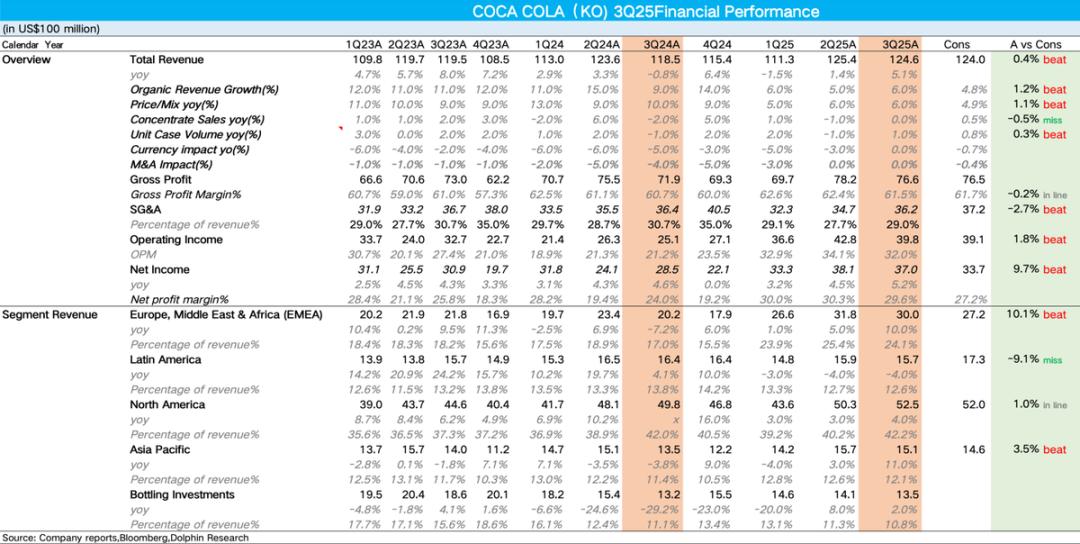
Core Viewpoint - Coca-Cola reported a strong Q3 2025 performance, with total revenue of $12.46 billion, a year-on-year increase of 5.1%, slightly exceeding market expectations [2][6][14] Revenue Performance - The company achieved organic revenue growth of 6%, marking a recovery from previous negative growth, driven by the introduction of smaller, lower-priced packaging and eco-friendly options [2][14] - Concentrate sales remained flat year-on-year, while prices increased by 6%, highlighting the importance of high-priced products in the company's growth strategy [2][28] Regional Performance - The Asia-Pacific region showed significant growth, with a 7% increase in revenue, primarily due to enhanced freezer placements in China [3][18] - North America generated $5.25 billion in revenue, a 4% increase, with strong performance in water and sports drinks, despite a weaker carbonated beverage market [17] - EMEA region revenue grew by 10% to $3 billion, benefiting from tourism and outdoor consumption [17] - Latin America faced challenges with a 4% decline in revenue, impacted by macroeconomic factors [17] Product Category Insights - Sugar-free cola experienced a remarkable 14% growth, continuing a trend of double-digit increases for five consecutive quarters, significantly outpacing classic cola [3][22] - Health-related products, including ready-to-drink tea and sports drinks, performed well, exceeding industry averages [3][22] Profitability Metrics - Gross margin improved by 0.8 percentage points to 61.5%, supported by lower raw material costs and an enhanced product mix [4][32] - Operating efficiency was boosted by AI applications across various processes, leading to a slight decrease in overall expense ratio to 29% [4][32] Future Guidance - The company expects to achieve organic growth of 5%-6% for the full year 2025, consistent with previous forecasts [5]

可口可乐公司2025Q3营收增长5%,净利润增长29%
Xin Lang Cai Jing· 2025-10-22 02:34
Financial Performance - Coca-Cola reported Q3 2025 revenue growth of 5% to $12.455 billion, exceeding market expectations of $12.41 billion, with organic revenue growth of 6% [1] - Net profit reached $3.683 billion, a 29% increase, and earnings per share (non-GAAP) were $0.82, up 6%, surpassing the expected $0.78 [1] - Global unit case volume increased by 1%, with flagship brand Coca-Cola's volume growing by 1%, driven mainly by markets in Europe, the Middle East, Africa, and Asia-Pacific [1] Product Performance - Sugar-free Coca-Cola saw a global volume increase of 14% [1] - Bottled water, sports drinks, coffee, and tea also experienced a global volume growth of 3%, while coffee and tea grew by 2% [1] Strategic Outlook - The company reaffirmed its 2025 performance guidance, expecting comparable currency-neutral earnings per share growth of approximately 8%, up from a previous estimate of 7%-9% [1] - Coca-Cola anticipates organic revenue growth of 5% to 6% for the full year 2025, consistent with prior expectations [1] Innovation and Marketing - Coca-Cola China focuses on consumer-centric strategies, enhancing brand experiences through collaborations and innovative marketing [3][6] - The "Sugar-free Coca-Cola" "全民代言" AI interactive campaign won a gold award at the Shanghai International Advertising Festival, showcasing successful marketing innovation [8] Supply Chain and Investment - Coca-Cola China is upgrading its supply chain across three major regions to meet growing consumer demand, with significant investments in production facilities [8][9] - New production facilities in Shaanxi and Zhengzhou are equipped with advanced digital production lines and sustainable practices, enhancing operational efficiency [8][9][13] Community Engagement - Coca-Cola China launched the "净水24小时" emergency response initiative, providing 28.15 million bottles of drinking water to over 3.26 million people during natural disasters [13]
股指期货将震荡整理,黄金、白银期货将震荡偏弱,焦煤、原油期货将偏强震荡,铜、豆粕期货将偏弱震荡
Guo Tai Jun An Qi Huo· 2025-10-22 02:26
Report Industry Investment Rating No relevant content provided. Core View of the Report Through macro - fundamental analysis and technical analysis, the report predicts the trend of various futures contracts on October 22, 2025, including the expected performance of stock index futures, bond futures, precious metal futures, and commodity futures [2]. Summary by Related Catalogs 1. Macro News and Trading Tips - Trump plans to visit China early next year, and the Chinese Foreign Ministry has no specific information to provide [7]. - Chinese Commerce Minister Wang Wentao held video talks with EU officials and had a phone call with the Dutch economic minister, discussing issues such as export controls and the global supply chain [7]. - The Ministry of Commerce held a policy - interpretation round - table for foreign - funded enterprises, emphasizing the importance of export controls and the stability of the global supply chain [7]. - In the first three quarters, domestic tourism increased by 18% in terms of the number of travelers and 11.5% in terms of spending [8]. - European leaders support a cease - fire negotiation in the Russia - Ukraine conflict [8]. - Japan's new Prime Minister, Kōichi Kanasugi, is considering a supplementary budget to address rising prices [8]. - The net financial assets of EU member states have declined [8]. - On October 21, precious metals tumbled, oil prices rose, London base metals mostly increased, the yuan strengthened against the dollar, and the dollar index rose [8][9][10]. 2. Futures Market Analysis and Forecast Stock Index Futures - On October 21, IF2512, IH2512, IC2512, and IM2512 all showed an upward trend, but failed to break through key resistance levels [11][12]. - The A - share market rose strongly on October 21, with over 4600 stocks rising, and the trading volume increased [13]. - Hong Kong stocks rose on October 21, while US stocks were mixed, and European stocks rose slightly [14][15]. - From April to September, investor leverage increased by 32.4%, which may be a risky entry point [15]. - It is expected that in October 2025, IF, IH, IC, and IM will have a wide - range and mostly weak oscillation. On October 22, they will oscillate and consolidate [15][17]. Bond Futures - On October 21, the ten - year and thirty - year bond futures had a slight upward trend, with the central bank conducting reverse repurchase operations and a net capital injection [34]. - It is expected that on October 22, the ten - year and thirty - year bond futures will have a wide - range oscillation [36][40]. Precious Metal Futures - On October 21, the gold futures rose during the day but fell sharply at night. It is expected that in October 2025, it will oscillate strongly and break new highs, and on October 22, it will oscillate weakly [40][41][42]. - On October 21, the silver futures rose during the day but fell at night. It is expected that in October 2025, it will oscillate strongly and break new highs, and on October 22, it will oscillate weakly [49][50]. Commodity Futures - On October 21, copper futures rose slightly, and it is expected that in October 2025, it will oscillate strongly, and on October 22, it will oscillate weakly [53]. - On October 21, aluminum futures rose slightly, and it is expected that in October 2025, it will oscillate strongly, and on October 22, it will oscillate and consolidate [59][60]. - On October 21, alumina futures fell slightly, and it is expected that in October 2025, it will oscillate weakly, and on October 22, it will oscillate strongly [63]. - On October 21, rebar futures rose slightly, and it is expected that in October 2025, it will oscillate widely, and on October 22, it will oscillate and consolidate [67]. - On October 21, hot - rolled coil futures rose slightly, and it is expected that on October 22, it will oscillate and consolidate [70]. - On October 21, iron ore futures rose slightly, and it is expected that in October 2025, it will oscillate widely, and on October 22, it will oscillate strongly [74]. - On October 21, coking coal futures fell, and it is expected that in October 2025, it will oscillate strongly, and on October 22, it will oscillate strongly [78][79]. - On October 21, glass futures fell, and it is expected that in October 2025, it will oscillate weakly, and on October 22, it will oscillate widely [82]. - On October 21, soda ash futures fell, and it is expected that in October 2025, it will oscillate weakly, and on October 22, it will oscillate strongly [86]. - On October 21, crude oil futures rose slightly, and it is expected that in October 2025, it will oscillate weakly, and on October 22, it will oscillate strongly [90]. - On October 21, PTA futures rose slightly, and it is expected that on October 22, it will oscillate strongly [95][96]. - On October 21, methanol futures rose slightly, and it is expected that on October 22, it will oscillate weakly [98]. - On October 21, soybean meal futures fell slightly, and it is expected that on October 22, it will oscillate weakly [101].
可口可乐10月起分阶段在美国推出玻璃瓶甘蔗糖可乐
Bei Jing Shang Bao· 2025-10-22 02:21
北京商报讯(记者 孔文燮)10月21日,可口可乐宣布,开启分阶段行动,在美国推出甘蔗糖可乐。此 次推出的甘蔗糖可乐,将采用玻璃瓶装进行销售。 ...
可口可乐三季度营收增长5%
Bei Jing Shang Bao· 2025-10-22 02:20
Core Insights - Coca-Cola's Q3 revenue increased by 5% year-over-year to $12.455 billion, driven by product price increases [1] - Net profit rose by 29% to $3.683 billion, with organic revenue growth of 6% reaching $12.41 billion [1] - Global unit case volume grew by 1%, with a notable 14% increase in the sales of Coca-Cola Zero Sugar [1] Revenue and Profit - Revenue for Q3 was $12.455 billion, reflecting a 5% increase compared to the previous year [1] - Net profit reached $3.683 billion, marking a 29% year-over-year growth [1] - Organic revenue growth was reported at 6%, totaling $12.41 billion [1] Sales Performance - Global unit case volume increased by 1%, with regional variations noted [1] - North America and Latin America reported flat unit case volume, while Asia experienced a 1% decline [1] - Europe, the Middle East, and Africa saw a 4% increase in unit case volume [1] Product Pricing - The growth in performance was primarily attributed to a 6% increase in product price mix [1]
茅台生肖酒将首次推出“日期酒”,食品饮料ETF天弘(159736)连续5日获资金净流入,机构:珍惜白酒当前低位布局机会
2 1 Shi Ji Jing Ji Bao Dao· 2025-10-22 02:01
Group 1 - The three major indices opened lower, while the food and beverage sector rose, with the CSI Food and Beverage Index increasing by 0.2% [1] - Key stocks in the food and beverage sector included Keta Bio, which rose over 12%, Shuangta Food, which increased nearly 8%, and Angel Yeast, which rose nearly 2% [1] - The CSI A500 Index fell by 0.39%, with notable increases in stocks such as Robotech, which rose nearly 5%, and Fihua, which increased over 4% [1] Group 2 - The Tianhong Food and Beverage ETF (159736) experienced a net inflow of 50.69 million yuan over five consecutive trading days, with a total circulation of 7.768 billion shares and a market size of 5.599 billion yuan [1] - The Tianhong A500 ETF (159360) saw a decline of 0.32%, with a circulation of 1.388 billion shares and a market size of 1.714 billion yuan [1] Group 3 - Yanjing Beer reported a third-quarter revenue of 13.433 billion yuan, a year-on-year increase of 4.57%, and a net profit of 1.770 billion yuan, up 37.45% year-on-year [1] Group 4 - The iMoutai APP announced that consumers can purchase the 53% vol 500ml Guizhou Moutai liquor without a reservation starting October 20, with limited quantities available [2] - According to feedback, the market for Moutai liquor remained stable from June to August, with a significant recovery in sales in September [2] - During the double festival period, overall white liquor sales declined by 20%-30%, with regional variations noted, particularly in traditional consumption provinces [2] - High-end liquor brands performed relatively well, with stable sales for Moutai 1935 and other premium products [2] - The domestic economy is expected to gradually stabilize, suggesting a potential return to high growth for the white liquor industry [2] Group 5 - The Tianhong Food and Beverage ETF closely tracks the CSI Food and Beverage Index, which selects stocks from the beverage, packaged food, and meat industries [3] - The top holdings in the Tianhong Food and Beverage ETF include major companies like Guizhou Moutai, Yili, Wuliangye, and others [3] - The Tianhong A500 ETF tracks the CSI A500 Index, which includes 500 large-cap, liquid securities from various industries [3]


10.22犀牛财经早报:A股三季报超七成已披露公司报喜 存储芯片“超级周期”来临
Xi Niu Cai Jing· 2025-10-22 01:36
Group 1 - Over 70% of A-share companies that have disclosed Q3 reports reported profit growth, with 254 out of 360 companies showing a year-on-year increase in net profit, particularly in the electronics, basic chemicals, automotive, power equipment, and machinery sectors [1] - 843 A-share companies announced a total of 6620.26 billion yuan in mid-term dividends, with 595 already implemented and 255 pending [1] - The storage chip market is experiencing a "super cycle," driven by AI and increasing demand for data storage, with price increases expected to continue until 2026 [2] Group 2 - The price of lithium hexafluorophosphate has surged by 44% since September 15, driven by strong demand recovery and supply constraints, while the utilization rate of lithium iron phosphate production has reached 73.46% [3] - Goldman Sachs predicts a slow bull market in the Chinese stock market, with key indices expected to rise by about 30% by the end of 2027, driven by profit growth and revaluation potential [4] - The insurance asset management sector has seen 92.7% of products achieve positive returns this year, with equity products averaging a return of 28% [2] Group 3 - Leju Robotics completed a Pre-IPO financing round of 1.5 billion yuan, with plans for an IPO underway [9] - Wens Foodstuff Group reported a 65.02% year-on-year decline in net profit for Q3, with total revenue down by 9.76% [10] - Poly Developments reported a 75.31% year-on-year decline in net profit for the first three quarters, despite a 30.65% increase in Q3 revenue [10]


突发!金价银价,闪崩!
中国能源报· 2025-10-22 01:25
Group 1: Market Overview - US stock investors are cautious amid global trade uncertainties, with technology and small-cap stocks under pressure [1] - Major companies like 3M and Coca-Cola reported strong earnings, boosting the Dow Jones, which closed at a record high [1] - The three major US stock indices had mixed results, with the Dow up 0.47%, S&P 500 slightly up 0.003%, and Nasdaq down 0.16% [1] Group 2: Commodity Prices - Gold prices fell significantly due to reduced market demand for safe-haven assets and profit-taking ahead of the US CPI data release [5] - As of the close, December gold futures were at $4109.1 per ounce, down 5.74%, while December silver futures were at $47.70 per ounce, down 7.16% [5] - Oil prices increased as US crude oil inventories fell by approximately 2.98 million barrels, easing concerns about weak demand [7] - Light crude oil futures for November closed at $57.82 per barrel, up 0.52%, and Brent crude for December closed at $61.32 per barrel, up 0.51% [7] Group 3: Company Earnings - Coca-Cola's Q3 2025 earnings showed a significant net profit increase of 30% to $3.69 billion, driven by a 6% rise in product pricing [10] - Despite the positive earnings, Coca-Cola reported zero growth in sales in key markets like North America and Latin America, indicating potential demand weakness [10] - General Motors' Q3 2025 adjusted EBIT fell 18% year-over-year, but the results were better than analysts feared, leading to a stock price increase of 14.86% [10] - GM plans to pass on more cost pressures to consumers through price increases and has adjusted its full-year guidance positively [10] Group 4: European Market Performance - European stock indices collectively rose, driven by gains in defense stocks, with the UK up 0.25%, France up 0.64%, and Germany up 0.29% [12] - The French CAC40 index reached a record closing high [12]


深夜突发,崩了!
Zhong Guo Ji Jin Bao· 2025-10-22 00:55
Market Overview - The Dow Jones Industrial Average reached a new high, driven by optimistic earnings reports from key components like General Motors, Coca-Cola, and 3M [1][6] - The Nasdaq index experienced a slight decline, while the S&P 500 remained flat [1] Technology Sector - Major tech stocks showed mixed performance ahead of earnings reports, with Amazon rising by 2.56% while Google, Tesla, and Nvidia saw declines [2] - Market strategist Anthony Saglimbene noted that if the tech giants meet elevated profit expectations, it could lead to further market gains [2] Gold Market - International gold prices saw a significant drop, with COMEX gold falling by 5.39%, leading to a widespread decline in gold stocks [3] - Notable declines included AngloGold down 11.38% and Barrick Gold down 9.27% [3] Company Earnings - Netflix reported Q3 revenue of $11.51 billion, a 17.2% increase year-over-year, but fell short of analyst expectations, resulting in a post-earnings drop of over 6% [4][5] - Coca-Cola's Q3 revenue grew by 5% to $12.455 billion, with net profit increasing by 29%, leading to a 4.11% rise in stock price [5] - General Motors' stock surged nearly 15% after raising its full-year adjusted core profit forecast to between $12 billion and $13 billion, with Q3 adjusted EPS at $2.80, exceeding market expectations [6] Chinese Stocks - The Nasdaq Golden Dragon China Index fell by 0.97%, with notable declines in Alibaba and NIO, while some stocks like Bilibili and New Oriental saw gains [7]