家电

Search documents
北京:优化实施机制 持续推动汽车、家电等大宗商品消费增长
Xin Lang Cai Jing· 2026-01-16 04:41
观点网讯:1月16日,北京市发改委综合处处长王育玲表示,对于市民关心的"以旧换新",今年本市将 主动对接国家新一轮以旧换新政策举措,优化实施机制,持续推动汽车、家电等大宗商品消费增长。开 年时刻历来是扩大投资的关键时间点。 免责声明:本文内容与数据由观点根据公开信息整理,不构成投资建议,使用前请核实。 市发改委投资处处长王丹丽透露,一季度,本市将坚持投资于物和投资于人紧密结合,加快建设和储备 重大项目,做好各类要素保障,持续扩大有效投资。按照计划,1月底前本市将发布全年供地计划,力 争一季度集中供应一批优质地块,春节前下达40%的市政府固定资产项目建设资金,2月底前发行首批 地方政府专项债券。1月底前还将形成城市更新储备项目和攻坚项目清单,推动建筑指标统筹、功能混 合和复合利用、优化土地续期和房屋租期等创新政策集成落地。 ...
“以旧换新”政策、多种补贴等举措全力激发消费新活力 节前市场“红红火火”
Yang Shi Wang· 2026-01-16 03:15
Group 1: Ningxia's "Old for New" Policy - Ningxia has officially implemented the "Old for New" policy for automobiles and home appliances in 2026, leading to increased consumer demand for these products [1] - The policy features a precise implementation method, with subsidies for scrapping and updating vehicles requiring qualification through the "My Ningxia" app, and a lottery system for vehicle replacement subsidies [1] - Consumers purchasing new energy vehicles can receive a subsidy of up to 12% of the vehicle price, capped at 20,000 yuan, while those buying fuel vehicles with an engine size of 2.0 liters or less can receive up to 10%, capped at 15,000 yuan [1] Group 2: Home Appliance Subsidies - The subsidy scope for home appliances has been expanded to include digital and smart products, utilizing an online consumption voucher system that provides a 15% discount on the selling price for traditional appliances and digital products [3] - The first phase of the automobile "Old for New" program saw over 7,600 registrations, with 4,226 winners selected through a lottery, and over 6,300 transactions for home appliances and digital products, directly driving consumption of 31.9 million yuan [5] Group 3: Consumption Trends in Anhui - In Anhui's Linquan County, various subsidies have stimulated pre-holiday consumption, with government-issued consumption vouchers being used to reduce prices on digital products [6] - The recent week has seen a rise in sales of digital products due to the application of national consumption vouchers [8] - The county has achieved full e-commerce coverage across 406 administrative villages, enabling same-day delivery of home appliances to rural households [10] Group 4: Quality and Smart Product Trends - The pre-holiday consumption in Linquan County shows a clear trend towards quality and smart products, with consumers shifting from traditional goods to various smart products [12] - The local government is enhancing supply chains and optimizing product offerings to quickly adapt popular smart products from urban areas to rural households, stimulating potential demand for consumption upgrades [12] Group 5: Guangdong's Consumption Promotion - Guangdong Province has launched the "Guangdong Goods Go Global" spring consumption promotion activity, aiming to invigorate consumer spending through online and offline collaboration [13] - The first promotional event for home appliances took place in Foshan, showcasing hundreds of companies with AI appliances, energy-saving products, and smart kitchen devices [13] - In the first quarter of this year, Guangdong plans to hold 12 promotional events, involving over 6,000 enterprises and more than 10 major commercial platforms [15]


邓庆旭对话贾少谦:恪守质量信仰,做快时代中的坚守者
Xin Lang Cai Jing· 2026-01-16 02:55
Core Viewpoint - The fundamental principle for a manufacturing enterprise, regardless of market cycles, is to prioritize quality as its core value [1][11]. Group 1: Company Development and Strategy - Hisense has shown steady growth over the past year, showcasing its latest World Cup customized products at CES, emphasizing "AI technology" and its advancements in artificial intelligence and smart hardware [1][11]. - The company has a long-standing commitment to quality, which is deeply embedded in its corporate philosophy and operational practices [3][14]. - Hisense's development strategy has evolved to include high technology, high quality, and high-level service since the maturation of the Chinese market economy in 1993 [3][13]. Group 2: Quality Management Philosophy - Hisense maintains a zero-tolerance policy towards quality issues, believing that even a 0.01% defect rate can lead to a complete failure for affected customers [3][13]. - The company has institutionalized its quality philosophy into what is known as the "Seven Military Regulations" for quality management [3][13]. - Quality is viewed as a moral obligation and a core value that cannot be overlooked, as stated by the chairman [4][18]. Group 3: Technological Innovation and R&D - Hisense has invested significantly in chip technology, being the only domestic home appliance company involved in research across various semiconductor fields [4][15]. - The RGB-Mini LED technology represents a breakthrough in display technology, requiring advanced capabilities in both RGB lighting and image quality control [5][15]. - The development of the "Xinxin" chip in 2005 marked a milestone for Hisense, enabling the company to lead in display technology [15]. Group 4: Digital Quality Management - Hisense is implementing a digital quality management system that leverages AI and machine vision for real-time monitoring and anomaly detection, shifting from post-production checks to proactive quality control [7][17]. - The company has established a digital framework that integrates research, supply chain, quality improvement, and carbon management, addressing traditional traceability challenges [6][16]. - Hisense's Qingdao factory has been recognized as a "lighthouse factory," showcasing its advanced AI-driven quality control processes that have improved detection efficiency by 70.7% [7][17]. Group 5: Global Brand Positioning - As a global sponsor for the upcoming 2026 World Cup, Hisense aims to enhance its brand visibility and trust through high-quality products showcased at major sporting events [9][19]. - The company emphasizes that quality is essential for brand strength and global competitiveness, committing to further integrate AI into its quality ecosystem [8][18]. - Hisense's approach to manufacturing focuses on long-term foundational values, ensuring that quality remains a priority in all aspects of its operations [10][19].

广东启动“广货行天下”春季行动,家电打头阵
Zhong Guo Xin Wen Wang· 2026-01-16 02:54
Group 1 - The "Guangdong Products Going Global" spring action was launched on January 15 in Foshan, marking the beginning of the 2026 promotional activities for Guangdong products [1] - The spring action covers 12 major categories including home appliances, mobile phones, clothing, food, smart terminals, automobiles, beauty and daily necessities, cultural tourism, and agriculture, attracting over 6,000 participating enterprises [1] - The first event focused on home appliances, featuring over 1,900 large-scale home appliance companies in Guangdong, with 55 well-known brands such as Midea, Gree, Galanz, and Hisense showcasing quality products and conducting live-stream sales [1] Group 2 - The promotional campaign is structured around a multi-layered discount system involving government subsidies, enterprise discounts, and platform support, providing consumers with various benefits including government "national subsidies," brand direct discounts, platform exclusive live prices, and consumer vouchers [2] - The Guangdong Provincial Department of Industry and Information Technology stated that the "Guangdong Products Going Global" initiative aims to enhance the market exposure and influence of high-quality industrial products from Guangdong, promoting online sales and contributing to economic stability [2] - The department plans to hold 12 online promotional events in a "one product per week" rhythm leading up to the Spring Festival, focusing on advantageous industries such as mobile phones, clothing, and food [2]


哈萨克斯坦最大城市,满街中国品牌
21世纪经济报道· 2026-01-16 02:25
Core Viewpoint - Chinese brands have established a strong presence in Kazakhstan, becoming integral to the local economy and daily life, with significant growth in trade and investment between China and Central Asia [1][2]. Group 1: Market Growth and Chinese Brand Presence - China has become Central Asia's largest trading partner, with trade volume reaching $60.7 billion from 2017 to 2024, a 1.5 times increase [1]. - By 2024, China's direct investment and loans to Central Asia are expected to exceed $24 billion, with over 9,000 Chinese companies operating in the region [1]. - Kazakhstan is emerging as a key hub for Chinese enterprises' overseas growth, with a young population and high smartphone penetration (95%) [1]. Group 2: Integration of Chinese Brands - Chinese brands, including Haier, BYD, and Xiaomi, are increasingly integrated into the daily lives of Central Asian consumers, with visible presence in various sectors [2][7]. - The automotive sector has seen rapid growth, with Chinese manufacturers' market share in Kazakhstan rising from 2% in 2020 to 38% by 2024 [8]. - In the first nine months of this year, Chinese automotive brands captured 34.5% of the market share, with local production initiated by brands like Changan and Chery [8]. Group 3: Marketing and Consumer Behavior - The shift in perception of Chinese automobiles from low-cost to reliable technology reflects a broader acceptance among Central Asian consumers [9]. - The rapid technological advancements in China provide a competitive edge, as local consumers are open to new experiences and innovations [9]. - The e-commerce market in Central Asia is projected to reach $14.7 billion in 2024, with Kazakhstan's market alone estimated at $6 billion [12]. Group 4: Challenges and Localization - Companies entering the Central Asian market must navigate complex local languages and cultural differences, as each country has unique consumer habits [13]. - The regulatory environment varies significantly across Central Asian countries, necessitating thorough market research and local partnerships to mitigate risks [14][15]. - A dual approach of utilizing mainstream e-commerce platforms and developing direct-to-consumer channels is recommended for effective market penetration [12].

热力全开 旺势十足 爆单连连
Sou Hu Cai Jing· 2026-01-16 01:43
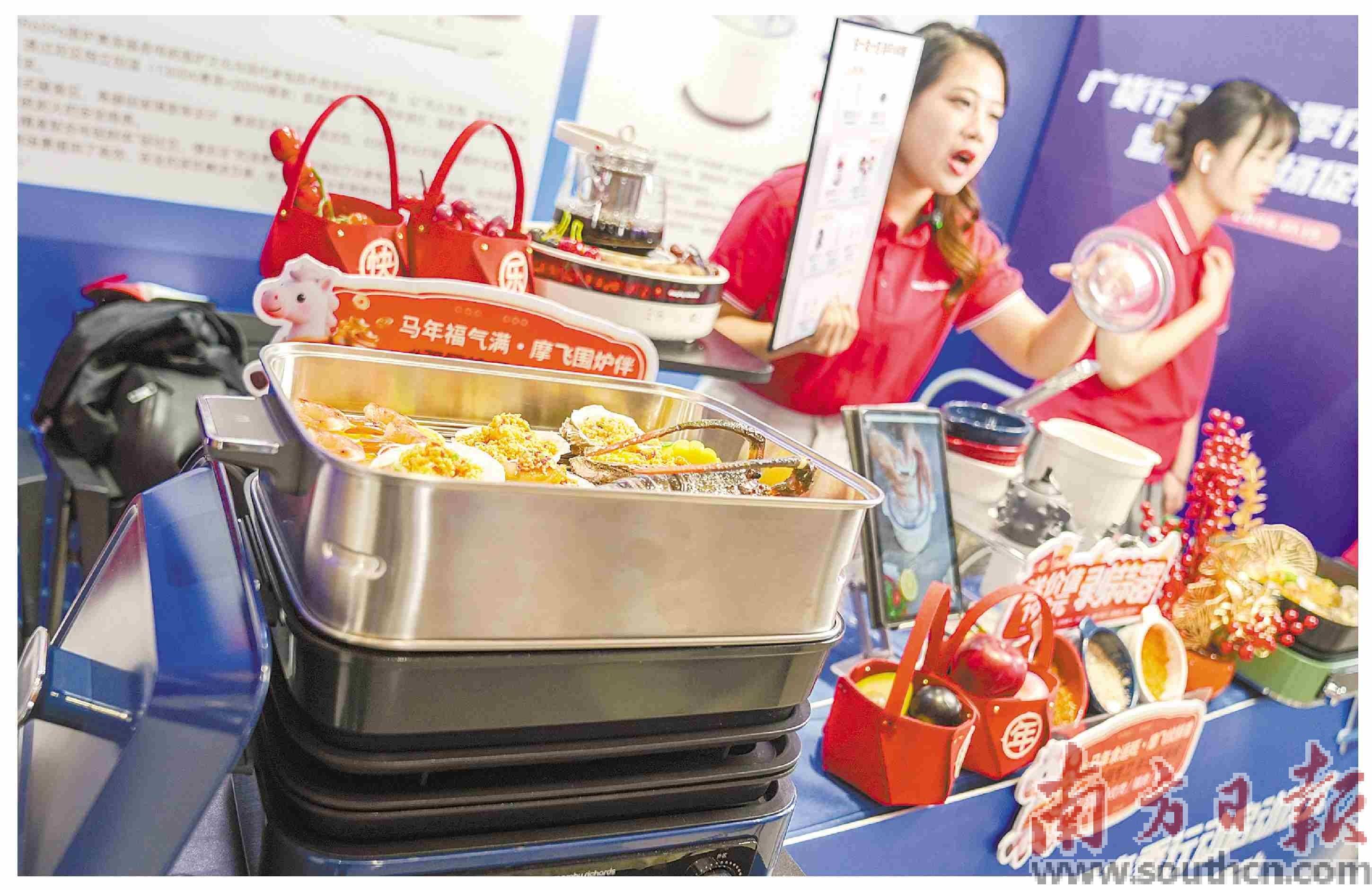
Core Insights - The "Guangdong Goods Going Global" spring campaign was launched on January 15, featuring a successful home appliance promotion event in Foshan, showcasing various Guangdong brands and products [6][11]. - The event highlighted the strong sales performance of participating companies, with significant sales recorded during live streaming sessions, indicating a robust consumer interest in Guangdong-made products [9][10][16]. Group 1: Event Overview - The spring campaign commenced with a vibrant atmosphere, featuring major Guangdong home appliance brands such as Midea, Galanz, Hisense, and Bear, showcasing innovative products at competitive prices [11][12]. - The event served as a platform for small and medium enterprises to gain visibility, with reports of high sales volumes, including over 200 units of home dryers sold by Kawa Technology and 300 units of travel dryers sold during a four-hour live stream [9][10]. Group 2: Product Highlights - Midea's low-sugar rice cooker and Galanz's multifunctional microwave were among the featured products, emphasizing their practicality and quality, which resonated well with consumers [16][17]. - The event showcased the strength of Guangdong's manufacturing capabilities, with the home appliance industry alone exceeding one trillion yuan in scale, accounting for nearly half of the national revenue and exports [17]. Group 3: Market Dynamics - The campaign leveraged various e-commerce platforms, including Douyin and major online retailers, to enhance market reach and consumer engagement, facilitating direct communication with both domestic and international consumers [14][15]. - The promotion included significant discounts, with some products seeing price reductions exceeding 20%, enhancing the appeal of Guangdong products to consumers [15][16]. Group 4: Future Prospects - The campaign is set to continue with a series of themed promotions across various product categories, aiming to showcase the innovation and quality of Guangdong goods while enhancing consumer value through multiple incentives [18]. - The integration of cultural elements and technological advancements in product design is expected to further elevate the brand image of "Guangdong Goods," making them more attractive to a global audience [18].

迅雷起诉前CEO陈磊:指控其隐秘掏空公司,追索资产2亿元;知名游戏公司发布反腐公告:3名员工涉嫌收受贿赂,已被拘留;京东成立文旅公司
雷峰网· 2026-01-16 00:36
Group 1 - Xunlei has filed a lawsuit against former CEO Chen Lei, accusing him of secretly siphoning off company funds, with the amount sought reaching 200 million yuan [4][5] - During Chen Lei's tenure, he allegedly established an external company to transfer assets and misappropriate company funds, totaling approximately 170 million yuan paid by a subsidiary [5] - The lawsuit comes after difficulties in internal anti-corruption efforts, particularly in gathering evidence against high-level management [4] Group 2 - Perfect World has announced a strict anti-corruption initiative, revealing that three employees have been detained for serious misconduct related to bribery [8][10] - The implicated employees were involved in key projects and are accused of inflating procurement prices and accepting bribes from suppliers [9][10] - The company emphasizes its commitment to legal accountability and cooperation with judicial investigations [10] Group 3 - JD.com has established a cultural tourism company, expanding its business model while emphasizing that all operations will revolve around supply chain efficiency [12] - The company aims to innovate within the tourism sector by leveraging its supply chain infrastructure and AI capabilities, rather than creating a generic OTA platform [12] - JD's strategy includes enhancing profitability for the tourism industry and tapping into the high spending potential of its JD PLUS members, which number 40 million [12] Group 4 - Ctrip is currently under investigation, with reports indicating that officials have begun interviewing employees and collecting devices for the inquiry [14] - The company has shown strong financial performance, with revenues of 47 billion yuan and a net profit of 29 billion yuan in the first three quarters of 2025, achieving a profit margin of 61.72% [14][15] - Ctrip's market position has improved significantly, ranking seventh among China's top internet companies, with a net profit of 19.9 billion yuan in Q3 2025 [14][15] Group 5 - The Step-Audio-R1.1 model from Jumpspace has topped the global rankings for native audio models, achieving a 96.4% accuracy rate [16][17] - This model is designed for real-time audio understanding and complex reasoning without additional latency, marking a significant advancement in voice technology [17] Group 6 - Gree Electric has announced a mid-year cash dividend of 5.585 billion yuan, representing a high payout ratio of approximately 38%-39% of its net profit for the first half of 2025 [32][33] - The company has maintained a consistent dividend policy over the past decade, reflecting its commitment to shareholder returns [33] Group 7 - SAIC Motor Corporation expects a net profit of 9 to 11 billion yuan for 2025, marking a substantial increase of 438% to 558% year-on-year [34] - The company reported a vehicle sales increase of 12.3% in 2025, with a record 1.643 million new energy vehicles sold, up 33.1% [34][35] Group 8 - Huawei's smartwatch market share has surpassed that of its smartphones, with over 30% of users being non-Huawei phone owners in China [36] - The company has seen a 42% year-on-year increase in smartwatch shipments, positioning it among the top five global smartwatch brands [36] Group 9 - Merge Labs, co-founded by Sam Altman, has raised $252 million for its brain-computer interface technology, aiming to connect humans and AI seamlessly [42][43] - The company plans to develop medical products initially, with a focus on enhancing human capabilities without invasive procedures [42][43]





广货行天下,不只卖产品
Xin Lang Cai Jing· 2026-01-16 00:33
Core Viewpoint - The "Guangdong Goods Going Global" spring campaign represents a collaborative effort among the government, platforms, and enterprises to transform the industrial ecosystem, moving beyond mere product sales to showcase Guangdong's manufacturing innovation and competitiveness [1][2][3] Government Role - The event is supported by six government departments, indicating a shift from merely promoting products to acting as industrial planners, aiming to elevate Guangdong manufacturing through coordinated promotional activities [1] - The campaign will span an entire season, featuring weekly promotional events and 18 series of activities around key consumption periods, demonstrating the government's proactive role in enhancing the industrial landscape [1] Platform Support - The campaign introduces an innovative "live demonstration zone," utilizing major e-commerce platforms like Taobao, JD.com, Douyin, and Pinduoduo to showcase Guangdong products and provide targeted promotional information [2] - This model combines live presentations, immediate experiences, and online sales, creating a synergistic effect that boosts short-term sales and establishes long-term consumer recognition of Guangdong products [2] Enterprise Participation - Over 6,000 enterprises are participating, driven by the desire to expand market reach and revenue, while showcasing innovative products such as AI appliances and energy-efficient devices [2] - The transition from "Guangdong manufacturing" to "Guangdong intelligent manufacturing" is highlighted, with products gaining global recognition due to their technological advancements and superior user experiences [2] Overall Significance - The "Guangdong Goods Going Global" initiative is a comprehensive system involving collaboration among government, platforms, and enterprises, aimed at promoting Guangdong products as intelligent, green, and open to the world [3] - This initiative is positioned as a crucial pathway for Guangdong manufacturing to achieve high-quality development and establish itself as a global leader in intelligent manufacturing [3]
家电专场掀热潮
Xin Lang Cai Jing· 2026-01-16 00:33
Group 1 - The "Guangdong Goods Go Global" spring campaign was launched on January 15, featuring a home appliance promotion event in Foshan, Guangdong, aimed at boosting consumer spending through an innovative model of "live streaming + instant experience + online direct sales" [1] - Over 30 Guangdong home appliance companies, including Galanz, Midea, and Wanhe, showcased their flagship products in live streaming sessions, with Galanz achieving significant sales shortly after starting its broadcast [1] - The event highlighted the robust manufacturing ecosystem in Guangdong, which supports a complete industrial system covering 31 major categories [1] Group 2 - The campaign offered substantial consumer incentives through a combination of government subsidies, corporate discounts, and platform promotions, with government subsidies reaching up to 15% for trade-in programs [2] - Major e-commerce platforms, including Taobao, JD.com, Douyin, and others, created dedicated sections for the campaign, allowing consumers to stack discounts, with some products seeing total discounts exceeding 20% [2] - The initiative is not just a short-term promotion but aims to establish a sustainable promotional brand, with plans to extend beyond home appliances to other advantageous industrial clusters in Guangdong [2]
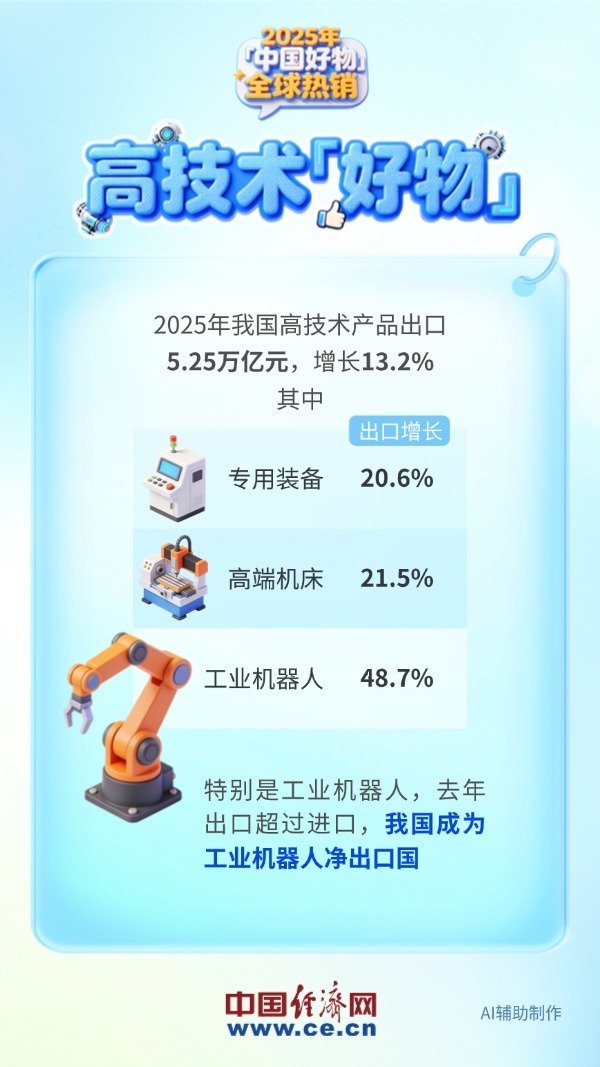
【图解】2025年出口逆势增长!“中国好物”全球热销
Zhong Guo Jing Ji Wang· 2026-01-15 23:50
Core Viewpoint - In 2025, China's exports are projected to reach 26.99 trillion yuan, representing a year-on-year growth of 6.1%, despite facing headwinds in the global market [1]. Group 1: Export Growth by Sector - Green energy exports are expected to see significant growth, with lithium batteries increasing by 26.2% and wind turbine sets by 48.7% [9]. - Electric motorcycles and bicycles are projected to grow by 18.1%, while railway electric locomotives are expected to increase by 27.1% [9]. - Industrial gas purification devices are anticipated to grow by 17.3%, and electric forklifts by 5.2% [9]. Group 2: Innovative Products and Market Expansion - Ceramic companies are integrating traditional Chinese craftsmanship with overseas cultures, leading to innovative ceramic trees becoming popular as holiday decorations abroad [5]. - Home appliance companies have developed "desert air conditioners" that can operate normally in outdoor temperatures exceeding 60 degrees Celsius, expanding their export markets [5]. - Smartwatches integrated with AI models will provide real-time health advice, while smart toys with touch sensing and contextual dialogue features are expected to sell well in over 170 countries and regions by 2025 [10]. - Robotics, including搬运 robots with visual systems and welding robots capable of optimal welding solutions, are set to excel in large-scale overseas infrastructure and transportation projects, with export growth rates exceeding 60% [10].