
房地产

Search documents
2025年12月经济数据点评:经济完成5%目标的结构性亮点与制约
Zhong Cheng Xin Guo Ji· 2026-01-23 08:10
Economic Performance - The economy achieved a growth target of 5% for 2025, with a GDP growth rate of 5.0% for the year, maintaining stability despite challenges[8] - Final consumption contributed over 52% to GDP growth, indicating effective policies to boost consumer spending[10] - Industrial production showed strong performance with an industrial added value growth rate of 5.9%, the highest in four years[10] Investment Trends - Fixed asset investment experienced a historical decline of 3.8%, marking the first annual negative growth[12] - Infrastructure investment faced challenges, with a significant drop in new special bonds allocated for infrastructure projects, totaling only 2.66 trillion yuan compared to 3.14 trillion yuan the previous year[13] - Real estate investment fell to a record low of -17.2%, reflecting ongoing weaknesses in the sector[15] Consumer Behavior - Retail sales growth for 2025 was only 3.7%, with December showing a low of 0.9%, the lowest level outside of pandemic periods[10] - Service consumption remained resilient, growing at 5.5%, supported by travel and entertainment demand during peak seasons[10] - The consumer price index (CPI) remained stable, with inflation pressures under control, indicating a manageable economic environment[4] External Factors - Export growth remained robust, with December exports exceeding expectations despite high base effects from the previous year[5] - The trade surplus reached 118.89 billion USD in December, reflecting strong external demand[24] - The economic outlook for 2026 anticipates a growth rate of around 4.8%, supported by new projects and resilient external demand[22]
杨德龙:2026年A股和港股的投资机会依然较多
Xin Lang Cai Jing· 2026-01-23 07:51
Group 1 - The market shows resilience despite recent cooling, with a "spring offensive" anticipated as credit issuance peaks in January, potentially reaching 4 trillion RMB [1][8] - The first quarter is typically a "window" for companies to disclose earnings, allowing for market momentum as most companies do not report formal earnings during this period [1][8] - The discussion around investment returns during the previous year's Spring Festival has created a "wealth effect," attracting more retail investors into the market [1][8] Group 2 - A slow bull market has been established, with investor confidence gradually increasing, and skepticism about the bull market diminishing [2][8] - By 2026, approximately 50 trillion RMB in bank deposits will mature, prompting investors to choose between low-interest renewals or reallocating funds into stocks, bonds, or funds [2][8] - This shift indicates a potential acceleration of capital moving from savings to the stock market, providing additional liquidity [2][8] Group 3 - In 2025, technology stocks are expected to outperform traditional sectors, which are struggling during the economic transition [3][9] - New industries such as AI and semiconductor sectors are thriving, while traditional industries face significant challenges [3][9] Group 4 - The market is expected to deepen in 2026, with more sectors likely to experience rotation, as many traditional stocks are at historical lows and may present investment opportunities [4][10] - Investors will need to decide between high-flying tech stocks and undervalued traditional stocks, leading to diverse investment strategies [4][10] Group 5 - The U.S. financial market is experiencing a simultaneous decline in stocks, bonds, and the dollar, raising concerns about the stability of the dollar [5][11] - The rise in gold prices, nearing $4,800 per ounce, reflects a growing distrust in the dollar, with predictions of further increases in gold prices [5][11] Group 6 - A-shares are expected to outperform Hong Kong stocks, which in turn will outperform U.S. stocks, as domestic investors seek new opportunities in the capital market [6][12] - The potential for a "golden decade" in the A-share market is supported by the shift of residential savings into capital markets [6][12]
半夏投资李蓓:很有可能两个季度内房地产市场会见底 后续是十年级别的上升周期
Jin Rong Jie· 2026-01-23 06:58
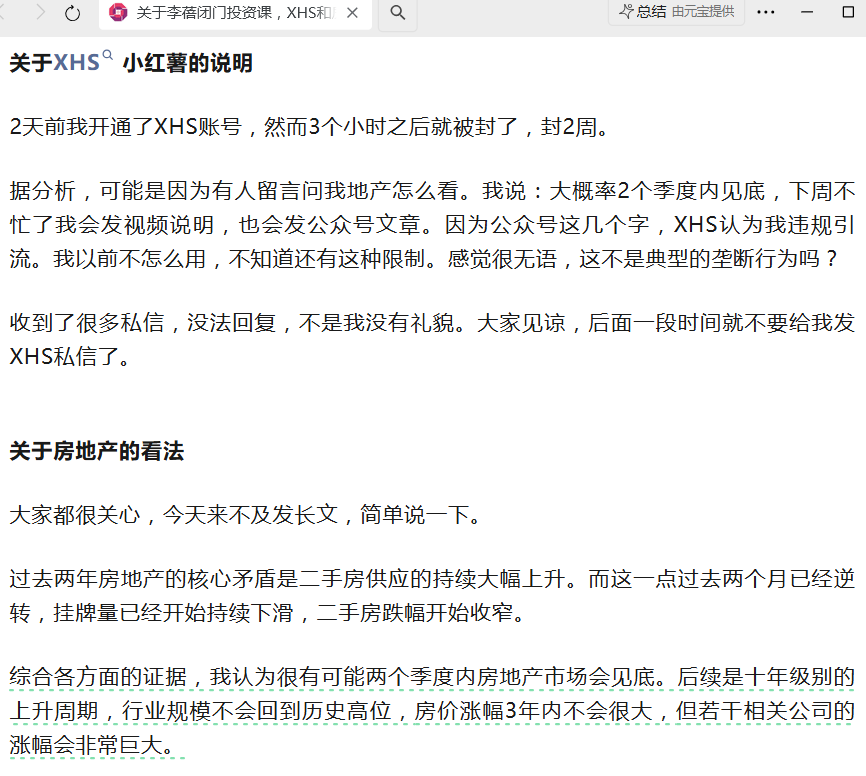
股票频道更多独家策划、专家专栏,免费查阅>> 责任编辑:栎树 1月23日,半夏投资李蓓在其公众号发表了关于房地产的看法。李蓓认为,过去两年房地产的核心矛盾 是二手房供应的持续大幅上升。而这一点过去两个月已经逆转,挂牌量已经开始持续下滑,二手房跌幅 开始收窄。综合各方面的证据,李蓓认为很有可能两个季度内房地产市场会见底。后续是十年级别的上 升周期,行业规模不会回到历史高位,房价涨幅3年内不会很大,但若干相关公司的涨幅会非常巨大。 ...
李蓓:房地产市场很有可能两个季度内会见底,房价涨幅3年内不会很大,若干相关公司涨幅会非常巨大
Jin Rong Jie· 2026-01-23 06:58
Group 1 - The founder of Banxia Investment, Li Bei, experienced a two-week ban on her Xiaohongshu account shortly after its creation, which she attributes to a comment regarding the real estate market that was interpreted as "violating traffic rules" by the platform [1] - Li Bei expressed confusion and dissatisfaction with the platform's rules, describing the situation as a typical monopolistic behavior [1] - The real estate market's core issue over the past two years has been the significant increase in second-hand housing supply, which has recently begun to reverse, with a continuous decline in listings and a narrowing of price drops [1] Group 2 - Li Bei predicts that the real estate market may reach its bottom within the next two quarters, based on various evidence [1] - Looking ahead, Li Bei anticipates a ten-year upward cycle for the market, although the industry scale is not expected to return to historical highs, and price increases will be modest over the next three years [2] - Despite the overall modest price growth, certain related companies are expected to experience significant increases [2]

重拳治谣 安商惠企
Ren Min Ri Bao· 2026-01-23 06:30
整治涉企谣言,仍需不断丰富"工具箱",升级治理手段。在司法实践中,尤其要注重打击组织化、 长期化实施敲诈勒索的犯罪行为。对企业而言,应完善舆情监测和危机公关体系,提升全链条取证、传 播溯源的意识与能力。 近来,持续优化营商环境、保护企业创新热情,成为多地的关注重点。呵护企业活力与创造力、营 造良好的网络舆论环境,也是优化营商环境的题中应有之义。期待更多地方能够有效打击涉企谣言,将 安商惠企的各项政策落到实处,为广大企业聚精会神干事业、心无旁骛谋发展营造健康清朗的环境。 (摘编自《工人日报》,原题为《持续打击涉企谣言,让安商惠企落到实处》) 编造"投资人撤资"不实信息、炮制金融企业被"巨额罚款"、以抹黑地产项目质量引流牟利……2025 年,针对一些涉企谣言,上海徐汇警方持续加大打击整治力度,查处一批案件,把安商惠企落到实处。 涉企谣言有一些共同特征:针对性强,瞄准特定企业,采用精心编排的话术发动攻击;组织性强, 谣言的产生和传播呈现规模大、时间集中、节奏统一等特点;杀伤力强,借助算法推荐和矩阵式传播, 短期内可形成巨大舆论压力,导致企业市值波动、订单流失等严重后果。这些行为带有极强的主观恶意 性,往往有幕后推手 ...
关于李蓓闭门投资课,XHS和房地产的说明
Xin Lang Cai Jing· 2026-01-23 05:26
Group 1 - The real estate market's core issue over the past two years has been the significant increase in the supply of second-hand homes, which has recently reversed with a continuous decline in listings and a narrowing of price drops [12] - It is believed that the real estate market may reach a bottom within the next two quarters, leading to a decade-long upward cycle, although the industry scale is not expected to return to historical highs and price increases will be modest over the next three years [12] - Certain related companies are anticipated to experience substantial growth despite the overall market conditions [12] Group 2 - The organizer has increased the capacity for the closed-door investment course from 200 to 350 participants due to a rise in investor interest, necessitating a change in venue to the Shanghai InterContinental Hotel [9] - There are now 20 additional spots available for the investment course due to last-minute cancellations from some participants [10] - The speaker plans to discuss the real estate market during the course and will provide further insights through articles and videos in the following week [5][13]
市场中枢抬升,波动可能加大,风格趋向均衡,紧跟政策指引与业绩主线
British Securities· 2026-01-23 04:59
Group 1: Market Overview - The A-share market is expected to continue its upward trend in 2026, characterized by an elevated index center, balanced styles, and increased volatility, aligning with the "slow bull" market phase [4][20][24] - The macroeconomic environment and monetary policy are crucial variables influencing A-share performance, with a focus on the "14th Five-Year Plan" and potential policy resonance with the U.S. midterm elections [3][18][26] - The market is anticipated to see a shift from valuation expansion to profit recovery as the main driver, supported by long-term confidence in China's economic prospects [3][20][19] Group 2: Industry Analysis - Semiconductor industry is highlighted for its trend towards self-sufficiency and independence [4][20] - The robotics sector is expected to benefit from technological leadership and policy support [4][20] - The TMT (Technology, Media, and Telecommunications) sector remains promising in the digital age, with a focus on performance and growth expectations [4][20] - The renewable energy sector is projected to see improved conditions, with a rebound likely to continue [4][20] - Brokerage firms are set to directly benefit from increased market activity [4][20] - The cyclical sectors are expected to gain from anti-involution policies and economic recovery [4][20] - Real estate is viewed as having rebound opportunities under the "survival of the fittest" principle [4][20] - The pharmaceutical sector is anticipated to experience a catch-up demand while providing defensive value [4][20] - Domestic consumption trends, including the "silver economy" for the elderly and "self-indulgent consumption" for the youth, are expected to drive growth [4][20] - High-dividend stocks are still considered valuable for investment [4][20] Group 3: Thematic Investments - Focus on emerging industries and core technological breakthroughs as outlined in the "14th Five-Year Plan" [4][20] - Opportunities in the AI theme, emphasizing the "computing power-application-end" chain [4][20] - Rare earth materials are highlighted for their supply control capabilities [4][20] - The military industry is supported by policy and driven by events, with a focus on military-civilian integration and military trade exports [4][20] - The industrial mother machine sector is expected to see demand growth driven by policy support [4][20] - The low-altitude economy is projected to expand due to policy drivers and diverse application scenarios [4][20] - The digital economy is anticipated to thrive with technology and policy support, focusing on computing power, cybersecurity, data elements, industrial digitization, and digital currency [4][20] - Commercial aerospace is expected to develop driven by policy implementation, focusing on satellite internet construction and the rocket launch and manufacturing supply chain [4][20]
政策与市场双轮驱动 REITs扩容激活商业地产新周期
Zhong Guo Jing Ying Bao· 2026-01-23 04:53
Core Insights - The Chinese real estate investment trust (REITs) market, particularly in commercial real estate, is poised for significant expansion by the end of 2025, marking a pivotal shift in real estate financial policy and indicating a transition from "development and sales" to "operation and management" [1] Market Overview - The Chinese real estate market is currently in a phase of "stabilization," undergoing profound structural changes amid ongoing policy support and market adjustments [2] - The primary market for new homes shows signs of bottoming out due to policy incentives, while inventory pressure remains across various cities [2] - The secondary housing and office markets are characterized by a "price for volume" strategy to stimulate transaction activity [2] - The commercial retail market demonstrates resilience through consumption upgrades and inventory transformations, while the bulk investment market has cooled significantly, with institutional investors adopting a cautious stance [2] - In Beijing, the total transaction volume for bulk property investments in 2025 was approximately 23.88 billion yuan, a decline of over 30% year-on-year, reaching a low not seen in over a decade [2] Policy Changes and Institutional Reform - Recent years have seen a concentration of policy benefits in the residential sector, with insufficient attention to commercial real estate assets [3] - A series of high-profile policies aimed at addressing liquidity issues in commercial real estate were introduced at the end of 2025, including the release of the "63rd Document" and the "21st Announcement" by the China Securities Regulatory Commission [3] - The "63rd Document" outlines a systematic framework for the high-quality development of the REITs market, while the "21st Announcement" initiates pilot programs for commercial real estate REITs, significantly broadening the scope of underlying assets [3] Commercial Real Estate and REITs - The inclusion of commercial real estate in the REITs framework is seen as a critical step in revitalizing the real estate sector, addressing the challenges of asset liquidity and promoting effective capital circulation [5] - The pilot policies set high-quality standards for underlying assets, compelling owners to enhance operational management to generate stable cash flows, thus creating a virtuous cycle of asset upgrading and capital recovery [6] - The move towards transparency and efficiency in the valuation of commercial real estate is expected to facilitate better asset pricing and liquidity premiums for quality projects [6] International Comparisons - The U.S. and Japan serve as benchmarks for successful REIT markets, where commercial real estate constitutes a significant portion of REIT market capitalization, underscoring its importance for long-term market health [7] - The expansion of China's REITs to include commercial real estate aligns with international best practices and signals a fundamental shift in the operational focus of real estate companies from high turnover development to sustainable cash flow management [7]
重庆:上市公司质量稳步提升 市场生态持续优化
Sou Hu Cai Jing· 2026-01-23 03:37
Group 1 - The securities industry regulatory authorities have implemented measures to support the development of the real economy and enhance capital market functions, achieving significant results in 2025 [1] - The total financing support for various operating entities reached 224.9 billion yuan, a year-on-year increase of 19%, with listed companies' refinancing amounting to 31.76 billion yuan, up 435% [1] - The issuance scale of industrial bonds nearly doubled year-on-year, effectively supporting key industry development [1] Group 2 - The quality of listed companies has steadily improved, with total assets in the district reaching 4 trillion yuan, a year-on-year increase of 7% [2] - Major asset restructuring transactions totaled 47.4 billion yuan, a ninefold increase year-on-year, indicating accelerated industrial integration and transformation [2] - Cash dividends distributed to investors amounted to 19.74 billion yuan, with share buybacks reaching 2.903 billion yuan, reflecting a growing willingness to return value to investors [2] Group 3 - The market ecosystem continues to optimize, with enhanced investor protection and risk prevention measures in place [3] - Collaborative efforts have effectively mitigated risks in key areas such as bonds and real estate, contributing to increased market stability [3] - The regulatory authority aims to enhance the operational standards and value creation capabilities of listed companies while promoting innovative bond issuance and improving the overall market environment [3]
——2025年统计局房地产数据点评:去年销量降幅收窄,关注今年重要政策节点
Changjiang Securities· 2026-01-23 01:43
Investment Rating - The investment rating for the real estate industry is "Positive" and maintained [7]. Core Insights - In 2025, the sales, construction starts, and funding for real estate are expected to maintain a double-digit decline, but the decline is slightly narrowing. The price index for new and second-hand homes has also seen a reduction in decline, with the second-hand home price index in first-tier cities experiencing an expanded decline. Investment decline has significantly widened. As important policy thresholds approach, recent marginal policy optimizations may signal a reopening of the policy window. Current conventional policies still have room for adjustment, and extraordinary policies also have considerable leeway, although there is uncertainty regarding timing. Attention should be paid to subsequent important policy nodes. The current stock positions are not significantly overpriced, emphasizing leading real estate companies with low inventory, good locations, and product strength. Additionally, focus on leading brokerage firms with stable cash flow, commercial real estate, and state-owned property management companies [2][11][12]. Summary by Sections Sales and Construction - In 2025, the total sales of commercial housing decreased by 12.6% year-on-year, and the sales area decreased by 8.7%. The decline in sales narrowed, with December sales down 23.6% and area down 15.6% year-on-year, maintaining a double-digit decline as expected. The price index for new homes and second-hand homes in December fell by 0.4% and 0.7% month-on-month, respectively, with year-on-year declines of 3.0% and 6.1%. The overall trend of volume and price adjustments is expected to continue, with increasing pressure on both residential and corporate sides [11][12]. Construction Starts and Completion - In 2025, the new construction area decreased by 20.4% year-on-year, with December seeing a 19.4% decline. The decline remains significant but has slightly narrowed. The completion area decreased by 18.1% year-on-year, with December down 18.3%. The overall trend indicates that the construction cycle has peaked and is expected to continue with double-digit declines in the short to medium term [11][12]. Funding and Investment - In 2025, the total funding for real estate companies decreased by 13.4% year-on-year, with December down 26.7%. The decline in domestic loans and self-raised funds was 7.3% and 12.2%, respectively, indicating continued financing pressure. The total investment in real estate development decreased by 17.2% year-on-year, with December down 35.8%. The investment performance is expected to remain under pressure due to increasing sales pressure [11][12]. Annual Outlook - After over four years of rapid adjustment, key indicators in China's real estate sector have significantly declined from their peaks. The industry is likely entering a second half of adjustment, but short-term recovery signs are not evident. Under neutral expectations, the industry is expected to maintain double-digit declines in core indicators in 2026, although the rate of decline may narrow if policy effects exceed expectations [11][12].