半导体

Search documents
Marvell:ASIC业务,远超预期
半导体行业观察· 2026-03-07 03:07
Core Insights - Marvell's strategic acquisitions have positioned it as a leader in the data center sector, enabling competition with Broadcom and catering to AI workloads for large-scale data centers and cloud builders [2][3][4] Acquisition Summary - The first key acquisition was the purchase of Avere for $650 million in September 2020, which allowed Marvell to enter the custom chip design market [2] - The second significant transaction was the acquisition of Inphi for approximately $10 billion in October 2020, enhancing Marvell's capabilities in digital signal processing for optical transceivers [2] - The third crucial acquisition was Innovium, acquired for $1.1 billion in August 2021, which generated over $300 million in revenue in the fiscal year ending February and is projected to exceed $600 million by fiscal year 2027 [3] Financial Performance - In the quarter ending February, Marvell's revenue grew by 22.1% to $2.22 billion, with operating income increasing by 71.9% to $404 million, translating to a net profit of $396 million, nearly double from the previous year [6] - The net profit margin reached 18.2%, the highest since fiscal years 2011 and 2012 [8] - Marvell ended the quarter with $2.64 billion in cash and equivalents, against $4.47 billion in debt, indicating a strong balance sheet [8] Business Segmentation - The data center business group reported sales of $1.65 billion, a year-over-year increase of 20.9%, while the communications and other business group saw sales of $567.4 million, up 25.6% [11] - The custom AI XPU business is expected to generate $1.5 billion in revenue for fiscal year 2026, with a growth forecast of at least 20% for fiscal year 2027 [11] Future Projections - Marvell anticipates total revenue of approximately $11 billion for fiscal year 2027, up from a previous estimate of $9.4 billion, with data center business growth projected at around 40% [15] - The company forecasts sales of $15 billion for fiscal year 2028, representing nearly a 40% increase from fiscal year 2027 [15]



2nm芯片代工,大乱斗
半导体行业观察· 2026-03-07 03:07
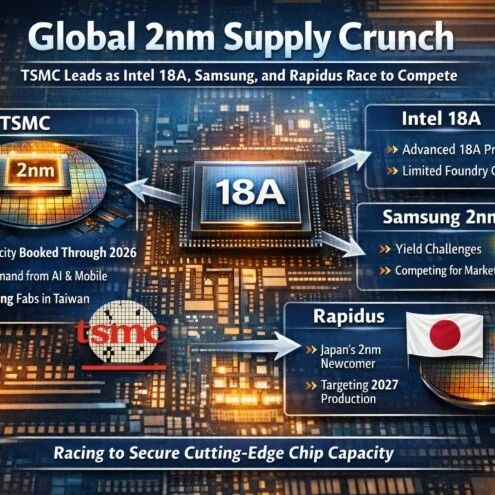
Core Viewpoint - The semiconductor industry is facing structural supply challenges driven by explosive demand for advanced chips, particularly for artificial intelligence and high-performance computing, with the 2nm process technology being a focal point of this transformation [2][11]. Group 1: TSMC and 2nm Capacity Crisis - TSMC's N2 process node is set to begin mass production by the end of 2025, with optimistic forecasts for yield and capacity ramp-up, making it attractive for next-generation AI accelerators and flagship mobile chips [4]. - TSMC's N2 chip capacity is reportedly sold out until 2026, with major clients like Apple, NVIDIA, Qualcomm, and AMD securing most of the initial capacity [4]. - To meet demand, TSMC plans to expand capacity across multiple fabs, targeting a monthly wafer output in the six-figure range between 2026 and 2028, with capital expenditures projected to reach $29.8 billion in 2024, increasing to $40.9 billion in 2025, and potentially hitting $52-56 billion in 2026 [4]. Group 2: Intel's 18A Process - Intel's 18A process node, part of its roadmap, introduces RibbonFET and PowerVia technologies aimed at enhancing performance and efficiency, with mass production expected to start in 2025 [5]. - Despite improvements in yield by mid-2025, Intel's 18A process is still considered to lag behind TSMC's N2 in yield, and its external foundry ecosystem remains smaller compared to TSMC's extensive global customer base [5][6]. - Intel's strategy is shifting to explore external foundry opportunities for its 18A process, indicating a potential competitive challenge to TSMC [6][7]. Group 3: Samsung's 2nm Process - Samsung is among the early adopters of GAA technology, with plans to advance to 2nm production by 2026, but faces challenges in yield stability and customer acceptance [8]. - Despite competitive pricing, Samsung's yield issues and lack of customer trust hinder its ability to serve as a viable alternative to TSMC for large-scale 2nm orders [8]. Group 4: Rapidus and Niche Market - Rapidus, a Japanese startup, aims to enter the 2nm market with government and corporate backing, planning to start production around 2027 and significantly increase monthly wafer output within a year of launch [9]. - The company has raised $1.7 billion, totaling $11.3 billion in government and private investment, but still requires $32 billion to achieve full-scale 2nm production by 2027 [9][10]. - Unlike larger firms, Rapidus focuses on short turnaround times and customized services, potentially appealing to niche markets and smaller tech companies [9]. Group 5: Broader Context - The current supply-demand imbalance in the semiconductor industry is influenced by TSMC's dominance, Intel's internal efforts, Samsung's technological challenges, and Rapidus's niche strategy [11]. - The 2nm capacity crisis is not merely a short-term supply fluctuation but a fundamental outcome of the strategic reshaping of the global semiconductor ecosystem driven by advanced computing and AI [11].


美油突破90美元周涨35%,三大股指齐跌,中概股逆势走强,金银拉升超2%
第一财经· 2026-03-07 00:49AI Processing
2026.03. 06 本文字数:1990,阅读时长大约4分钟 作者 | 第一财经 樊志菁 周五美股大幅下挫,因数据显示非农就业人数意外下滑,与此同时,中东军事冲突升级,推动国际油 价突破每桶90美元。 截至收盘,道指跌453.19点,跌幅0.95%,报47501.55点,纳指跌1.59%,报22387.68点,标 普500指数跌1.33%,报6740.02点。 本周,道指下跌3%,创近一年最差表现,标普500指数累计 下跌2%,纳指下跌1.2%。 【大宗表现】 国际油价大幅上涨,市场担心中东战事陷入持久战泥潭。据新华社,美国总统特朗普6日在社交媒体 上宣称,"与伊朗不会达成任何协议,除非其无条件投降"。 WTI原油近月合约涨12.21%,报90.90美元/桶,周涨35%,布伦特原油近月合约涨8.52%,报 92.69美元/桶,周涨27%,本周两大合约均创下史上最大涨幅纪录。 受非农不及预期和避险情绪推动,贵金属市场走强。截至发稿时,纽约商品交易所4月交割的 COMEX黄金期货涨1.95%,报5176.10美元/盎司,白银期货涨3.14%,报84.77美元/盎司。 【热门股表现】 明星科技股承压, 特斯拉、M ...

中芯国际:第三大晶圆代工企业,受益本土企业崛起和本地化制造趋势-20260307
Guoxin Securities· 2026-03-07 00:45
Investment Rating - The report maintains an "Outperform" rating for the company [5] Core Insights - The company is the third-largest foundry globally, benefiting from the rise of domestic enterprises and the trend of localized manufacturing [1][11] - The semiconductor industry has long-term growth potential, characterized by cyclical and growth aspects, with global semiconductor sales expected to reach a record high of $791.6 billion in 2025 [2][34] - The company's revenue is projected to grow from $31 billion in 2017 to $93 billion in 2025, with a CAGR of 15% [20] - The company maintains a high capacity utilization rate, expected to reach 95.7% by Q4 2025, driven by the increasing demand from Chinese chip design companies [2][55] Financial Projections - Revenue and net profit forecasts for 2025 are $9.3 billion and $685 million, respectively, with a net profit CAGR of 18% from 2017 to 2025 [4][20] - The company’s gross margin is expected to be 21% in 2025, with over 90% of revenue coming from integrated circuit foundry services [23][29] - The company plans to increase its capital expenditure significantly, reaching $8.1 billion by 2025 to support capacity expansion [56][59] Market Dynamics - The company is positioned to benefit from the increasing number of Chinese chip design firms, which are expected to grow from 1,380 in 2017 to 3,901 by 2025, with a CAGR of 14% [43] - The demand for 12-inch wafers is rising, with their revenue share expected to increase to 77% by 2025, while the share of 8-inch wafers declines to 23% [29][31] - The global semiconductor sales are projected to continue double-digit growth into 2026, indicating a robust market environment [34]

黄仁勋新财年目标绩效奖金曝光 与英伟达营收挂钩
Feng Huang Wang· 2026-03-07 00:04
Core Viewpoint - Nvidia has established a new variable compensation plan for CEO Jensen Huang, linking a cash bonus of $4 million to specific revenue targets for the fiscal year ending January 31, 2027 [1] Group 1: Executive Compensation - The compensation plan was approved by Nvidia's compensation committee on March 2 [1] - In the fiscal year 2025, Jensen Huang's total compensation was reported at $49.9 million, primarily from stock awards valued at $38.8 million [1] Group 2: Financial Performance - Nvidia's fourth-quarter performance exceeded expectations, and the company provided a revenue forecast for the current quarter that is above Wall Street's expectations [1] - The company anticipates first-quarter sales of $78 billion, with a variance of 2% [1]


凌晨,全线大跌!美国,重大发布!
券商中国· 2026-03-06 23:31
Core Viewpoint - The U.S. stock market experienced a significant sell-off due to unexpectedly weak employment data and a sharp rise in international oil prices, raising concerns about the economic outlook and inflation risks [1][2]. Employment Data - The U.S. non-farm payrolls for February showed a net decrease of 92,000 jobs, significantly below the expected increase of 55,000, marking the second instance of negative growth since 2020 [3][4]. - The unemployment rate unexpectedly rose to 4.4% from 4.3% in January, higher than the market expectation of 4.3% [4]. Market Reactions - Major U.S. stock indices fell sharply, with the Dow Jones down 0.95%, the Nasdaq down 1.59%, and the S&P 500 down 1.33% [2]. - Large tech stocks faced significant declines, with Intel dropping over 5% and Nvidia down over 3% [2]. Oil Price Surge - International oil prices surged, with WTI crude oil futures for April rising by 12.21% and Brent crude for May increasing by 8.52%, contributing to inflation concerns [1][2]. Investor Sentiment - The VIX index, a measure of market volatility, rose by 22%, reaching its highest level since April of the previous year, indicating increased investor anxiety [2]. - Analysts noted a shift in investor sentiment from complacency to near-panic, suggesting a potential for a real panic moment in the market [2]. Federal Reserve Outlook - Following the employment report, traders slightly increased bets on the Federal Reserve cutting rates at least once by 2026, with probabilities for rate cuts rising [5][6]. - There is a significant internal divide within the Federal Reserve regarding the impact of rising oil prices and the labor market's health on future monetary policy [7][8].

美股科技股集体下挫,英特尔跌超5%,油价周涨35%,创有记录来最大周涨幅
21世纪经济报道· 2026-03-06 23:27
Market Overview - The US stock market experienced a collective decline, with the Dow Jones down approximately 3%, the S&P 500 down about 2%, and the Nasdaq down 1.24% [1] - Major European indices also fell, with the DAX30 down 1.21%, FTSE 100 down 1.22%, CAC40 down 0.94%, and FTSE MIB down 0.99% [1] Key Index Performance - The Dow Jones Industrial Average closed at 47,501.55, down 453.19 points (-0.95%) [2] - The Nasdaq index closed at 22,387.68, down 361.31 points (-1.59%) [2] - The S&P 500 index closed at 6,740.02, down 90.69 points (-1.33%) [2] Sector Performance - Major technology stocks saw declines, with Intel down over 5%, Nvidia down about 3%, and Amazon, Tesla, and Meta down over 2% [2] - Semiconductor stocks collectively fell, with Micron Technology and Applied Materials down over 6%, ASML down over 5%, and TSMC down over 4% [2] Notable Stock Movements - Marvell Technology surged 18%, marking its best single-day gain since April 2025, driven by strong earnings and an optimistic revenue growth forecast for FY2027 [3] - Defense and aerospace stocks led gains, with Boeing up over 4%, and Raytheon Technologies and Lockheed Martin up over 2% [3] - Chinese concept stocks showed resilience, with the Nasdaq Golden Dragon China Index up 0.69%, and notable gains in JD.com and Xpeng [3] Commodity Prices - Spot gold rose to $5,168 per ounce, up 1.64%, while spot silver reached $84.47 per ounce, up 2.67% [4] - International oil prices surged, with WTI crude oil at $91.27 per barrel, up over 12%, and Brent crude at $93.17 per barrel, up over 9% [4] Cryptocurrency Market - Bitcoin traded at $68,369, down over 4%, while Ethereum fell to $1,986 [6] Geopolitical Developments - Reports indicated that the Iranian military claimed responsibility for a drone attack on the US aircraft carrier Lincoln in the Gulf of Oman [6] - Former President Trump stated he must personally participate in selecting Iran's next leader, warning of potential military conflict if a new leader continues current policies [7]



【金牌纪要库】英伟达投资全球光芯片领域技术龙头,提升、锁定高端部件供货能力,这家英伟达核心供应商有望进一步提升高端光模块出货能力
财联社· 2026-03-06 15:30
Group 1 - Nvidia invests $4 billion in global optical chip technology leaders to enhance and secure high-end component supply capabilities, positioning its core supplier to further increase high-end optical module shipments [1] - The MicroLED solution is positioned alongside CPO, NPO, and traditional 3.2T optical modules as a competitive route, with potential for significant demand increase for such hardware in the future [1] - Domestic 100G EML chips have not yet achieved mass production, but higher speed remains the mainstream research direction for optical modules, with this company being the absolute leader in the domestic EML chip sector [1]

【招商电子】博通(AVGO.O)26Q1跟踪报告:六大XPU客户业务势头强劲,27年AI芯片收入将超千亿美元
招商电子· 2026-03-06 14:33
Core Viewpoint - Broadcom (NASDAQ: AVGO) reported record revenue of $19.311 billion for FY2026 Q1, driven primarily by its AI semiconductor business, with a year-over-year growth of 29% and a quarter-over-quarter growth of 7% [2][9] Group 1: Financial Performance - FY2026 Q1 revenue reached a historical high of $19.311 billion, exceeding previous guidance of approximately $19.1 billion, primarily driven by AI semiconductor business [2][9] - The gross margin for FY2026 Q1 was 76.99%, a decrease of 2.11 percentage points year-over-year and 0.94 percentage points quarter-over-quarter, aligning with prior guidance [2][9] - Adjusted EBITDA for FY2026 Q1 was $13.1 billion, accounting for 68% of revenue, surpassing the previous expectation of 67% [2][9] Group 2: Semiconductor Division - The semiconductor segment generated $12.515 billion in revenue, a year-over-year increase of 52% and a quarter-over-quarter increase of 13%, representing 65% of total revenue [3][10] - AI business revenue reached $8.4 billion, a remarkable year-over-year growth of 106%, significantly exceeding prior expectations, with further acceleration anticipated in Q2 [3][10] - Non-AI business revenue remained flat at $4.1 billion, with growth in enterprise networking, broadband services, and storage offset by seasonal declines in wireless business [3][13] Group 3: Infrastructure Software - Infrastructure software revenue for FY2026 Q1 was $6.796 billion, reflecting a year-over-year increase of 1% and accounting for 35% of total revenue [3][14] - The gross margin for this segment was 93%, with operating expenses of $979 million and an operating profit margin of 78%, up 1.9 percentage points year-over-year [3][14] - Strong order volume continued, with total contract value exceeding $9.2 billion and annual recurring revenue (ARR) growing by 19% year-over-year [3][14] Group 4: Future Guidance - For FY2026 Q2, revenue guidance is approximately $22 billion, representing a year-over-year increase of 47% and a quarter-over-quarter increase of 14% [4][16] - Semiconductor revenue is expected to be around $14.8 billion, with AI business revenue projected at $10.7 billion, reflecting a year-over-year growth of 140% [4][16] - Infrastructure software revenue is anticipated to reach $7.2 billion, a year-over-year increase of 9% [4][16] Group 5: AI Business Outlook - The company expects AI chip revenue to exceed $100 billion by 2027, with significant contributions from its six major clients, including Google, Meta, and OpenAI [5][11] - AI network revenue grew by 60% year-over-year in Q1, expected to account for 40% of total AI revenue in Q2 [5][11] - The company has secured critical supply chain capacity through 2028, ensuring the ability to meet future demand [5][11]

半导体精品公众号推荐!
国芯网· 2026-03-06 14:25
Core Viewpoint - The article emphasizes the importance of focusing on high-quality information sources in the fragmented era of the semiconductor industry, suggesting that professionals should streamline their information intake to enhance efficiency and effectiveness. Group 1: Information Sources - The article recommends following five specific WeChat public accounts dedicated to the semiconductor industry for high-quality information [1][3][5][7][9]. - It highlights that the "Semiconductor Industry Circle" is a community for semiconductor professionals, indicating a growing network of industry participants [7][9]. - The "China Semiconductor Forum" WeChat group has 80,000 members and is open for free access, promoting community engagement among industry professionals [12]. Group 2: Community Engagement - The article outlines steps to join the WeChat group, which includes scanning a QR code and responding with "join group" in the public account [13][15]. - It encourages collaboration and information sharing within the semiconductor community, indicating a trend towards collective knowledge-building [18].