
食品饮料

Search documents
谨慎加仓?
第一财经· 2026-01-20 10:40
Market Overview - The A-share market shows a differentiated adjustment pattern, with the Shanghai Composite Index demonstrating resilience, regaining the 4100-point level, primarily driven by the real estate, banking, and oil sectors [4] - A total of 2231 stocks experienced an increase [5] - The market exhibited a clear divergence, with the real estate sector leading gains, while the TMT (Technology, Media, Telecommunications) sector and power equipment faced significant adjustments [6] Trading Activity - The total trading volume of both markets reached 1 trillion yuan, an increase of 2.56%, indicating a moderate increase in trading activity as funds shifted from previously popular sectors to those with lower valuations or solid fundamentals [7] - Institutional investors are reallocating their portfolios, selling off previously popular sectors like power equipment and telecommunications, and moving towards defensive sectors such as banking, construction, insurance, and real estate [9] Fund Flows - There was a net outflow of 68.4 billion yuan from major funds, while retail investors saw a net inflow [8] - Retail investors are absorbing the selling pressure and speculating on themes, with some funds flowing into short-term overbought stocks, partially offsetting the outflow from popular sectors like semiconductors and commercial aerospace [9] Investor Sentiment - As of January 20, 32.96% of investors increased their positions, while 20.13% reduced their holdings, with 46.91% remaining unchanged [12] - Retail investor sentiment is currently at 75.85% [10]


主力资金|9股遭主力大幅出逃
Zheng Quan Shi Bao· 2026-01-20 10:18
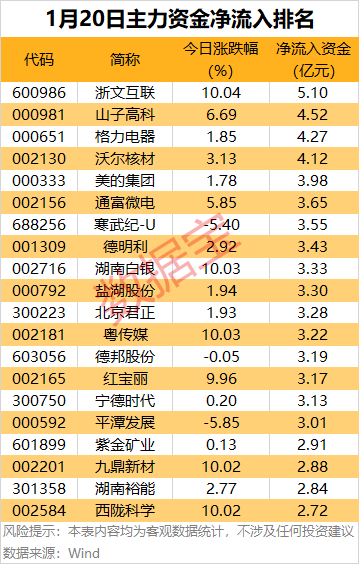
Group 1 - The A-share market showed mixed performance on January 20, with major indices diverging and most industry sectors experiencing declines, while precious metals, chemical raw materials, cement and building materials, and chemical fiber industries saw gains [1] - The net outflow of main funds from the Shanghai and Shenzhen markets reached 76.407 billion yuan, with six industries experiencing net inflows, including real estate, food and beverage, and retail, each exceeding 200 million yuan [1] - Among the 25 industries with net outflows, power equipment, electronics, and communications had the largest outflows, each exceeding 10 billion yuan [1] Group 2 - From individual stocks, 29 stocks saw net inflows exceeding 200 million yuan, with 16 stocks receiving over 300 million yuan in net inflows [2] - Zhejiang Wenlian led with a net inflow of 510 million yuan, attributed to its collaboration with ByteDance's Douyin in developing a digital marketing application [2] - Gree Electric Appliances announced a cash dividend distribution of 5.585 billion yuan to shareholders, with a payout of 10 yuan per 10 shares [3] Group 3 - The top five stocks with the highest net inflows included Zhejiang Wenlian, Shanzi High-Tech, Gree Electric Appliances, and Wolong Nuclear Materials, with inflows ranging from 412 million to 510 million yuan [4] - Conversely, nine stocks experienced net outflows exceeding 900 million yuan, with New Yisheng and Zhongji Xuchuang leading the outflows at 2.194 billion yuan and 2.122 billion yuan, respectively [5] - In the tail-end trading session, the market saw a net outflow of 6.161 billion yuan, with significant inflows in the non-ferrous metals and defense industries [6] Group 4 - Notable individual stocks with significant tail-end inflows included Xinwei Communication and Aerospace Development, each exceeding 300 million yuan [6] - The top five stocks with the highest tail-end net inflows were Xinwei Communication, Aerospace Development, and Wolong Nuclear Materials, with inflows ranging from 154 million to 395 million yuan [7] - Conversely, stocks like Shenghong Technology and TBEA experienced substantial tail-end net outflows, exceeding 300 million yuan [8]
如何从一二级市场联动寻找产业债交易信号?(行业篇)
Soochow Securities· 2026-01-20 09:28
Report Industry Investment Rating No information provided in the content. Core Viewpoints - The secondary - market trends of industrial bond sub - industries show a divergence in the correlation between primary and secondary markets. This divergence may be due to differences in supply among industries and differences in bond liquidity and trading popularity within each industry. If an industry has many issuing entities with strong willingness and ability to issue bonds and is in a good development trend, the probability of a synchronous resonance relationship between primary - market supply and secondary - market demand is relatively high, which can improve the accuracy of judging trading signals of narrowing spreads from daily net financing [1][14]. - Most industries have trading signals transmitted from primary - market supply to secondary - market demand, including comprehensive, non - ferrous metals, and others. Some industries show a stronger negative correlation between primary - market supply and secondary - market demand, such as comprehensive and non - ferrous metals. Some industries have a weak correlation between daily net financing and daily spreads, including communication and food and beverage [2][4]. Summary by Directory 1. Industrial Bond Sub - industries Show Divergence in Primary - Secondary Market Trend Correlation - **Research Method**: Classify industrial bond issuers by Shenwan primary industries, calculate the daily net financing and daily credit spreads of each sub - industry from January 1, 2025, to December 19, 2025, to observe the correlation between primary - market supply and secondary - market demand [12]. - **Divergence Performance**: Most industries have trading signals transmitted from primary - market supply to secondary - market demand, while some do not show this feature significantly [13]. - **Reasons for Divergence**: Differences in supply among industries are related to the number, size, and life - cycle stage of issuing entities. Differences in bond liquidity and trading popularity within industries are related to the scale of outstanding bonds, valuation levels, and event catalysts [14]. 1.1. Industries with Obvious Correlation - **Comprehensive Industry**: From January to March 2025, daily net financing decreased and daily spreads increased; from March to June, daily net financing increased and daily spreads decreased; from June to December, both were in a low - level oscillation [21]. - **Non - ferrous Metals Industry**: From January to July 2025, daily net financing increased and daily spreads decreased; from July to September, daily net financing decreased and daily spreads increased; from October to December, both were in a low - level oscillation [25]. - **Other Industries**: Similar analysis is conducted for industries such as pharmaceutical biology, social services, and others, with different trends in different time intervals [27][30][32]. - **Common Features**: These industries generally have a large scale of outstanding bonds and high institutional investor attention, which is conducive to the transmission of primary - market supply changes to secondary - market spread changes [3][87]. 1.2. Industries with General Correlation - **Industries Included**: Communication, food and beverage, and other industries have a weak correlation between daily net financing and daily spreads, and the linkage and transmission between primary - and secondary - market indicators are relatively weak [4][13]. - **Reasons**: These industries have low participation in the bond market, and their secondary - market trading demand is more affected by overall bond - market trends, industry risk premiums, and liquidity premiums. Different types of industries have specific reasons for the weak correlation [4][90][91].
雀巢奶粉召回事件中的ARA是什么?婴幼儿配方奶粉中为什么加ARA?
Zhong Guo Jing Ji Wang· 2026-01-20 09:25
Group 1 - Nestlé has announced a precautionary recall of infant formula products due to quality issues with arachidonic acid (ARA) oil from a major supplier, although no related illness cases have been confirmed [1] - ARA is a long-chain polyunsaturated fatty acid that is important for brain development in infants and is commonly added to most infant formulas on the market [1] - The CEO of Nestlé, Philipp Navratil, has publicly apologized to consumers regarding the recall [1] Group 2 - According to national standards, ARA is classified as an "optional ingredient" in infant formula, with a maximum allowable content of 80 mg per 100 kcal [2] - The addition of ARA and DHA in infant formulas has become a market norm due to clinical evidence supporting their benefits for brain and nervous system development in infants [3] - The standards for nutrient addition in infant formula are continuously updated to ensure higher quality products, with the aim of promoting comprehensive growth and development in infants [3]

14股今日获机构买入评级
Zheng Quan Shi Bao Wang· 2026-01-20 09:24
Group 1 - 14 stocks received buy ratings from institutions today, with notable upgrades for Saisir and first-time attention for Jianghuai Automobile and Yirui Technology [1] - The average performance of stocks with buy ratings declined by 0.42%, underperforming the Shanghai Composite Index, with five stocks experiencing price increases [1] - The top gainers included Nanshan Aluminum, Hunan YN, and Zhongsheng Pharmaceutical, with respective increases of 7.49%, 2.77%, and 1.80% [1] Group 2 - Among the stocks rated by institutions, eight released annual performance forecasts, with Hunan YN expecting a net profit growth of 114.81%, followed by Zhenyu Technology and Lintai New Materials with expected growths of 106.74% and 75.22% respectively [1] - The power equipment industry was the most favored, with four stocks including Keda and Hunan YN making the buy rating list, while the automotive and food & beverage sectors also attracted attention with three and two stocks respectively [1]

“十五五”开局之年定下“实干实绩攻坚”基调 巴中画定今年经济发展“施工图”
Si Chuan Ri Bao· 2026-01-20 08:20
Group 1: Economic Goals and Strategies - The core goal for Bazhong is to achieve a rapid economic growth rate while aiming for a total economic output of 100 billion yuan by 2026, marking it as a year of practical achievements [1] - The annual economic work focuses on six key tasks, emphasizing the importance of expanding domestic demand and boosting consumption as primary objectives [2][3] Group 2: Investment and Industrial Development - Bazhong plans to combine investments in physical infrastructure and human resources, focusing on industries with sustainable tax sources and effective investments [3] - The city aims to strengthen its industrial foundation by developing key industries such as energy and chemicals, advanced materials, food and beverage, electronic information, and healthcare [5][6] Group 3: Urban-Rural Integration and Social Welfare - The city is committed to enhancing urban planning and development, promoting urban-rural integration, and improving the quality of life for residents [7][8] - Specific initiatives include creating modern urban spaces and improving employment services, education, and healthcare, with a focus on enhancing public cultural services [8]
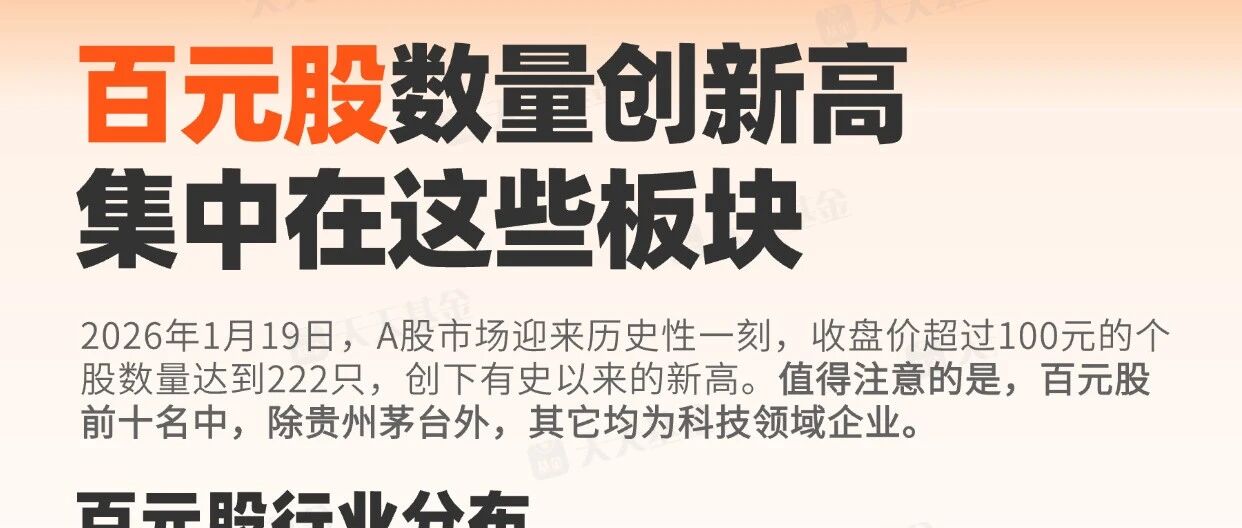
百元股数量创新高,集中在这些板块
天天基金网· 2026-01-20 07:07
Core Viewpoint - The A-share market has reached a historic milestone with the number of stocks closing above 100 yuan reaching 222, marking a new high in history, predominantly driven by technology companies, except for Kweichow Moutai [1][6]. Group 1: Distribution of Hundred Yuan Stocks - The electronic industry leads with 79 stocks, accounting for 35.59% of the total hundred yuan stocks. The machinery equipment industry has 26 stocks (11.71%), and the computer industry has 24 stocks (10.81%) [6]. Group 2: Top Ten Hundred Yuan Stocks - The top three stocks are: 1. Cambricon (寒武纪-U) with a closing price of 1419.66 yuan and a 2025 increase of 106.01% [3]. 2. Kweichow Moutai (贵州茅台) at 1376.00 yuan with a decrease of 6.29% [3]. 3. Source Code Technology (源杰科技) at 748.29 yuan with a remarkable increase of 379.34% [4]. Group 3: Market Trends and Future Outlook - The overall rise in the A-share market has led to a significant increase in the average stock price level, with the number of hundred yuan stocks surpassing 200 as of January 19, 2026 [6]. - Experts predict that the hundred yuan stock group will continue to expand due to ongoing trends in the technology industry and sustained inflow of long-term capital, although structural differentiation is expected to become more pronounced [6].






运动巨头渠道策:销售下滑 门店升级丨消费参考
2 1 Shi Ji Jing Ji Bao Dao· 2026-01-20 05:10
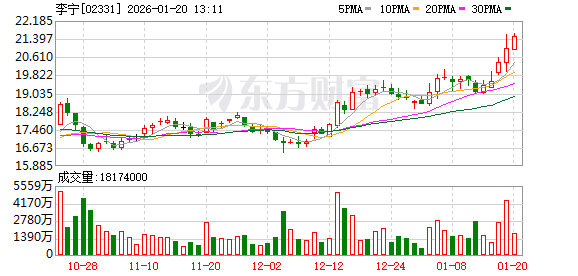
Group 1: Li Ning Company Overview - Li Ning remains optimistic about its future despite a low single-digit decline in retail sales for the fourth quarter ending December 31, 2025, excluding Li Ning YOUNG [2] - The number of sales points in China for Li Ning (excluding Li Ning YOUNG) decreased by 41 to a total of 6,091, with retail points down by 59 and wholesale points up by 33 [3] - Li Ning is investing in flagship stores, launching its first "Dragon Store" in Beijing, which is expected to create a strong synergy with the new "Honor Gold Standard" product line [3] Group 2: Market Trends and Competitors - The trend in the industry shows major brands like Nike upgrading key stores in China, with a reported 25% sales increase in upgraded locations, despite a 16% decline in overall sales [4] - Li Ning's stock price increased by 2.94% to HKD 21 per share on January 19, 2026, indicating positive market sentiment [4] Group 3: Financial Performance and Projections - Li Ning's e-commerce virtual store business remained flat, indicating stability in that segment amidst overall sales declines [2] - The company is focusing on enhancing customer experience through flagship stores, aligning with broader industry trends of investing in experiential retail [4]
红棉股份2026年1月20日涨停分析:饮料业务增长+园区运营提升+现金流改善
Xin Lang Cai Jing· 2026-01-20 04:02
Core Viewpoint - Hongmian Co., Ltd. (SZ000523) experienced a limit-up on January 20, 2026, reaching a price of 4.24 yuan, with a 10.13% increase, resulting in a total market capitalization of 7.782 billion yuan and a circulating market value of 5.619 billion yuan, with a total transaction amount of 376 million yuan [1][2]. Group 1 - The increase in stock price is attributed to growth in the beverage business, improved park operations, and enhanced cash flow [2]. - The company's main business includes food and beverage as well as cultural and creative industry park development and operation. Recent announcements indicate that the beverage segment has seen both revenue and gross margin growth, with significant results from e-commerce and expansion into external markets. The launch of multiple new products in 2025 has received positive market feedback [2]. - The subsidiary, Xinshicheng, is actively exploring external markets, leading to increased revenue and profit in the park operation segment, which supports the stock price increase [2]. Group 2 - The company's financial situation has improved, with operating cash flow shifting from a negative 37.33 million yuan to a positive 338 million yuan, representing a year-on-year increase of 1004.86%. The non-recurring net profit for the first three quarters grew by 13.87%, indicating enhanced profitability in core operations [2]. - The company has been revising multiple systems to optimize corporate governance, which is expected to benefit long-term governance levels and development potential [2]. - The recent performance of the food and beverage and park operation sectors has attracted market attention, with some related stocks also performing well, creating a sectoral linkage effect [2].

【盘中播报】沪指跌0.73% 国防军工行业跌幅最大
Zheng Quan Shi Bao Wang· 2026-01-20 03:37
Market Overview - The Shanghai Composite Index fell by 0.73% as of 10:27 AM, with a trading volume of 783.95 million shares and a transaction value of 1,378.36 billion yuan, an increase of 0.13% compared to the previous trading day [1] Industry Performance - Real estate, oil and petrochemicals, and beauty care sectors showed the highest gains, with increases of 0.86%, 0.72%, and 0.70% respectively [1] - The defense and military, comprehensive, and communication sectors experienced the largest declines, with decreases of 3.41%, 3.19%, and 3.06% respectively [1][2] Leading Stocks - In the real estate sector, Chengdu Investment Holdings led with a gain of 10.11% [1] - In the oil and petrochemical sector, Blue Flame Holdings increased by 2.86% [1] - In the beauty care sector, Yanjiang Co. rose by 9.34% [1] Detailed Industry Data - Real Estate: 0.86% increase, transaction value of 189.40 billion yuan, up 20.93% from the previous day [1] - Oil and Petrochemicals: 0.72% increase, transaction value of 80.28 billion yuan, up 26.01% from the previous day [1] - Beauty Care: 0.70% increase, transaction value of 35.84 billion yuan, up 11.01% from the previous day [1] - Defense and Military: 3.41% decrease, transaction value of 883.06 million yuan, up 45.81% from the previous day [2] - Communication: 3.06% decrease, transaction value of 754.04 million yuan, up 0.40% from the previous day [2]